Advertisement
Advertisement
March 2021
Sponsored by Medtronic
Off-the-Shelf Solutions to Treat a Short Neck: A Data Overview and Case-Based Discussion
Endovascular suture aneurysm repair (ESAR) using the Heli-FX™ EndoAnchor™ system (Medtronic) in combination with a standard endograft has been proposed as an off-the-shelf endovascular solution in patients with a challenging aneurysm neck, including short, angulated, and wide infrarenal aortic neck. Results from the primary arm of the ANCHOR registry proved that ESAR with prophylactic use of EndoAnchor implants was effective in preventing neck dilation and increasing aneurysm sac regression.1,2
ESAR can be particularly effective to supplement endovascular aneurysm repair (EVAR) when properly deployed with adequate aortic wall penetration in selected patients, especially in short (< 10 mm), conical necks where durability may be compromised if treated with standard EVAR. ESAR in combination with the Endurant™ II/IIs bifurcated stent graft system (Medtronic) is approved for use in patients with aortic neck lengths > 4 mm and < 10 mm when used in conjunction with the Heli-FX EndoAnchor system (bifurcated stent graft only). It is the first solution for short-neck abdominal aortic aneurysms (AAAs) that is independent of renal stenting. Although other techniques have been demonstrated to be safe and durable, certain anatomic constraints may lead to procedural complications or failure, such as upward orientation of the renal arteries, iliac/brachial access tortuosity, calcification/tortuosity, or arch thrombus load, which increases the risk of stroke.
EndoAnchor implants may become a useful tool for the endovascular approach to hostile AAA in such conditions. To that end, a subgroup analysis of the ANCHOR registry was performed, demonstrating the safety and effectiveness of ESAR for treating AAA with a short aortic neck.3
ANCHOR Short-Neck Cohort Data Overview
By Frank R. Arko III, MD
Data originally presented by Dr. Arko at CX 2020 Live, the virtual Charing Cross Symposium, which took place online from May through June 2020.
The clinical experience that led to support of this technique was derived from patients with short, proximal neck lengths (≥ 4 mm, < 10 mm) implanted with an Endurant II/IIs endograft in conjunction with the Heli-FX EndoAnchor implants in ANCHOR, the Aneurysm Treatment Using the Heli-FX™ EndoAnchor™ System Global Registry.2 Proximal neck length was defined by the core lab as the length over which the aortic diameter remained within 10% of the infrarenal diameter. In this subgroup analysis, a total of 70 patients were treated with an average core lab–measured neck length of 6.9 mm. This was a challenging cohort of “real-world” patients: 93% were American Society of Anesthesiologists classification III/IV, 17% had a symptomatic presentation (including two patients with rupture), and 31% were deemed urgent or emergent by the treating physician. Primary outcomes of the analysis included technical success at the index procedure, rate of type Ia endoleak at 1 and 12 months, and secondary procedures through 12 months.
The published 12-month data were significant.4 The overall procedural success rate was 97.1% and was defined as satisfactory implantation of the required number of EndoAnchors for the endograft size, adequate penetration of all EndoAnchors, no EndoAnchor fractures, and absence of type Ia endoleak after implantation of the last EndoAnchor. An average of 5.5 ± 2.1 EndoAnchor implants were implanted per patient, and the total procedural time was 148 ± 80 minutes. At 30-day follow-up, four type Ia endoleaks were detected, three of which resolved spontaneously by 12-month follow-up. One type Ia endoleak persisted at 12-month follow-up but was not associated with AAA enlargement or a secondary procedure. There were four (5.7%) deaths within 30 days of the index procedure (three were cardiac-related deaths and one was due to acute hepatitis, renal failure, and pancreatitis). The Kaplan-Meier estimate for freedom from secondary endovascular procedures and all-cause mortality was 95.5% and 92.7% through 1 year, respectively. No patients in the short-neck cohort experienced main body stent migration, increase in maximum aneurysm diameter, aneurysm rupture, or conversion to open repair through 12 months.
At CX 2020 Live, midterm data were presented on the short-neck cohort.3 Of note, there were two (2/31) type Ia endoleaks and no migrations as reported by the sites at 3 years. Also at 3 years, two of 32 patients had an AAA sac increase, whereas 15 had a stable AAA aneurysm sac and 15 had a decreasing aneurysm sac. The Kaplan-Meier estimate for freedom from secondary endovascular procedures and aneurysm-related mortality was 91.5% and 92.4% through 3 years, respectively.
Whereas longer-term follow-up is still needed to assess the durability of this treatment strategy, the ANCHOR short-neck cohort results showed that ESAR with Endurant II/IIs endograft and complementary Heli-FX EndoAnchor implants is a safe and effective off-the-shelf therapy for treating a short aortic neck, providing high technical success rate and low incidence of type Ia endoleak through 3 years.
Case Example: ESAR for Hostile Necks
By Jeffrey Jim, MD, MPHS, FACS
This case, “The Challenging Aortic Neck,” was originally presented as part of a VEITHsymposium webinar in August 2020 and published in the VEITH Bulletin in September 2020. Republished with permission from the VEITH organization (February 2021).
A patient in their late 70s presented with a 6-cm AAA, and imaging demonstrated the presence of an 8-mm-long infrarenal “neck.” In treating a patient with a short aortic neck, a physician has a variety of potential treatment options, ranging from traditional open repair to various EVAR techniques. However, additional patient information must be considered. This patient had multiple medical comorbidities, including a requirement for home oxygen and overall frailty. In addition, the patient reported nonspecific abdominal discomfort with some radiation to the back for the previous 2 days. On more thorough review, the patient was noted to have relatively small-sized iliac arteries.
DISCUSSION
This patient’s clinical presentation is not uncommon in our daily routine practice. Although open aortic surgery remains the gold standard treatment option in terms of durability of repair, this patient may be unfit for open surgery, making EVAR preferred due to its lower rates of perioperative mortality and morbidity. This patient also presented with some nonspecific pain symptoms. The diagnosis of a “symptomatic” aneurysm must be entertained if a clear alternate cause cannot be confirmed. The need for more urgent intervention as well as the smaller access vessels precluded certain endovascular treatment options. In this and other clinical situations, ESAR presents an attractive endovascular solution that can offer the perioperative benefits of EVAR with the desired clinical durability for AAA repairs.
The ESAR technique essentially incorporates an endovascular “suture line” to mimic an open surgical aortic anastomosis (Figure 1). For successful EndoAnchor implantation, the neck must be free from significant thrombus, calcification, or plaque to ensure adventitial penetration of the EndoAnchors (Figure 2). The addition of “endosutures” provides the radial fixation needed to increase proximal seal and potentially mitigate future aortic neck dilatation.1
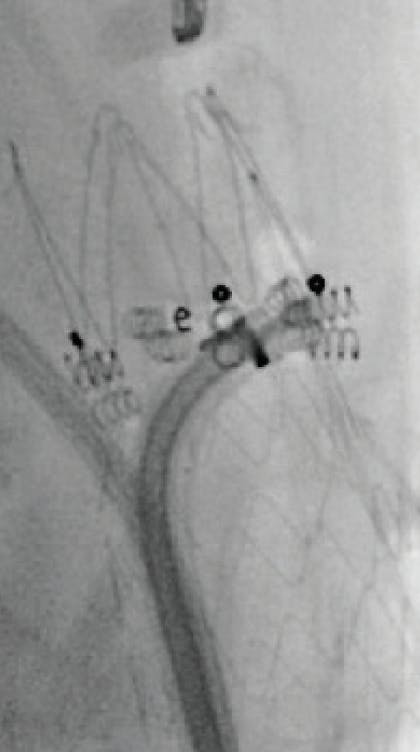
Figure 1. The endosuture line is created by placing EndoAnchors at the proximal aortic neck to mimic the surgical anastomoses created during open aortic surgery.
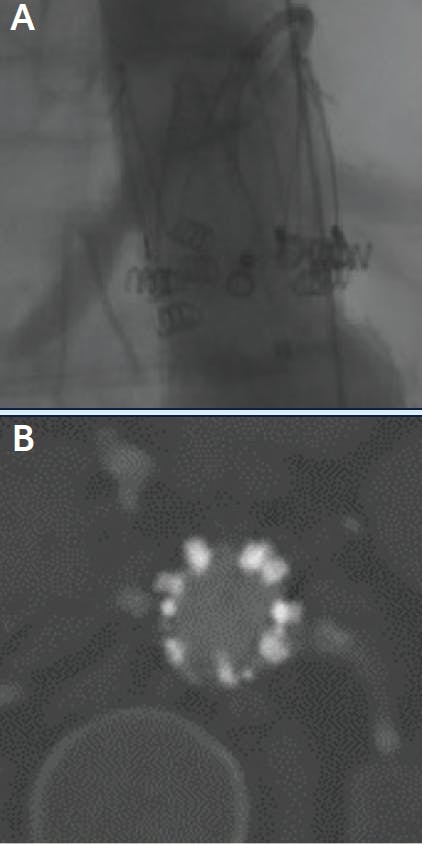
Figure 2. Intraoperative (A) and CT (B) images show adventitial penetration of EndoAnchors into the aortic wall.
ESAR uses EndoAnchors to provide radial fixation and increase the proximal seal. This offers a readily available off-the-shelf solution with broader patient applicability. The procedure can be performed with short procedure times, minimal radiation use, and no need for renal artery instrumentation. The available clinical data demonstrate that ESAR provides the perioperative benefits of a less invasive treatment while maintaining durable midterm outcomes.
ESAR is a solution with reduced complexity, which may decrease cost and resource use. Further, its short learning curve means it can be readily adopted by most vascular specialists. Physicians should carefully consider aortic anatomy, overall health, and the clinical situation when providing the best treatment modality for AAA repair, and ESAR is certainly a procedure that should be considered for treating aneurysms with hostile neck characteristics.
CONCLUSION
ESAR with the Heli-FX EndoAnchor system is an off-the-shelf solution that, when combined with the Endurant II/IIs stent graft, adds treatment options for patients with short-neck AAAs. ESAR may provide a fixation and sealing mechanism for hostile EVAR necks.
1. Tassiopoulos AK, Monastiriotis S, Jordan WD, et al. Predictors of early aortic neck dilatation after endovascular aneurysm repair with EndoAnchors. J Vasc Surg. 2017;66:45-52. doi: 10.1016/j.jvs.2016.12.117
2. Muhs BE, Jordan W, Ouriel K, et al. Matched cohort comparison of endovascular abdominal aortic aneurysm repair with and without EndoAnchors. J Vasc Surg. 2018;67:1699-1707. doi: 10.1016/j.jvs.2017.10.059
3. Arko FR 3rd; on behalf of the ANCHOR registry for the Evaluation of the Treatment of Short Abdominal Necks with the Endurant System Investigators. ESAR in a challenging seal zone can be an effective treatment: early mid-term results. Presented at: CX 2020 Live; June 18, 2020.
4. Arko FR 3rd, Stanley GA, Pearce BJ, et al. Endosuture aneurysm repair in patients treated with Endurant II/IIs in conjunction with Heli-FX EndoAnchor implants for short-neck abdominal aortic aneurysm. J Vasc Surg. 2019;70:732-740. doi: 10.1016/j.jvs.2018.11.033


Indications
The Endurant™ II/Endurant™ IIs bifurcated stent grafts are indicated for the endovascular treatment of infrarenal abdominal aortic or aortoiliac aneurysms. They may be utilized in conjunction with the Heli-FX™ EndoAnchor™ system when augmented radial fixation and/or sealing is required; in particular, in the treatment of abdominal aortic aneurysms with short (> 4 mm and < 10 mm) infrarenal necks (see Neck length definition below). The Endurant II stent graft system aorto-uni-iliac (AUI) stent graft is indicated for the endovascular treatment of infrarenal abdominal aortic or aortoiliac aneurysms in patients whose anatomy does not allow the use of a bifurcated stent graft. The Endurant II/IIs stent graft system is indicated for use in patients with the following characteristics:
- Adequate iliac or femoral access that is compatible with vascular access techniques, devices, or accessories
- Proximal neck length of ≥ 10 mm; or
- > 4 mm and < 10 mm when used in conjunction with the Heli-FX EndoAnchor system (bifurcated stent graft only)
Note: Neck length is defined as the length over which the aortic diameter remains within 10% of the infrarenal diameter.
- > 4 mm and < 10 mm when used in conjunction with the Heli-FX EndoAnchor system (bifurcated stent graft only)
- Infrarenal neck angulation of ≤ 60°
- Aortic neck diameters with a range of 19 to 32 mm
- Distal fixation length(s) of ≥ 15 mm
- Iliac diameters with a range of 8 to 25 mm
- Morphology suitable for aneurysm repair
Contraindications
The Endurant II/Endurant IIs stent graft system is contraindicated in:
- patients who have a condition that threatens to infect the graft
- patients with known sensitivities or allergies to the device materials
When used with the Heli-FX EndoAnchor system, the Endurant II/IIs stent graft system is also contraindicated in:
- patients with known sensitivities to the EndoAnchor implant materials.
For contraindications regarding ancillary devices used with the Endurant II/Endurant IIs stent graft system, refer to the Instructions for Use provided with the device.
Warnings and Precautions
- The long-term safety and effectiveness of the Endurant II/Endurant IIs stent graft system has not been established. All patients should be advised that endovascular treatment requires lifelong, regular follow-up to assess the health and the performance of the implanted endovascular stent graft. Patients with specific clinical findings (e.g., endoleaks, enlarging aneurysms, changes in the structure or position of the endovascular graft), or less than the recommended number of EndoAnchor implants when used in short proximal necks (> 4 mm and < 10 mm), should receive enhanced follow-up. Specific follow-up guidelines are described in the Instructions for Use.
- Patients experiencing reduced blood flow through the graft limb, aneurysm expansion, and persistent endoleaks may be required to undergo secondary interventions or surgical procedures.
- The Endurant II/Endurant IIs stent graft system is not recommended in patients unable to undergo or who will not be compliant with the necessary preoperative and postoperative imaging and implantation procedures as described in the Instructions for Use.
- Renal complications may occur: 1) From an excess use of contrast agents. 2) As a result of emboli or a misplaced stent graft. The radiopaque marker along the edge of the stent graft should be aligned immediately below the lower-most renal arterial origin.
- Studies indicate that the danger of micro-embolization increases with increased procedure duration.
- The safety and effectiveness of the Endurant II/Endurant IIs stent graft system has not been evaluated in some patient populations. Please refer to the product Instructions for Use for details.
MRI Safety and Compatibility: Non-clinical testing has demonstrated that the Endurant II/Endurant IIs stent graft is MR Conditional. It can be scanned safely in both 1.5T & 3.0T MR systems under certain conditions as described in the product Instructions for Use. For additional MRI safety information, please refer to the product Instructions for Use.
Adverse Events
Potential adverse events include (arranged in alphabetical order): amputation; anesthetic complications and subsequent attendant problems (e.g., aspiration), aneurysm enlargement; aneurysm rupture and death; aortic damage, including perforation, dissection, bleeding, rupture and death; arterial or venous thrombosis and/or pseudoaneurysm; arteriovenous fistula; bleeding, hematoma or coagulopathy; bowel complications (e.g., ileus, transient ischemia, infarction, necrosis); cardiac complications and subsequent attendant problems (e.g., arrhythmia, myocardial infarction, congestive heart failure, hypotension, hypertension); claudication (e.g., buttock, lower limb); death; edema; EndoAnchor system (for infrarenal EVAR procedures using the Heli-FX EndoAnchor system): partial deployment, inaccurate deployment, fracture, dislodgement, embolization, stent graft damage, modelling balloon damage); embolization (micro and macro) with transient or permanent ischemia or infarction; endoleak; fever and localized inflammation; genitourinary complications and subsequent attendant problems (e.g., ischemia, erosion, femoral-femoral artery thrombosis, fistula, incontinence, hematuria, infection); hepatic failure; impotence; infection of the aneurysm, device access site, including abscess formation, transient fever and pain; lymphatic complications and subsequent attendant problems (e.g., lymph fistula); neurologic local or systemic complications and subsequent attendant problems (e.g., confusion, stroke, transient ischemic attack, paraplegia, paraparesis, paralysis); occlusion of device or native vessel; pulmonary complications and subsequent attendant problems; renal complications and subsequent attendant problems (e.g., artery occlusion, contrast toxicity, insufficiency, failure); stent graft: improper component placement; incomplete component deployment; component migration; suture break; occlusion; infection; stent fracture; graft twisting and/or kinking; insertion and removal difficulties; graft material wear; dilatation; erosion; puncture and perigraft flow; surgical conversion to open repair; vascular access site complications, including infection, pain, hematoma, pseudoaneurysm, arteriovenous fistula, dissection; vascular spasm or vascular trauma (e.g., iliofemoral vessel dissection, bleeding, rupture, death); vessel damage; wound complications and subsequent attendant problems (e.g., dehiscence, infection, hematoma, seroma, cellulitis)
Please reference product Instructions for Use for more information regarding indications, warnings, precautions, contraindications and adverse events.
CAUTION: Federal (USA) law restricts this device to sale by or on the order of a physician.
500637 ©2021 Medtronic. All rights reserved. Medtronic, Medtronic logo are trademarks of Medtronic. All other brands are trademarks of a Medtronic company. For global distribution. 03/2021
Advertisement
Advertisement