Advertisement
Advertisement
May 2021 Supplement
Sponsored by Philips
Case Report: A Multimodality Approach to Critical Limb Ischemia and Limb Salvage
CASE PRESENTATION
A man in his early 70s with a known history of diabetes, hypertension, and dyslipidemia presented with over a month of painful bilateral necrotic toes involving the digits of both feet (Figure 1). Imaging suggested supranormal ankle-brachial indices bilaterally (> 2.0) with noncompressible vessels and monophasic waveforms in the bilateral infrapopliteal segments without high velocities.
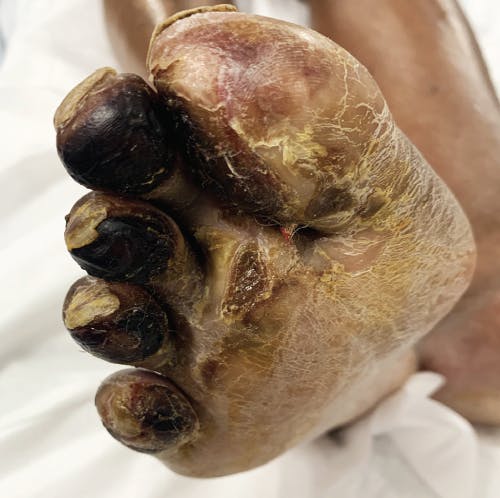
Figure 1. The patient experienced painful bilateral necrotic toes on his right foot, which was the target of our described intervention.
TREATMENT OPTIONS
A comprehensive limb salvage plan was initiated between wound care, orthopedics/podiatry, cardiology, and vascular interventional services. Given his comorbidities, an endovascular-first approach was considered. The plan was to pursue staged revascularization bilaterally with subsequent debridement to determine the level of viability. Despite his significant tissue loss, there was hope to find viable tissue under the eschar.
COURSE OF TREATMENT
For brevity, we detailed the right-sided intervention. Imaging at the level of the popliteal artery was performed from an antegrade approach in the right common femoral artery. The patient was noted to have an anomalous anterior tibial (AT) artery and three-vessel occlusion (Figure 2A). Antegrade crossing with a 0.014-inch Command ES wire (Abbott) was subintimal. We opted to access both the posterior tibial (PT) and AT arteries with 4/5-F Slender sheaths (Terumo Interventional Systems) under ultrasound guidance (Figure 2B). We then crossed retrograde with the 0.014-inch Quick-Cross catheter (Philips) into the true lumen of the AT and PT arteries above. From the pedal access, laser atherectomy was performed in both the AT and PT arteries using a 1.4-mm Turbo-Elite laser catheter (Philips) at 60 mJ/mm2/40 Hz, 60 mJ/mm2/60 Hz, and 60 mJ/mm2/80 Hz for four passes forward and backward. After this, we performed initial percutaneous transluminal angioplasty (PTA) using a 3- X 220-mm Coyote balloon (Boston Scientific Corporation) in both vessels. Intravascular ultrasound (IVUS) with the Visions PV .014P Rx (Philips) revealed that there were several areas of dissection, but we were in the true lumen. However, both vessels were close to 4 mm, and therefore our initial PTA was undersized (Figure 2C).
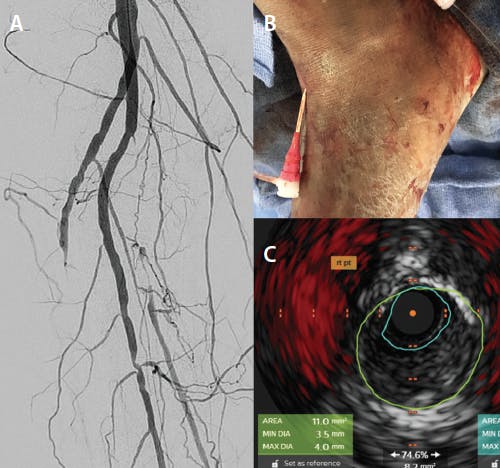
Figure 2. The patient presented with three-vessel occlusion (A). We opted to access both the AT and PT arteries (B). IVUS confirmed location in the true lumen as well as several dissections (C).
At this point, we reversed our access and wired antegrade into the occluded pedal loop with a Fielder XT wire (Asahi Intecc, USA), and the balloon occluded the pedal access sites, which allowed us to remove both sheaths and ensure no compromise of distal flow due to the access. The arch was crossed with a 3- X 150-mm Coyote balloon (Figure 3A), but there was severe recoil despite several prolonged inflations (Figure 3B). IVUS in the foot revealed severe medial calcium and severe plaque (not shown). We used a 0.9-mm Turbo-Elite laser catheter (Philips) at 60 mJ/mm2/60 Hz, 60 mJ/mm2/80 Hz, and 80 mJ/mm2/80 Hz for four passes to debulk and modify the plaque. The lesion then yielded with a 3- X 40-mm AngioSculpt balloon (Philips) at high pressure (Figure 3C and 3D).
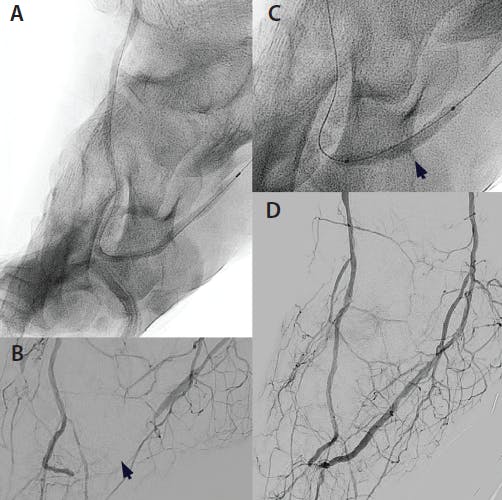
Figure 3. Reversed access to cross the pedal arch and perform PTA (A). Experienced severe recoil despite prolonged inflations (B). IVUS revealed severe medial calcium and plaque and drove decision to use Turbo-Elite laser catheter and AngioSculpt balloon to debulk and modify the plaque and gain yield of the lesion (C,D).
Three 1.5- to 4.5-mm below-the-knee (BTK) Tack implants (Philips) were placed in the distal AT artery and postdilated (not shown). Dissection in the proximal PT artery is shown (Figure 4A). Four BTK Tack implants were deployed in the proximal PT artery (Figure 4B) and postdilated with a 4- X 40-mm Coyote balloon. Final angiography showed no significant residual dissection in the proximal PT artery (Figure 4C). We closed the right common femoral arteriotomy site with a Perclose ProGlide system (Abbott) with excellent hemostasis.
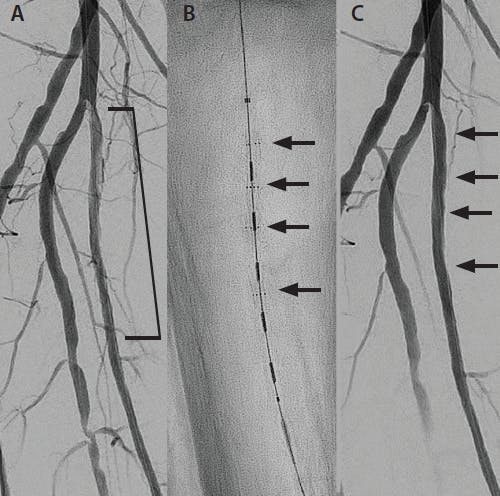
Figure 4. For the post-PTA dissection in the PT (A), four Tack implants were placed (B) to repair the dissection (C).
Similar findings were found in the left limb, and the AT, PT, and pedal arch were revascularized 2 days later. Pulses were palpable in both the dorsalis pedis and PT territories. On postoperative day 3, the patient went to the operating room and had hydrosurgical resection of eschar of the necrotic digits with findings of viable bleeding tissue. No amputation was necessary. He was discharged to the wound care clinic for further treatment.
DISCUSSION
This case highlights several teaching points of the vessel preparation and treatment strategy employed in an angiosomal/“woundasomal”-directed limb salvage. The Philips portfolio leverages several key technologies that work well in these complex cases. Our algorithm, in general, follows a program of imaging, debulking, plaque scoring/modification, and drug therapies (above-the-knee [ATK]) and/or scaffolds (ATK/BTK). Utilizing IVUS upfront takes the guesswork out of anatomy and morphology and helps answer several questions including:
- Is there medial versus intimal calcium and is atherectomy needed (which type)?
- Is there soft plaque or thrombus that might require initial thrombectomy?
- What is the vessel size and is the treatment appropriate for its caliber?
- Are there dissections?
- Is the wire subintimal or in the true lumen?
Quick IVUS runs at different points of “image-guided” therapy can help plan the treatment strategy and potentially increase efficiency and improve outcomes. In this case, upfront IVUS was not possible due to dense occlusion, and we had to debulk and perform limited angioplasty prior to imaging, which was undersized relative to the vessel. Using appropriately sized treatments can prevent complications such as perforations or missed dissections. Acute vessel closure in infrapopliteal interventions may be related not only due to recoil from inadequately prepared vessels but also to pressurized dissections.
Laser atherectomy is possible in mixed morphologies, even in calcified vessels where traditional rotational or orbital atherectomy systems may be used. Many patients with BTK disease have more medial calcium, which affects vessel elastance and compliance. The acoustic wave generated by the laser pulse may modify this plaque. Moreover, the hydrophilic low profile of the 1.4- and 0.9-mm Turbo-Elite laser fibers permits easy crossing even in dense occlusions.
Utilizing plaque scoring with AngioSculpt allows for high-pressure angioplasty for difficult-to-yield lesions with minimal dissections, even when traditional angioplasty has failed. The helical nitinol scoring elements allow for 15 to 20 times focal force in plaque compared with conventional balloons.1 If a scaffold like a drug-eluting stent is not needed ATK, I favor using Stellarex drug-coated balloon angioplasty (Philips) and spot-dissection stenting with Tack when there is no recoil. This keeps the metal-to-tissue ratio at a minimum and permits normal vessel dynamics. Unfortunately, with BTK intervention, drug-coated angioplasty options are limited and are likely to not be available in the United States. However, the 12-month data with targeted BTK dissection therapy using Tack implants (TOBA II BTK) are compelling, and Tack is the first approved scaffold for use in this space.2 The investigators reported 100% dissection resolution, 81.3% 12-month Tacked segment patency, and 83.1% 12-month freedom from clinically driven target limb revascularization. For critical limb ischemia (CLI) patients in the study, a remarkable 96.1% had 12-month freedom from amputation and 89% achieved amputation-free survival.2 Hopefully, we will continue to expand on the BTK therapy options to improve vessel patency and CLI outcomes.
1. Data on file with Philips.
2. Geraghty PJ, Adams G, Schmidt A, et al. Twelve-month results of Tack-optimized balloon angioplasty using the Tack endovascular system in below-the-knee arteries (TOBA II BTK). J Endovasc Ther. 2020;27:626-636. doi: 10.1177/1526602820944402
Advertisement
Advertisement