Advertisement
Advertisement
May 2021 Supplement
Sponsored by Philips
Challenges of Calcium in Critical Limb Ischemia
Describing the prevalence of calcium in CLI, its impact on outcomes, and the use of IVUS to improve identification before intervention.
Although there have been many advances in the endovascular treatment of critical limb ischemia (CLI) in the past decade, calcification remains an important limitation in the success of lesion crossing, adequate lesion dilation, and long-term outcomes after angioplasty. Calcification is highly prevalent in patients with CLI, and its presence in both intimal and medial locations is associated with increased adverse outcomes. The use of intravascular ultrasound (IVUS) can more accurately determine calcium location and severity compared with angiography alone, thereby helping identify adjunctive therapies to improve procedural success and ultimately improve outcomes in this complex patient cohort.
PREVALENCE OF CALCIUM IN CLI
Patients with CLI have a significantly higher prevalence of calcium compared to patients with less severe manifestations of peripheral artery disease. In a cross-sectional cohort of patients where tibial artery calcification was assessed, CLI was associated with significantly higher calcification scores.1 Increased tibial artery calcification was also associated with an increased risk of amputation. A subsequent study found that peripheral arterial calcification is associated with increasing ischemia categories, suggesting that calcification is an independent risk factor for lower extremity ischemia.2
In addition to calcification, patients with CLI often have concomitant mixed plaque morphologies in the infrapopliteal vessels, including diffuse thrombosis.3 In these cases, calcium is also likely a mediator of plaque rupture and disease progression, as calcium is associated with an increased risk of in situ thrombosis from plaque erosion and rupture.4 Therefore, both cohort and pathology studies emphasize the critical importance of calcium in mediating CLI development and progression.
ASSOCIATION OF CALCIUM WITH CLINICAL OUTCOMES
The presence of calcification significantly influences both acute procedural outcomes and long-term outcomes of endovascular intervention. Calcification is associated with an increased likelihood of dissection due to greater shear forces, as well as inadequate luminal gain compared to noncalcified lesions. Typically, these dissections tend to occur at the interface between calcified and noncalcified segments. Multiple studies have demonstrated that vessel calcification is associated with worse outcomes after endovascular interventions.5 In the case of drug-coated balloons, the presence of concentric calcification is associated with significantly decreased patency, potentially due to impaired paclitaxel diffusion through the calcium barrier.6 Calcium is likely also a mediator of long-term restenosis after stent implantation, possibly due to smaller luminal diameters that are achieved.
Medial artery calcification (MAC) is defined as calcium deposited in the media/deeper wall of the artery. Historically, the relationship between MAC and outcomes was unclear, because MAC is not always associated with luminal encroachment. However, MAC was also recently shown to be a strong and independent predictor of major adverse limb events in patients with CLI.7 The presence of MAC was strongly associated with so-called small arterial disease in the below-ankle segment, suggesting that patients with extensive MAC may require alternative endovascular approaches, including below-the-ankle angioplasty or deep vein arterialization.
IDENTIFYING CALCIFICATION IN INFRAPOPLITEAL VESSELS
Accurate identification of calcium prior to intervention is paramount to directing interventional approaches and the choice of adjunctive therapies. Multiple scoring systems have been developed to define calcium severity in the femoropopliteal segment.8 The limitation of these scores is that they are all based on angiography. As a result, the location of calcium in the vessel (eg, intimal vs deep) cannot be determined by angiography alone. This distinction can be even more difficult when treating infrapopliteal vessels due to the smaller vessel size as well as the extensive bony overlap when imaging below the knee.
IVUS offers many benefits for the identification of calcium severity and location. Compared with angiography, IVUS provides important additional information, including the arc of calcium and delineation between intimal and medial calcium (Figure 1). In addition, IVUS can help with optimal vessel sizing. Recent studies have shown that the vessel diameter as assessed by IVUS is often 0.5 to 1 mm larger than by angiographic assessment. This increased luminal gain achieved with optimal balloon sizing likely translates into increased vessel flow and has the potential to improve rates of wound healing.9,10
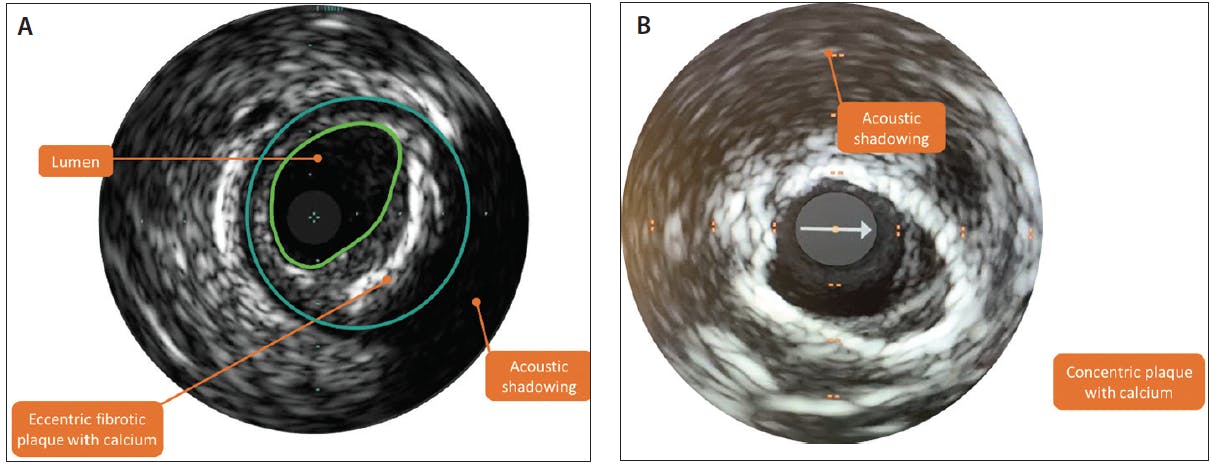
Figure 1. Eccentric and concentric calcification. IVUS can identify the location and depth of calcium in a lesion. In this example, the lesion contains eccentric calcium (A). Note the acoustic shadowing behind the sheet of calcium. In concentric calcification, the ring of calcium extends around the circumference of the vessel (B).
Treatment Options for Infrapopliteal Calcification
Multiple therapies have been developed to assist with treatment of calcified lesions in CLI. Intravascular lithotripsy (IVL) is a recently developed therapy that couples the use of lithotripsy with balloon angioplasty. One advantage of IVL is that it can modify both intimal and deep calcium.
Mechanical atherectomy devices that cut, capture, and clear are an important adjunctive therapy to debulk areas of calcification. The Phoenix atherectomy catheter (Philips) debulks below-the-knee calcium with a front-cutting directional head, then captures the plaque within the device shaft continuously clearing the debris. Phoenix shows promising benefits for the CLI population.11
Orbital atherectomy is another important adjunctive therapy that preferentially sands away calcification. This results in differential sanding and improved vessel compliance in calcified lesions.12,13
Laser atherectomy may be an ideal choice for CLI disease as the photoablation mechanism of action can treat mixed morphologies, including calcium at the molecular level.14 At higher frequencies, rigid materials like calcium respond well and result in improved vessel compliance.15 Laser atherectomy also ablates accompanying diffuse thrombus.15
In addition to the use of adjunctive calcium-modifying technologies, specialty balloons may help improve the outcomes of balloon angioplasty. Multiple specialty balloons are available, and each seeks to increase luminal gain while minimizing dissection. The AngioSculpt balloon (Philips) consists of nitinol wires wrapped around a semi-compliant balloon. Upon inflation, the nitinol elements “score” the plaque with focal force, with enough power to open up calcium.16,17 The Serranator balloon (Cagent Vascular) is a newer therapy that consists of a semi-compliant balloon with four embedded metal serrated strips along the length of the balloon. Recent studies have demonstrated the safety and potential efficacy of this device when treating calcified lesions.18
Because calcification is associated with higher rates of dissection, dissections may still occur despite use of these adjunctive therapies. In such cases, bailout therapies may be necessary to optimize the acute angiographic result and prevent early failure or subsequent restenosis (Figure 2). The Tack endovascular system (Philips) is available in a 4-F compatible system for use in infrapopliteal vessels as a tool for treating dissections after balloon angioplasty. In the TOBA II BTK study, use of the Tack implant to treat postangioplasty dissections was associated with excellent patency and freedom from major adverse limb events.19
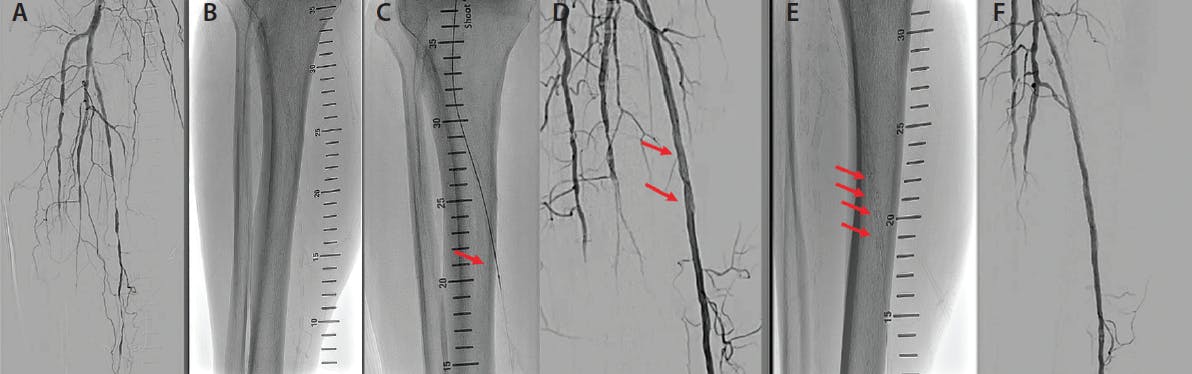
Figure 2. Atherectomy followed by Tack placement for dissection. A woman in her mid-80s presented with a nonhealing wound of the left heel. Baseline angiography revealed zero-vessel infrapopliteal runoff (A). Nonsubtracted images confirmed severe calcification (B). A 1.25-mm micro crown orbital atherectomy device was used in the posterior tibial artery (C). An area of severe dissection was identified after atherectomy (D). Four Tack implants were placed at the area of dissection (E). Final angiography revealed excellent luminal gain and no residual dissection (F).
CONCLUSION
Calcification remains a significant barrier to both acute and long-term success when treating patients with CLI. However, recent advances in imaging with IVUS have helped identify optimal techniques for treating calcified lesions. Concurrently, new therapies such as IVL, scoring balloons, and Tacks for dissection repair have recently made it possible to develop calcium-focused therapies for CLI.
1. Guzman RJ, Brinkley DM, Schumacher PM, et al. Tibial artery calcification as a marker of amputation risk in patients with peripheral arterial disease. J Am Coll Cardiol. 2008;51:1967-1974. doi: 10.1016/j.jacc.2007.12.058
2. Zettervall SL, Marshall AP, Fleser P, Guzman RJ. Association of arterial calcification with chronic limb ischemia in patients with peripheral artery disease. J Vasc Surg. 2018;67:507-513. doi: 10.1016/j.jvs.2017.06.086
3. Narula N, Dannenberg AJ, Olin JW, et al. Pathology of peripheral artery disease in patients with critical limb ischemia. J Am Coll Cardiol. 2018;72:2152-2163. doi: 10.1016/j.jacc.2018.08.002
4. Chang Z, Yan H, Zhen Y, et al. Lower limb arterial calcification and acute thrombosis risk in patients with peripheral artery disease. Ann Vasc Surg. 2020;63:227-233. doi: 10.1016/j.avsg.2019.06.043
5. Tepe G, Beschorner U, Ruether C, et al. Drug-eluting balloon therapy for femoropopliteal occlusive disease: predictors of outcome with a special emphasis on calcium. J Endovasc Ther. 2015;22:727-733. doi: 10.1177/1526602815600156
6. Fanelli F, Cannavale A, Gazzetti M, et al. Calcium burden assessment and impact on drug-eluting balloons in peripheral arterial disease. Cardiovasc Intervent Radiol. 2014;37:898-907. doi: 10.1007/s00270-014-0904-3
7. Ferraresi R, Ucci A, Pizzuto A, et al. A novel scoring system for small artery disease and medial artery calcification is strongly associated with major adverse limb events in patients with chronic limb-threatening ischemia. J Endovasc Ther. Published online October 15, 2020. doi: 10.1177/1526602820966309
8. Rocha-Singh KJ, Zeller T, Jaff MR. Peripheral arterial calcification: prevalence, mechanism, detection, and clinical implications. Catheter Cardiovasc Interv. 2014;83:E212-220. doi: 10.1002/ccd.25387
9. Soga Y, Takahara M, Ito N, et al. Clinical impact of intravascular ultrasound-guided balloon angioplasty in patients with chronic limb-threatening ischemia for isolated infrapopliteal lesion. Catheter Cardiovasc Interv. 2021;97:E376-E384. doi: 10.1002/ccd.29347
10. Pliagas G, Saab F, Stavroulakis K, et al. Intravascular ultrasound imaging versus digital subtraction angiography in patients with peripheral vascular disease. J Invasive Cardiol. 2020;32:99-103.
11. Ayad M. Phoenix 500 : Final results from the Phoenix registry. Presented at: International Symposium on Endovascular Therapy (ISET); January 23, 2020; Fort Lauderdale, Florida.
12. Dattilo R, Himmelstein SI, Cuff RF. The COMPLIANCE 360° trial: a randomized, prospective, multicenter, pilot study comparing acute and long-term results of orbital atherectomy to balloon angioplasty for calcified femoropopliteal disease. J Invasive Cardiol 2014;26:355-360.
13. Adams GL, Khanna PK, Staniloae CS, et al. Optimal techniques with the Diamondback 360 system achieve effective results for the treatment of peripheral artery disease. J Cardiovasc Transl Res. 2011; 4:220-229. doi: 10.1007/s12265-010-9255-x
14. Dippel EJ, Makam P, Kovach R, et al. Randomized controlled study of excimer laser atherectomy for treatment of femoropopliteal in-stent restenosis: initial results from the EXCITE ISR trial (EXCImer Laser Randomized Controlled Study for Treatment of FemoropopliTEal In-Stent Restenosis). JACC Cardiovasc Interv. 2015;8:92-101. doi: 10.1016/j.jcin.2014.09.009
15. Dave RM, Patlola R, Kollmeyer K, et al. Excimer laser recanalization of femoropopliteal lesions and 1-year patency: results of the CELLO registry. J Endovasc Ther. 2009;16:665-675. doi: 10.1583/09-2781.1
16. Kronlage M, Werner C, Dufner M, et al. Long-term outcomes upon treatment of calcified lesions of the lower limb using scoring angioplasty balloon (AngioSculpt). Clin Res Cardiol. 2020;109:1177-1185. doi: 10.1007/s00392-020-01610-3
17. AngioSculpt Test Plan ST-1197 (2008), on file at Philips.
18. Holden A, Hill A, Walker A, et al. PRELUDE prospective study of the Serranator device in the treatment of atherosclerotic lesions in the superficial femoral and popliteal arteries. J Endovasc Ther. 2019;26:18-25. doi: 10.1177/1526602818820787
19. Geraghty PJ, Adams G, Schmidt A, et al. Six-month pivotal results of tack optimized balloon angioplasty using the Tack endovascular system in below-the-knee arteries. J Vasc Surg. 2021;73:918-929. doi: 10.1016/j.jvs.2020.08.135
Advertisement
Advertisement