Advertisement
Advertisement
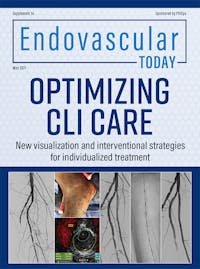
May 2021 Supplement
Sponsored by Philips
Why We Are Better Prepared to Fight CLI Than Ever Before
Recent publications have quantified the harm that critical limb ischemia (CLI) poses to the general population. The CLI Global Society has found more incident cases of death over 5 years after a CLI diagnosis than any type of cancer other than lung cancer,1 and a recent study by Armstrong et al showed that the 5-year mortality for patients with diabetic foot complications was comparable to cancer.2
Despite posing a major threat to public health, treatment for CLI varies widely. Each year, approximately 150,000 amputations are attributed to CLI in the United States.3,4 This is in part due to primary amputation still being considered a first-line therapy at some institutions,1,5-9 with studies finding that most patients who had undergone primary amputation did not receive either diagnostic angiography or revascularization attempts before amputation.8,9
Although work is still needed to control CLI, physicians are better prepared than ever to fight CLI with new imaging equipment, low-profile tools, and techniques to tackle complex CLI cases.
NEEDS OF A CLI CENTER
The country is seeing an interest in the development of CLI centers with a focus on the complex multilevel, multivessel needs of the CLI patient. These complex cases require high-caliber imaging for fluoroscopy, intravascular ultrasound, and extravascular ultrasound.
An adequate selective digital subtraction angiogram is critical to map out a treatment strategy. However, it should be married with ultrasound to get the complete assessment necessary to adequately plan access, crossing, treatment, and closure.
Vascular sonography provides detailed real-time imaging of arterial and venous anatomy and surrounding structures. This provides significant benefits when incorporated into interventional procedures of the peripheral vascular systems, including increased safety, improved outcomes, and decreased radiation times for both patients and staff. Vascular sonographers are uniquely qualified to assist in this role, as they undergo extensive training to recognize vascular anatomy and pathology when performing diagnostic ultrasounds. Real-time imaging with ultrasound can do more than just increase patient safety; it can also improve patient outcomes. Fluoroscopy has long been utilized during interventions and is an invaluable tool. The use of ultrasound will never replace fluoroscopy; however, it can be another beneficial tool, working in tandem with fluoroscopy to improve patient outcomes. Real-time imaging of catheters and wires by an interventional sonographer can quickly and accurately identify when a wire is outside the vessel or engaged within a lesion. This gives the operator confidence when crossing difficult pathology, which has two significant benefits: limiting potential complications in the form of vessel perforation and increased speed in crossing lesions. This translates to safer, shorter procedures. Ultrasound use can also minimize the use of ionizing radiation in the form of fluoroscopy. This benefits not only the patient but all staff present.
Additionally, a broad spectrum of tools and devices must be available to the CLI operator. A wide variety of wires, catheters, balloons, drug-eluting technology, scaffolds, and atherectomy devices are a must to treat complex CLI arterial anatomy, which is fraught with chronic total occlusions that are dense, collagenous, and have varying degrees of calcification.
Finally, let’s not forget experience and techniques. Having the right tools in your toolbox is only half the solution for success. The other half is having highly experienced operators and well-trained staff. An investment in the education and training of staff is necessary to ensure successful outcomes for your patients.
1. Mustapha JA, Katzen BT, Neville RF, et al. Determinants of long-term outcomes and costs in the management of critical limb ischemia: a population-based cohort study. J Am Heart Assoc. 2018;7:e009724. doi: 10.1161/JAHA.118.009724
2. Armstrong DG, Swerdlow MA, Armstrong AA, et al. Five year mortality and direct costs of care for people with diabetic foot complications are comparable to cancer. J Foot Ankle Res. 2020;13:16. doi: 10.1186/s13047-020-00383-2
3. Hirsch AT, Duval S. The global pandemic of peripheral artery disease. Lancet. 2013;382:1312-1314. doi: 10.1016/S0140-6736(13)61576-7
4. Li Y, Burrows NR, Gregg EW, et al. Declining rates of hospitalization for nontraumatic lower-extremity amputation in the diabetic population aged 40 years or older; U.S., 1988-2008. Diabetes Care. 2012;35:273-277. doi: 10.2337/dc11-1360
5. Abu Dabrh AM, Steffen MW, Undavalli C, et al. The natural history of untreated severe or critical limb ischemia. J Vasc Surg. 2015;62:1642-1651.e3. doi: 10.1016/j.jvs.2015.07.065
6. Mustapha JA, Katzen BT, Neville RF, et al. Disease burden and clinical outcomes following initial diagnosis of critical limb ischemia in the Medicare population. JACC Cardiovasc Interv. 2018;11:1011-1012. doi: 10.1016/j.jcin.2017.12.012
7. Valle JA, Waldo SW. Worth an arm and a leg: the critical importance of limb ischemia. J Am Heart Assoc. 2018;7:e010093. doi: 10.1161/JAHA.118.010093
8. Henry AJ, Hevelone ND, Belkin M, et al. Socioeconomic and hospital-related predictors of amputation for critical limb ischemia. J Vasc Surg. 2011;53:330-339.e1. doi: 10.1016/j.jvs.2010.08.077
9. Goodney PP, Travis LL, Nallamothu BK, et al. Variation in the use of lower extremity vascular procedures for critical limb ischemia. Circ Cardiovasc Qual Outcomes. 2012;5:94-102. doi: 10.1161/CIRCOUTCOMES.111.962233
Advertisement
Advertisement