Advertisement
Advertisement
November 2021
Before the Stick: Tests, Setup, and Routine for Radial Access Patient Prep
Preparation and setup for optimal neurovascular radial artery access.
By Fadi Al Saiegh, MD, and Pascal Jabbour, MD
The common femoral artery (CFA) has been the primary access point for neuroendovascular procedures since the modern domain’s emergence. The advantages of this access site are its large vessel diameter, the compressible location over the femoral head, and the relatively straight trajectory to the supra-aortic vasculature. However, even with enormous progression of sheath design, endovascular catheters, and vascular closure devices, certain risks of this access site cannot be eliminated, such as the formation of thigh hematomas, retroperitoneal hematomas, or pseudoaneurysms. Those risks can turn a minimally invasive endovascular procedure into a major, sometimes life-threatening, complication.1
Like the majority of endovascular surgery, radial access was pioneered by interventional cardiologists in the 1990s. There are several anatomically fixed advantages of the radial artery. Unlike the femoral artery, it courses superficially in the forearm, making it easily accessible and compressible against the radius. Because of its superficial course and proximity to the radius, there is no large potential space for hematoma formation, and any bleeding is identified early and managed easily with compression. Most importantly, as opposed to the CFA, the radial artery is not an end artery and the blood supply to the hand is robust with many redundant collaterals, which significantly lowers the risk of ischemic events as shown by multiple cardiology-led trials (eg, the RIVAL2 and RIFLE3 trials). This makes the occurrence of a radial artery occlusion a clinically insignificant event.
All safety considerations aside, the transfemoral access can be less optimal in cases of femoral occlusive disease, previous aortofemoral bypass surgery, severe coagulopathy, or tortuous aortic arch configurations. Last but not least, radial access is preferred by patients because the “groin stick” is less pleasant and can cause soreness or discomfort postprocedure.4
TECHNICAL ROUTINE OF TRANSRADIAL ACCESS
Communication With Radiology Technician Staff
Before the patient is brought back to the room, it is important to let the staff know that the procedure will be performed via transradial access (TRA). This dictates important nuances to room setup. For TRA, the goal is to position the arm next to the patient’s hip. This requires the use of a radial arm board (Figure 1), which serves to laterally extend the interventional neuroradiology (INR) table to accommodate for the patient’s arm. In addition, a tapered pad is placed on the board, onto which the patient’s arm will later be placed (Figure 2).
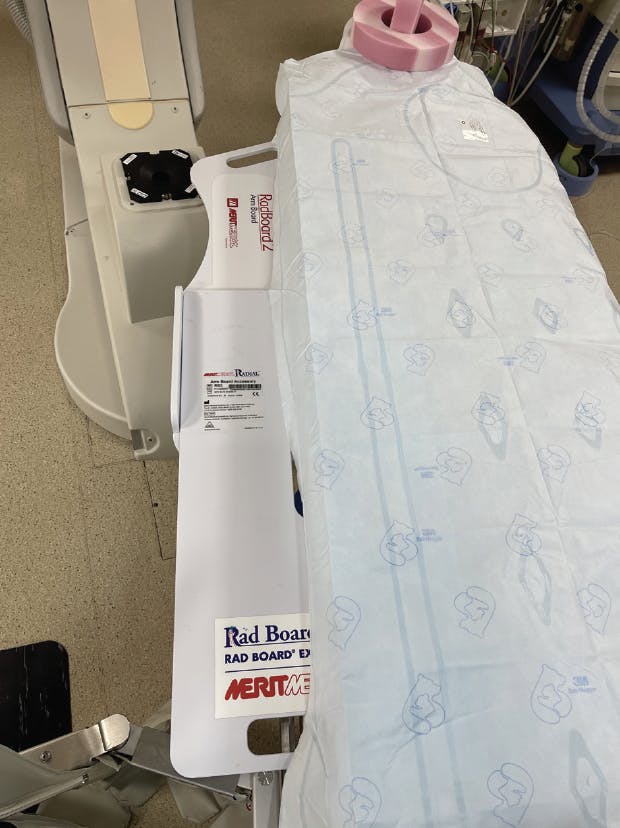
Figure 1. Biplane INR table with the radial arm board in position for lateral extension of the table to accommodate for the patient’s right arm.
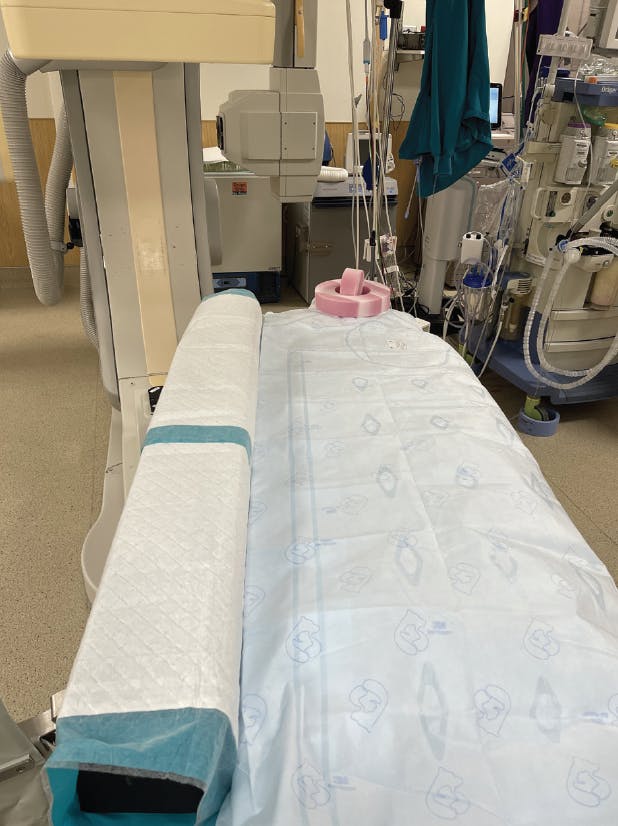
Figure 2. Elevated tapered pad onto which the patient’s right arm will be positioned.
Procedural planning is equally important because it helps save time and additional costs related to catheters and devices used. Routinely, the Simmons 2 catheter is used for vessel selection in patients with typical anatomy (Figure 3).5 However, if the ipsilateral vertebral artery is the primary focus of the procedure, a Berenstein catheter is recommended. This catheter is also used for patients with bovine arch anatomy because it is easier to navigate it from the right radial to left common carotid artery. These examples illustrate the importance of having a precise plan that is communicated to the staff ahead of time.
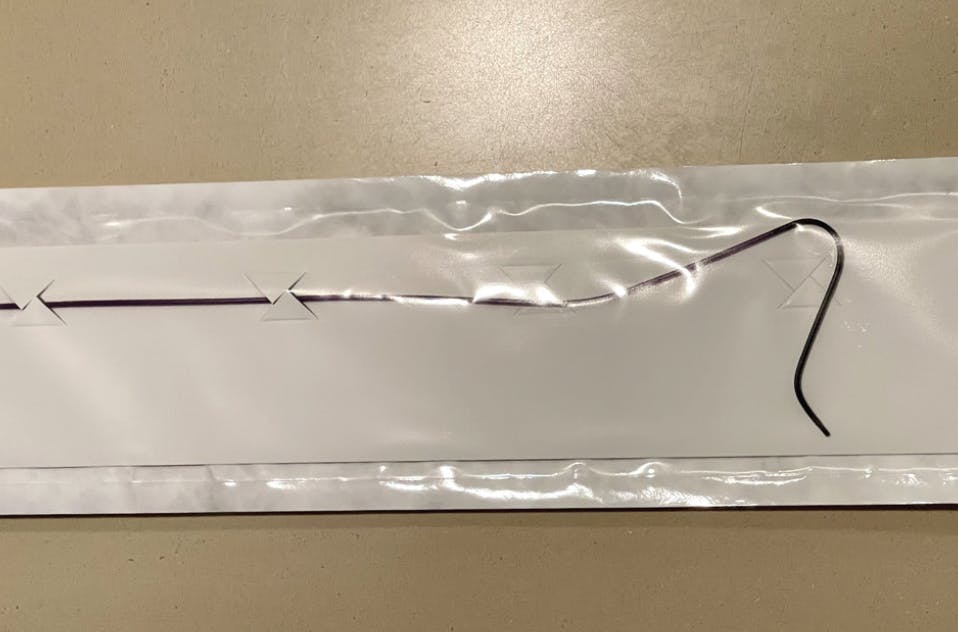
Figure 3. Tip of a Simmons 2 selection catheter.
Communication With Anesthesia Staff
It is just as important to communicate the choice of access site to the anesthesia staff. TRA requires the use of a “radial cocktail,” which optimizes the radial artery for access and prevents vasospasm, as discussed in the next section. However, due to the administration of nitroglycerin and nicardipine, the patient’s blood pressure can plummet, and the anesthesia staff needs to be prepared to treat it adequately. In addition, because intravenous line placement is sometimes done on the dorsal surface of the hand, it is important for the anesthesia staff to choose a different site so adequate radial artery access can still be achieved.
Patient Positioning
Most transradial neurointerventions are performed using the right side.6,7 Checking the patient’s radial pulse in the preoperative holding is important to evaluate for procedural success later on. The patient is then positioned supine on the interventional radiology suite table. The right arm is positioned right next to the right hip, and the wrist is elevated using soft pads, with gentle supination of the hand (Figure 4). Positioning the patient’s arm against the hip ensures that the surface is flat, which allows the operator to easily advance the catheters in the same customary fashion as the transfemoral approach. It is important that only gentle supination is applied because too much supination is uncomfortable to patients and unnecessary and may make radial access more difficult. Tape on the thenar eminence is used to keep the hand in an optimal position. Continuous pulse oximetry is placed on the ipsilateral thumb or index finger to monitor hand perfusion.
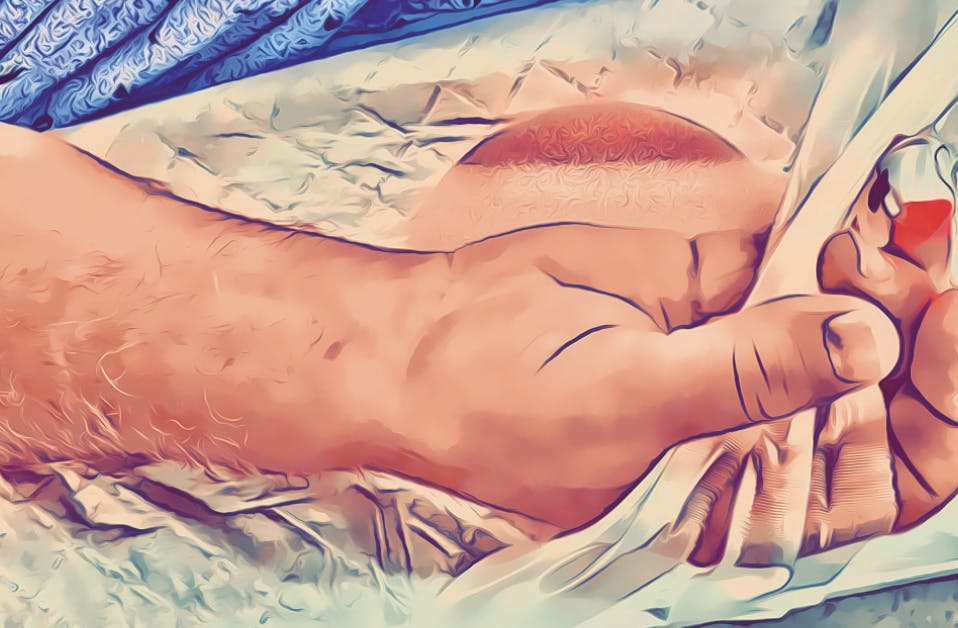
Figure 4. Right hand positioned in gentle supination and secured with tapes for radial artery access.
After sterile preparation, draping, and surgical time-out, ultrasound is used in all cases for evaluation and cannulation of the radial artery (Figure 5). Next, lidocaine (without epinephrine) is injected subcutaneously, and a 21-gauge needle is used for radial puncture under ultrasound guidance. Once blood return is obtained, a soft guidewire is advanced and a low-profile hydrophilic sheath placed using the Seldinger technique. Next, a “radial cocktail” consisting of 2,000 units of heparin, 5 mg of nicardipine, and 200 µg of nitroglycerin is injected intra-arterially for vasodilation and to prevent radial artery thrombosis.8
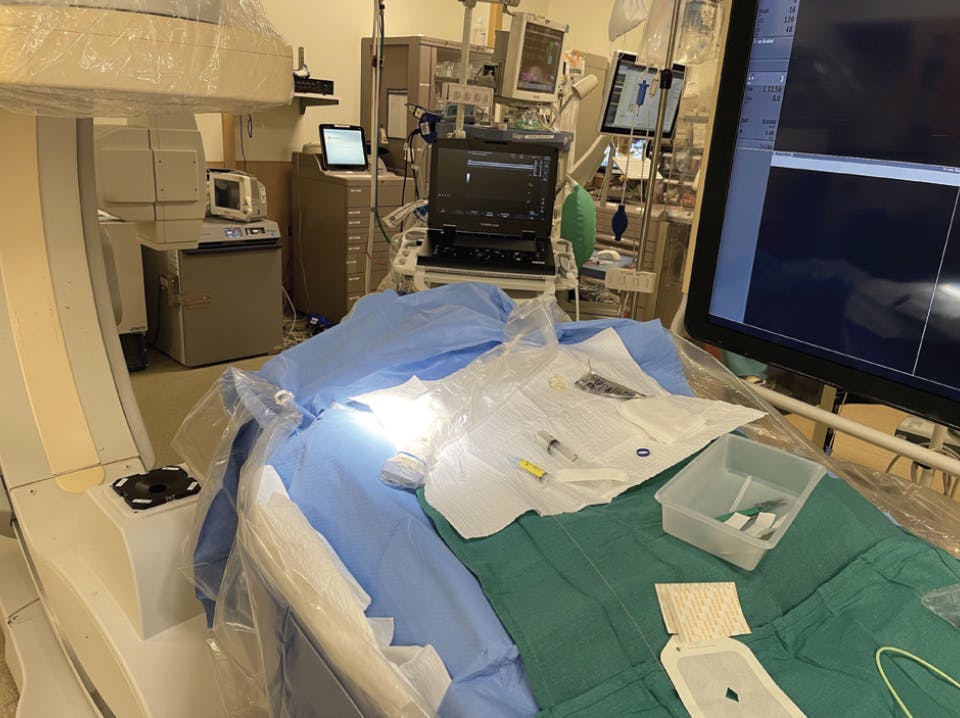
Figure 5. Final setup for right radial artery access. Note the rotated INR table with the ultrasound in position to visualize and cannulate the radial artery under ultrasound guidance.
Distal Transradial “Snuffbox” Approach
At the distal segment of its course, the radial artery courses over the radius and then proceeds into the floor of the anatomic snuffbox.9 This is a triangular area on the radial part of the wrist that is bordered by the tendons of the abductor pollicis longus and extensor pollicis brevis muscles laterally and by the tendons of the extensor pollicis longus muscle medially. Distally, it continues as the deep palmar arch of the hand and forms an anastomosis with ulnar artery branches. Importantly, the radial artery in the anatomic snuffbox is distal to the origin of the superficial palmar branch. Therefore, even in the case of an occlusion, ischemic events are even less likely than with traditional radial access. In addition, accessing the distal radial artery is particularly useful when used for diagnostic procedures as it preserves proximal TRA as a backup for interventions. The conversion from the anatomic snuffbox to proximal TRA should be considered before the conversion to the transfemoral approach.
To perform distal TRA, the patient’s hand is placed in the neutral position, which is more ergonomic for the patient and is especially beneficial in elderly patients.
LEFT TRANSRADIAL APPROACH
Most transradial procedures are done via the right radial artery. However, there are certain advantages to using the left radial artery. Much of the evidence for the benefits of left TRA stem from the cardiology literature. First, left TRA allows for use of the nondominant hand in most people. Second, using the left radial artery obviates the need to rotate the INR table and allows it to remain neutral from the outset. However, the most important advantage is the relative ease of access of the left vertebral artery using a Berenstein catheter. Contrary to the right TRA for left vertebral artery access, navigating the catheter from the left obviates the need to cross the aortic arch. This reduces the risk of any atheromatous emboli from catheter manipulation and helps shorten fluoroscopy time. Using a Simmons 2 catheter allows for selection of the right-sided supra-aortic vessels. However, one disadvantage of left TRA we have found is the difficulty of catheterizing the left internal carotid artery with currently available catheters.10
For left TRA, the left arm is elevated with soft pads and, in patients with good arm mobility and favorable body habitus, it is brought over the torso toward the right hemibody to bring the access site closer to the neurointerventionalist. When mobility is restricted, the left arm can remain next to the left hip. The left hand is then secured with tapes as described previously. Draping and preparation are done the same way as for right TRA, and ultrasound guidance should be used for each case of left TRA as well.
The left TRA approach expands the options of the neurointerventionalist to avoid transfemoral access and can be the primary access site when certain anatomic variants exist or when left vertebral artery access is the goal.
CONCLUSION
Neuroendovascular is a continuously evolving domain that requires an open mind toward adaptation and learning of new techniques. The transradial approach provides numerous advantages in procedural safety and is favored by patients. Establishing a protocol for setup and involving all team members can help maximize success rates for diagnostic and interventional procedures.
1. Jabbour P, Peterson E. Radial Access for NeuroIntervention. Oxford University Press; 2021.
2. Jolly SS, Yusuf S, Cairns J, et al. Radial versus femoral access for coronary angiography and intervention in patients with acute coronary syndromes (RIVAL): a randomised, parallel group, multicentre trial. Lancet. 2011;377:1409-1420. doi: 10.1016/S0140-6736(11)60404-2
3. Romagnoli E, Biondi-Zoccai G, Sciahbasi A, et al. Radial versus femoral randomized investigation in ST-segment elevation acute coronary syndrome: the RIFLE-STEACS (radial versus femoral randomized investigation in ST-elevation acute coronary syndrome) study. J Am Coll Cardiol. 2012;60:2481-2489. doi: 10.1016/j.jacc.2012.06.017
4. Khanna O, Sweid A, Mouchtouris N, et al. Radial artery catheterization for neuroendovascular procedures. Stroke. 2019;50:2587-2590. doi: 10.1161/STROKEAHA.119.025811
5. Al Saiegh F, Sweid A, Chalouhi N, et al. Comparison of transradial vs transfemoral access in neurovascular fellowship training: overcoming the learning curve. Oper Neurosurg (Hagerstown). 2021;21:E3-E7. doi: 10.1093/ons/opab018
6. Mouchtouris N, Al Saiegh F, Sweid A, et al. Transradial access for newly Food and Drug Administration-approved devices for endovascular treatment of cerebral aneurysms: a technical note. World Neurosurg. J2019;131:6-9. doi: 10.1016/j.wneu.2019.07.149
7. Chalouhi N, Sweid A, Al Saiegh F, et al. Initial experience with transradial intraoperative angiography in aneurysm clipping: technique, feasibility, and case series. World Neurosurg. 2020;134:e554-e558. doi: 10.1016/j.wneu.2019.10.130
8. Al Saiegh F, Sweid A, Chalouhi N, et al. Comparison of transradial vs transfemoral access in neurovascular fellowship training: overcoming the learning curve. Oper Neurosurg (Hagerstown). 2021;21:E3-E7. doi: 10.1093/ons/opab018
9. Al Saiegh F, Mouchtouris N, Sweid A, et al. Placement of the Woven EndoBridge (WEB) device via distal transradial access in the anatomical snuffbox: a technical note. J Clin Neurosci. 2019;69:261-264. doi: 10.1016/j.jocn.2019.08.018
10. Chalouhi N, Sweid A, Al Saiegh F, et al. Feasibility and initial experience of left radial approach for diagnostic neuroangiography. Sci Rep. 2021;11:1089. doi: 10.1038/s41598-020-80064-z
Advertisement
Advertisement
