Advertisement
Advertisement
October 2021
Tackle the Block: Pain Management and Sedation for Percutaneous Ablation
A review of key regional nerve block techniques that may be used to reduce periprocedural pain during percutaneous ablation.
By Ravjot Dhatt, MD, FRCPC; Anastasia Hadjivassiliou, MBBS, MRCP, FRCR (UK), FRCPC; Stephen G. F. Ho, MD, FRCPC; Darren Klass, MBChB, MD, MRCS, FRCR, FRCPC; and David M. Liu, MD, FRCPC, FSIR
Percutaneous ablation of solid tumors is a minimally invasive procedure to curative intent to treat primary and/or metastatic tumors via targeted thermal energy deposition and coagulative necrosis.1,2 Currently, the most commonly treated lesions are within the liver, kidney, and lung, with applications expanding to include pancreatic, soft tissue, bone, and thyroid neoplasms.1-3 Evolving from percutaneous ethanol injection, thermal ablation utilizing radiofrequency ablation and microwave ablation has become the standard approach to treat isolated lesions that meet the size criteria for curative-intent therapy (typically 3-4 cm).4 With the innovation of more intense thermal ablation, such as microwave ablation, the increase in both the size of the ablation zone and intensity of heat generation have further expanded the scope of this technique.4 With the ability to perform more complex percutaneous ablative procedures, intra- and postprocedural pain has also increased, requiring a greater focus on periprocedural pain management.
Interventional radiologists are usually responsible for periprocedural pain and sedation, and expertise in this area is therefore essential.5 To match the increase in therapeutic intensity with more innovative ablative techniques, higher dosages of intravenous (IV) sedation have been utilized. However, this carries the risk of oversedation when the noxious stimulus is removed and adds further difficulty to postprocedural recovery.4 Patient compliance with breathing instructions can become challenging with deeper sedation, making probe placement during ablation more difficult, particularly with lung tumors and high subdiaphragmatic hepatic tumors, and can increase the complication rate.
Although general anesthesia may mitigate these complications, the increased focus on reducing aerosol-generating medical procedures, such as intubation due to the COVID-19 pandemic, has highlighted the need for alternatives where feasible. The resources required to provide general anesthesia may also result in substantial delays in treatment.4
Over the years, thoracic and upper abdominal regional nerve block techniques have been used to manage pain related to trauma, surgery, and cancer. They have gained popularity for a variety of procedures in interventional radiology because they have decreased the frequency of opioid-related adverse events.5 Since incorporating regional nerve block techniques, the amount of sedative administrated during the procedure has been significantly reduced. Decreased patient discomfort during localization and ablation as well as better-controlled postprocedural pain allows for faster time to discharge and an overall reduction in room procedural time.4,6
This article discusses the role, indication, technical considerations, and potential risks of common regional nerve block techniques used at our institution during percutaneous ablation.
GENERAL CONCEPTS OF REGIONAL NERVE BLOCKS
A good understanding of embryology, morphology of organ targeted for ablation, nerve anatomy, and physiology is critical to performing regional nerve block techniques in a safe and effective manner. These concepts have been well described in the literature and are beyond the scope of this article.4,5,7-17
For any nerve block, a few basic principles should be followed to reduce complications:
- For most blocks, a 21- or 22-gauge spinal or Chiba needle should be used. Needles with echogenic tips can help facilitate ultrasound guidance.
- Vital sign and electrocardiographic monitoring should be performed throughout the procedure to detect and manage potential autonomic nervous system derangement.
- Optimal imaging technique should be used to visualize the target. Although CT or fluoroscopy might be necessary for deep blocks, ultrasound guidance provides real-time imaging that may be faster, safer, and potentially more accurate.
- Confirmation of extravascular location of the needle tip is essential. This can be achieved with the following techniques: lack of blood aspiration, lack of epinephrine-induced tachycardia upon injecting 3 mL of lidocaine with epinephrine, contrast injection demonstrating correct spread of contrast on CT, or injection of saline/dextrose 5% in water (D5W) under ultrasound guidance to confirm compartmentalization of injectate/infusate.
- Various combinations of nerve block agents can be used, from short-acting agents with safer profiles such as lidocaine (1-2 hours) to longer-acting agents such as bupivacaine or ropivacaine (6-8 hours). The maximum weight-based dose should not be exceeded (lidocaine 5 mg/kg, bupivacaine 2 mg/kg, and ropivacaine 3 mg/kg).6
- A management plan, including access to IV lipid infusion for “lipid rescue” technique should be available in case of intravascular toxicity.18,19
- Careful postprocedural monitoring of the patient in the recovery room will be needed for 2 hours to ensure absence of delayed nerve block toxicity characterized by perioral numbness, lightheadedness, dizziness, visual/auditory disturbances, disorientation, seizures, or cardiac arrhythmias.
OVERVIEW OF SEDATION/ANESTHESIA
Preprocedural preparation requires nothing by mouth at minimum 6 hours before procedure with the caveat that clear fluids can be taken until 2 hours prior to anticipated procedural sedation administration. Arrangements should be made for IV access and appropriate resuscitation protocols, including the potential use of reversal agents. Imaging and confirmation visualization of both target lesion and target regional block/anesthesia compartment should be confirmed prior to preparing/sterilizing the surgical field.
Institutional moderate sedation protocols may be implemented and initiated in a gradual fashion. At our institution, we approach anxiolysis, sedation, and analgesia in the following phases:
- Phase 1: Preprocedural optimization. Oral or IV diphenhydramine (25-50 mg orally or IV) and oral benzodiazepine (eg, 1-2 mg lorazepam sublingual) upon arrival in the procedural suite provides anxiolysis, further decreasing “catch-up boluses” of opioids and minimizing the downregulatory effects on centrally mediated drivers of respiration. Patient consent is obtained prior to any agents being administered.
- Phase 2: Initial IV sedation. A combination of short-acting IV opioids and benzodiazepines is used to achieve moderate sedation. Active monitoring should be maintained throughout the course of the procedure (including oxygen saturation, cardiac monitoring, and capnography if available). Airway assistance and resuscitation equipment should be readily available.
- Phase 3: Nerve/regional block. After imaging localization, preparation of the sterile field, and administration of local anesthetic, image-guided localization of the target anatomy is achieved and confirmed.
- Phase 4: Ablation. Prior to initiation of ablation, a secondary supplemental bolus of IV sedation and analgesia is administered with anticipation of transient increased demand during the ablation cycle.
- Phase 5: Postablation. Postablation recovery includes standardized protocols after administration of moderate sedation, with a transition to oral analgesics prior to discharge (typically 2-3 hours postprocedure). If required, a low-dose oral analgesic/opioid can be provided to the patient upon discharge (eg, acetaminophen/codeine) for up to 48 hours postdischarge.
HEPATIC HILAR BLOCK
Hepatic hilar blocks can be used for lobar intraparenchymal lesions with technical and clinical success.4,6 The position of the needle tip for hepatic hilar block during hepatic ablations should be aimed at the periportal fat near the bifurcation of the main portal vein into the right and left portal branches.4 A transhepatic approach using ultrasound is favored. Approach through the left lobe is usually easier due to shorter distance to the target and absence of intervening ribs, but an intercostal approach can also be used. Once the needle tip has been advanced into the periportal fat, confirmation of extravascular position is performed. Upon confirmation of needle position, 10 to 15 mL of 0.25% bupivacaine or 0.5% ropivacaine is injected (Figure 1). Potential complications include inadvertent intravascular administration and decreasing visibility of the target lesion.
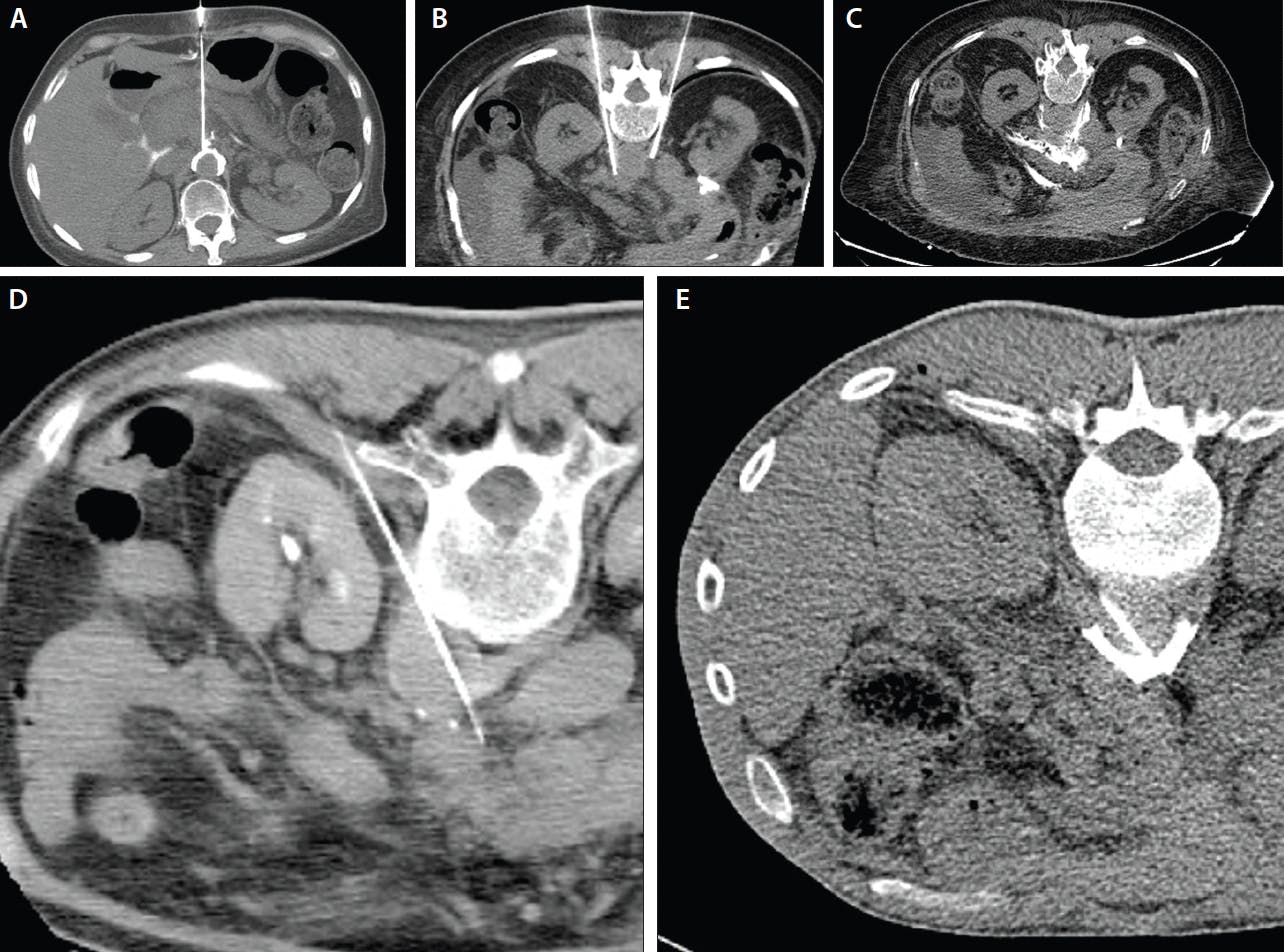
Figure 1. CT-guided anterior and posterior approaches for celiac plexus nerve block technique. CT-guided transgastric approach to the celiac axis using a 22-gauge needle, confirmed with dilute contrast injection distributing along the celiac axis and adjacent tissue (A). CT-guided posterior bilateral approach to a celiac block using a paraspinal technique with confirmation of distribution via injection of dilute contrast (B, C). CT-guided posterior unilateral approach to a celiac block using a right-sided paraspinal technique with confirmation of distribution via injection of dilute contrast (D, E).
CELIAC PLEXUS BLOCK
Celiac plexus can be used for general hepatic ablation, particularly when a hepatic hilar nerve block is not possible, such as if the hilum is occupied by a mass.4 Celiac plexus block has also been described for acute and chronic pain management, including in the setting of palliation for intractable upper abdominal pain secondary to pancreatic, gastric, and biliary malignancies.20 Numerous studies have demonstrated excellent pain relief after a celiac plexus block, a decrease in opioid burden, and improvement in quality of life.20
The target position of the needle tip is anterior to the aorta between the origin of the celiac trunk and superior mesenteric artery. In thin patients, an anterior ultrasound approach can be used. Otherwise, a CT- or fluoroscopy/CT-guided approach can be used. If an anterior approach is not possible, a posterior bilateral approach can be used targeting both celiac ganglia. Alternatively, a posterior unilateral transaortic or wide posterolateral unilateral approach attempting to place the needle as close as possible to the anterior wall of the aorta can be used. When the needle gets close to the aorta and the pulsations are strongly felt on the needle, it should no longer be advanced and final position should be confirmed with injection of contrast. Once the needle tip is in position and absence of intravascular leakage is demonstrated, 10 to 15 mL of 0.25% bupivacaine or 0.5% ropivacaine is injected (Figure 2).
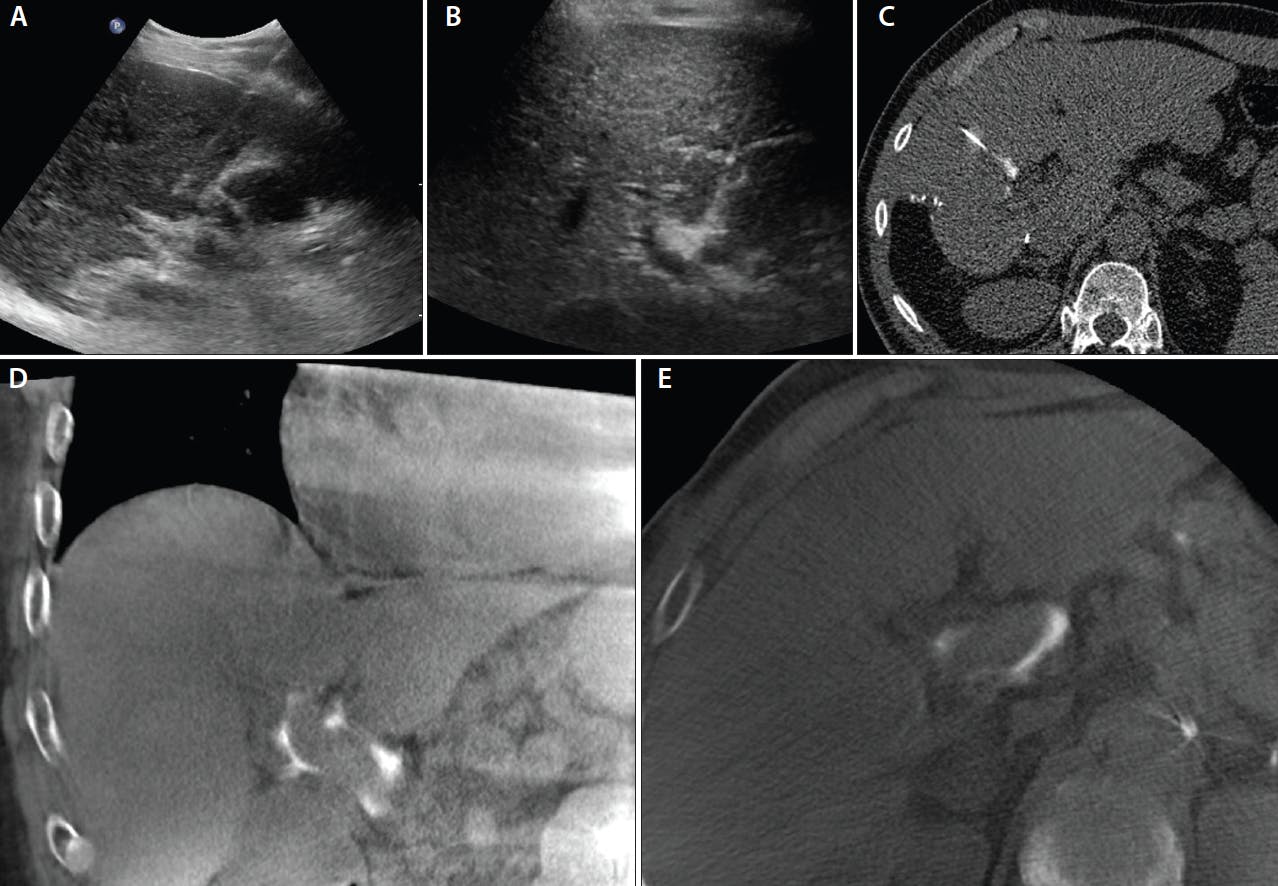
Figure 2. Ultrasound-guided perihilar block technique with cone-beam CT confirmation. Off-axial sonographic images demonstrating needle trajectory toward the portal vein (A, B). Axial CT demonstrating needle positioning within the periportal fat (C). After satisfactory needle positioning, local anesthetic is injected in the target region. During injection, fluid around the portal vein may be visualized and a mild amount of resistance to the infusion may be encountered. Coronal and axial cone-beam CT illustrates the distribution of infusate (with dilute contrast) along the branch and main portal vein (D, E).
Risks of celiac plexus block include transient diarrhea (44%) and postural hypotension (10%-52%). Serious complications occur in < 2% and include vascular and organ injury that are approach-specific. An anterior approach can lead to gastrointestinal or pancreatic injury. A posterior approach can lead to vascular injury, including to spinal vessels with very rare complication of paralysis.21
SPLANCHNIC NERVE BLOCK
Similar to the celiac plexus block, a splanchnic nerve block can be used for general hepatic ablation if the hilum is occupied by a mass.4 Furthermore, splanchnic nerve neurolysis can be performed in advanced malignancies when the celiac plexus anatomy is distorted by the underlying malignancy or enlarged celiac axis lymph nodes, which makes access to celiac ganglia difficult or lead to inadequate spread of the neurolytic agent.22
The target position of the needle tip is along the anterior third of the T11 vertebral body on either side. A posterior fluoroscopic-guided approach is most often used. The vertebral body is “squared” by angulating the fluoroscopy tube craniocaudally. The tube is then angulated ipsilaterally until the concave contour of the side of the vertebral body is seen. Using a “down-the-barrel” approach, the needle is advanced alongside the vertebral body until its tip is at the anterior one-third of the vertebral body on the lateral view. The same procedure is performed on the opposite side. Once in position, with no evidence of intravascular leakage, 8 mL of 0.25% bupivacaine or 0.5% ropivacaine is injected on either side.
Risks of splanchnic nerve block include transient diarrhea (14%-30%) and orthostatic hypotension (19%-53%). Very rare complications include paralysis, sexual dysfunction, pneumothorax, and chylothorax.22
HYDRODISSECTION WITH DILUTE LOCAL ANESTHETIC (MODIFIED TUMESCENT ANESTHESIA TECHNIQUE)
The admixture of dilute forms of local anesthetic administered in the peritoneal space or intrabdominal compartment can be performed easily as a continuation of subcutaneous local administration and without additional discomfort. At our institution, we commonly use this for subcapsular lesions requiring hydrodissection.
Buffered or dilute local anesthetic (10 mL of 1% lidocaine per 250 mL normal saline or D5W) administered into the peritoneal cavity can provide simultaneous anesthesia to both peritoneal and visceral surfaces, minimizing pain associated with peritoneal puncture, liver capsule puncture, and irritation due to thermal flux.4 For superficial subcapsular lesions, a 22-gauge spinal needle is positioned just proximal to Glisson’s capsule, and 20 mL of dilute local anesthetic is administered under direct sonographic visualization (Figure 3).
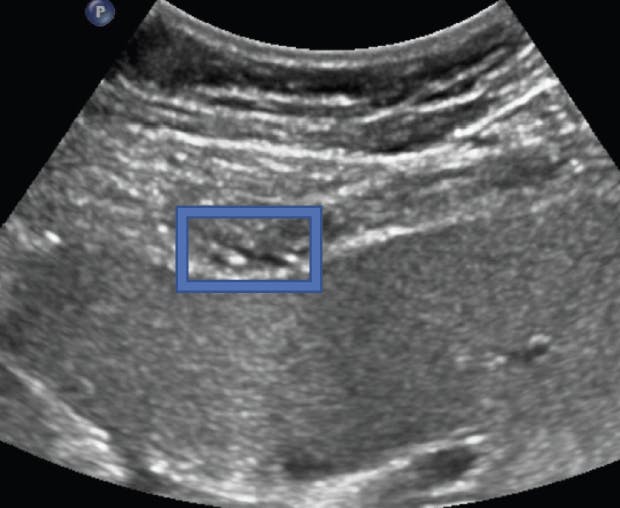
Figure 3. Ultrasound-guided hydrodissection with dilute local anesthetic (modified tumescent anesthesia technique). Hydrodissection with dilute local anesthetic can be performed prior to ablation of a subcapsular hepatic lesion. Early sonographic representation of a 22-gauge needle just proximal to Glisson’s capsule for tumescent anesthesia with dilute local anesthetic.
For deeper subcapsular lesions, techniques to elicit iatrogenic ascites have been well described in the literature. In brief, use of a modified Seldinger technique using a micropuncture access point (via ultrasound and/or loss-of-resistance technique) allows for serial dilation and upsizing to peritoneal drain placement, thus allowing for larger-volume ascites formation with dilute local anesthetic after localization and placement of an ablation needle/probe.23-25 Ascites may be aspirated or removed at the conclusion of the procedure.
Furthermore, hydrodissection has been described as a method to displace structures away from hepatic and renal tumors in order to minimize the risk of thermal and mechanical injury during ablation. Hydrodissection is done with dilute contrast (250-500 mL of 20 mL iohexol in 500 mL normal saline) injected between the tumor and the adjacent nontarget organ. Less commonly, gas insufflation can be used.
INTERCOSTAL NERVE/PARAVERTEBRAL NERVE BLOCK
Thoracic paravertebral block and intercostal nerve blocks are well-established techniques for anesthetizing the spinal nerve roots and sympathetic chain in the paravertebral space and may provide unilateral chest and abdominal wall analgesia. The blocks have been used to control pain specifically of hepatic origin from tumor infiltration, during percutaneous transhepatic biliary drainage, following liver trauma, prior to lung ablation, and for pain management of neoplasms invading the chest wall or pleura.26-30 Studies utilizing paravertebral and intercostal nerve block techniques have confirmed their value in decreasing narcotic requirements and decreasing pain prior, during, and after ablation, as well as increasing operator satisfaction.4
For intercostal nerve block, with the patient in the prone position, the inferior border of the corresponding rib is identified 4 to 5 cm lateral to the spinous process using CT (alternatively, the procedure could be performed with a combination of ultrasound and fluoroscopy). After skin and deep tissue anesthesia infiltration, a 25-gauge, 1.5-inch needle is advanced in-plane to the inferior border of the rib between the internal and innermost intercostal muscles, and following confirmation of extravascular position, a solution of 3 to 5 mL of 0.5% ropivacaine or 0.25% bupivacaine is infiltrated, with the procedure repeated at all affected levels.30
For paravertebral nerve block, with the patient in the prone position, the superior border of the corresponding rib is identified, and the needle entry is 2 to 3 cm lateral to each spinous process on the affected side using CT. After skin and deep tissue anesthesia infiltration, a 25-gauge, 2-inch needle is advanced until contact is made with the transverse process.30 The needle is then withdrawn and angled to “walk off” to the caudal edge of the transverse process approximately 1 cm anteriorly.30 Following confirmation of extravascular position, a solution of 3 to 5 mL of 0.5% ropivacaine or 0.25% bupivacaine is infiltrated. The procedure is repeated at all affected levels.
PHRENIC NERVE BLOCK
Although more commonly described for treatment of intractable hiccups, phrenic nerve blocks can also be used for subdiaphragmatic and subcapsular hepatic lesion ablation. With the patient in the supine position and the patient’s head toward the left, high-frequency ultrasound axial scanning of the neck along the surface of the anterior scalene muscle will demonstrate the phrenic nerve rounding the anterior scalene muscle from the outside to the inside, coursing between the common carotid artery and anterior scalene muscle.31 Using an in-plane technique, 3 mL of 0.25% bupivacaine is administered around the phrenic nerve. Given that a phrenic nerve block can impact respiratory function, close cardiorespiratory monitoring is required during the periprocedural period.31
INTRA-ARTERIAL INFUSION DURING COMBINED INTRA-ARTERIAL CHEMOEMBOLIZATION AND ABLATION
The use of intra-arterial lidocaine before and after liver-directed chemoembolization and embolization has demonstrated safety and efficacy with respect to subjective pain both during and after therapy, resulting in a significant decrease in narcotic requirements when undergoing embolization.32-35 Due to the innervation and arterial anatomy of the liver, intra-arterial administration of local anesthetic results in permeation into the subcapsular (and viscerally innervated) portion of the liver and exposure of anesthetic to the liver parenchyma, as well as the segmental portal triads and hepatic veins.4
In our experience, the adoption of these techniques when performing embolization/ablation combined procedures (commonly referred to as “double hit” therapy) has resulted in decreased overall pain during and after the ablation segment of the procedure.32-35 Slow infusion of 50 mg lidocaine diluted into 50 mL of normal saline, administered in the target vascular bed over 2 to 4 minutes, mitigates the potential for pain during the initial infusion thought to be due to the acidic/low pH of lidocaine at room temperature.36
QUADRATUS LUMBORUM BLOCK
Quadratus lumborum blocks have been successfully used for a wide array of surgical procedures including but not limited to cesarean section, proctosigmoidectomy, hip surgery, knee amputation, hernia repair, colectomy, and radical nephrectomy.37 We have recently incorporated this technique at our institution for renal ablations (Figure 4).
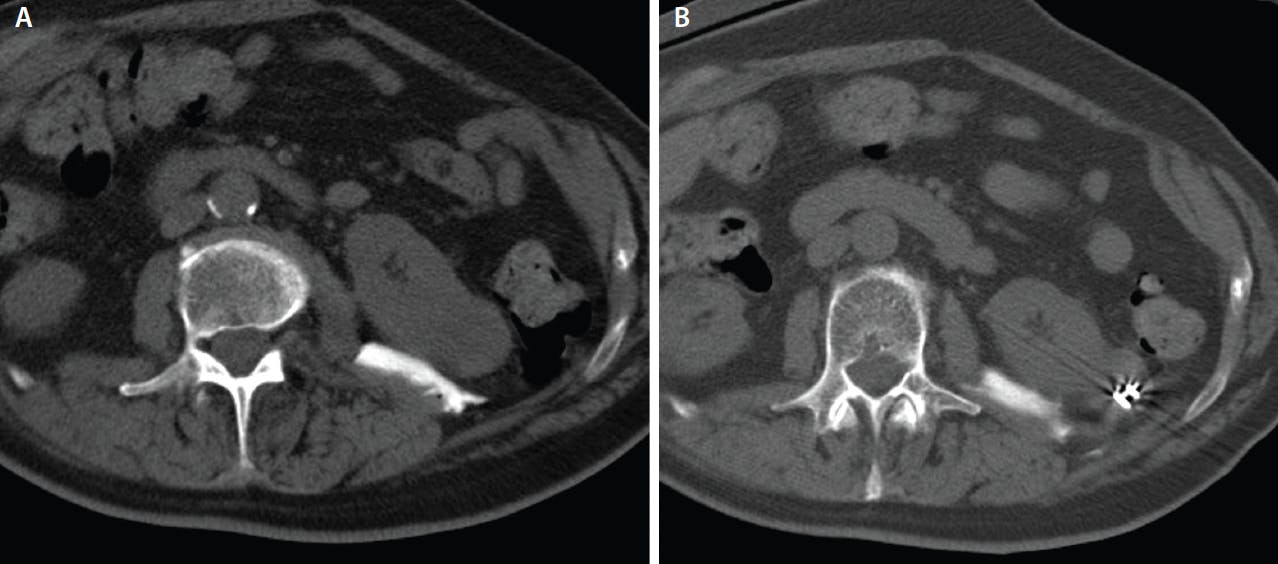
Figure 4. Ultrasound- and CT-guided quadratus lumborum block. Under ultrasound guidance, a 22-gauge needle was advanced between the quadratus lumborum and erector spinae muscles. Injection of a small volume of dilute contrast diffuses along the quadratus lumborum and between the posterior aspect of the kidney (A). Local anesthetic dosage of 15 to 20 mL of 0.25% bupivacaine was then performed. Two Neuwave PR XT probes (Ethicon, a Johnson & Johnson company) course through the exophytic posterior renal mass with dilute contrast noted along the inferior margin of the quadratus lumborum muscle (B).
Like all nerve block techniques, understanding of the anatomy is critical and well described in the literature. We are proponents of the three-layered model of the thoracolumbar fascia. The posterior thoracolumbar fascia layer surrounds the erector spinae muscles, the middle layer passes between the erector spinae muscles and quadratus lumborum, and the anterior layer lies anterior to both quadratus lumborum and psoas muscles.37 Lateral, posterior, and anterior quadratus lumborum block approaches have been described in the literature.
Patient positioning is dependent on the approach utilized, but we typically have the patient in a prone oblique position and favor a posterior in-plane approach using an anterior-to-posterior or posterior-to-anterior trajectory. Using a high-frequency linear ultrasound and a 22-gauge, 5- to 7-inch spinal needle, local anesthetic is injected on the posterior surface of the quadratus lumborum muscle between the quadratus lumborum and erector spinae muscles.37
Similarly, for the lateral in-plane approach, a needle is inserted lateral to the ultrasound transducer with an anterior-to-posterior needle trajectory.37 Local anesthetic is deposited at the lateral border of quadratus lumborum muscle after the needle tip penetrates the transversus abdominis aponeurosis.38
Anterior quadratus lumborum block can be performed using an in-plane approach with a needle insertion medial to the ultrasound transducer using a posterior-to-anterior or anterior-to-posterior trajectory.37,39 Another option is the subcostal oblique anterior approach with the needle insertion caudal to the transducer with an in-plane, caudal-lateral to cranial-medial trajectory.37 The point of injection of local anesthetic lies in the tissue plane between the quadratus lumborum and psoas muscles.37-41 These variants differ in the needle trajectory used (anterior-to-posterior, posterior-to-anterior, caudal-to-cranial), but have the same plane of injection.37
Local anesthetic dosage between 15 and 20 mL of 0.25% bupivacaine or 0.5% ropivacaine is recommended on the affected side. At present, there is insufficient evidence to recommend one approach and transducer positioning over another for individual patient populations and specific surgical types.37
Potential risks of the procedure include prolonged motor block, delaying mobilization and hospital discharge.37 Lower limb weakness has been reported after use of all quadratus lumborum block approaches.42,43 Hypotension has been reported, which may be secondary to local anesthetic spread to the paravertebral space.44 Proximity of the quadratus lumborum block to the pleura and kidney in the subcostal anterior approach presents a risk because of direct needle trauma.45 Risks of bleeding complications are not yet known.
CONCLUSION
The incorporation of nerve block and regional anesthesia techniques in ablation procedures has been shown to be beneficial for a multitude of reasons, including the ability to perform ablations of higher intensity (such as larger lesions or in challenging locations), improved periprocedural comfort, reduced overdose-related complications, and faster patient recovery and discharge. The decrease in requirement for general anesthesia reduces strain on hospital resources and reduces infection risk associated with aerosol-generating medical procedures.
The key regional nerve block techniques described may be used to reduce periprocedural pain during percutaneous ablation and interventional radiology practice. These regional anesthesia techniques improve patient satisfaction and technical success and should be utilized when feasible.
1. Tatl S, Tapan U, Morrison PR, et al. Radiofrequency ablation: technique and clinical applications. Diagn Interv Radiol. 2012;18:508-516. doi: 10.4261/1305-3825.DIR.5168-11.1
2. Lencioni R, Cioni D, Lera J, et al. Radiofrequency ablation: principles and techniques. In: Lencioni R, Cioni D, Bartolozzi C, eds. Focal Liver Lesions. Detection, Characterization, Ablation. Springer Verlag; 2005:307-316.
3. Beermann M, Lindeberg J, Engstrand J, et al. 1000 consecutive ablation sessions in the era of computer assisted image guidance—lessons learned. Eur J Radiol Open. 2018;6:1-8. doi: 10.1016/j.ejro.2018.11.002
4. Liu D, Hadjivassiliou A, Valenti D, et al. Optimizing nerve block techniques while performing percutaneous hepatic ablation: literature review and practical use. J Interv Med. 2020;3:161-166. doi: 10.1016/j.jimed.2020.06.002
5. Midia M, Dao D. The utility of peripheral nerve blocks in interventional radiology. AJR Am J Roentgenol. 2016;207:718-730. doi: 10.2214/AJR.16.16643
6. El-Boghdadly K, Pawa A, Chin KJ. Local anesthetic systemic toxicity: current perspectives. Local Reg Anesth. 2018;11:35-44. doi: 10.2147/LRA.S154512
7. Mizuno K, Ueono Y. Autonomic nervous system and the liver. Hepatol Res. 2017;47:160-165. doi: 10.1111/hepr.12760
8. Loukas M, Klaassen Z, Merbs W, et al. A review of thoracic splanchnic nerves and celiac ganglia. Clin Anat. 2010;23:512-522. doi: 10.1002/ca.20964
9. Berthoud HR. Anatomy and function of sensory hepatic nerves. Anat Rec A Discov Mol Cell Evol Biol. 2004;280:827-835. doi: 10.1002/ar.a.20088
10. Jensen KJ, Alpini G, Glaser S. Hepatic nervous system and neurobiology of the liver. Comp Physiol. 2013;3:655-665. doi: 10.1002/cphy.c120018
11. Cervero F. Visceral nociception: peripheral and central aspects of visceral nociceptive systems. Philos Trans R Soc Lond B Sci. 1985;308:325-337. doi: 10.1098/rstb.1985.0033
12. Kawarada Y, Das BC, Taoka H. Anatomy of the hepatic hilar area: the plate system. J Hepatobiliary Pancreat Surg. 2000;7:580-586. doi: 10.1007/s005340070007
13. Kirkpatrick JJ, Foutz S, Leslie SW. Anatomy, abdomen and pelvis, kidney nerves. In: StatPearls. StatPearls Publishing; 2020.
14. DiBona GF, Kopp UC. Neural control of renal function. Physiol Rev. 1997;77:75-197. doi: 10.1152/physrev.1997.77.1.75
15. Becker BK, Zhang D, Soliman R, et al. Autonomic nerves and circadian control of renal function. Auton Neurosci. 2019;217:58-65. doi: 10.1016/j.autneu.2019.01.003
16. Maeda S, Kuwahara-Otani S, Tanaka K, et al. Origin of efferent fibers of the renal plexus in the rat autonomic nervous system. J Vet Med Sci. 2014;76:763-765. doi: 10.1292/jvms.13-0617
17. Burke M, Pabbidi MR, Farley J, et al. Molecular mechanisms of renal blood flow autoregulation. Curr Vasc Pharmacol. 2014;12:845-858. doi: 10.2174/15701611113116660149
18. Abbott PJ Jr, Sullivan G. Cardiovascular toxicity following preincisional intra-articular injection of bupivicaine. Arthroscopy. 1997;13:282. doi: 10.1016/s0749-8063(97)90177-8
19. Heath ML. Bupivicaine toxicity and bier blocks. Anesthesiology. 1983;59:481. doi: 10.1097/00000542-198311000-00028
20. Patel I, Pirasteh A, Passalacqua M, et al. Palliative procedure for the interventional oncologist. AJR Am J Roentgenol. 2013;201:726-735. doi: 10.2214/AJR.12.9732
21. Kambadakone A, Thabet A, Gervais DA. CT-guided celiac plexus neurolysis: a review of anatomy, indications, technique and tips for successful treatment. Radiographics. 2011;31:1599-1621. doi: 10.1148/rg.316115526
22. Ahmed A, Arora D. Fluoroscopy-guided neurolytic splanchnic nerve block for intractable pain from upper abdominal malignancies in patients with distorted celiac axis anatomy: an effective alternative to celiax plexus neurolysis—a retrospective study. Indian J Palliat Care. 2017;23:274-281. doi: 10.4103/IJPC.IJPC_28_17
23. Campbell C, Lubner MG, Hinshaw JL, et al. Contrast media-doped hydrodissection during thermal ablation: optimizing contrast media concentration for improved visibility on CT images. AJR Am J Roentgenol. 2012;199:677-682. doi: 10.2214/AJR.11.7999
24. DeBenedectis CM, Beland MD, Dupuy DE, et al. Utility of iodinated contrast medium in hydrodissection fluid when performing renal tumor ablation. J Vasc Interv Radiol. 2010;21:745-747. doi: 10.1016/j.jvir.2010.01.022
25. Liu CH, Yu CY, Chang WC, et al. Computed tomographic-guided percutaneous radiofrequency ablation with hydrodissection of hepatic malignancies in the subcapsular location: evaluation of safety and technical efficacy. J Chin Med Assoc. 2016;79:93-100. doi: 10.1016/j.jcma.2015.07.013
26. Waldman SD, Feldstein GS, Donohoe CD, Waldman KA. The relief of body wall pain secondary to malignant hepatic metastases by intercostal nerve block with bupivacaine and methylprednisolone. J Pain Symptom Manage. 1988;3:39-43. doi: 10.1016/0885-3924(88)90136-4
27. Culp WC Jr, Culp WC. Thoracic paravertebral block for percutaneous transhepatic biliary drainage. J Vasc Intervent Radiol. 2005;16:1397-1400. doi: 10.1097/01.RVI.0000174285.84995.7F
28. Culp WC, McCowan TC, DeValdenebro M. Paravetebral block: an improved method of pain control in percutaneous transhepatic biliary drainage. Cardiovasc Intervent Radiol. 2006;29:1015-1021. doi: 10.1007/s00270-005-0273-z
29. Hall H, Leach A. Paravetebral block in the management of liver capsule pain after blunt trauma. Br J Anaesth. 1999;83:819-821. doi: 10.1093/bja/83.5.819
30. Gulati A, Shah R, Puttanniah V, et al. A retrospective review and treatment paradigm of interventional therapies for patients suffering from intractable thoracic chest wall pain in the oncologic population. Pain Med. 2015;16:802-810. doi: 10.1111/pme.12558
31. Zhang Y, Duan F, Ma W. Ultrasound-guided phrenic nerve block for intraoperative persistent hiccups: a case report. BMC Anesthesiol. 2013;18:123. doi: 10.1186/s12871-018-0589-2
32. Espinosa W, Liu YW, Wang CC. Combined resection and radiofrequency ablation versus transarterial embolization for intermediate stage hepatocellular carcinoma: a propensity score matching study. J Formos Med Assoc. 2018;117:197-203. doi: 10.1016/j.jfma.2017.03.014
33. Huang ZM, Zuo MX, Gu YK. Computed tomography-guided radiofrequency ablation combined with transarterial embolization assisted by a three-dimensional visualization ablation planning system for hepatocellular carcinoma in challenging locations: a preliminary study. Abdom Radiol (NY). 2020;45:1181-1192. doi: 10.1007/s00261-020-02426-5
34. Yamada R, Bassaco B, Dufour L. Safety and efficacy of combined transarterial embolization and percutaneous radiofrequency ablation for liver tumors using cone beam CT and needle navigation software in a single session. J Vasc Interv Radiol. 2019;30:390-395. doi: 10.1016/j.jvir.2018.11.015
35. Yuan Z, Wang Y, Hu C. Efficacy of percutaneous thermal ablation combined with arterial embolization for recurrent hepatocellular carcinoma after hepatectomy and a prognostic nomogram to predict survival. Technol Cancer Res Treat. Published online January 1, 2018. doi: 10.1177/1533033818801362
36. Powell MF. Stability of lidocaine in aqueous solution: effect of temperature, pH, buffer and metal ions on amide hydrolysis. Pharm Res. 1987;4:42-45. doi: 10.1023/a:1016477810629
37. Elsharkawy H, El-Boghdadly K, Barrington M. Quadratus lumborum block: anatomical concepts, mechanisms, and techniques. Anesthesiology. 2019;130:322-335. doi: 10.1097/ALN.0000000000002524
38. Børglum J, Gögenür I, Bendtsen TF. Abdominal wall blocks in adults. Curr Opin Anaesthesiol. 2016;29:638-643. doi: 10.1097/ACO.0000000000000378
39. Dam M, Hansen CK, Børglum J, et al. A transverse oblique approach to the translumbar quadratus lumborum block. Anaesthesia. 2016;71:603-604. doi: 10.1111/anae.13453
40. Hansen CK, Dam M, Bendtsen TF, et al. Ultrasound-guided quadratus lumborum blocks: definition of the clinical relevant endpoint of injection and the safest approach. A A Case Rep. 2016;6:39. doi: 10.1213/XAA.0000000000000270
41. Elsharkawy H. Quadratus lumborum block with paramedian sagittal oblique (subcostal) approach. Anaesthesia. 2016;7:241-242. doi: 10.1111/anae.13371
42. Ueshima J, Hiroshi O. Incidence of lower-extremity muscle weakness after quadratus lumborum block. J Clin Anesth. 2018;44:104. doi: 10.1016/j.jclinane.2017.11.020
43. Wikner M. Unexpected motor weakness following quadratus lumborum block for gynaecological laparoscopy. Anaesthesia. 2017;72:230-232. doi: 10.1111/anae.13754
44. Sá M, Cardoso JM, Reis H, et al. Quadratus lumborum block: are we aware of its side effects? A report of 2 cases. Braz J Aneshtesiol. 2018;68:396-399. doi: 10.1016/j.bjan.2017.04.023
45. Elsharkawy H, El-Boghdadly K, Kolli S, et al. Injectate spread following anterior subcostal and posterior approaches to the quadratus lumborum block: a comparative cadaveric study. Eur J Anaesthesiol. 2017;34:587-595. doi: 10.1097/EJA.0000000000000680
Advertisement
Advertisement