Advertisement
Advertisement
September 2021
The Near Future of Antiproliferative Therapy for Femoropopliteal Disease
Discussing the methods of vascular drug delivery in the treatment of SFA lesions.
Vascular drug delivery has revolutionized the treatment of obstructive atherosclerosis throughout the circulation.1 In the superficial femoral artery (SFA), restenosis rates of 30% to 50% at 1 year for percutaneous transluminal angioplasty and stenting2 were remarkably reduced by the advent of local drug delivery with the introduction of drug-eluting stents (DESs), such as the Zilver PTX (Cook Medical),3 and drug-coated balloons (DCBs), such as Lutonix (BD Interventional).4 Interestingly, both devices present a large “bolus” of paclitaxel to the vascular wall at deployment, and the physicochemical properties of paclitaxel permit avid binding of the drug to the vessel, resulting in therapeutic concentrations of paclitaxel in the media.
Although there have been attempts in delivery of sirolimus and other similar compounds for the inhibition of intimal hyperplasia in the peripheral arteries, early clinical data, such as in the STRIDES and SIROCCO trials,5-8 have not translated into clinical or commercial success, whereas the experience with paclitaxel has been extremely promising, as demonstrated by the Zilver, Lutonix, and In.Pact (Medtronic) devices.2-4 This is widely thought to be caused by difficulty achieving therapeutic concentrations of sirolimus and its analogues due to the physicochemical properties of these drugs compared to paclitaxel.
Against this backdrop, it seems clear that the future of antiproliferatives for the SFA will focus on enhancements in device coating materials that will improve the efficiency of drug delivery and the development of “new” antiproliferative agents, principally sirolimus and its analogues. This article discusses the recent advances and speculates on future directions for this technology in the treatment of SFA lesions.
THE DEVICE COATING
Optimal drug delivery and retention are governed by the engineering of the drug-eluting device. In the case of DCBs, drug delivery is controlled by the properties of the coating and density of the antiproliferative drug applied.9 The properties of the coating in turn are impacted by the excipient and manufacturing process of the balloons. Some first-generation paclitaxel DCBs used highly crystalline drug formulations to essentially load the artery with crystalline paclitaxel, which then gradually diffuses into the media to achieve therapeutic levels of the drug in the vascular wall via specific and nonspecific binding. These formulations also result in a high number of coating particles in the vessel after treatment.10-13 However, concerns regarding macroparticle shedding and distal embolization in critical limb ischemia or below-the-knee lesions has also been raised as a theoretical concern.14,15 Newer-generation DCBs have reduced the crystallinity of paclitaxel and introduced a more amorphous drug. Such modifications subsequently led to improved vascular drug delivery efficiency and reduced particle shedding and distal embolization.16 Amorphous paclitaxel DCBs have more efficient transfer of antiproliferative therapy to the target lesion compared to highly crystalline forms. This partially explains why the total drug concentration of paclitaxel administered is less on newer-generation DCBs with similar levels of clinical efficacy.
Additional advances between first- and newer-generation DCBs include balloon coating techniques. Original DCBs were manually coated, which resulted in nonuniform application of an antiproliferative drug, especially in the folds of the balloon. Inconsistent distribution of antiproliferative drug over the balloon surface results in uneven distribution, particularly at the proximal and distal edges of DCB application.16 Newer-generation DCBs achieve more homogenous drug distribution using semiautomatic syringe deposition, among other techniques.16 Taken together, these iterative improvements seem to effectively improve therapeutic drug concentrations in treated patients with resultant improved clinical outcomes (Figure 1).
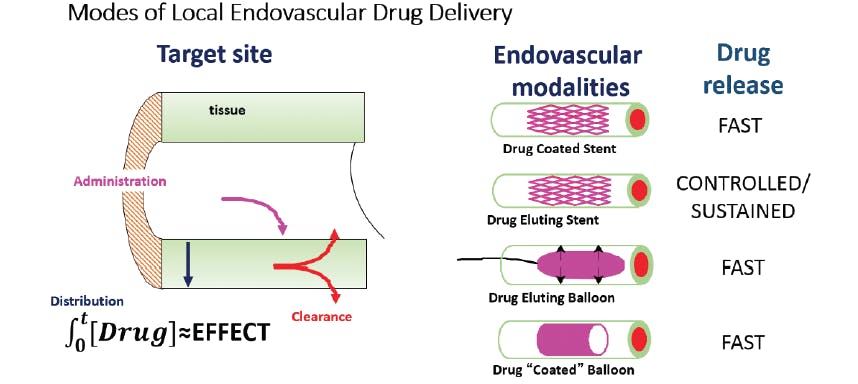
Figure 1. Most available devices for local drug delivery to the arterial wall administer drug from the lumen into the arterial wall. The drug diffuses into the media from the luminal interface and binds selectively and nonselectively. The drug can be administered rapidly as with drug coated stents which have no polymer release vehicle, drug-eluting balloons, which pressure perfuse drug into the arterial wall, or DCB, which use an excipient and drug combination that are released upon balloon dilation. DES are able to slowly release drug into the artery using a polymer that gradually degrades and frees drug to diffuse into the artery. Variations on these themes will continue to dominate drug delivery in peripheral vascular intervention in the foreseeable future.
The COMPARE study represents an important head-to-head comparison between higher-dose (In.Pact Admiral or In.Pact Pacific [Medtronic], paclitaxel dose density of 3.5 µg/mm2) and lower-dose DCB (Ranger [Boston Scientific Corporation], paclitaxel dose density of 2.0 µg/mm2).17 The study was a prospective, multicenter, randomized controlled trial (RCT) that included 414 patients with Rutherford class 2 to 4 symptoms. Lesions were stratified according to length: short (≤ 100 mm), moderate (100-200 mm), or long (200-300mm). Average lesion length was almost 130 mm. Over one-third of the patients had total occlusions and over one-half had moderate to severe calcification. The primary patency at 12 months for the high- and low-dose DCB were similar, 81.5% versus 83%, respectively, and met significance for noninferiority (P < .01). Additionally, the primary safety endpoint, which was defined as composite of freedom from device- or procedure-related death at 30 days plus any 12-month target lesion revascularization (TLR), met criteria for nonsignificance between high-dose DCB and low-dose DCB (92.6% vs 91.0%, P < .01, respectively). Twelve-month mortality for the high-dose DCB arm was 1.6% and 2.5% for the low-dose DCB arm (P < .73).18 Although both balloons performed well, suggesting similar steady state drug concentrations in the vascular wall, the similar results seen in the COMPARE trial suggest that improved drug delivery efficacy of the low-dose DCB coupled with manufacturing refinements can result in the ability to achieve similar therapeutic drug concentrations with less drug (ie, improved drug delivery efficiency). Future devices will likely leverage these lessons learned.
THE DRUG
Sirolimus and its analogues dominate the coronary DES market to the extent that paclitaxel-eluting stents are no longer available in the United States. This market domination was borne out of extensive clinical data suggesting superior therapeutic efficacy of -limus agents compared to paclitaxel when delivered from polymeric DESs.19 However, SFA antiproliferative therapies have been predominantly paclitaxel-based. The biologic efficacy of -limus drugs seems beyond reproach in coronary intervention; however, as we have learned repeatedly, the coronary analogy does not perfectly apply to the SFA and other peripheral arteries. The pharmacokinetics and pharmacodynamics of drug delivery in the elastic, large-caliber peripheral arteries is a far cry from that of the muscular, smaller-caliber coronary arteries. Despite the early commercial success of paclitaxel-eluting products in the SFA and perhaps in part due to the paclitaxel mortality controversy, research and development of sirolimus delivery devices has taken significantly more time, but promising new technologies are only now beginning to appear.
As with many novel drug delivery systems, modification of the drug and/or alteration of the delivery vehicle is needed to achieve therapeutic concentrations of sirolimus in vascular tissue in preclinical models.20 These modifications have come in a few ways but seemingly are coalescing around the ability to use nanoparticles to encapsulate the hydrophobic drug sirolimus and achieve better target tissue delivery. This has resulted in two products now on the near horizon for clinical investigation.
The Selution SLR drug delivery system (MedAlliance) was specifically developed to overcome challenges of sirolimus drug delivery. The DCB is composed of sirolimus coupled with four unique excipients that create sirolimus nanoparticles housed in reservoirs admixed with a slowly dissolving excipient, resulting in therapeutic drug levels in preclinical models out to 60 days.21 In human trials, the Selution SLR DCB has been used in femoropopliteal lesions. In the first-in-human trial, the Selution SLR DCB was studied in 50 patients with Rutherford class 2 to 3 peripheral artery disease in Germany, with enrollment in 2016 to 2017 and results published in 2020. The primary objective of the study was to compare angiographic late lumen loss (LLL) to an objective performance goal (OPG) of 1.04 mm LLL. Supporting the biologic efficacy of sirolimus, the median LLL at follow-up was 0.19 mm with a mean of 0.29 ± 0.84 mm with a P < .001 for significant reduction against the OPG. However, the data support that a biologic signal exists and that sirolimus, when administered properly, can in fact reduce neointimal hyperplasia in the SFA and set the stage for a planned investigational device exemption RCT, which is expected to begin within the next 12 months in the United States.
Another approach at overcoming the sirolimus drug delivery conundrum entails the use of nanoparticles of sirolimus. The MagicTouch sirolimus-coated balloon system (Concept Medical) relies upon nanoparticle encapsulation of drugs in a phospholipid bilayer, which are then coated onto a balloon for drug delivery.22 This device has European CE Mark approval for coronary and peripheral use and has been studied in limited registries and small RCTs outside of the United States. Notably, the device is being developed and has been studied both in coronary in-stent restenosis,23 peripheral de novo disease,24 and arteriovenous fistulas.25 As with the Selution SLR system, clinical data in each lesion subset demonstrate biologic plausibility of sirolimus delivery via DCB with therapeutic effect. As such, forthcoming pivotal clinical trials in Europe (SIRONA) (NCT04475783),26 Asia (FUTURE SFA/BTK) (NCT04511234/NCT04511247), and the United States are planned.27,28
THE SCAFFOLD
DES have been a mainstay of endovascular therapy for femoropopliteal disease since the introduction of the Zilver PTX. Whereas the Zilver PTX is composed of a paclitaxel-coated design that had a relatively short elution period with a polymer-free design,29 the Eluvia DES (Boston Scientific Corporation) has polymeric drug delivery of paclitaxel with a biostable fluorinated polymer that permits a lower drug density (0.167 µg/mm2) to elute over nearly a year. The IMPERIAL study, which has since led to FDA approval of the Eluvia stent, provided an essential comparison between two paclitaxel DES systems: one with polymer coating (Eluvia) and one without (Zilver PTX). This multicenter study randomized 465 patients with native SFA or proximal popliteal artery lesions with stenosis of at least 70% by visual angiographic assessment 2:1 to Eluvia or Zilver PTX. Primary patency assessed by duplex ultrasound was determined to be 86.8% with Eluvia and 81.5% with Zilver PTX, meeting the primary endpoint of noninferiority, as well as for superiority based on a prespecified post hoc analysis. Looking at the primary safety endpoint (major adverse events; all-cause death through 1 month and target limb major amputation and TLR through 1 year), Eluvia was noninferior to Zilver PTX (4.9% vs 9.0%). It was also reported that there were numerically but nonsignificantly lower rates of TLR (4.5% vs 9.0% P = .0672) and stent thrombosis (1.7% vs 4.0% P = .1956) in the Eluvia arm.30,31 At 2 years, the TLR rate was significantly lower for Eluvia (12.7% vs 20.1% P = .0495) and primary patency rates were similar for both stents (83.0% for Eluvia vs 77.1% for Zilver PTX; P = .1008). Therefore, IMPERIAL follow-up at 2 years showed the Eluvia system to beneficial in reducing the need for repeat revascularization compared to Zilver PTX.32 Despite Eluvia’s advantages in the trial, it should be noted that the data are limited to 2 years at this time, while Zilver PTX has shown efficacy and safety up to 5 years.33
Although polymer-based drug delivery upon metallic scaffolds has been the predominant paradigm in the femoropopliteal artery, emerging studies with bioresorbable scaffolds (BRSs) offered renewed hope for this once promising technology. Perhaps the most notable early experience with bioresorbable technology in the femoropopliteal circulation, the ESPRIT 1 study evaluated the role of the Absorb BVS platform (Abbott) in the external iliac artery and SFA. In a small cohort of patients (N = 32; 88% in the SFA), binary restenosis was noted to be 12.1% at 12 months and 16.1% at 24 months with TLR rates of 8.8% and 11.8%, respectively. Although the technology was never brought forward, the feasibility of a balloon-expandable femoropopliteal BRS was demonstrated. More recently, Efemoral Medical has initiated the Efemoral 1 trial (NCT04584632). This study is examining the safety and feasibility of the Efemoral vascular scaffold system (Efemoral Medical), which is a polymeric platform with sirolimus-eluting properties in femoropopliteal lesions. Initial patient enrollment has been completed, and preliminary data are pending. However, this may herald a resurgence of interest in BRSs for SFA applications, and the lessons learned from early experience with both paclitaxel and -limus agents will no doubt be applied.
CONCLUSION
The role of local vascular drug delivery is central in the development of new endovascular therapies. Although paclitaxel has heretofore been the dominant drug in both DCBs and DESs, sirolimus and its analogues are now rapidly being developed in both DCB and DES platforms. With the paclitaxel mortality crisis cooling, it stands to reason that the field must insist upon high-quality science to lead the way to new therapeutic paradigms. Head-to-head RCTs would be optimal in approval of new technologies wherein the current standard of care is compared to the next generation of devices. The future for these new technologies remains bright, and the unmet need has never been higher.
1. Marlevi D, Edelman ER. Vascular lesion-specific drug delivery systems: JACC state-of-the-art review. J Am Coll Cardiol. 2021;77:2413-2431. doi: 10.1016/j.jacc.2021.03.307
2. Schillinger M, Sabeti S, Loewe C, et al. Balloon angioplasty versus implantation of nitinol stents in the superficial femoral artery. N Engl J Med. 2006;354:1879-1888. doi: 10.1056/NEJMoa051303
3. Dake MD, Ansel GM, Jaff MR, et al. Paclitaxel-eluting stents show superiority to balloon angioplasty and bare metal stents in femoropopliteal disease: twelve-month Zilver PTX randomized study results. Circ Cardiovasc Interv. 2011;4:495-504. doi: 10.1161/CIRCINTERVENTIONS.111.962324
4. Rosenfield K, Jaff MR, White CJ, et al. Trial of a paclitaxel-coated balloon for femoropopliteal artery disease. N Engl J Med. 2015;373:145-153. doi: 10.1056/NEJMoa1406235
5. Lammer J, Bosiers M, Zeller T, et al. First clinical trial of nitinol self-expanding everolimus-eluting stent implantation for peripheral arterial occlusive disease. J Vasc Surg. 2011;54:394-401. doi: 10.1016/j.jvs.2011.01.047
6. Lammer J, Scheinert D, Vermassen F, et al. Pharmacokinetic analysis after implantation of everolimus-eluting self-expanding stents in the peripheral vasculature. J Vasc Surg. 2012;55:400-405. doi: 10.1016/j.jvs.2011.08.048
7. Duda SH, Bosiers M, Lammer J, et al. Drug-eluting and bare nitinol stents for the treatment of atherosclerotic lesions in the superficial femoral artery: long-term results from the SIROCCO trial. J Endovasc Ther. 2006;13:701-710. doi: 10.1583/05-1704.1
8. Duda SH, Pusich B, Richter G, et al. Sirolimus-eluting stents for the treatment of obstructive superficial femoral artery disease: six-month results. Circulation. 2002;106:1505-1509. doi: 10.1161/01.cir.0000029746.10018.36
9. Li J, Tzafriri R, Patel SM, Parikh SA. Mechanisms underlying drug delivery to peripheral arteries. Interv Cardiol Clin. 2017;6:197-216. doi: 10.1016/j.iccl.2016.12.004
10. Milewski K, Afari ME, Tellez A, et al. Evaluation of efficacy and dose response of different paclitaxel-coated balloon formulations in a novel swine model of iliofemoral in-stent restenosis. JACC Cardiovasc Interv. 2012;5:1081-1088. doi: 10.1016/j.jcin.2012.06.012
11. Buszman PP, Nowakowski P, Milewski K, et al. Clinical randomized trial evaluating novel, microcrystalline, and biocompatible polymer paclitaxel-coated balloon for the treatment of femoropopliteal occlusive disease: the BIOPAC trial. JACC Cardiovasc Interv. 2018;11:2436-2438. doi: 10.1016/j.jcin.2018.07.029
12. Radke PW, Joner M, Joost A, et al. Vascular effects of paclitaxel following drug-eluting balloon angioplasty in a porcine coronary model: the importance of excipients. EuroIntervention. 2011;7:730-737. doi: 10.4244/EIJV7I6A116
13. Cremers B, Speck U, Kaufels N, et al. Drug-eluting balloon: very short-term exposure and overlapping. Thromb Haemost. 2009;101:201-206.
14. Yazdani SK, Pacheco E, Nakano M, et al. Vascular, downstream, and pharmacokinetic responses to treatment with a low dose drug-coated balloon in a swine femoral artery model. Catheter Cardiovasc Interv. 2014;83:132-140. doi: 10.1002/ccd.24995
15. Zeller T, Beschorner U, Pilger E, et al. Paclitaxel-coated balloon in infrapopliteal arteries: 12-month results from the BIOLUX P-II randomized trial (BIOTRONIK’S-first in man study of the Passeo-18 LUX drug releasing PTA balloon catheter vs. the uncoated Passeo-18 PTA balloon catheter in subjects requiring revascularization of infrapopliteal arteries). JACC Cardiovasc Interv. 2015;8:1614-1622. doi: 10.1016/j.jcin.2015.07.011
16. Buszman PP, Tellez A, Afari ME, et al. Tissue uptake, distribution, and healing response after delivery of paclitaxel via second-generation iopromide-based balloon coating: a comparison with the first-generation technology in the iliofemoral porcine model. JACC Cardiovasc Interv. 2013;6:883-890. doi: 10.1016/j.jcin.2013.04.013
17. Steiner S, Schmidt A, Zeller T, et al. COMPARE: prospective, randomized, non-inferiority trial of high- vs. low-dose paclitaxel drug-coated balloons for femoropopliteal interventions. Eur Heart J. 2020;41:2541-2552. doi: 10.1093/eurheartj/ehaa049
18. COMPARE: Similar efficacy and safety for paclitaxel balloons regardless of dose. McKeown LA. January 28, 2020. www.tctmd.com/news/compare-similar-efficacy-and-safety-paclitaxel-balloons-regardless-dose
19. Palmerini T, Benedetto U, Biondi-Zoccai G, et al. Long-term safety of drug-eluting and bare-metal stents: evidence from a comprehensive network meta-analysis. J Am Coll Cardiol. 2015;65:2496-507. doi: 10.1016/j.jacc.2015.04.017
20. Vargason AM, Anselmo AC, Mitragotri S. The evolution of commercial drug delivery technologies. Nat Biomed Eng. Published online April 1, 2021. doi: 10.1038/s41551-021-00698-w
21. Zeller T, Brechtel K, Meyer DR, et al. Six-month outcomes from the first-in-human, single-arm SELUTION sustained-limus-release drug-eluting balloon trial in femoropopliteal lesions. J Endovasc Ther. 2020;27:683-690. doi: 10.1177/1526602820941811
22. Lemos PA, Farooq V, Takimura CK, et al. Emerging technologies: polymer-free phospholipid encapsulated sirolimus nanocarriers for the controlled release of drug from a stent-plus-balloon or a stand-alone balloon catheter. EuroIntervention. 2013;9:148-156. doi: 10.4244/EIJV9I1A21
23. El-Mokdad R, di Palma G, Cortese B. Long-term follow-up after sirolimus-coated balloon use for coronary artery disease. Final results of the Nanolute study. Catheter Cardiovasc Interv. 2020;96:E496-E500. doi: 10.1002/ccd.28863
24. BLearning Peripheral. LINC 2020: XTOSI study interim findings suggest “highly promising” safety and efficacy of sirolimus DCB. Accessed August 31, 2020. https://blearning.net/sirolimus-dcb-safety/
25. Tang TY, Soon SXY, Yap CJQ, et al. Early (6 months) results of a pilot prospective study to investigate the efficacy and safety of sirolimus coated balloon angioplasty for dysfunctional arterio-venous fistulas: MAgicTouch Intervention Leap for Dialysis Access (MATILDA) Trial. PLoS One. 2020;15:e0241321. doi: 10.1371/journal.pone.0241321
26. Sirolimus- vs. Paclitaxel-Drug Coated Balloons in Patients With Peripheral Artery Disease (SIRONA). NCT04475783. Clinicaltrials.gov website. Accessed August 31, 2021. https://clinicaltrials.gov/ct2/show/NCT04475783
27. Sirolimus Coated Balloon Versus Standard Balloon for SFA and Popliteal Artery Disease (FUTURE-SFA). Clinicaltrials.gov website. Accessed August 31, 2021. https://www.clinicaltrials.gov/ct2/show/study/NCT04475783
28. SirolimUs CoaTed Balloon for The TrEatment of Below The Knee Arterial Disease (FUTURE-BTK). Clinicaltrials.gov website. Accessed August 31, 2021. https://clinicaltrials.gov/ct2/show/NCT04511247
29. Dake MD, Van Alstine WG, Zhou Q, Ragheb AO. Polymer-free paclitaxel-coated Zilver PTX Stents--evaluation of pharmacokinetics and comparative safety in porcine arteries. J Vasc Interv Radiol. 2011;22:603-610. doi: 10.1016/j.jvir.2010.12.027
30. Gray WA, Keirse K, Soga Y, et al. A polymer-coated, paclitaxel-eluting stent (Eluvia) versus a polymer-free, paclitaxel-coated stent (Zilver PTX) for endovascular femoropopliteal intervention (IMPERIAL): a randomised, non-inferiority trial. Lancet. 2018;392:1541-1551. doi: 10.1016/S0140-6736(18)32262-1
31. IMPERIAL: Eluvia tops Zilver PTX in battle of DES in femoropopliteal disease. Neale T. September 22, 2018. https://www.tctmd.com/news/imperial-eluvia-tops-zilver-ptx-battle-des-femoropopliteal-disease
32. Muller-Hulsbeck S, Benko A, Soga Y, et al. Two-year efficacy and safety results from the IMPERIAL randomized study of the Eluvia polymer-coated drug-eluting stent and the Zilver PTX polymer-free drug-coated stent. Cardiovasc Intervent Radiol. 2021;44:368-375. doi: 10.1007/s00270-020-02693-1
33. Dake MD, Ansel GM, Jaff MR, et al. Durable clinical effectiveness with paclitaxel-eluting stents in the femoropopliteal artery: 5-year results of the Zilver PTX randomized trial. Circulation. 2016;133:1472-1483. doi: 10.1161/CIRCULATIONAHA.115.016900
Advertisement
Advertisement