Advertisement
Advertisement
December 2022 Supplement
Sponsored by Surmodics™
Case Report: Novel Use of the Pounce™ Thrombectomy System for Acute Left Axillary Artery Thrombosis
Patient Presentation
A 71-year-old woman with a prior medical history of hypertension, hyperlipidemia, type 2 diabetes, and obstructive sleep apnea developed an abrupt onset of ischemic rest pain and numbness in her left hand and fingers. The emergency department obtained a CTA, which revealed a proximal axillary artery stenosis with a significant, moderate amount of proximal and large distal thrombus. She was started on intravenous heparin and prepped for a diagnostic intervention.
Diagnostic Findings
Right femoral access was obtained with a 5 Fr sheath and a .035 stiff angled Glidewire Advantage® Peripheral Guidewire. Arch angiography was performed with a pigtail catheter, which demonstrated a type 1 arch with no pathology. The pigtail catheter was then switched out for a 5 Fr JR4 catheter, which selectively engaged the left subclavian artery for diagnostic angiography. Diagnostic angiography revealed severe stenosis with presence of thrombus in the proximal left axillary artery (Figure 1). The procedural strategy was planned to initially remove the thrombus, look to dilate the target vessel using a drug-coated balloon (DCB), and then place a stent.
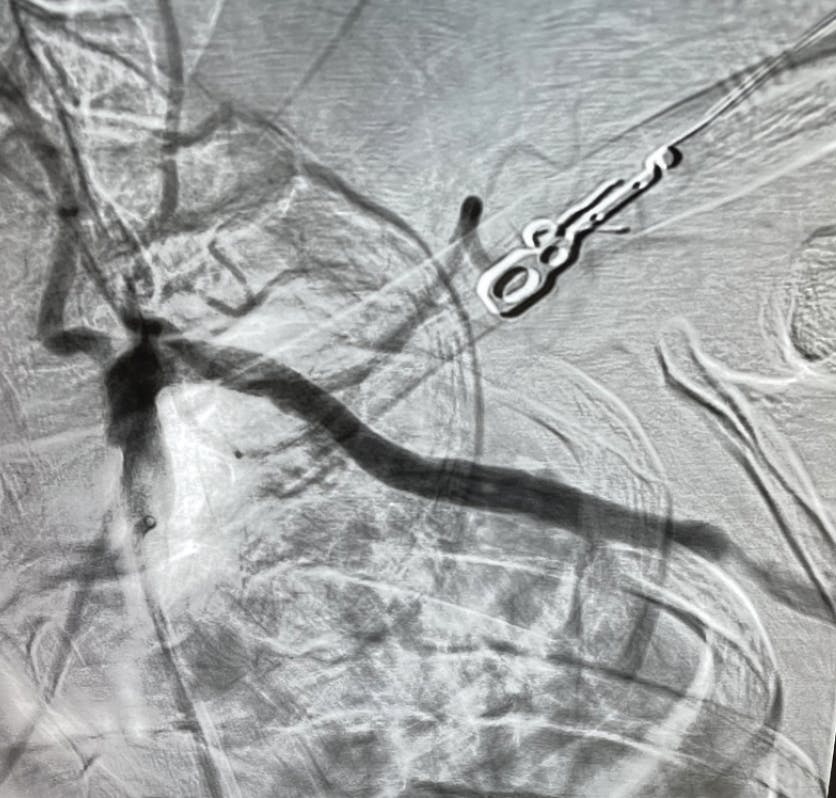
Figure 1. Diagnostic angiography from left subclavian artery.
Treatment
The 5 Fr JR4 catheter was replaced with a 7 Fr, 90 cm Flexor® Shuttle® Guiding Sheath. The thrombus was then crossed with a .035 stiff angled Glidewire Advantage® Peripheral Guidewire. The Pounce™ Thrombectomy System was prepped. The delivery catheter traversed the .035 stiff angled Glidewire Advantage® Peripheral Guidewire, the Glidewire was removed, and the basket wire was then delivered and positioned distal to the thrombus. The funnel catheter was inserted, and the funnel was positioned distal to the vertebral artery.
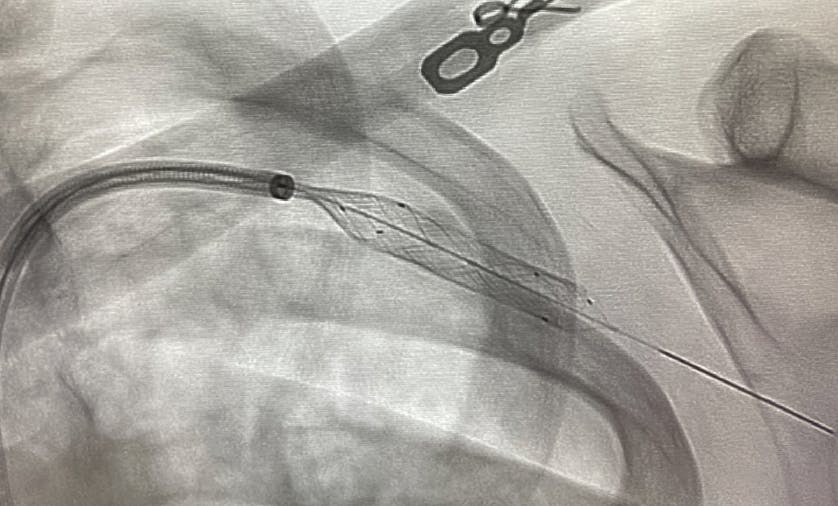
Figure 2. Pounce™ System baskets withdrawn into funnel. Note the distal basket markers located at the edge of the funnel.
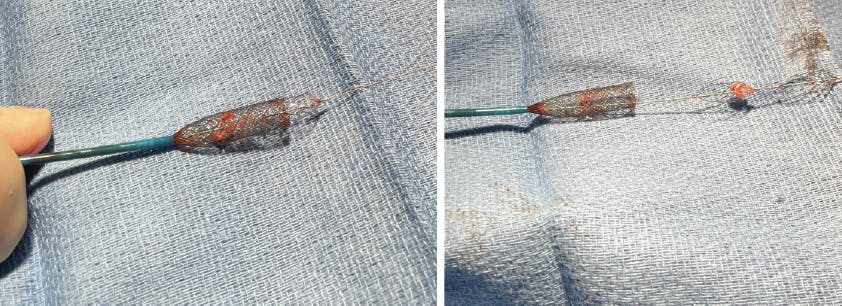
Figure 3. Clot removed after one Pounce™ System pass. (Used with permission of the author.)
After one pull back of the basket wire into the funnel (Figure 2), significant debris was removed (Figure 3). A .014 wire was placed, and an intravascular ultrasound was completed that demonstrated ruptured plaque and minimal wall-adherent thrombus remaining (Figure 4). The patient underwent a dilatation with a 6 mm X 40 mm IN.PACT™ Admiral™ Drug-Coated Balloon Catheter that was inflated to 7 atm. Final angiography was completed, showing minimal residual stenosis and normal runoff to the hand (Figure 5). The patient’s symptoms reversed on the table, revealing normal palpable radial pulses. The total procedure time was 55 minutes from access to closure.
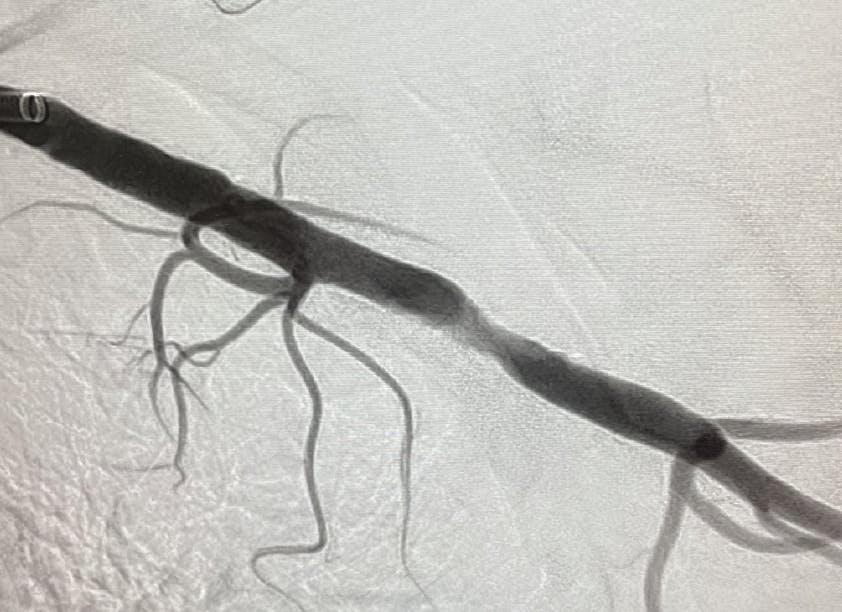
Figure 4. Post Pounce™ System pass.
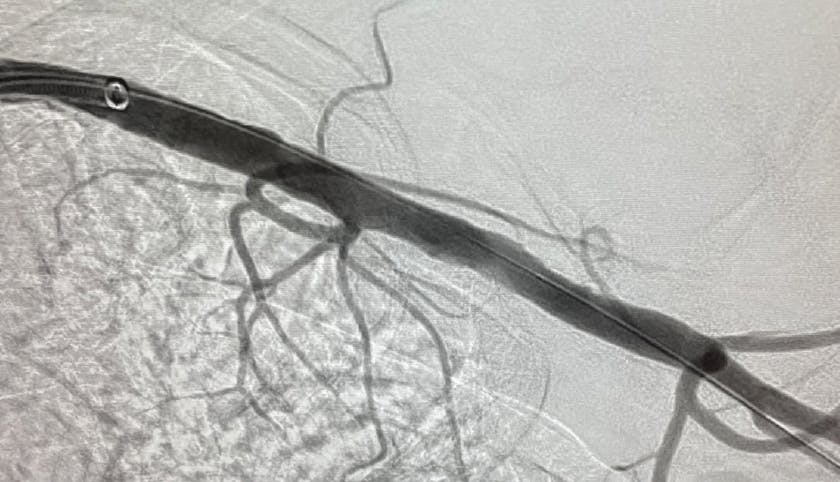
Figure 5. Post DCB final angiography.
Post Procedure Outcome
The patient was discharged the next morning on dual antiplatelet therapy after a normal motor and sensory examination.
The Pounce™ Thrombectomy System allowed for a complex clinical presentation to be treated simply and easily without the need for a brachial cutdown. There was no evidence of distal embolization. The patient returned to normal functional activity with no need for wound care or physical therapy.

Caution: Federal (US) law restricts the Pounce™ Thrombectomy System to sale by or on the order of a physician. Please refer to Instructions for Use for indications, contraindications, warnings, and precautions. SURMODICS, POUNCE, and SURMODICS and POUNCE logos are trademarks of Surmodics Inc., and/or its affiliates. Third-party trademarks are the property of their respective owners.
Advertisement
Advertisement