Advertisement
Advertisement
February 2022
STEP: A Platform Trial for Stroke Thrombectomy
The rationale and status of the StrokeNet endovascular thrombectomy platform proposal.
By Colin Derdeyn, MD; J Mocco, MD, MS; Tudor G. Jovin, MD; and Caitlyn Meinzer, PhD
The pivotal randomized trials of endovascular thrombectomy versus best medical therapy for patients with acute ischemic stroke and large vessel occlusion demonstrated a magnitude of benefit for treated patients that is among the largest observed in medicine. These trials have opened avenues for further study and improvement in multiple different domains. The first avenue is methods to achieve more complete and more rapid recanalization rates (eg, new devices, use of balloon guide catheters vs distal aspiration, pharmacologic adjuncts, general anesthesia). The second is the use of neuroprotection and other interventions aimed at mediating secondary or reperfusion injuries, as nearly half of treated patients still do not regain functional independence. The large number of neuroprotective drugs that failed in human trials during the 1990s might now be reevaluated because reperfusion of the brain likely makes their mechanism of action much more relevant. The third is to expand the indications for this therapy. The magnitude of benefit observed in trials performed to date suggests that many patients who were excluded from previous trials and consequently not covered in current guidelines could benefit from reperfusion as well. For many of these populations, the question centers on futility, not safety. Finally, the fourth is the development of better approaches to prehospital assessment and systems of care to get endovascular thrombectomy candidates to thrombectomy faster.
A major challenge for our stroke community is to figure out how to best answer these questions in the most efficient way possible. Our traditional approach, which involves multiple serial, independent, randomized trials with conventional 5-year timelines, will not answer these questions quickly or efficiently. Given the magnitude of benefit with this procedure, the failure to move quickly will have a direct adverse impact on patient outcome for years.
WHAT IS A PLATFORM TRIAL?
First developed for cancer chemotherapy, platform or master trials represent a new approach for these situations. They allow enrollment into multiple different arms and use novel statistic approaches (Bayesian prediction models, response-adaptive randomization schemes) to allow these arms to be terminated early for futility or benefit, new arms to be added, and, potentially, for information to be shared across treatment arms. For example, any given patient with any given type of cancer would be enrolled into one of several different experimental arms or in the control group. These patients can serve as controls for multiple different arms. In addition, trial infrastructure at clinical sites and for central administration does not shut down at the conclusion of a study arm. This creates great flexibility and efficiency in terms of resource use and time to conclusion. Because of its success in oncology, platform trials have begun in other diseases as well, such as amyotrophic lateral sclerosis and chronic pain.
NATIONAL INSTITUTES OF HEALTH NOTICE OF SPECIAL INTEREST
This past summer, the National Institutes of Health (NIH) National Institute of Neurological Disorders and Stroke issued a notice of special interest (NOSI) for establishing an endovascular thrombectomy platform trial as a module within the NIH-funded StrokeNet. The specific areas of focus included (1) trials to expand therapeutic indications of endovascular thrombectomy, (2) trials of innovative adjunctive therapies added to endovascular thrombectomy, (3) innovative methods of performing endovascular thrombectomy, and (4) trials of pre- and early hospital techniques and systems of care.
STEP STROKENET THROMBECTOMY ENDOVASCULAR PLATFORM
Along with a larger group of investigators that includes Drs. Jeffrey Saver, Pooja Khatri, Eva Mistry, Raul Nogueira, Adnan Siddiqui, and David Fiorella, we responded to the NOSI with an application to the NIH. In addition, we engaged a much larger group of colleagues to participate in working groups/cores that cover trial execution and develop and oversee trials aimed at the four aforementioned focus areas described in the NOSI. Our team has tremendous experience in stroke clinical trials and stroke trial biostatistics. We engaged and solicited support from all three major United States neurointerventional societies in preparation for the application (Society of NeuroInterventional Surgery, American Association of Neurological Surgeons/Congress of Neurological Surgeons, and Society of Vascular and Interventional Neurology). Our application received a score and reviews from a study section, and we are preparing a revised application. We are optimistic that it will be funded and launched, potentially as soon as June 2022.
Our proposal is called STEP, the StrokeNet thrombectomy endovascular platform. It will be a part of StrokeNet, and endovascular thrombectomy trials will be executed on the platform. The first study proposed for STEP is STEP STONE (starting with optimization of eligibility), which is aimed at expanding indications for endovascular thrombectomy in patients for whom there is scientific and clinical equipoise for randomization. This would include patients with large core infarctions at presentation and medium vessel occlusions such as nondominant M2 branches. Patients would be adaptively allocated to either endovascular thrombectomy or medical management using a novel, dynamic, probabilistic, model-based assignment that estimates the relative benefit of endovascular thrombectomy using acquired data from recent patients who were treated in routine care (STEP-Observational), previous completed trials, and currently enrolled patients with observed outcome data. A successful arm would see randomization gradually move toward assigning all the patients to the best performing arm, at which point that arm would cease enrollment.
STEP will use clinical data from existing registries (Get With the Guidelines, NeuroVascular Quality Initiative) to build an observational arm to provide baseline data on patient characteristics and outcomes (STEP-Observational). These registry data will then be further enriched by traditional trial data acquisition for the patients enrolled in subsequent prospective trials.
Additional endovascular thrombectomy trials will then be brought onto the platform (Figure 1). These trials will be incorporated into STEP so that data can be shared and used across the platform. This will allow us to concurrently address three target-rich domains for efficient endovascular thrombectomy–related trial conduct, including identifying (1) which patient cohorts with defined biomarkers (eg, initial core size, target occlusion location, presenting deficit severity, preexisting severe disability) can safely and effectively be treated with endovascular thrombectomy, (2) which adjuvant therapies or technical strategies can synergistically improve outcomes in these cohorts, and (3) which systems of care refinements may importantly enhance speedy patient access to endovascular thrombectomy. This comprehensive design, which combines the capacity to conduct multiarm/multistage trials, umbrella trials (one disease, multiple interventions), “minesweeper trials,” and real-world evidence, has been termed a Portfolio of Innovative Platform Engines, Longitudinal Investigations and Novel Effectiveness (PIPELINE) design.
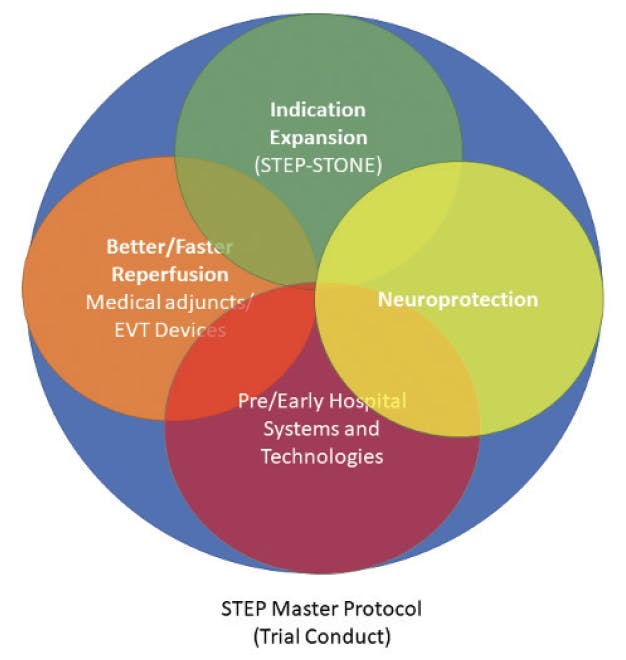
Figure 1. STEP platform concept.
CONCLUSION
The STEP platform will provide an approach to rapidly evaluate multiple interventions to improve the outcome of patients treated with thrombectomy. This is a critical need. The magnitude of benefit observed in the randomized trials of endovascular thrombectomy strongly support the idea that many more patients outside of the study populations can benefit from this procedure. In addition, this platform offers a great opportunity to find ways to achieve faster and more complete recanalizations in patients, increasing their chances for recovery. Neuroprotective agents may come into play here as well. A platform trial design for thrombectomy trials has great potential to dramatically accelerate endovascular thrombectomy research and provide better care and better outcomes for stroke patients worldwide.
Advertisement
Advertisement