Advertisement
Advertisement
January 2022 Supplement
Sponsored by Silk Road Medical
Medicare Reimbursement for TransCarotid Arterial Revascularization (TCAR)
How are hospitals and physicians reimbursed by Medicare for TCAR procedures?

Understanding reimbursement for the transcarotid artery revascularization (TCAR) procedure requires identifying the primary payer, what specific payer coverage policies apply to TCAR, what is the correct diagnosis and procedure coding, and finally, what are the hospital and physician procedural payments (Figure 1).
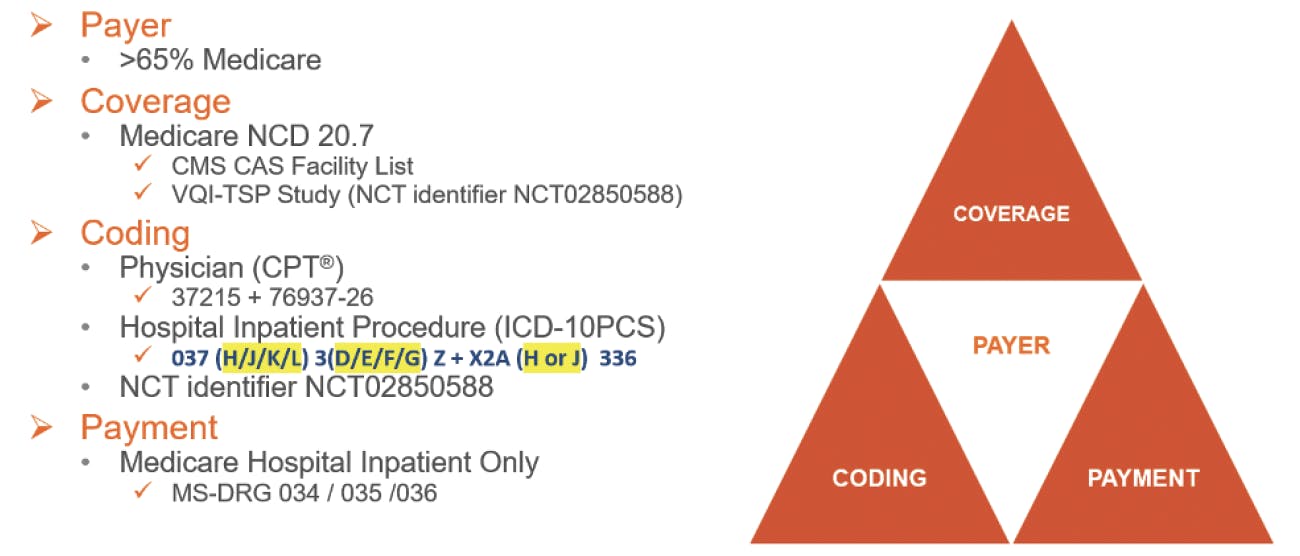
Figure 1. Four key components for TCAR reimbursement.
The TCAR procedure uses the FDA-approved ENROUTE Transcarotid Stent and Neuroprotection system (Silk Road Medical) and has a distinct Centers for Medicare & Medicaid (CMS) reimbursement pathway as of September 2016.
PAYER
The first step to understanding reimbursement is to identify the patient’s primary payer. Based on the Society of Vascular Surgery/Vascular Quality Initiative transcarotid artery revascularization (SVS/VQI TCAR) Surveillance Project (TSP), > 65%1 of the patients are Medicare beneficiaries and will therefore follow Medicare coverage policies, coding guidance, and payment systems.
For commercial payers, such as Blue Cross Blue Shield, United Healthcare, and Aetna, extracranial carotid angioplasty and stenting policies differ and require case-by-case review.
COVERAGE
The Medicare Coverage policy for TCAR is based on a broad CMS National Coverage Determination (NCD) 20.7 titled Percutaneous Transluminal Angioplasty (PTA).2 Within this policy, which was last revised on January 1, 2013, there are two key nationally covered indications that apply to carotid artery stent placement (which includes TCAR):
"B. Nationally Covered Indications
3. Concurrent with Carotid Artery Stent Placement in FDA-Approved Post Approval Studies
4. Concurrent with Carotid Artery Stent Placement in Patients at High Risk for Carotid Endarterectomy"
A letter from CMS to the Society of Vascular Surgery Patient Safety Organization (SVS PSO) dated 09/01/2016 states “patients participating in the VQI-TCAR Surveillance Project are included in the currently covered population of patients participating in FDA-approved post-approval studies (Pub. 100-3, 20.7, B3).” Therefore, TCAR cases performed at facilities participating in the VQI Carotid Artery Stenting (CAS) Registry are part of the CMS-approved CAS Investigational Studies – VQI-TSP as referenced on the CMS website (https://www.cms.gov/Medicare/Medicare-General-Information/MedicareApprovedFacilitie/Carotid-Artery-Stenting-CAS-Investigational-Studies). Hospital and physician claims document their participation in the VQI-TSP by adding the National Clinical Trial identifier NCT02850588 to their claims. To date, most patients treated with TCAR are enrolled in the VQI-TSP, which expands coverage to include the patients at high risk for carotid endarterectomy (CEA) and symptomatic with ≥ 50% stenosis or asymptomatic with > 80% stenosis.
As of September 2021, 726 (85%) of the 855 SVS/VQI participating centers subscribe to the CAS Registry. To learn more about participating in the SVS/VQI CAS Registry you can contact the SVS/VQI directly (https://www.vqi.org/directory/join-the-vqi/).
The other key requirement for Medicare CAS coverage is for the facilities to be listed on the Carotid Artery Stenting Facilities list of hospitals that have met the CMS minimum facility standards for performing CAS for high-risk patients.
As of September 2021, there are 1,458 facilities on the CMS Carotid Artery Stenting Facilities website (https://www.cms.gov/Medicare/Medicare-General-Information/MedicareApprovedFacilitie/Carotid-Artery-Stenting-Facilities).
CODING
The primary physician procedural coding for TCAR is the same as for CAS—CPT procedure code 37215. However, for TCAR, when ultrasound guidance for vascular access in the femoral vein is required with permanent recording and reporting, CPT 76937-26 may also be documented and coded.
CPT 37215—Transcatheter placement of intravascular stent(s), cervical carotid artery, open or percutaneous, including angioplasty, when performed, and radiological supervision and interpretation; with distal embolic protection
CPT 76937-26—Ultrasound guidance for vascular access requiring ultrasound evaluation of potential access sites, documentation of selected vessel patency, concurrent real-time ultrasound visualization of vascular needle entry, with permanent recording and reporting (List separately in addition to code for primary procedure) – professional component (-26)
For hospital inpatient procedure coding, TCAR has two distinct ICD-10 PCS codes to identify the carotid stenting and the reverse flow neuroprotection components (Figure 2).
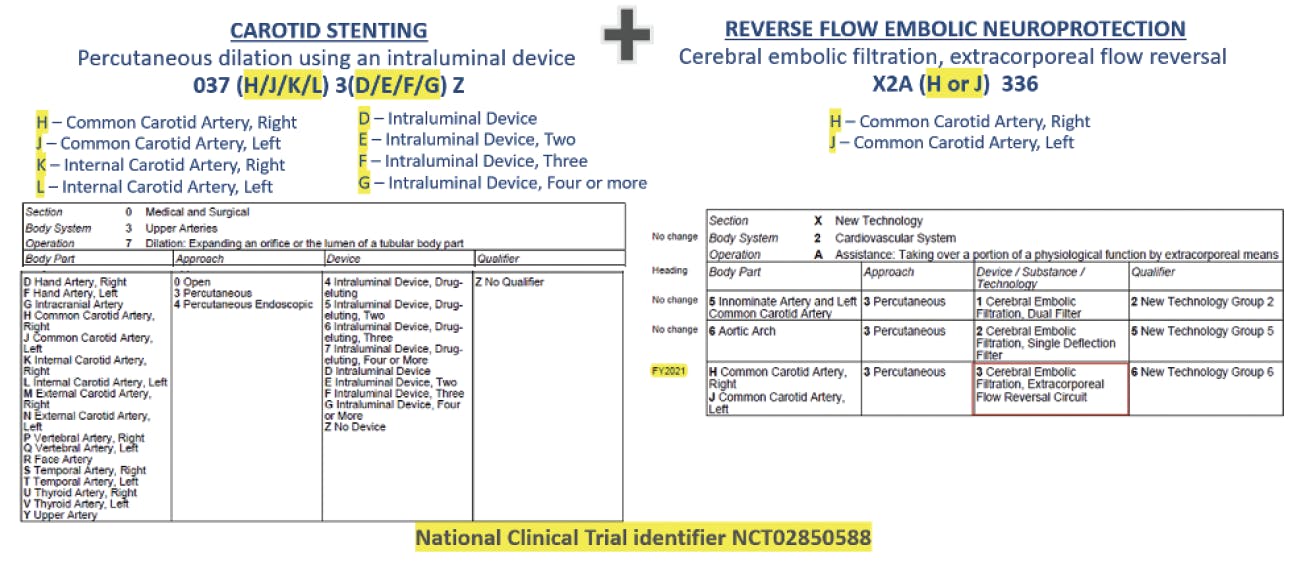
Figure 2. Hospital inpatient only procedure coding (ICD-10 PCS) (https://www.cms.gov/medicare/icd-10/2021-icd-10-pcs).
PAYMENT
Medicare hospital TCAR payment policies are aligned with CAS procedures. Medicare updates annually in the Hospital Outpatient Prospective Payment System Rule a list of procedures that are deemed as hospital inpatient only procedures. The CPT code 37215 for CAS is on the CY 2021 list (https://www.cms.gov/medicaremedicare-fee-service-paymenthospitaloutpatientppshospital-outpatient-regulations-and-notices/cms-1736-fc).
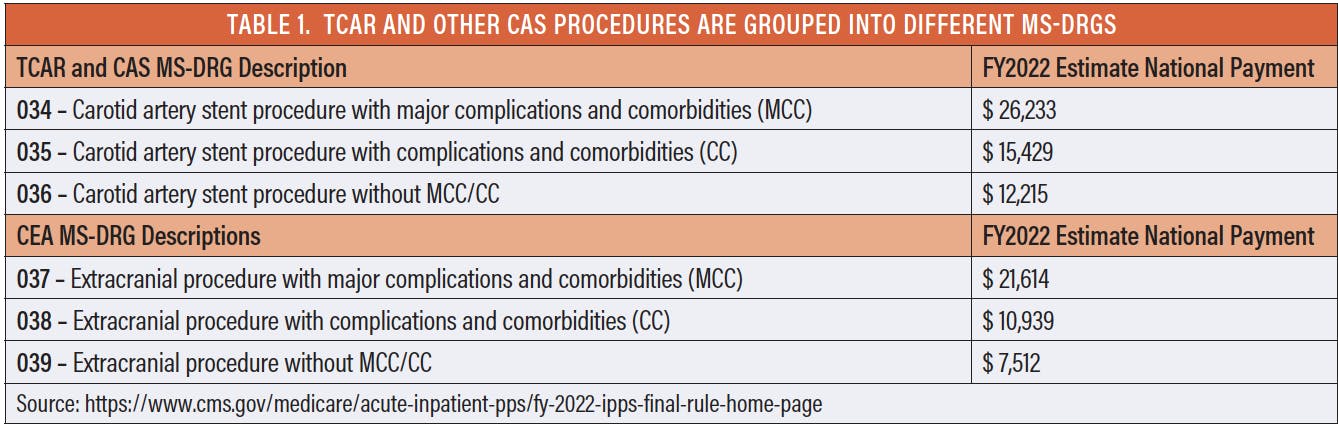
The Medicare Hospital Inpatient Payment System for TCAR, is paid according to Medicare Severity–Diagnosis Related Groups (MS-DRGs) assigned to an inpatient discharge. Hospital-specific MS-DRG payments can differ significantly based on hospital locality wage index, graduate teaching status, and uncompensated care status. TCAR and other CAS procedures are grouped into different MS-DRGs (MS-DRGs 034/035/036) from CEA procedures (MS-DRGs 037/038/039) based on ICD-10 diagnoses and procedures (Table 1).
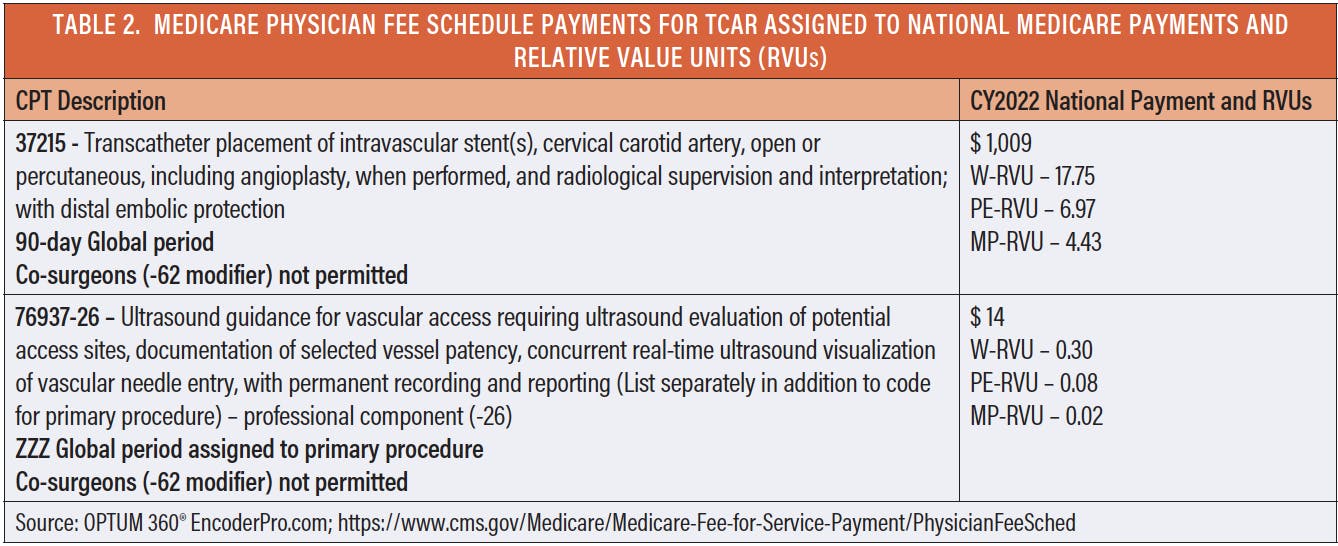
The Medicare Physician Fee Schedule payments for TCAR are assigned to the following National Medicare payments and relative value units (RVUs) (Table 2).
SUMMARY
Hospital and physician reimbursement for medical procedures such as TCAR are based on four key components: payer, coverage, coding, and payment. Because the primary payer for TCAR is Medicare, we focused our coverage, coding, and payment policies on Medicare. Updates to Medicare hospital inpatient payments are effective as of October 1, 2021, and physician payment updates are effective as of January 1, 2022.
1. Mahmoud B. Malas, M. e. (2020). TransCarotid Revascularization with Dynamic Flow reversal versus Carotid Endarterectomy in the Vascular Quality Initiative Surveillance Project. Annals of Surgery, 16.
2. CMS Manual System Pub. 100-3 Medicare National Coverage Determination 20.7 Percutaneous Transluminal Angioplasty (PTA) ; February 8, 2013; https://www.cms.gov/medicare-coverage-database/view/ncd.aspx?ncdid=201&ncdver=10&bc=0
Advertisement
Advertisement