Advertisement
Advertisement
July 2022
Venous Stent Failure in Postthrombotic Occlusions
A review on how attention to detail throughout the procedure can help avoid stent failure.
The endovascular management of venous obstructive disease has generated considerable enthusiasm over the past several years, with the introduction of several stents specifically approved for iliofemoral venous obstruction. This has directly led to a significant increase in stent placement procedures; however, this enthusiasm has been tempered by concerns about appropriate utilization, safety (ie, concerns for stent migration), and the long-term durability of the therapy. Stent failure, defined here as loss of luminal patency, is particularly noteworthy because venous stents are typically placed in patients who are significantly younger than arterial obstruction patients. Thus, the concern for luminal patency is no longer a matter of years, as it is in arterial patients; rather, it can be an issue for several decades.
The concern of poor patency is primarily in patients with postthrombotic iliofemoral obstruction. A 2015 meta-analysis projected the 5-year primary patency of stents in such patients at approximately 60%.1 This appears to be corroborated by trends identified from the data of several investigational device exemption trials, where 2-year patency data range from approximately 75% to 83%. Given that this subset of patients may have to undergo numerous interventions to maintain stent patency, identification of factors associated with loss of patency is key to improving outcomes.
This article discusses a few of the most common causes of stent failure that can be avoided with attention to detail during the procedure: inflow, coverage of the entire diseased iliofemoral segment, appropriate stent sizing, and postprocedural pharmacotherapy.
ENSURING PROPER INFLOW
A frequently invoked cause of stent failure is lack of proper inflow. Historically, the judgment of inflow has largely been a matter of expert opinion; there are little objective data to evaluate what inflow is needed to maintain stent placement. Recently, there have been efforts to categorize different inflow patterns (ie, PFV only, PFV and femoral vein, no infrainguinal postthrombotic obstruction) by correlating patency outcomes with the type of inflow that is present.2 Although this represents progress, the issue remains that classification is still subjective, based on imaging (such as CT venography and intravascular ultrasound [IVUS]) interpretation. Work is ongoing to identify objective metrics by which to judge inflow, but in the interim, we can rely on the following: In the presence of significant postthrombotic obstruction of the CFV, a key determinant to patency is the PFV.
In general, there is expert consensus on not crossing the origin of the PFV with a stent. There is less consensus on the necessity of the femoral vein in maintaining inflow; some feel that it is not critical with a good-quality PFV, and others feel that it is an important contributor—again, more data are needed.
Anecdotally, underappreciation of inflow is perhaps the most common cause of stent occlusion in postthrombotic obstructions (Figure 1). This can be mitigated at the initial procedure by careful use of IVUS and venography to assess the CFV for disease and, if present, carefully assessing the quality and position of the PFV that will provide inflow into the stent. If managing a stent occlusion where inflow disease was missed, recanalizing the occluded stent followed by stent extension to proper inflow often results in durable patency.
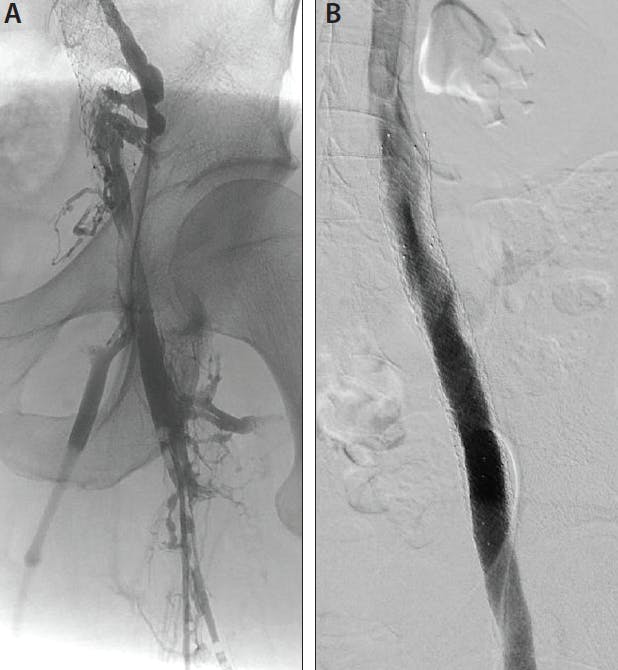
Figure 1. Selective femoral venogram demonstrating postthrombotic changes of the common femoral vein (CFV) and an occluded iliac vein stent (A). Extension of the stent below the inguinal ligament to the profunda femoris vein (PFV) inflow results in stent patency (B).
Complete COVERAGE OF THE DISEASED ILIAC VEIN
Similar to ensuring proper inflow to an iliofemoral stent, bridging the entire segment of diseased iliac vein is critical (Figure 2). Again, the use of IVUS and venography in a concerted manner are key in connecting “healthy to healthy” veins, identifying proper stent landing zones to bridge the inflow with compression lesions (ie, most commonly the right common iliac artery over the left common iliac vein) or the obstructed iliac segments.
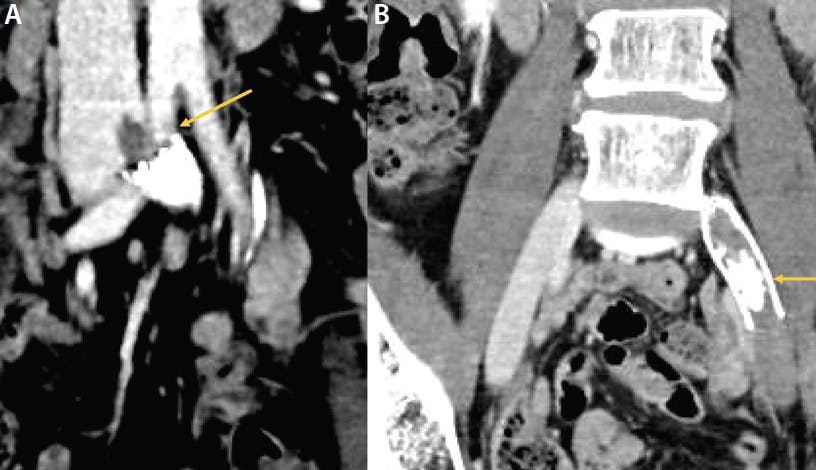
Figure 2. Coronal reconstructed CT venogram of the pelvis demonstrating incomplete extension of the stent across a compression lesion caused by the right common iliac artery (A), resulting in calcified stent occlusion (B).
STENT SIZING
Selection of stent size is an important component of the procedure. Although proper sizing for nonthrombotic lesions has been discussed extensively, sizing for postthrombotic obstructions is a subjective decision. Frequently, there is no normal reference segment for which to base stent size. In most cases, particularly in cases where the postthrombotic occlusion is from the CFV through the iliac vein, it is a matter of operator choice and expert opinion. In most cases, a 14- or 16-mm self-expanding iliofemoral venous stent is sufficient for the iliac vein, and a 12- or 14-mm stent for extension across the inguinal ligament is sufficient in cases where the CFV is compromised. In such cases, care must be taken to have the stent junction occur in the pelvis, not at the ligament or level of the pubic ramus where it can result in stent separation. Gross undersizing of a stent can lead to occlusion that may preclude further revascularization. Additionally, it is worth mentioning that gross stent undersizing in nonthrombotic lesions (both in terms of stent diameter and length) can lead to migration.3 Gross oversizing can result in severe, unrelenting back pain (Figure 3) that may only be managed by operative stent explantation.
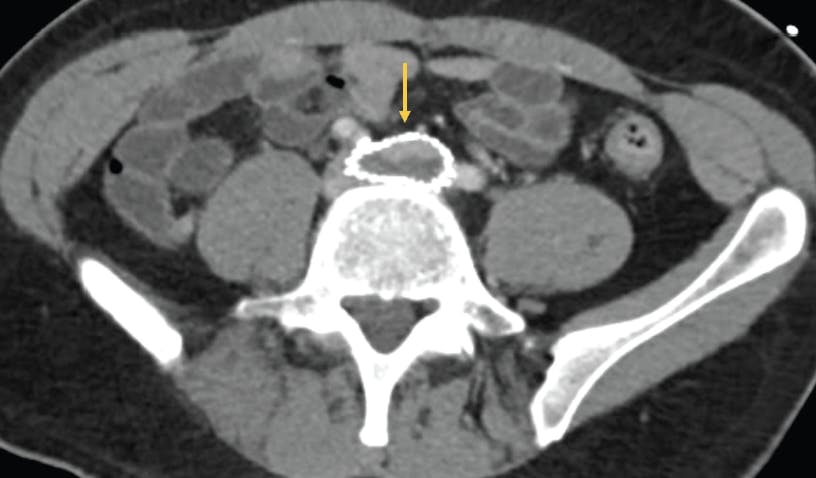
Figure 3. Axial CT venogram of the pelvis demonstrating a 20-mm self-expanding nitinol iliofemoral venous stent in the left iliac vein; this patient was unable to ambulate due to oversizing and required operative removal of the stent.
PHARMACOTHERAPY
Anticoagulation management, particularly in patients who have received a stent for postthrombotic obstruction, is a critical component to the procedure. As with many aspects of deep venous disease, the ideal anticoagulation regimen for such patients has not been rigorously studied and remains an area where high-quality investigations are needed.
From expert consensus, anticoagulation appears to be the most important, and there is somewhat broad agreement on the usage of low-molecular-weight heparin in the periprocedural and postprocedural periods for up to a few months. Transition to a direct oral anticoagulant or warfarin frequently occurs thereafter. The duration of anticoagulation is unclear, and there is less consensus. What is clear is that monitoring for patient compliance is critical, and regular follow-up is necessary to ensure compliance and address any potential obstacles.
Regarding antiplatelet therapy, it is frequently prescribed, and though it may be important, there are little supportive data and consensus on the choice, intensity, or length of the regimen.
CONCLUSION
Iliofemoral venous stent placement for postthrombotic obstructions can significantly improve symptoms, the patient’s ability to carry out activities of daily living, and quality of life. However, long-term durability of the therapy remains a concern, particularly given that these patients tend to be young. Attention to detail in intraprocedural technique and postprocedural management can positively impact outcomes for this subset of patients.
1. Razavi MK, Jaff MR, Miller LE. Safety and effectiveness of stent placement for iliofemoral venous outflow obstruction: systematic review and meta-analysis. Circ Cardiovasc Interv. 2015;8:e002772. doi: 10.1161/CIRCINTERVENTIONS.115.002772
2. Grotta O, Enden T, Sandbaek G, et al. Infrainguinal inflow assessment and endovenous stent placement in iliofemoral post-thrombotic obstructions. CVIR Endovasc. 2018;1:29. doi: 10.1186/s42155-018-0038-9
3. Hosny Sayed M, Salem M, Desai KR, et al. A review of the incidence, outcome and management of venous stent migration. J Vasc Surg Venous Lymphat Disord. 2022;10:482-490. doi: 10.1016/j.jvsv.2021.07.015
Advertisement
Advertisement