Advertisement
Advertisement
March 2022
Ask the Experts: In Which Clinical Presentations Do You Prefer Nonthermal Options, and Which Are Better Suited to Thermal Ablation?
With Ronald S. Winokur, MD, FSIR, RPVI; Julianne Stoughton, MD, FACS; and Juan Carlos Jimenez, MD, MBA, FACS

The ideal tool for ablation of axial reflux in the great saphenous vein (GSV), anterior accessory great saphenous vein (AA-GSV), or small saphenous vein (SSV) has been an active area of discussion since the development of nonthermal (NT) tools such as VenaSeal (Medtronic), Varithena (Boston Scientific Corporation), and ClariVein (Merit Medical Systems, Inc.). There are some distinct advantages of these NT ablation tools, which have demonstrated effective closure rates in clinical studies with decreased postprocedural pain. However, the current insurance coverage for NT ablation procedures is variable and may drive the decision to abstain from the use of these new devices if they are not covered. Setting aside insurance coverage as the driver of device or procedure choice, there are some specific advantages of each tool that allow for optimization of patient treatment and outcome.
The biggest limitation to the use of thermal ablation is the presence of an extrafascial or superficial accessory GSV. Because it is often not possible to prevent skin burn injury with tumescent anesthetic, using one of the NT tools is an excellent choice. Other options would be ambulatory phlebectomy to remove the extrafascial GSV or performing ultrasound-guided foam sclerotherapy of the extrafascial segment. These alternative strategies come with challenges of difficulty removing the extrafascial GSV and potential skin discoloration, respectively.
Use of thermal ablation is also challenging in patients with simultaneous reflux in the GSV and AA-GSV with intervening large varicose veins in the upper thigh. Options for treatment using thermal ablation would require an extended period to allow for both vessels to undergo thermal ablation and challenges of reuse of the laser in both veins, as well as ambulatory phlebectomy of the intervening segment to prevent superficial phlebitis postprocedure. In these cases, NT ablation with Varithena can allow for treatment of both refluxing axial segments as well as the intervening varicosities in one setting. Another situation where Varithena can be a useful alternative approach is in a tortuous GSV, AA-GSV, or SSV that makes it difficult to advance the thermal ablation tools.
NT tools also have limitations to widespread use because thermal ablation with endovenous laser (EVL) therapy and radiofrequency (RF) ablation both have extremely effective occlusion rates. VenaSeal can be associated with hypersensitivity reactions to cyanoacrylate glue that present similar to superficial phlebitis and occur in 4% to 20% of patients1; therefore, knowledge of sensitivity to glue-type products should be considered prior to use. Varithena has been associated with deep vein thrombosis (DVT) in 8.6% of patients,2 which may be a limiting factor in patients with a history of DVT. However, this may not be as much of an issue if anticoagulation is being used.
In summary, I still use thermal ablation tools to treat axial reflux in the GSV, AA-GSV, and SSV as long as those segments are straight and can be separated from the skin with tumescent anesthesia. In cases of an extrafascial or superficial vein, tortuous veins, or large interconnected segments of axial reflux, NT technologies can be useful alternative tools.
1. Lam YL, De Maeseneer M, Lawson J, et al. Expert review on the VenaSeal® system for endovenous cyano-acrylate adhesive ablation of incompetent saphenous trunks in patients with varicose veins. Expert Rev Med Devices. 2017;14:755-762. doi: 10.1080/17434440.2017.1378093
2. Todd KL 3rd, Wright DI; VANISH-2 Investigator Group. The VANISH-2 study: a randomized, blinded, multicenter study to evaluate the efficacy and safety of polidocanol endovenous microfoam 0.5% and 1.0% compared with placebo for the treatment of saphenofemoral junction incompetence. Phlebology. 2014;29:608-618. doi: 10.1177/0268355513497709

This is certainly a loaded question. There are now at least five separate types of endovenous ablation: thermal methods such as laser (ie, EVL or RF) and NT methods such as cyanoacrylate glue, polidocanol endovenous microfoam (PEM), and mechanochemical ablation (MOCA). In my practice, we have all five tools available, and there can be a lengthy discussion involving the risks and benefits of each procedure if a patient is a candidate for all of them. My initial choice is made depending on the refluxing truncal vein anatomy (size, depth, length, tortuosity, proximity to nerves or skin, presence of synechia in the lumen, etc.), which is evaluated by a preliminary duplex reflux exam. Additionally, important patient factors include age, comorbidities, allergies, use of anticoagulants, ability to wear compression postprocedure, presence of patent foramen ovale (PFO), sensitivity to epinephrine, advanced stage of venous insufficiency, and presence of ulceration or infection. In the end, it sometimes comes down to patient preference or differences in insurance coverage. Discomfort while injecting tumescent local anesthesia with RF and EVL can be weighed against less discomfort but, at times, slightly lower closure rates and less long-term data with NT methods.
Certainly, one of the most common presentations where I prefer NT options includes patients with disease along the entire length of the saphenous vein (from the groin to the ankle in the GSV) or down to the ankle/Achilles area for the SSV. The proximity to nerves and skin makes NT options much safer when treating the distal leg truncal veins.1 When choosing which NT method, I consider the previously mentioned patient factors.
The following case demonstrates my decision-making. A woman in her early 70s presented with CEAP (clinical, etiology, anatomy, pathophysiology) C4 disease and a GSV refluxing from groin to ankle, with a diameter of 5 to 6 mm along the length. She had a PFO, making PEM a less safe or desirable option. She was highly allergic to adhesives, which is a contraindication to glue. Finally, a discovery at the medial knee of chronic changes in the GSV from a remote superficial thrombosis years ago was a contraindication to MOCA (Figure 1). Her full-length GSV anatomy was best suited for NT methods, but she had a contraindication to each of the NT methods. Thus, this patient could be treated with a combination therapy of thermal ablation in the proximal GSV and liquid sclerotherapy (chemical ablation without foam) in the lower GSV and tributaries. Choosing these treatments becomes an art as well as a science.3
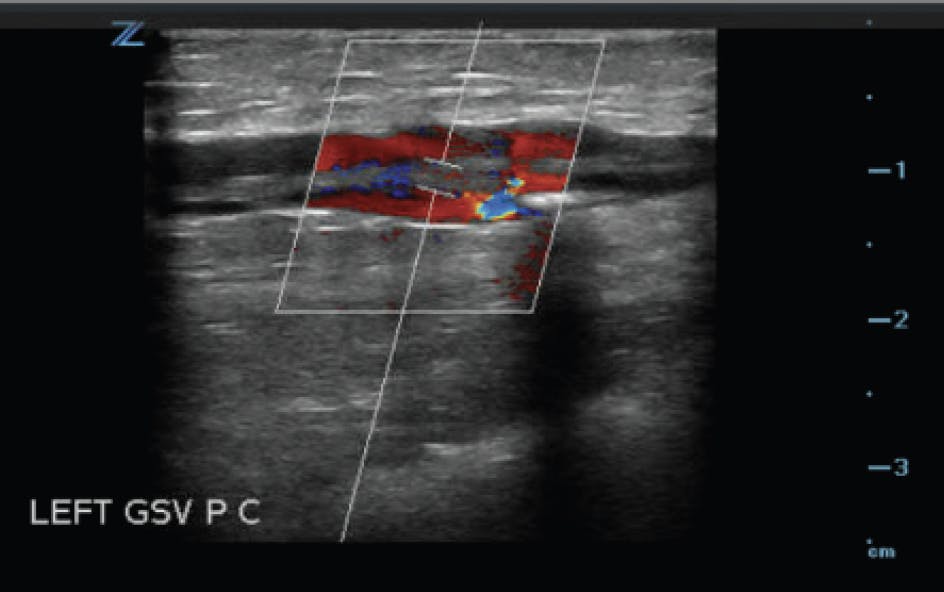
Figure 1. Careful ultrasound evaluation was performed along the entire length of the refluxing segment to uncover issues like these chronic changes seen below the knee in the GSV from remote superficial thrombosis years ago. This is a contraindication to MOCA because the wire can become tangled in the synechia within the vessel lumen. This emphasizes the importance of venous mapping before making decisions on types of treatment.
Thermal ablation has been the standard of care for > 2 decades, since it was proven equivalent and even superior to vein stripping and ligation.2 It has had the best primary closure rates, and it remains my method of choice when there are larger-diameter veins that require a more aggressive ablation method. Shorter-length veins (< 6 cm) are also best treated in my practice with thermal methods. One can treat larger-diameter veins (> 12 mm) with higher levels of energy, which can improve closure rates as well. Although there is some mild discomfort when administering the tumescent local anesthesia (to create a heat sink and provide anesthetic), the thermal methods continue to be a safe and highly effective approach to treating patients with truncal vein reflux. In my practice, the main contraindications to thermal ablation include significant vein tortuosity where a wire is unable to negotiate the vessel (foam would be chosen here) or proximity to skin or nerves (NT would be chosen when possible). Finally, patients with small-diameter GSV reflux associated with a large burden of varicosities are best treated with phlebectomy alone and GSV preservation (ambulatory selective varicose vein ablation under local anesthesia approach, or ASVAL).3
1. Kugler NW, Brown KR. An update on the currently available nonthermal ablative options in the management of superficial venous disease. J Vasc Surg Venous Lymphat Disord. 2017;5:422-429. doi: 10.1016/j.jvsv.2017.01.014
2. Lurie F, Creton D, Eklof B, et al. Prospective randomised study of endovenous radiofrequency obliteration (closure) versus ligation and vein stripping (EVOLVeS): two-year follow-up. Eur J Vasc Endovasc Surg. 2005;29:67-73. doi: 10.1016/j.ejvs.2004.09.019
3. Pittaluga P, Chastanet S. Treatment of varicose veins by ASVAL: results at 10 years. Ann Vasc Surg. 2017;38. doi: 10.1016/j.avsg.2016.07.021

The emergence of NT treatment options for ablation of superficial truncal veins has added to the venous interventionalist’s armamentarium to the patient’s great benefit. Despite the proven safety and efficacy of RF and laser ablation of refluxing truncal veins, some clinical scenarios are better suited for NT options. We recently reported our experience using commercially available polidocanol microfoam (Varithena) to close refluxing saphenous veins in patients with symptomatic venous disease.1,2 We noted excellent immediate closure rates and a low incidence of adverse thrombotic events. These outcomes compared favorably with previous reports from our institution after saphenous vein closure with RF ablation.3 As our clinical experience with saphenous vein closure using cyanoacrylate is limited, microfoam ablation is our NT technique of choice.
I prefer to use Varithena for below-knee truncal vein closure. NT closure obviates the possibility of heat-induced saphenous and sural nerve injuries in this area. Another advantage of NT closure is avoiding the need to inject subcutaneous and perivenous tumescence during the procedure. During thermal ablation, we typically use a spinal needle to inject a tumescent saline solution to the tissues surrounding the saphenous vein being treated. In obese or anxious patients, avoidance of tumescence infusion may be advantageous; NT options are a better choice for these patients because they avoid tumescence. Microfoam ablation with Varithena is also preferable for patients with tortuous truncal veins because sheath and catheter advancement to the saphenofemoral junction may be difficult or not possible in these patients. This technique has been particularly useful in tortuous anterior accessory saphenous veins in our practice. Saphenous veins near the skin surface are also better treated with microfoam ablation. Although some patients may become symptomatic from superficial phlebitis after NT vein closure, it is still preferable to skin burns that may occur with thermal ablation, in my opinion.
In patients where multiple perforator veins arise from the targeted truncal vein, thermal ablation is a better option. The presence of numerous perforator veins increases the risk of microfoam migration into the deep venous system. In my experience, large-diameter truncal veins (> 10 mm) are also better treated with thermal ablation because they frequently require an increased volume of microfoam for successful closure. In our study, we limited the amount of microfoam volume per session (mean microfoam volume, 7.6 mL) from the 15 mL suggested by the Varithena instructions for use.1 Thermal ablation of larger-diameter truncal veins (where an increased microfoam volume is required) may also be more cost-effective.
1. Jimenez JC, Lawrence PF, Woo K, et al. Adjunctive techniques to minimize thrombotic complications following microfoam sclerotherapy of saphenous trunks and tributaries. J Vasc Surg Venous Lymphat Disord. 2021;9:904-909. doi: 10.1016/j.jvsv.2020.11.015
2. Jimenez JC, Lawrence PF, Pavlyha M, et al. Endovenous microfoam ablation of below knee superficial truncal veins is safe and effective in patients with prior saphenous treatment across a wide range of CEAP classes. J Vasc Surg Venous Lymphat Disord. Published online August 30, 2021. doi: 10.1016/j.jvsv.2021.08.015
3. Harlander-Locke M, Jimenez JC, Lawrence PF, et al. Endovenous ablation with concomitant phlebectomy is a safe and effective method of treatment for symptomatic patients with axial reflux and large incompetent tributaries. J Vasc Surg. 2013;58:166-172. doi: 10.1016/j.jvs.2012.12.054
Advertisement
Advertisement