Advertisement
Advertisement
March 2022
EVAR Versus the Endoleak
Understanding the risks for developing type I, II, and III endoleaks and the available treatment options when they are identified.
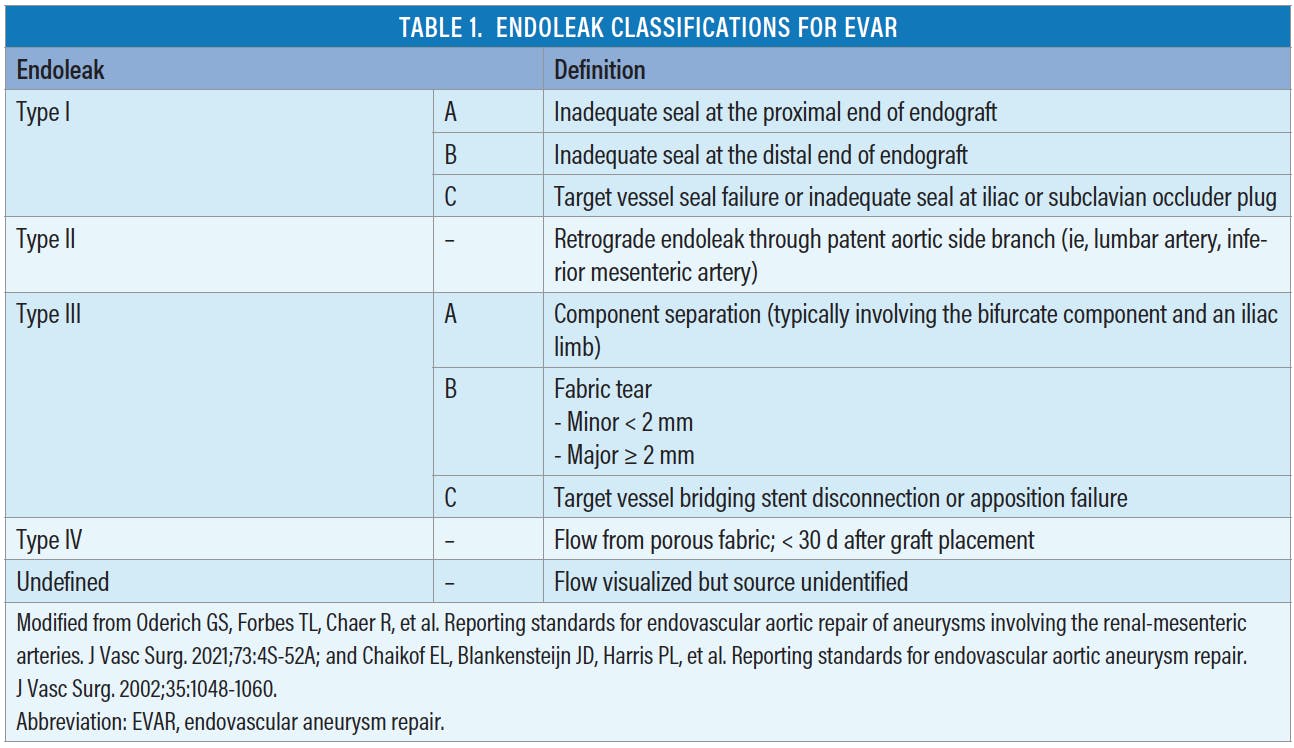
Few things are more frustrating after an endovascular aneurysm repair (EVAR) than visualizing an endoleak on follow-up imaging. Even the name is bothersome—it confuses patients (and some medical providers) and is equated to having a “leaking aneurysm.” Other than their clear annoyance to me, how devastating are endoleaks to the long-term durability of EVAR? In search of information about the incidence, natural history, and management of EVAR-associated endoleaks, nearly 2,000 papers on some aspect of this topic were identified. If you are bold enough to establish dogma on the management of the various types (Table 1), there is a plethora of data to support your approach one way or another. Despite this, some clear messages unfold. Endoleaks, for the most part, represent EVAR failure, and if there are successful methods to avoid and/or treat them effectively, we should pursue those interventions. It is the EVAR (and us) versus the endoleak.
Despite its early advantage, EVAR is associated with a higher rate of late (8 years) rupture compared with open repair (5.4% vs 1.4%).1 Some of the key contributors to this failure are endoleaks. The approach to endoleak management has varied over time. Early in the application of EVAR, an aggressive approach was implemented for treatment of all persistent sac flow. However, results from the EUROSTAR registry suggested that intervention should be tailored to the type of endoleak and any associated sac growth.2 Persistent endoleaks are a risk for sac expansion and late rupture, and rupture is most affected by the presence of a type I or III endoleak.3,4 This led to a continued aggressive treatment of type I and III endoleaks but a more cautious approach to type II endoleaks. Long-term follow-up from the EVAR 1 trial noted a number of deaths related to persistent endoleak with associated sac expansion that did not undergo reintervention. Correcting these endoleaks may have increased the rate of reintervention, but it also may have prevented rupture and death, although that is hard to predict.5 However, long-term surveillance is clearly important in potentially preventing endoleak-related mortality.
The growing experience with EVAR conversion provides some insight into the influence of endoleaks on its failure. Turney et al reported that open conversion occurred relatively late after the index procedure (median time, 41 months) and that endoleak was the most common reason for EVAR failure.6 One or more endoleaks were present in 82% of patients, and the endoleak distribution was predominantly composed of type I (40%), type II (30%), and type III (22%), which we will focus on in this discussion. Similar results have been reported globally.7 In addition, Dias et al reported on EVAR conversion to either open repair or fenestrated endograft (FEVAR).8 In this series of 247 failed EVAR repairs, 162 were converted to open repair, while 85 were repaired with FEVAR. Etiology of failure in the open group was secondary to type I (40%), II (28%), and III (17%) endoleaks, predominantly. Although not identified in this analysis, it is possible that some subpopulation of this cohort could either have had their endoleak prevented or at least addressed in a less invasive fashion prior to explantation or complex FEVAR, thus sparing a more morbid procedure. This requires an understanding of the risk for developing the various endoleaks and the treatment options available when they are identified.
Predicting who will develop an endoleak remains challenging and likely varies based on the type of endoleak. Endoleak detection on early postoperative imaging may be predictive of longer-term outcomes. Gill et al reported that 20% of their EVAR cohort had an initial CT scan that was positive for endoleak, and these were predominantly type II (70%) or type I (30%).9 In those with a negative scan, < 5% of patients required subsequent intervention for development of a late endoleak. Of those with a positive CT, 37% required subsequent reintervention, and these occurred at a much earlier time point than in those with a negative CT (mean, 8 vs 30 months). Factors associated with leak-related and all-cause reintervention were neck angulation, neck calcification, and maximum aneurysm diameter.
TYPE I ENDOLEAK
Theoretically, type Ia endoleaks (failure of the proximal seal) should not occur provided that an ideal landing zone is chosen. However, experience with FEVAR demonstrates that even when a seal zone has been obtained in any portion of the aorta, type Ia endoleaks may still occur, and this likely represents the incidence of proximal disease progression.10 Even when the proximal neck is not ideal, adjuncts may be available to help secure the fixation and seal, providing endoleak-free durability.11 We do know that aortic wall pathology in the sealing zone, also termed a hostile neck, will increase the risk of late graft failure. These hostile factors have included the presence of calcification, thrombus, irregular shape, short necks, angulated necks, and larger-diameter necks, and the presence of combinations of these characteristics will further increase the risk.9,12-14 We rarely see the outcomes from EVAR used in hostile necks in commercial trials because these anatomic features place them outside most indications for use (IFU). Registry outcomes suggest that even in challenging anatomy, EVAR may fair well at least through 5 years, with the concession that longer-term follow-up and close monitoring are necessary.15 However, other series demonstrate that use outside the IFU is associated with later proximal neck dilation and risk of type I endoleak development, independent of the graft manufacturer.16,17 Late type Ia endoleak development has a high rate of rupture, and thus, close follow-up should be mandated in those with a compromised aortic neck.13
Treatment of type Ia endoleak, as described previously, is either open conversion or proximal extension with FEVAR. Experience is growing, but these procedures frequently carry a higher morbidity and mortality than would potentially have been observed if a more complete procedure had been performed at the outset.
TYPE III ENDOLEAKS
Type III endoleaks occur in several varieties (Table 1), and their incidence is reported to range from 3% to 5%.5,18,19 Type IIIa endoleaks occur secondary to component separation, while type IIIb endoleaks are secondary to a tear in the endovascular graft fabric. Type III endoleaks can present early and/or late, with a reported median time to presentation of 54 months.20 The etiology of type IIIa endoleaks is either failure to provide sufficient device overlap (often identified early on angiography after case completion) or secondary to conformational change in the aorta (eg, aneurysm sac growth, aortic elongation), which induces endograft movement to accommodate the anatomic changes.21 Large aneurysms may be a risk factor for late type IIIa endoleak development, and prevention may occur by maximizing graft-graft overlap. Treatment typically involves placement of additional components.
Type IIIb endoleaks are not common and have been reported to occur in a broad sampling of commercially available endograft systems.20 The presentation of late type IIIb endoleaks may be more malignant as it may be associated with a higher frequency of rupture (32% of the reported cases). The location of the endoleak varies and occurs in similar frequency at the aortic main body, flow divider, and iliac limb. Treatment of this endoleak type requires either open repair or endovascular relining of the stent graft.
The etiology of a type IIIb endoleak may be attributable to wear and tear of the graft fabric. Natural degradation of polyethylene terephthalate (also known as polyester) occurs after 10 to 20 years as a result of hydrolysis, and the material will lose nearly one-third of its burst strength over 10 years.20,22 However, the presentation of the type IIIb endoleak tends to occur well before that time frame, suggesting that additional factors may be at play in the development of this failure mode. These factors may include graft and stent interaction (particularly in angled/tortuous anatomy), component-component interaction, and chronic external stressors such as vessel wall calcification, all of which may accelerate graft material degradation.20,23 In addition, given the higher prevalence of these endoleaks arising from the main body, it has been suggested that this portion of the main body may be exposed to increased stress compared to other endograft locations.20,24 The main body, as well as the flow divider region, are sites that more frequently undergo balloon angioplasty during the index procedure, which may adversely affect the graft long term, secondary to balloon-induced fabric distortion.20,25
The development of type IIIb endoleaks has garnered a lot of attention over the past few years. In 2018, FDA directed a recall of the AFX endovascular graft system (Endologix) due to a high rate of type III endoleaks, and the device was replaced with one that featured a redesign in the graft material. An analysis by Lemmon et al reported outcomes of 151 patients who underwent EVAR, 83 of whom received the Endologix device. It was observed in this cohort that the Endologix device had a significantly higher rate of type IIIb endoleak development.26 A number of risk factors were evaluated, and the only one to show a correlation was a treated aneurysm diameter > 6.5 cm. It has been suggested that one reason this specific graft may exhibit a higher risk is its positioning directly on the aortic bifurcation. This is one of the benefits of the graft design, but it is possible that abutting the aortic bifurcation may increase the interaction of the graft with the aortic wall, contributing to poorer durability.20 Conversely, other series refute the risk and suggest the device is safe and effective.27
In January 2022, the FDA provided an update on the risk of type III endoleaks with the use of the Endologix AFX endovascular abdominal aortic aneurysm (AAA) graft systems. This followed a meeting of the Circulatory System Devices Panel of the Medical Devices Advisory Committee of the Center for Devices and Radiological Health in which most committee members recommended that AFX2 endovascular grafts should not be used for routine AAA treatment. The committee did report that there would be continued support for availability of the device for select populations in which alternative treatment options are insufficient or not available. Clearly, additional information is necessary to understand the pathophysiology of type IIIb endoleaks to either prevent them from occurring with the currently available EVAR systems or to design devices that are at lower risk for developing this type of failure mode.
TYPE II ENDOLEAKS
The legacy of type II endoleaks is one of mystery. Are they a sign of a failed EVAR repair? Can we prevent them? Do they occur more readily with different graft designs? If so, why? Are they always present from the start, or are patients really able to develop “new” leaks from dormant lumbar arteries over time, and how does that happen? There has even been a suggestion that the current era of type II endoleaks is more “malignant” than in years past. Is this true? How does that happen? I’m not sure we will know the answers to many of these questions, but we will keep searching.
Type II endoleaks can occur in nearly 25% of patients undergoing EVAR. Data from a meta-analysis of 33 observational studies suggest that the development of a type II endoleak is a dynamic process. In this evaluation, a total of 2,643 type II endoleaks were evaluated.28 A little more than half (54%) were diagnosed within the first 30 days. After 30 days, 39% were newly diagnosed, and those appearing as new endoleaks beyond 1 year dropped to 8.4%. This becomes important because persistent endoleaks and those that appear late have been associated with increased risk of sac expansion.18 Overall, the risk of rupture associated with type II endoleaks remains low (< 1%), but alarmingly, nearly half of the patients who ruptured had no evidence of sac growth, which was the finding we have looked at to determine whether some type II endoleaks should be pursued.29
Results of data from the Vascular Study Group of New England demonstrated that risk factors for developing a type II endoleak included hypogastric coil embolization, distal graft extension, older age, and graft type.30 The influence of graft type is hypothesized to be related to the permeability of different graft materials. The ENGAGE registry data revealed that patients with an isolated type II endoleak had a higher incidence of sac growth, but this was not associated with aneurysm rupture or death.31 It was observed that a subset of patients with persistent type II endoleak went on to develop type Ia endoleak, and those were associated with increased risk of rupture.
When a type II endoleak has been identified and determined to be contributing to aneurysm sac growth (or the risk thereof), there are a number of options that can be used to occlude these branch vessels. A detailed review of each of these processes is beyond the scope of this article, but they include translumbar sac embolization, transarterial branch embolization, transcaval sac/branch embolization, transgraft embolization, and laparoscopic/open ligation of inferior mesenteric and lumbar arteries. In addition, a variety of embolic materials have been assessed. These procedures are frequently met with immediate technical success, but endoleak recurrence is common, and multiple reinterventions may be necessary to achieve ultimate sac thrombosis.32-34 One approach that has been growing in popularity is preemptive branch vessel occlusion either prior to or during the performance of the EVAR. The presence of a patent inferior mesenteric artery and/or increasing numbers of patent lumbar arteries has a significant impact on type II endoleak development and future sac growth.35 Addressing these arteries with embolic occlusion at the time of index EVAR has demonstrated early technical success, but long-term outcomes are necessary.36,37
SUMMARY
Endoleaks, particularly the big three (types I, II, and III), are a rate-limiting step in ensuring the long-term durability of EVAR. Type Ia endoleaks should be avoided, if possible, and aggressively treated when present. Avoidance relies on choosing a proximal seal zone that limits as many of the contributors to the definition of a hostile neck as possible. When use of an ideal proximal seal zone is not possible, diligent follow-up is absolutely necessary. Similarly, type IIIa endoleaks can be avoided in most instances by maximizing overlap. When this fails, they require prompt attention, and this is usually accomplished in an endovascular fashion. The enigma of the type IIIb endoleak persists. It is not clear exactly who is at risk for this, nor what is to blame. Is it graft design, anatomic configuration, or bad luck? This will require continued investigation. Type II endoleaks remain a nuisance. Early imaging control seems reasonable, and intervention if there is associated aneurysm sac growth also seems obvious. Late-developing, new-onset, and persistent type II endoleaks at least warrant close observation—I favor attempts at intervention. The best approach is not clear, and there are a lot of options. Preoperative occlusion of the at-risk branch vessels needs further long-term data. All EVARs, especially in light of the increased risk of late rupture, should undergo some form of long-term surveillance.
1. Schermerhorn ML, Buck DB, O’Malley AJ, et al. Long-term outcomes of abdominal aortic aneurysm in the Medicare population. N Engl J Med. 2015;373:328-338. doi: 10.1056/NEJMoa1405778
2. Buth J, Harris PL, Van Marrewijk C, Fransen G. Endoleaks during follow-up after endovascular repair of abdominal aortic aneurysm. Are they all dangerous? J Cardiovasc Surg (Torino). 2003;44:559-566.
3. Cuypers P, Buth J, Harris PL, et al. Reprinted article “Realistic expectations for patients with stent-graft treatment of abdominal aortic aneurysms. Results of a European multicentre registry”. Eur J Vasc Endovasc Surg. 2011;42(suppl 1):S63-71. doi: 10.1016/j.ejvs.2011.06.012
4. Walker J, Tucker LY, Goodney P, et al. Type II endoleak with or without intervention after endovascular aortic aneurysm repair does not change aneurysm-related outcomes despite sac growth. J Vasc Surg. 2015;62:551-561. doi: 10.1016/j.jvs.2015.04.389
5. Patel R, Sweeting MJ, Powell JT, et al. Endovascular versus open repair of abdominal aortic aneurysm in 15-years’ follow-up of the UK endovascular aneurysm repair trial 1 (EVAR trial 1): a randomised controlled trial. Lancet. 2016;388:2366-2374. doi: 10.1016/S0140-6736(16)31135-7
6. Turney EJ, Steenberge SP, Lyden SP, et al. Late graft explants in endovascular aneurysm repair. J Vasc Surg. 2014;59:886-893. doi: 10.1016/j.jvs.2013.10.079
7. Doumenc B, Mesnard T, Patterson BO, et al. Management of type IA endoleak after EVAR by explantation or custom made fenestrated endovascular aortic aneurysm repair. Eur J Vasc Endovasc Surg. 2021;61:571-578. doi: 10.1016/j.ejvs.2020.10.033
8. Dias AP, Farivar BS, Steenberge SP, et al. Management of failed endovascular aortic aneurysm repair with explantation or fenestrated-branched endovascular aortic aneurysm repair. J Vasc Surg. 2018;68:1676-1687.e3. doi: 10.1016/j.jvs.2018.03.418
9. Gill HL, Ladowski S, Sudarshan M, et al. Predictive value of negative initial postoperative imaging after endovascular aortic aneurysm repair. J Vasc Surg. 2014;60:325-329. doi: 10.1016/j.jvs.2014.03.005
10. Mastracci TM, Eagleton MJ, Kuramochi Y, et al. Twelve-year results of fenestrated endografts for juxtarenal and group IV thoracoabdominal aneurysms. J Vasc Surg. 2015;61:355-364. doi: 10.1016/j.jvs.2014.09.068
11. Jordan WD Jr, Mehta M, Varnagy D, et al. Results of the ANCHOR prospective, multicenter registry of EndoAnchors for type Ia endoleaks and endograft migration in patients with challenging anatomy. J Vasc Surg. 2014;60:885-892.e2. doi: 10.1016/j.jvs.2014.04.063
12. D’Oria M, Galeazzi E, Veraldi GF, et al. Impact of proximal neck anatomy on short-term and mid-term outcomes after treatment of abdominal aortic aneurysms with new-generation low-profile endografts. Results from the multicentric “Italian north-east registry of endovascular aortic repair with the Bolton Treo endograft (ITA-ENDOBOOT)”. Ann Vasc Surg. Published online November 6, 2021. doi: 10.1016/j.avsg.2021.08.059
13. O’Donnell TFX, McElroy IE, Mohebali J, et al. Late type 1a endoleaks: associated factors, prognosis and management strategies. Ann Vasc Surg. Published online November 6, 2021. doi: 10.1016/j.avsg.2021.08.057
14. Deslarzes-Dubuis C, Stern JR, Tran K, et al. Fenestrated endovascular repair with large device diameters (34-36 mm) is associated with type 1 and 3 endoleak and reintervention. Ann Vasc Surg. Published online October 14, 2021. doi: 10.1016/j.avsg.2021.07.055
15. Teijink JAW, Power AH, Bockler D, et al. Five year outcomes of the Endurant stent graft for endovascular abdoinal aortic aneurysm repair in the ENGAGE registry. Eur J Vasc Endovasc Surg. 2019;58:175-181. doi: 10.1016/j.ejvs.2019.01.008
16. Deltomme M, Van den Berge S, Mufty H, et al. A five-year computed tomography follow-up study of proximal aortic neck dilation after endovascular aortic repair using four contemporary types of endograft. Cardiovasc Intervent Radiol. 2021;44:1384-1393. doi: 10.1007/s00270-021-02913-2
17. Schanzer A, Greenberg RK, Hevelone N, et al. Predictors of abdominal aortic aneurysm sac enlargement after endovascular repair. Circulation. 2011;123:2848-2855. doi: 10.1161/CIRCULATIONAHA.110.014902
18. Lal BK, Zhou W, Li Z, et al. Predictors and outcomes of endoleaks in the Veterans Affairs Open Versus Endovascular Repair (OVER) trial of abdominal aortic aneurysms. J Vasc Surg. 2015;62:1394-1404. doi: 10.1016/j.jvs.2015.02.003
19. Hobo R, Buth J, EUROSTAR collaborators. Secondary interventions following endovascular abdominal aortic aneurysm repair using current endografts. A EUROSTAR report. J Vasc Surg. 2006;43:896-902. doi: 10.1016/j.jvs.2006.01.010
20. Kwon J, Dimuzio P, Salvatore D, Abai B. Incidence of stent graft failure from type IIIB endoleak in contemporary endovascular abdominal aortic aneurysm repair. J Vasc Surg. 2020;71:645-653. doi: 10.1016/j.jvs.2019.06.183
21. Stoecker JB, Glaser JD. Review of type III endoleaks. Semin Intervent Radiol. 2020;37:371-376. doi: 10.1055/s-0040-1715874
22. Riepe G, Loos J, Imig H, et al. Long-term in vivo alterations of polyester vascular grafts in humans. Eur J Vasc Endovasc Surg. 1997;13:540-548. doi: 10.1016/s1078-5884(97)80062-7
23. Jacobs TS, Won J, Gravereaux EC, et al. Mechanical failure of prosthetic human implants: a 10-year experience with aortic stent graft devices. J Vasc Surg. 2003;37:16-26. doi: 10.1067/mva.2003.58
24. Beebe HG, Cronenwett JL, Katzen BT, et al. Results of an aortic endograft trial: impact of device failure beyond 12 months. J Vasc Surg. 2001;33(2 suppl):S55-63. doi: 10.1067/mva.2001.111663
25. van der Vliet JA, Blankensteijn JD, Kool LJ. Type III endoleak caused by fabric tear of a Zenith endograft after low-pressure balloon modeling. J Vasc Interv Radiol. 2005;16:1042-1044. doi: 10.1016/s1051-0443(07)61042-2
26. Lemmon GW, Motaganahalli RL, Chang T, et al. Failure mode analysis of the Endologix endograft. J Vasc Surg. 2016;64:571-576. doi: 10.1016/j.jvs.2016.03.416
27. Gennai S, Andreoli F, Saitta G, et al. Two decades of abdominal aortic endovascular repair with the anatomical fixation at the aortic bifurcation in a large single-center experience. J Endovasc Ther. 2022;29:42-56. doi: 10.1177/15266028211030537
28. Charisis N, Bouris V, Conway AM, Labropoulos N. A systematic review and pooled meta-analysis on the incidence and temporal occurrence of type II endoleak following an abdominal aortic aneurysm repair. Ann Vasc Surg. 2021;75:406-419. doi: 10.1016/j.avsg.2021.01.083
29. Sidloff DA, Gokani V, Stather PW, et al. Type II endoleak: conservative management is a safe strategy. Eur J Vasc Endovasc Surg. 2014;48:391-399. doi: 10.1016/j.ejvs.2014.06.035
30. Lo RC, Buck DB, Herrmann J, et al. Risk factors and consequences of persistent type II endoleaks. J Vasc Surg. 2016;63:895-901. doi: 10.1016/j.jvs.2015.10.088
31. Dijkstra ML, Zeebregts CJ, Verhagen HJM, et al. Incidence, natural course, and outcome of type II endoleaks in infrarenal endovascular aneurysm repair based on the ENGAGE registry data. J Vasc Surg. 2020;71:780-789. doi: 10.1016/j.jvs.2019.04.486
32. Wu WW, Swerdlow NJ, Dansey K, et al. Surgical treatment patterns and clinical outcomes of patients treated for expanding aneurysm sacs with type II endoleaks after endovascular aneurysm repair. J Vasc Surg. 2021;73:484-493. doi: 10.1016/j.jvs.2020.05.062
33. Guo Q, Zhao J, Ma Y, et al. A meta-analysis of translumbar embolization versus transarterial embolization for type II endoleak after endovascular repair of abdominal aortic aneurysm. J Vasc Surg. 2020;71:1029-1034.e1. doi: 10.1016/j.jvs.2019.05.074
34. Spanos K, Tsilimparis N, Larena-Avellaneda A, et al. Systematic review of laparoscopic ligation of inferior mesenteric artery for the treatment of type II endoleak after endovascular aortic aneurysm repair. J Vasc Surg. 2017;66:1878-1884.
35. Ide T, Masada K, Kuratani T, et al. Risk analysis of aneurysm sac enlargement caused by type II endoleak after endovascular aortic repair. Ann Vasc Surg. 2021;77:208-216. doi: 10.1016/j.avsg.2021.06.013
36. Mascoli C, Faggioli G, Gallitto E, et al. Tailored sac embolization during EVAR for preventing persistent type II endoleak. Ann Vasc Surg. 2021;76:293-301. doi: 10.1016/j.jvs.2017.07.066
37. Zhang H, Yang Y, Kou L, et al. Effectiveness of collateral arteries embolization before endovascular aneurysm repair to prevent type II endoleaks: a systematic review and meta-analysis. Vascular. Published online July 15, 2021. doi: 10.1177/17085381211032764
Advertisement
Advertisement