Advertisement
Advertisement
March 2022
Fiber Optic RealShape Guidance in Endovascular Aortic Repair
Alternative guidance systems in endovascular surgery are poised to transform the way procedures are performed.
By Eric J. Finnesgard, MD, MS; Jessica P. Simons, MD, MPH; and Andres Schanzer, MD, FACS
Since the beginning of the endovascular revolution, fluoroscopy has been the core technology enabling minimally invasive guidance for interventions. As the field has matured, surgeons have evolved endovascular techniques to treat a broader array of vascular diseases. For aortic diseases, these efforts have yielded methods of endovascular aortic repair (EVAR) that can now incorporate multiple target vessels and accommodate a greater extent of disease. However, increases in repair complexity have required greater fluoroscopy times and ionizing radiation doses, which place patients, providers, and operating room staff at higher risk of radiation injuries.1
ALTERNATIVE GUIDANCE SYSTEMS
Efforts to mitigate radiation exposure in endovascular surgery have been multipronged. Fixed hybrid imaging suites have evolved to incorporate hardware and software measures that reduce radiation use. For instance, in complex aortic interventions, the advent of fusion imaging techniques that use preoperative CTA has coincided with decreases in fluoroscopy time.2 Alternative guidance technologies have been another area of development, seeking to reduce or even completely remove reliance on fluoroscopy in endovascular interventions. Electromagnetic and robotic-assisted guidance are examples of such systems. These technologies have shown promise, but development and dissemination to the broader vascular community have been slow. We are currently at an inflection point where new, nonradiation-based guidance modalities will transform the way in which minimally invasive vascular surgery is performed.
FIBER OPTIC REALSHAPE GUIDANCE
FORS (Fiber Optic RealShape, Philips) is a new alternative guidance system for endovascular surgery developed by Koninklijke Philips. It uses light reflected along optical fibers embedded within wires and catheters to generate real-time, high-fidelity, three-dimensional (3D) reconstructions of endovascular devices without fluoroscopy. The technology was originally developed by the United States National Aeronautics and Space Administration as a lightweight solution to sense structural strain in aeronautical applications.3 It was subsequently acquired by Philips Research, which worked with Luna Innovations and Hansen Medical to incorporate the technology into medical devices.
FORS leverages several key technologies to sense device shape. To detect bend and strain, gratings are manufactured into the fiber cores (filaments), which reflect specific wavelengths of light when a bend is applied. To determine where a bend has occurred along the length of the fiber, a laser light source and sensor are used to measure light backscatter. Finally, FORS-enabled devices are embedded with an optical fiber composed of multiple fiber cores, enabling differentiation of axial force and twisting from the applied bend. This approach also mitigates the effect of temperature on the wavelength of light reflected, which would otherwise impair measurement accuracy. These technologies work in concert to enable FORS to sense device shape with minimal variance as well as tip position with submillimeter accuracy.4
In its current iteration, the FORS guidance system is designed to work with a Allura or Azurion generation fixed imaging system (Philips). Additional software updates must be made to the hybrid imaging suite and dedicated equipment installed. Within the suite, this necessary equipment consists of a desktop workstation, the FORS engine that contains the light source and hardware to generate the reconstruction, and a detachable bedside docking hub to which FORS-enabled devices within the sterile field interface (Figure 1). The initial offering of wires and catheters has been engineered to use a 0.035-inch platform; this may change as additional devices are introduced to the market in the future. Currently, there are three FORS-enabled devices available: an angled hydrophilic guidewire (120-cm length, not backloadable), a 5.5-F Cobra C2 catheter (80-cm length), and a 5.5-F Berenstein catheter (80-cm length) (Figure 2). FORS-enabled devices can be used either alone or in combination with conventional wires, catheters, and sheaths. Pairing with a conventional device, such as a non-FORS–enabled selection catheter, does not impair shape reconstruction of FORS-enabled devices.
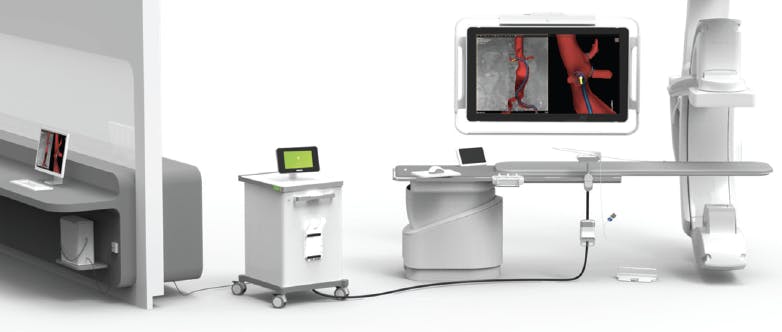
Figure 1. In-room equipment necessary to use FORS technology. Reprinted with permission from Philips Medical.
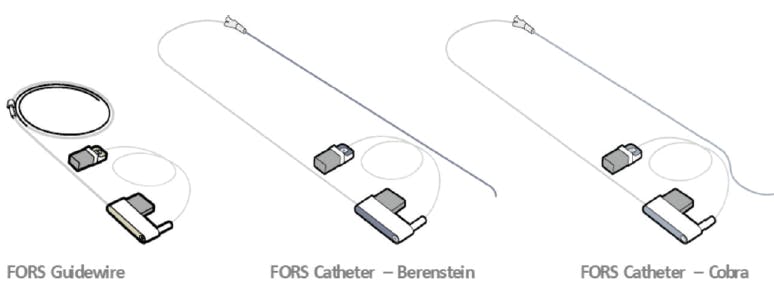
Figure 2. The initial market offering of FORS-enabled endovascular wires and catheters; all use a 0.035-inch system. From left to right: an angled guidewire (120 cm), a 5.5-F Berenstein catheter (80 cm), and a 5.5-F Cobra C2 catheter (80 cm). Reprinted with permission from Philips Medical.
The setup for a procedure that uses FORS guidance requires on-table registration of the devices and a fusion overlay with an anatomic roadmap. Operators can use preoperative CTA or digital subtraction imaging to create the roadmap. At the start of the case, the roadmap is fused with the patient’s on-table position using either cone-beam CT or fluoroscopy. The FORS-enabled devices are then prepared, first by connecting to the bedside docking hub and then by obtaining two fluoroscopy images of the device oriented ≥ 30° from one another. The operator can then manually register and adjust the position of the device using the on-screen interface (see video 1). Intraoperatively, FORS-enabled wires and catheters are rendered on screen in 3D with distinct colors and at larger than actual size to improve visibility. The viewing plane can be adjusted by the surgeon or an assistant at the computer in real time, and this biplane viewing allows multiple orientations to be viewed simultaneously.
Video 1. Demonstration of FORS-enabled device registration at the start of an endovascular case.
Aortic Interventions
Initial study of FORS has focused on use in complex endovascular aortic interventions. These procedures not only use large doses of radiation but also involve complex navigational tasks. In the first published study of FORS guidance, interventionalists performed navigational tasks in phantom and porcine models.5 This confirmed the accuracy of on-table device renderings and demonstrated a high degree of technical success when the devices were used for navigational tasks. The feasibility of the guidance system was subsequently studied in EVAR and peripheral artery lesion treatment in humans.6 The rate of technical success was 91% for navigational tasks, and some tasks were able to be performed without fluoroscopy.
Current use of FORS guidance in complex aortic interventions has primarily been for navigational tasks. Examples of such tasks include catheterization of the aorta, target vessel cannulation, and bifurcated device gate cannulation (see video 2). A key advantage has been the ability to simultaneously view wires and catheters in multiple projections without fluoroscopy. Due to the limited initial offering of FORS-enabled wires and catheters, operators often use the devices in combination with conventional catheters and steerable sheaths (see video 3). Although conventional devices are not yet rendered on screen, this approach enables users to harness the versatility and directionality afforded by steerable sheaths to complete tasks with FORS-enabled devices. Although not yet available, a catheter-agnostic FORS 3D hub is being developed to enable shape detection of conventional catheters without an embedded optical fiber. The current lack of a back-loadable wire, increased fragility compared to conventional wires (axial load and excessive bend can fracture the fibers), lack of exchange-length devices, limited catheter shapes, and restriction to a 0.035-inch platform continue to present significant limitations.
Video 2. Use of FORS devices for navigational tasks in EVAR, including cannulation of the celiac artery, superior mesenteric artery, right renal artery, left renal artery, and contralateral gate of a bifurcated stent graft.
Video 3. Pairing of FORS-enabled wires and catheters with a steerable sheath to facilitate cannulation of the superior mesenteric artery.
Clinical Availability
The FDA has granted approval for the marketing of FORS technology in the United States, and it has now entered commercial distribution.7-10 The initial phase of FORS deployment has been limited to 10 participating sites (five in Europe and five in the United States). Data from all cases using FORS guidance are currently being captured in a prospective registry and used in nested cohort studies. The initial study goals are focused on measuring the effects of FORS on procedural time, radiation usage, and patient outcomes in aortic interventions.
CONCLUSION
FORS technology presents a new alternative to fluoroscopic guidance in endovascular surgery. It aims to offset the complexity of interventions and reduce dependence on ionizing radiation. Although the technology has not yet been rigorously studied in clinical trials, early findings with usage in complex EVAR have been encouraging. As the system continues to mature and evolve, its potential role in the broader field of endovascular surgery will become clearer.
Acknowledgments: Trademarks and copyright in the pictures or in product design(s) are owned by Koninklijke Philips N.V.
1. Stecker MS, Balter S, Towbin RB, et al. Guidelines for patient radiation dose management. J Vasc Interv Radiol. 2009;20(7 suppl):S263-73. doi: 10.1016/j.jvir.2009.04.037
2. Hertault A, Maurel B, Sobocinski J, et al. Impact of hybrid rooms with image fusion on radiation exposure during endovascular aortic repair. Eur J Vasc Endovasc Surg. 2014;48:382-390. doi: 10.1016/j.ejvs.2014.05.026
3. National Aeronautics and Space Administration. Fiber optic sensing technologies. Accessed January 22, 2022. https://ntts-prod.s3.amazonaws.com/t2p/prod/t2media/tops/pdf/DRC-TOPS-37.pdf
4. Megens M, Leistikow MD, Dusschoten A, et al. Shape accuracy of fiber optic sensing for medical devices characterized in bench experiments. Med Phys. 2021;48:3936-3947. doi: 10.1002/mp.14881
5. Jansen M, Khandige A, Kobeiter H, et al. Three dimensional visualisation of endovascular guidewires and catheters based on laser light instead of fluoroscopy with Fiber Optic RealShape technology: preclinical results. Eur J Vasc Endovasc Surg. 2020;60:135-143. doi: 10.1016/j.ejvs.2020.02.035
6. van Herwaarden JA, Jansen MM, Vonken EPA, et al. First in human clinical feasibility study of endovascular navigation with Fiber Optic RealShape (FORS) technology. Eur J Vasc Endovasc Surg. 2021;61:317-325. doi: 10.1016/j.ejvs.2020.10.016
7. National Library of Medicine. DEVICE: AltaTrack catheter (00884838070950). Accessed January 22, 2022. https://accessgudid.nlm.nih.gov/devices/00884838070950
8. National Library of Medicine. DEVICE: AltaTrack catheter (00884838070967). Accessed January 22, 2022. https://accessgudid.nlm.nih.gov/devices/00884838070967
9. National Library of Medicine. DEVICE: AltaTrack equipment (00884838099340). Accessed January 22, 2022. https://accessgudid.nlm.nih.gov/devices/00884838099340
10. National Library of Medicine. DEVICE: AltaTrack guidewire (00884838070974). Accessed January 22, 2022. https://accessgudid.nlm.nih.gov/devices/00884838070974
Advertisement
Advertisement