Advertisement
Advertisement
March 2022
Sponsored by Medtronic
The VenousTSQ
Why physicians, and their patients with chronic venous insufficiency, need this new questionnaire to measure satisfaction with treatment for varicose veins.
With Clare Bradley, PhD; Charlie Gilbride, PhD; Raghu Kolluri, MD; and Kathleen Gibson, MD




How does a physician measure the success of an intervention to treat chronic venous insufficiency?
Dr. Kolluri: It depends on the stage of venous disease. Some goals are more objective than others. If there is a leg ulcer that needs to heal, then healing it is one goal. If we have a patient with intense pain, discomfort, and pruritus—maybe from C4b lipodermatosclerosis—then those things should improve. With varicose veins, the goal is for them to disappear. If the patient complains of edema, then resolution is the goal. If there is evidence that a postthrombotic great saphenous vein is causing recurrent venous thrombosis, the goal would be for our procedures to shut that vein down. Venous claudication is another important consideration. Whatever complaints the patient comes in with, whether or not they will improve is what I’m looking at as a measure of success.
I always ask the patient what they would like to achieve with intervention on their veins. I level set expectations with the patient as to whether or not I can help with that. Anatomic success is a feel-good endpoint for the physician, but the patient should feel that they received good care and that their problem resolved or improved after undergoing such an intervention.
Dr. Gibson: There is a range of venous disease severity. Sometimes the measure of success is objective, such as the healing of an ulcer or the circumference of a leg with swelling. The more advanced the disease state, the more often we have objective measures that can be used. When the disease is less advanced, success is more often determined by patient feedback: Were the symptoms that caused them to seek treatment resolved? With the majority of the chronic venous insufficiency cases we treat in the United States, the outcomes may be more subjective (eg, how the leg looks and feels to the patient). Many times, a physician gauges the success of the treatment not by what the patient is feeling but by what the physician sees when they examine them. That’s probably not the right way of doing things. I might look at a patient’s leg and think it looks good and they should feel better, but that might not be what the patient is experiencing. Physicians use surrogate markers for success, such as vein closure on duplex ultrasound, to measure success as a primary outcome measure. Such tools aren’t based on how the patient feels. Patients don’t say, “I’m here because I have great saphenous vein reflux.” Nor do they report later, “I’m delighted that my ultrasound showed no reflux.” Patients are more likely to feel that their procedure was successful if their quality of life (QOL) improved and/or their leg feels better.
How does a physician know that a patient is satisfied with the treatment for their vein condition?
Dr. Kolluri: The first visit with the patient should involve level setting expectations and documenting that in the chart. A few weeks after the procedure, we should assess whether we achieved everything the patient was expecting from the treatment. It’s less about the physician’s goals.
For example, we can objectively demonstrate to the patient that their ulcer is healed or that the postthrombotic saphenous vein will not clot again, but patient satisfaction also involves patient-reported measures and whether we reach the patient-expected endpoint.
Dr. Gibson: Physicians usually rely on patients to tell them at follow-up, but a few practices use a questionnaire. The problem is that some patients tell the physician what they want to hear, and they may understate or overstate problems. This highlights the need for a questionnaire that asks questions that patients think are important, not just questions that are important to their physician. Generally, a physician asks whether the patient is satisfied with a treatment and then digs deeper to determine the reason.
Why is it important to achieve patient satisfaction when treating vein disease?
Dr. Kolluri: Patient satisfaction should be the goal of all health care providers. Physicians provide a service, and patients should feel that they have been served. Venous disease is not an exception. Even in the hospital setting with lifesaving procedures, satisfaction measures improve with comprehensive care from a team consisting of nursing, ancillary personnel, and physicians.
Dr. Gibson: Patient satisfaction is very important with venous disease because it impacts daily activities and QOL. Venous disease doesn’t shorten life expectancy and rarely causes hospitalization. It is very much a disease that impacts how a patient may feel about their body or how it functions. The outcome should not be measured solely by an imaging finding. It should also assess the patient’s experience.
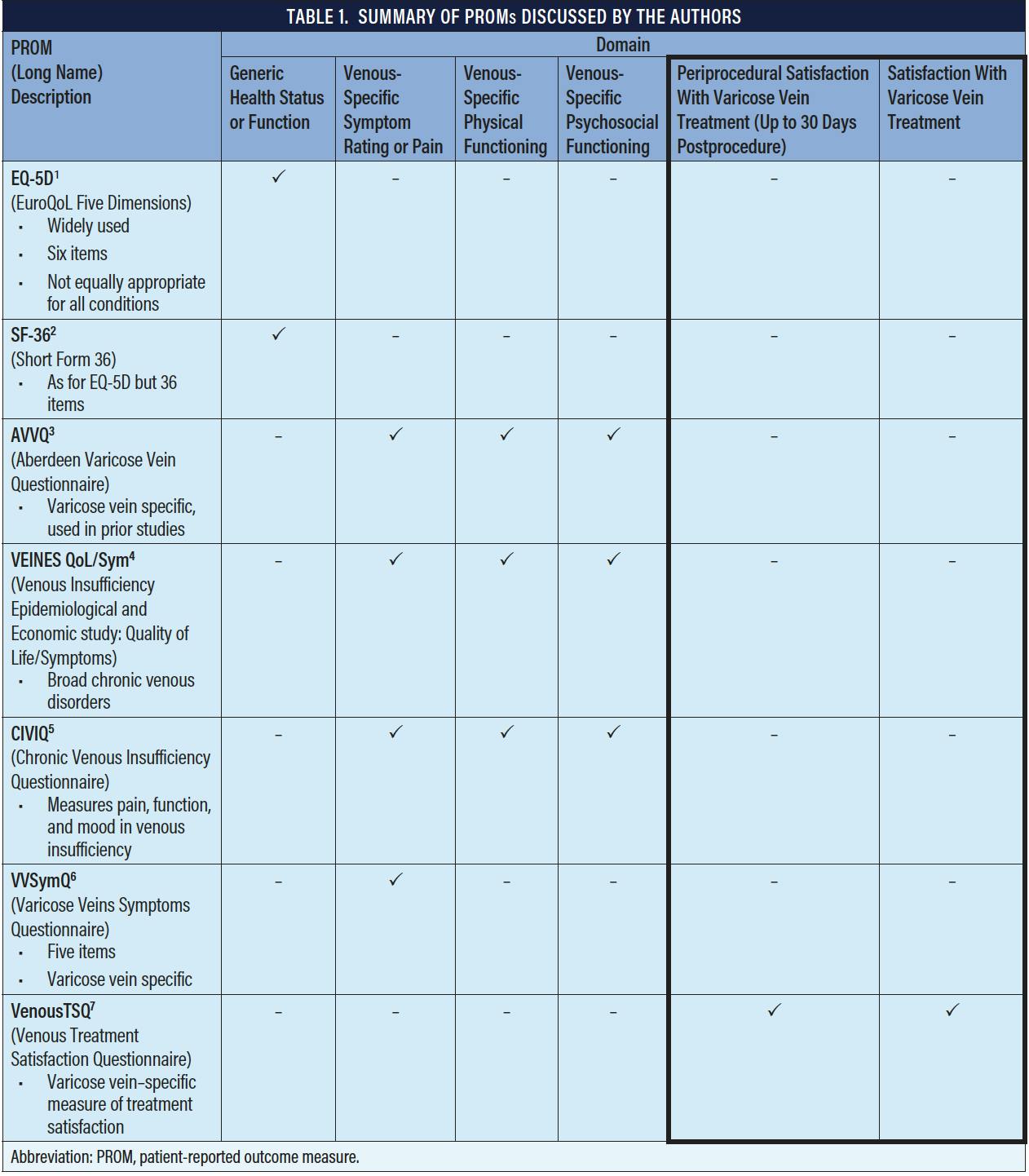
In what settings are patient-reported outcome measures (PROMs) used (Table 1)?1-7
Dr. Kolluri: They are most often used in a clinical trial setting and are a great way of systematically assessing how patients are feeling.
Dr. Gibson: They are primarily used in research and not often in daily practice. If you have one that is easy to use, reproducible, and fast, then I think it would be applicable for use in practice for a physician to see how they are doing and whether their patients are satisfied. You could also use it in a larger practice to benchmark or say, “This is our goal” or “We expect this level of satisfaction.” It could be beneficial for physicians to use them more often.
What is the VenousTSQ?
Prof. Bradley: The VenousTSQ7 is one of a series of condition-specific treatment satisfaction questionnaires (TSQs) that ask about satisfaction with treatments for a particular medical condition. The first of these was the DTSQ for diabetes,8 and a dozen or so TSQs for other conditions have followed. TSQs aim to capture satisfaction/dissatisfaction with all salient aspects of a treatment, including any procedures or education provided by the hospital and follow-up treatments and self-management by the patients themselves.
How is the VenousTSQ different from other PROMs in this patient population?
Prof. Bradley: The VenousTSQ is condition specific but not treatment specific. This means that the VenousTSQ contains items that are selected for their relevance to patients with varicose veins, and the measure is designed to be sensitive to any differences in satisfaction levels between patients receiving different treatments.
None of the other PROMs designed specifically for patients receiving varicose vein treatment measure treatment satisfaction (Table 1).1-7 They measure symptoms, health status, physical functioning, social functioning, emotional functioning, or a mixture of these. Measuring these concepts may be useful, but they are no substitute for directly asking patients how satisfied they are with their treatment. The VenousTSQ can identify which aspects of treatment contribute to satisfaction and which, if any, aspects of treatment are less satisfactory. By clearly focusing on one specific concept for one condition, the VenousTSQ can be shorter, more relevant, easier to interpret and understand, and more responsive to differences between treatments compared to the longer questionnaires that attempt to measure a mixture of different concepts.
How is the VenousTSQ designed?
Dr. Gilbride: Having developed TSQs for other conditions in the past, we used a template that is common to those TSQs for the VenousTSQ. We also used an item library that contains all the items developed for previous TSQs. Each TSQ will ask questions that are likely to be highly condition specific (eg, “How bothered have you been by wearing compression stockings/bandages?”), but others are likely to be relevant for other patient groups (eg, “How bothered are you by the discomfort or pain?”). As with other new TSQs, we started by asking specialist clinicians to review the item library to indicate the relevance of each existing item and suggest new ones. Our clinician colleagues Drs. Manjit Gohel and Kathleen Gibson contributed to the VenousTSQ design in this way. After the clinician review, the design team, made up of psychologists and linguists with experience of questionnaire design or linguistic validation of other TSQs into other languages, met to discuss the clinician input and produce a first draft of the VenousTSQ.
Then, the interviews began. The design team met after every two to four interviews and made revisions based on participant feedback. This was a crucial step in the design process to ensure that the items are relevant for the intended patient population. After 11 interviews were conducted with United Kingdom participants, it was clear that no additional changes to the questionnaire were required for the United Kingdom. We went on to interview patients with experience of varicose vein treatment in the United States. The United Kingdom English questionnaire was first linguistically adapted into United States English, and the drafts were reviewed by Drs. Gibson and Gohel. Four interviews with patients from the United States demonstrated that no further changes were needed. Using a library of previously tried and tested items and involving both patients and specialist clinicians in the design process gives us confidence that our measure of treatment satisfaction for varicose veins will be shown to be valid and reliable. To provide quantitative evidence of the questionnaire’s validity and reliability, we need to undertake psychometric analyses. The data collection to be used for this is underway.
For those who wish to know more, we have described the design of the VenousTSQ in a published abstract7 and virtual poster9 and will be submitting a manuscript to a peer-reviewed journal in the near future.
Why is the VenousTSQ needed?
Dr. Kolluri: In my clinical practice, the goal is to obtain CEAP (clinical, etiology, anatomy, pathophysiology), Venous Clinical Severity Score (VCSS), and Villalta clinical scores in 100% of patients. However, none of those capture how the patient felt during the procedure and how satisfied they were after. When each patient comes back, we ask, “Are you satisfied with the procedure?” The answer choices are yes, maybe, and no. This is not offered in any PROMs other than VenousTSQ. Right after a procedure, I ask patients how they felt postprocedure compared to their expectation, as well as what their discomfort was like, using the Numeric Pain Rating Scale10 for example. I immediately document that patient response. At the follow-up visit 1 to 6 weeks later, I ask every patient about the satisfaction, going back to, “Have we achieved what you wanted from the procedure?”
The VenousTSQ represents what I have been missing and trying to find on my own for my patients.
Dr. Gibson: Currently, we do not ask if patients had problems during recovery or how satisfied they are with the treatment. Asking these questions could benefit a physician’s daily practice. In terms of research, the VenousTSQ may help us differentiate between various therapies. The other tools don’t tell us if the patient liked a therapy. The VenousTSQ is different in that it can tell us a lot about a patient’s journey through treatment.
Please visit www.healthpsychologyresearch.com for access to the VenousTSQ and TSQs for other conditions, including the AneurysmTSQ.
Disclosures:
The VenousTSQ work is funded by the Medtronic Bakken Research Center via a research grant and honoraria to Health Psychology Research (HPR) Ltd. HPR is a small, family-led company specializing in the design, development, linguistic validation, and use of PROMs.
Prof. Bradley: Director and majority shareholder of HPR Ltd; owns the copyright in the VenousTSQ and other PROMs designed with her research team; receives royalties when license fees are paid by commercial companies for use of her questionnaires.
Dr. Gilbride: Led the design work on the VenousTSQ and is Prof. Bradley’s son.
Dr. Kolluri: Consultant, advisor, data and safety monitoring board, and clinical events committee services for Medtronic, Philips, Thrombolex, Vesper Medical, Inari, Abbott, Surmodics, Penumbra, and Mercador; executive board member at VIVA Physicians, Inc., a 501(c)3 corporation; and President of Syntropic Core Lab.
Dr. Gibson: On the advisory board for Boston Scientific, Terumo, and Vesper; consultant to and receives honoraria and research funding from Medtronic.
1. Balestroni G, Bertolotti G. [EuroQol-5D (EQ-5D): an instrument for measuring quality of life]. Monaldi Arch Chest Dis. 2012;78:155-159. doi: 10.4081/monaldi.2012.121
2. Garratt AM, Macdonald LM, Ruta DA, et al. Towards measurement of outcome for patients with varicose veins. Qual Health Care. 1993;2:5-10. doi: 10.1136/qshc.2.1.5
3. Garratt AM, Ruta DA, Abdalla MI, Russell IT. Responsiveness of the SF-36 and a condition-specific measure of health for patients with varicose veins. Qual Life Res. 1996;5:223-234. doi: 10.1007/bf00434744
4. Ribeiro-Samora GA, Carvalho MLV, de Moura RMF, Pereira DAG. Limitations of VEINES QOL/SYM for discriminating chronic venous insufficiency severity. J Vasc Bras. 2019;19:e20180096. doi: 10.1590/1677-5449.180096
5. Launois R, Reboul-Marty J, Henry B. Construction and validation of a quality of life questionnaire in chronic lower limb venous insufficiency (CIVIQ). Qual Life Res. 1996;5(6):539-554. doi: 10.1007/bf00439228
6. Wright DD, Paty J, Turner-Bowker DM, Bradbury A. Psychometric evaluation of a new patient-reported outcome (PRO) symptom diary for varicose veins: VVSymQ(®) instrument. Patient. 2016;9:335-348. doi: 10.1007/s40271-015-0159-3
7. Gilbride C, Bayfield J, Wilson A, et al. (3102) Design of a treatment satisfaction measure for patients undergoing varicose vein treatment: the venous treatment satisfaction questionnaire (VenousTSQ). Qual Life Res. 2020;29(suppl 1):1-196. doi: 10.1007/s11136-020-02626-y
8. Bradley C. The diabetes treatment satisfaction questionnaire: DTSQ. In: Bradley C, ed. Handbook of Psychology and Diabetes: A Guide to Psychological Measurement in Diabetes Research and Practice. Harwood Academic Publishers; 1994:111-132.
9. International Society for Quality of Life Research. Design of a treatment satisfaction measure for patients undergoing varicose vein treatment: the venous treatment satisfaction questionnaire (VenousTSQ). Accessed February 28, 2022. https://isoqol27-isoqol.ipostersessions.com/default.aspx?s=A3-60-D9-89-22-06-FE-BA-C9-D4-49-8F-33-98-5B-D6&guestview=true
10. Hjermstad MJ, Fayers PM, Haugen DF, et al. Studies comparing numerical rating scales, verbal rating scales, and visual analogue scales for assessment of pain intensity in adults: a systematic literature review. J Pain Symptom Manage. 2011;41:1073-1093. doi: 10.1016/j.jpainsymman.2010.08.016
500989 ©2022 Medtronic. Medtronic, Medtronic logo are trademarks of Medtronic. All other brands are trademarks of Medtronic. For global distribution. 03/2022
Advertisement
Advertisement