Advertisement
Advertisement
May 2022
Extra-Anatomic Solutions for Long SFA Occlusions in CLI
An overview of emerging extra-anatomic interventions for critical limb ischemia and techniques for challenging superficial femoral artery occlusions.
Critical limb ischemia (CLI) is the most severe presentation of peripheral artery disease (PAD) and is characterized by severe rest pain and foot ulcers as well as high morbidity and mortality. Studies have shown that 45% of these patients have superficial femoral artery (SFA) lesions and frequently have long chronic total occlusions (CTOs).1 The standard treatment for SFA occlusions > 25 cm is surgical bypass, as recommended by most recent guidelines2,3; however, an endovascular approach should be considered in selected cases, particularly in patients with CLI. In fact, the absence of a vein conduit, the presence of severe comorbidities, or the absence of a target artery to perform distal anastomosis should be considerations for an endovascular approach. Several new strategies, including the use of drug-coated balloons, drug-eluting stents, atherectomy, and covered stents, have been introduced and have improved outcomes of the endovascular approach.4
However, failure rates range from 10% to 20% according to recent meta-analyses, particularly in patients with previously failed bypass or in the presence of severe calcifications.5 Alternative extra-anatomic solutions can be considered in experienced centers to reduce the failure rate and improve limb salvage for these patients.
INDICATIONS FOR EXTRA-ANATOMIC APPROACHES FOR LONG SFA CTO
The main indication for the extra-anatomic approach is the presence of CLI with a risk of major amputation. The aim of the procedure is to create direct flow to the foot in a patient with previous failure of surgical and conventional intraluminal or subintimal approaches.
Patients with no option for a surgical bypass due to concomitant comorbidities, lack of vein conduit, or absence of a target vessel for a distal anastomosis should be considered for these procedures if a conventional endovascular approach (including intraluminal or subintimal retrograde approach) failed. One cause of failure of a conventional endovascular approach is a previous ligature of a native artery during surgical bypass or heavy calcifications that did not allow for recanalization and significantly reduced short-term patency.
TYPES OF EXTRA-ANATOMIC PROCEDURES FOR LONG SFA CTO
Different types of extra-anatomic revascularization have been recently described in various studies. Each approach presents some advantages and disadvantages, and there are no studies comparing these interventions. Procedures could be divided into totally arterial extra-anatomic endovascular bypass and transvenous extra-anatomic endovascular bypass.
Totally Arterial Endovascular Bypass
The first totally arterial extra-anatomic endovascular bypass was described by Sarradon et al.6 In a study including 22 patients, the authors describe a procedure divided into the following three steps: (1) the creation of three arterial access sites, (2) guidewire tunneling, and (3) covered stenting (Figure 1). The procedure starts with an 8-F contralateral common femoral approach, a retrograde puncture of the 8-F homolateral occluded SFA, and an antegrade puncture of the distal patent SFA using a peel-away introducer (Figure 1A). Once the three vascular access sites are created, a long 260-cm guidewire is advanced from the contralateral access into the proximal superficial femoral retrograde access (Figure 1B). Then, a long sheath is advanced on this guidewire (Figure 1C). The guidewire is subfascially tunneled to the distal antegrade access (Figure 1D), and it is inserted in the distal patent artery through the peel-away sheath (Figure 1E). The procedure is completed with stenting of the extra-anatomic path and postdilatation (Figure 1F).
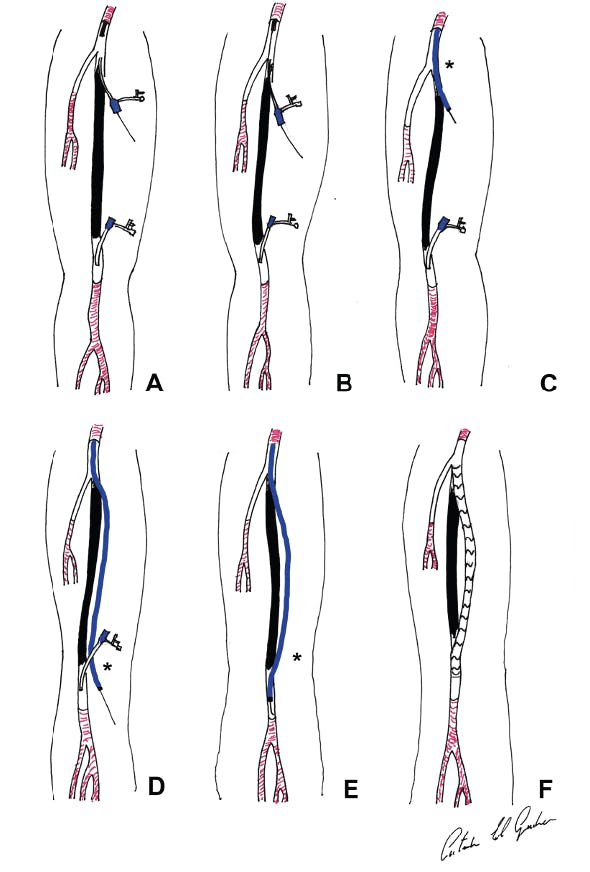
Figure 1. Totally arterial endovascular bypass as described by Sarradon et al.6 The procedure begins with a retrograde contralateral puncture of the common femoral artery, retrograde puncture of the homolateral common femoral artery, and antegrade puncture of the distal patent SFA using a peel-away introducer (A). A long 260-cm guidewire is advanced into the proximal superficial femoral retrograde access (B), and a long sheath is advanced on this guidewire (C). A subfascial tunneling of the guidewire is performed (D), and it is inserted into the distal patent artery through the peel-away sheath (E). The procedure is completed by achieving covered stenting of the extra-anatomic tract and postdilatation (F).
Experience with ultrasound-guided puncture is needed for this approach, but overall it is not technically demanding. This technique uses covered self-expanding stents, such as Viabahn (Gore & Associates) or Covera (BD Interventional). Experience with subfascial tunneling is also required. The biggest disadvantage is the risk of kinking of the covered stent in the extra-anatomic anatomy, which could reduce patency. Sarradon et al reported good mid-term results, with a primary patency of 83%.6
Another approach was introduced by Di Primio et al, who evaluated 15 patients with CLI treated with extra-anatomic femoropopliteal bypass.7,8 In this technique, the procedure is performed through an 8-F antegrade femoral artery approach. The occluded femoral artery could be treated by an extra-anatomic endovascular bypass from the SFA or from the deep femoral artery depending on anatomic features (eg, the presence of a previous surgical ligation of the SFA). The extra-anatomic path is created using a Colapinto needle (Cook Medical) or a BRK transseptal needle (Abbott). Once the site of puncture is joined with a diagnostic catheter (Figure 2A), the needle is advanced on the guidewire (Figure 2B). After the puncture gains the right amount of extra-anatomic space, the needle is retracted and a hydrophilic 0.035-inch stiff guidewire, supported by a vertebral or Bern-shaped catheter, is used to create the trajectory in the muscle to the target vessel below the occlusion. Finally, the needle is used to reenter in the patent vessel (Figure 2C) and advance the guidewire distally (Figure 2D). The procedure is completed with a covered stent as previously described (Figure 2E). Sometimes the puncture of the distal vessels can be facilitated by a retrograde puncture to advance and inflate a balloon in the target zone. The use of a combined retrograde approach improves guidewire support to advance the covered stent in the extra-anatomic trajectory and reduces the risk of kinking.7
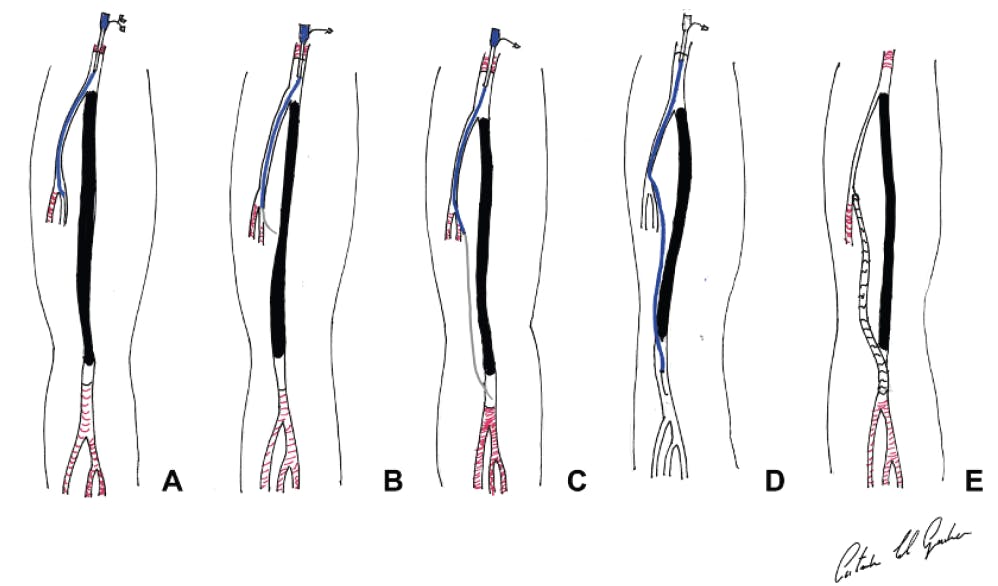
Figure 2. Totally arterial endovascular bypass as described by Di Primio et al.7 The site of puncture is joined with a diagnostic catheter (A), and the needle is advanced on the guidewire (B). The needle reenters the patent vessel (C) and advances the guidewire distally (D). The procedure is completed with a covered stent (E).
As reported by Di Primio et al, this approach presented a poor result in terms of primary patency (27%) and secondary patency (60%), with several reinterventions needed to maintain a flow to the foot (67%). Most of these patients were severely ill and had diabetes (27%), and many had severely calcified PAD, which could account for the poor patency outcome. However, patients presented with 80% freedom from amputation at 1-year follow-up and complete wound healing in 73%.7
An alternative technique of arterial extra-anatomic bypass using the Outback catheter (Cordis) was presented at the 2021 Pan Arab Interventional Radiology Society Congress.9 In this technique, an antegrade common femoral approach is performed using a 6-F sheath. After a vertebral or Bern-tip catheter is advanced in contact with the proximal part of the occluded SFA, the arterial wall is intentionally punctured using the back tip of a 0.035-inch stiff guidewire. The catheter is advanced into the extra-anatomic space, with the guidewire inverted and its stiff back end used to advance the catheter beyond the occluded tract. Then, the Outback catheter is advanced on a 0.014-inch guidewire. A patent tibial artery is distally punctured, and a 3.5-mm balloon is advanced retrograde on a 0.014-inch guidewire to the occluded tract. After balloon inflation, the Outback catheter is used to puncture the arterial wall, and a guidewire is advanced in the distal patent artery using the inflated balloon as a target. The endovascular bypass is then created using a covered stent (Figure 3).
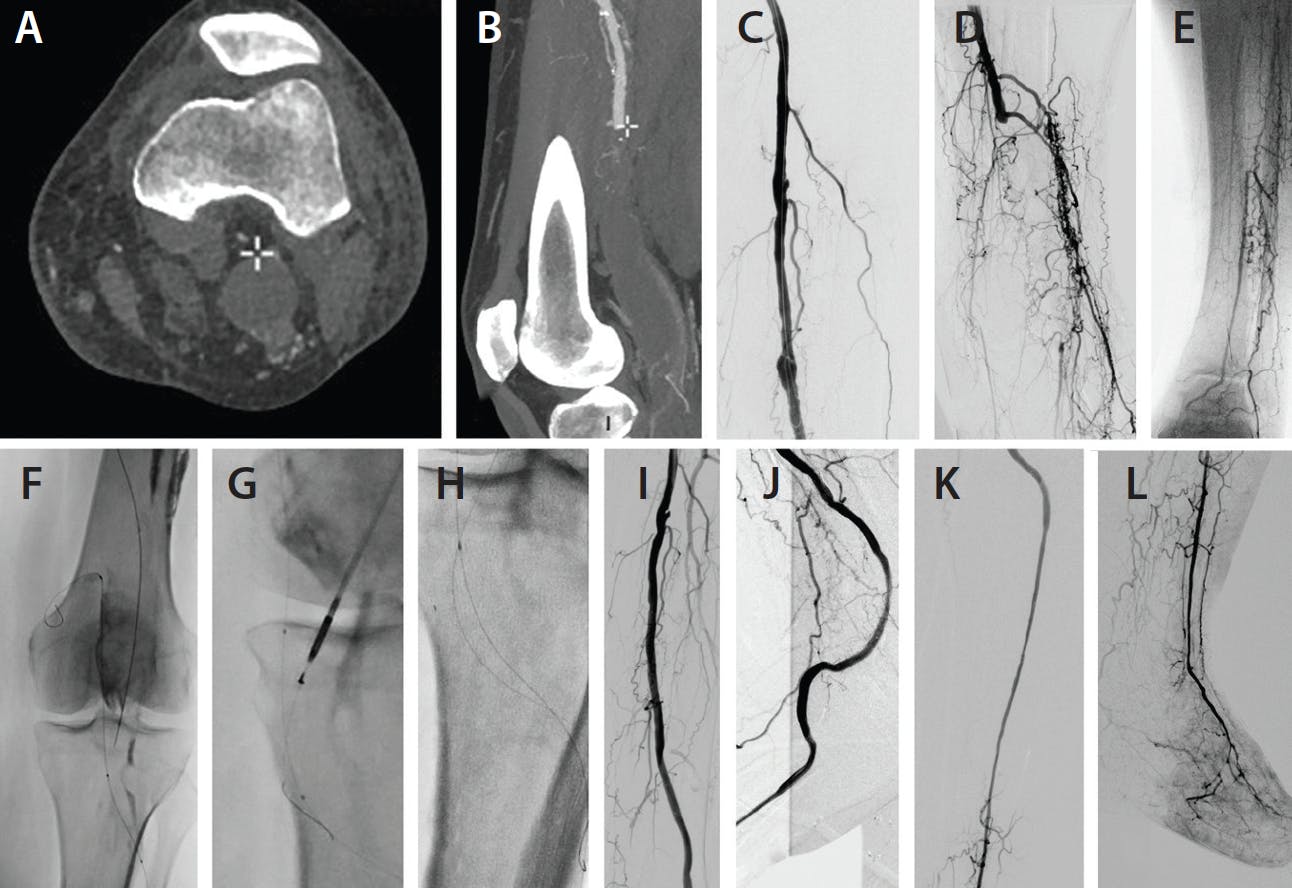
Figure 3. Revascularization of a patient with diabetes with a Rutherford class 6 forefoot ulcer. Occlusion of a popliteal aneurysm (A-E). The aneurysm sac is intentionally punctured with the back tip of a stiff guidewire, after failure to achieve an antegrade and retrograde access (F). An Outback catheter is used to reenter into the true lumen from an extra-anatomic space (G, H). The endovascular bypass is created with a covered stent (I-L).
Five CLI patients were treated for long SFA CTOs without periprocedural adverse events and with 100% short-term patency. The main advantage of this approach is the possibility of conventional subintimal recanalization and, in case of failure, use of the same devices to create an extra-anatomic bypass. Moreover, the extra-anatomic bypass is close to the native artery without the risk of kinking, which could potentially reduce long-term patency.
Transvenous Endovascular Bypass
In the transvenous endovascular bypass approach, an extra-anatomic path is created to connect the occluded artery to an adjacent vein used as bypass. The first experience with this approach used a dedicated device, the Detour system (PQ Bypass), to create a connection between the artery and vein.10 This device has an arterial catheter, characterized by a lateral needle used to create the extra-anatomic path; a dedicated venous snare; and a dedicated stent graft, the Torus stent (PQ Bypass). The procedure is performed from an 8-F contralateral femoral approach and a venous tibial access (Figure 4A). The arterial catheter is advanced proximally to the SFA occlusion vein, and the venous snare is advanced into the femoral vein at the same level. A first crossing between the artery and vein is created using the lateral needle under fluoroscopy guidance (Figure 4B). The needle transfixes the arterial and vein walls using the snare as a target. A 0.014-inch guidewire is advanced into the crossing device to the venous snare, both devices are retracted, and an 8-F sheath is advanced from the contralateral femoral access to the vein. Next, a second crossing is performed with the arterial catheter using the needle to distally connect the artery to the occluded tract (Figure 4C). The procedure is completed with a covered stent (Figure 4D).
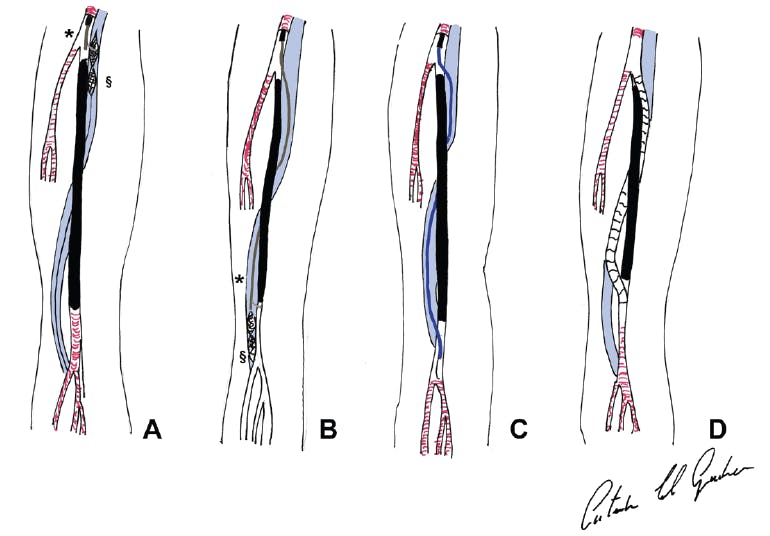
Figure 4. Transvenous endovascular bypass with the Detour system. An 8-F contralateral femoral approach is performed and venous tibial access achieved (A). A crossing between the artery and vein is created using the lateral needle under fluoroscopy guidance (B). A second crossing is performed with the catheter using the needle to connect the vein distally to the occluded tract (C). The procedure is completed with a covered stent (D).
The DETOUR I trial included 78 patients with TransAtlantic Inter-Society Consensus C and D lesions.10 The procedure was characterized by a low rate of major adverse events with excellent 2-year primary (79%) and secondary patency (86%).11
Touma et al recently published a case series of three CLI patients using a similar technique.12 In this technique, the proximal crossing between the artery and vein is performed through a direct puncture of the femoral vein and artery under ultrasound guidance. Then, the guidewire is recovered from a snare loop advanced from a contralateral approach (Figure 5A), and the contralateral sheath is advanced into the femoral vein (Figure 5B). Once the level of the occluded SFA artery is crossed, a second crossing between the distal patent artery and the femoral vein is created with an ultrasound-guided puncture using the same technique. A second guidewire is then advanced into the femoral vein to perform a rendezvous with the sheath in the femoral vein (Figure 5C). Finally, the guidewire is advanced into the distal patent artery (Figure 5D) and the endovascular bypass is created using a covered stent (Figure 5E). Immediate good results were described with 100% patency at 6-month follow-up. This approach allows the creation of a transvenous endovascular bypass without the need for a dedicated device but required particular skills in ultrasound-guided puncture.
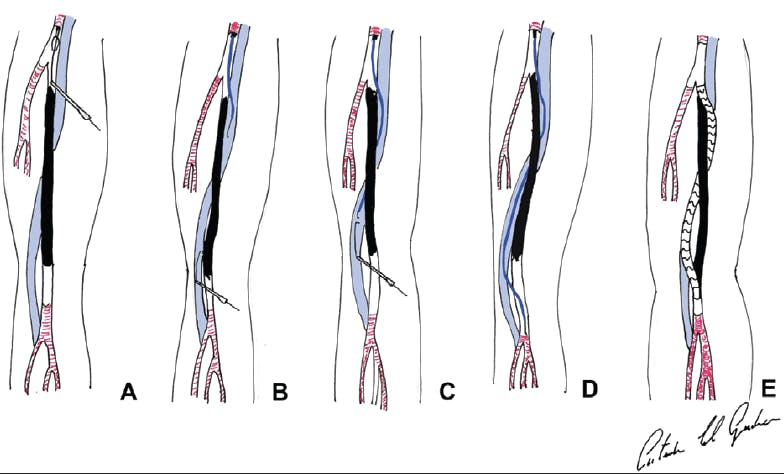
Figure 5. Transvenous endovascular bypass as described by Touma et al.12 The guidewire is recovered from a snare loop advanced from a contralateral approach (A), and the contralateral sheath is advanced into the femoral vein (B). A second guidewire is advanced from a needle transfixing the distal patent femoral artery and the vein, and a rendezvous is performed with the sheath in the femoral vein (C). Finally, the guidewire is advanced into the distal patent artery (D), and the endovascular bypass is created using a covered stent (E).
CONCLUSION
Several treatment approaches exist for patients with long SFA CTOs who have no conventional surgical or endovascular treatment options. Appropriate patient selection is fundamental to evaluate those who may benefit from these techniques. These procedures could be considered by interventionalists in the event of failure of the conventional approaches, but further investigations are needed to understand the real efficacy and value of extra-anatomic solutions in clinical practice.
1. Ferraresi R, Mauri G, Losurdo F, et al. BAD transmission and SAD distribution: a new scenario for critical limb ischemia. J Cardiovasc Surg (Torino). 2018;59:655-664. doi: 10.23736/S0021-9509.18.10572-6
2. Aboyans V, Ricco JB, Bartelink MLEL, et al. 2017 ESC guidelines on the diagnosis and treatment of peripheral arterial diseases, in collaboration with the European Society for Vascular Surgery (ESVS): document covering atherosclerotic disease of extracranial carotid and vertebral, mesenteric, renal, upper and lower extremity arteries. Endorsed by: the European Stroke Organization (ESO), The Task Force for the Diagnosis and Treatment of Peripheral Arterial Diseases of the European Society of Cardiology (ESC), and of the European Society for Vascular Surgery (ESVS). Eur Heart J. 2018;39:763-816. doi: 10.1093/eurheartj/ehx095
3. Hirsch AT, Haskal ZJ, Hertzer NR, et al. ACC/AHA guidelines for the management of patients with peripheral arterial disease (lower extremity, renal, mesenteric, and abdominal aortic): a collaborative report from the American Associations for Vascular Surgery/Society for Vascular Surgery, Society for Cardiovascular Angiography and Interventions, Society for Vascular Medicine and Biology, Society of Interventional Radiology, and the ACC/AHA Task Force on Practice Guidelines (writing committee to develop guidelines for the management of patients with peripheral arterial disease)—summary of recommendations. J Vasc Interv Radiol. 2006;17:1383-1397. doi: 10.1097/01.RVI.0000240426.53079.46
4. AbuRahma AF. When are endovascular and open bypass treatments preferred for femoropopliteal occlusive disease? Ann Vasc Dis. 2018;11:25-40. doi: 10.3400/avd.ra.18-00001
5. Met R, Van Lienden KP, Koelemay MJW, et al. Subintimal angioplasty for peripheral arterial occlusive disease: a systematic review. Cardiovasc Intervent Radiol. 2008;31:687-697. doi: 10.1007/s00270-008-9331-7
6. Sarradon P. LEA 22. Totally percutaneous femoral-popliteal bypass: the best of both worlds. J Vasc Surg. 2018;68(suppl):e122. doi: 10.1016/j.jvs.2018.08.033
7. Di Primio M, Angelopoulos G, Lazareth I, et al. Endovascular extra-anatomic femoro-popliteal bypass for limb salvage in chronic critical limb ischemia. Cardiovasc Intervent Radiol. 2019;42:1279-1292. doi: 10.1007/s00270-019-02253-2
8. Di Primio M, Angelopoulos G, Lazareth I, et al. Innovative endovascular approach for limb salvage in critical limb ischemia. J Med Vasc. 2020;45:23-27. doi: 10.1016/j.jdmv.2019.09.005
9. Del Giudice C. Extra-anatomic endovascular femoro-popliteal bypass: when and how. Presented at: PAIRS Congress; February 26-27, 2021; virtual meeting.
10. Krievins D, Savlovskis J, Ezite N, et al. The DETOUR procedure: no more need for conventional bypass surgery? J Cardiovasc Surg (Torino). 2018;59:172-177. doi: 10.23736/S0021-9509.18.10353-3
11. Helena G, Krievins KD, Scheinert D, et al. Percutaneous femoropopliteal bypass: 2-year results of the Detour system. J Endovasc Ther. 2022;29:84-95. doi: 10.1177/15266028211034862
12. Touma J, Senemaud J, Jaziri A, et al. Percutaneous trans-venous femoropopliteal bypass in long occlusions of the superficial femoral artery. Cardiovasc Intervent Radiol. 2019;42:1800-1805. doi: 10.1007/s00270-019-02310-w
Advertisement
Advertisement