Advertisement
Advertisement
November 2022
Sponsored by Inari Medical
First Reports on the Novel InThrill Thrombectomy System
A lytic-free approach for the rapid removal of venous thrombi outside the iliofemoral region.
With Vivek Kumar, DO, FACC, FSCAI, MBA, and Pavan Khanna, MD, MS, DABR
There is an unmet need for an approach to the treatment of venous thrombosis outside of the iliofemoral region that avoids the complications of thrombolytics and has the potential to provide symptom relief in a single session. Approximately 10% of all venous thrombosis cases occur in the upper extremities.1 Below-the-knee (BTK) cases are even more substantial, involving about half of all diagnosed venous leg thromboses.2 Complications from these cases include rethrombosis, postthrombotic syndrome (PTS), and, in some cases, pulmonary embolism (PE) and even mortality.1 Symptomatic PE has been reported in approximately 5.2% of patients with upper extremity venous thrombosis,2-5 and in patients with BTK occlusions, up to 33% were found to have PE.6-8 PTS occurs in approximately 20% of patients with upper extremity venous thromboses.2,4,5
Current guidelines for treatment are extremely conservative: a 3-month course of anticoagulation alone is recommended.1,2,4,5 Anticoagulants only prevent the formation of new thrombi and do not break down existing thrombus. Guidelines state that thrombolysis may be considered in young and active patients and that treatment is most effective when used within the first 2 weeks of symptoms, as organized thrombus older than 2 weeks is less responsive to thrombolytics. Catheter-directed thrombolysis was shown to be 11 times less effective against chronic thrombus (> 4 weeks) compared to acute and subacute thrombus.9
Venous thrombi often do not immediately present with symptoms, and this delayed or gradual onset may result in an underestimate of thrombus chronicity. By the time symptoms appear, subacute or chronic obstructions may have already formed, and a majority of the thrombus will have become resistant to thrombolytics by the time of treatment.10 Furthermore, thrombolytic therapy is associated with a high risk of bleeding complications regardless of dosage or patient selection.1,11 With catheter-directed thrombolysis, a catheter is typically left in place for at least 24 hours, requiring the patient to be monitored in an intensive care unit (ICU), with venograms obtained every 8 to 24 hours to assess for residual thrombus.12 Therefore, availability of ICU beds and other patient monitoring resources need to be considered, as well as the additional costs associated with an extended hospital stay.
Current percutaneous thrombectomy treatment options frequently use thrombolytics, are associated with serious complications including acute kidney injury and major bleeding, and/or rely on continuous aspiration leading to high volume of blood loss.13-15 To remove the full spectrum of thrombus from small vessels, an effective, thrombolytic-free approach is needed, one that can provide patients with immediate symptom relief in a single session.
The InThrill Thrombectomy System (Inari Medical) is a minimally invasive, mechanical thrombectomy device designed to remove acute to chronic thrombi and emboli from the peripheral vasculature without the associated bleeding risks of thrombolysis or the substantial blood loss associated with devices that use continuous aspiration (Figure 1). This simple and intuitive 8-F system consists of the InThrill sheath and the InThrill thrombectomy catheter. The sheath has a recapturable, distal-braided funnel and a side port for aspiration and is designed to simplify insertion, repositioning, and thrombus removal. The InThrill thrombectomy catheter features a self-expanding nitinol coring element and a working length of 65 cm for precise positioning and versatility in 4- to 10-mm vessels.
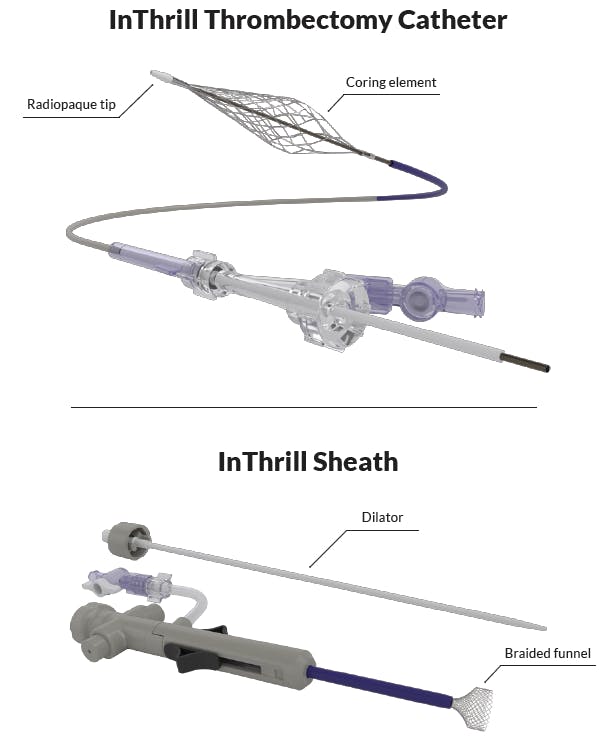
Figure 1. InThrill Thrombectomy System.
This article highlights two cases in which the InThrill Thrombectomy System was used successfully as a first-line treatment to remove thrombus in a patient with upper extremity peripheral thrombosis and a patient with lower extremity thrombosis. These cases demonstrate the feasibility and initial outcomes of a novel thrombolytic-free treatment option for the rapid removal of thrombus with a range of chronicities in the peripheral vasculature.
1. Kakkos SK, Gohel M, Baekgaard N, et al. Editor’s choice—European Society for Vascular Surgery (ESVS) 2021 clinical practice guidelines on the management of venous thrombosis. Eur J Vasc Endovasc Surg. 2021;61:9-82. doi: 10.1016/j.ejvs.2020.09.023
2. Kearon C, Akl EA, Comerota AJ, et al. Antithrombotic therapy for VTE disease: antithrombotic therapy and prevention of thrombosis, 9th ed: American College of Chest Physicians evidence-based clinical practice guidelines. Chest. 2012;141(2 suppl):e419S-e496S. doi: 10.1378/chest.11-2301
3. Williams GW, Giri S, Siwakoti K, et al. Incidence, risk factors and outcomes of upper extremity deep venous thrombosis among hospitalized patients in the United States. Am J Respir Crit Card Med. 2016;193:A7768.
4. Kearon C, Akl EA, Ornelas J, et al. Antithrombotic therapy for VTE disease: CHEST guideline and expert panel report. Chest. 2016;149:315-352. doi: 10.1016/j.chest.2015.11.026
5. Stevens SM, Woller SC, Baumann Kreuziger L, et al. Antithrombotic therapy for VTE disease: second update of the CHEST guideline and expert panel report. Chest. 2021;160:e545-e608. doi: 10.1016/j.chest.2021.07.055
6. Stein PD, Matta F, Musani MH, Diaczok B. Silent pulmonary embolism in patients with deep venous thrombosis: a systematic review. Am J Med. 2010;123:426-431. doi: 10.1016/j.amjmed.2009.09.037
7. Moreno-Cabral R, Kistner RL, Nordyke RA. Importance of calf vein thrombophlebitis. Surgery. 1976;80:735-742.
8. Kim SM. Clinical presentation of isolated calf deep vein thrombosis in inpatients and prevalence of associated pulmonary embolism. J Vasc Surg Venous Lymphat Disord. 2022;10:1037-1043. doi: 10.1016/j.jvsv.2022.02.011
9. Arnoldussen CWKP, Notten P, Brans R, et al. Clinical impact of assessing thrombus age using magnetic resonance venography prior to catheter-directed thrombolysis. Eur Radiol. 2022;32:4555-4564. doi: 10.1007/s00330-022-08599-5
10. Maldonado TS, Dexter DJ, Kado H, et al. Outcomes from the ClotTriever Outcomes Registry show symptom duration may underestimate deep vein thrombus chronicity. J Vasc Surg Venous Lymphat Disord. 2022;10:1251-1259. doi: 10.1016/j.jvsv.2022.04.015
11. Thiyagarajah K, Ellingwood L, Endres K, et al. Post-thrombotic syndrome and recurrent thromboembolism in patients with upper extremity deep vein thrombosis: a systematic review and meta-analysis. Thromb Res. 2019;174:34-39. doi: 10.1016/j.thromres.2018.12.012
12. Fleck D, Albadawi H, Shamoun F, et al. Catheter-directed thrombolysis of deep vein thrombosis: literature review and practice considerations. Cardiovasc Diagn Ther. 2017;7(suppl 3):S228-s237. doi: 10.21037/cdt.2017.09.15
13. Salem KM, Saadeddin Z, Go C, et al. Risk factors for acute kidney injury after pharmacomechanical thrombolysis for acute deep vein thrombosis. J Vasc Surg Venous Lymphat Disord. 2021;9:868-873. doi: 10.1016/j.jvsv.2020.11.005
14. Leung DA, Blitz LR, Nelson T, et al. Rheolytic pharmacomechanical thrombectomy for the management of acute limb ischemia: results from the PEARL registry. J Endovasc Ther. 2015;22:546-557. doi: 10.1177/1526602815592849
15. Sista AK, Horowitz JM, Tapson VF, et al. Indigo aspiration system for treatment of pulmonary embolism. JACC Cardiovasc Interv. 2021;14:319-329. doi: 10.1016/j.jcin.2020.09.053
Extracting Highly Organized Thrombus From the Peripheral Vasculature in a Patient With New-Onset Symptoms of Left-Sided Thoracic Outlet Syndrome and Upper Extremity Deep Vein Thrombosis

CASE PRESENTATION
A healthy and active woman in her early 60s with a history of right-sided venous thoracic outlet syndrome presented to the emergency department (ED) with a sudden onset of swelling and tightness of her left arm. Although she was not in pain, her symptoms were similar to those she had experienced 3 years prior, when she had been diagnosed with venous thrombosis of the right subclavian vein and subsequently underwent a right rib resection. The patient had been on anticoagulation for a short time after the surgical correction but was not at present. She had hyperlipidemia and palpitations and experienced some fatigue and shortness of breath the day before the current presentation. Mild edema of the left upper arm was noted; no enlarged collaterals were seen in the neck, upper extremities, or chest.
A venous duplex ultrasound showed extensive thrombosis of the left upper extremity venous system involving the left axillary and subclavian veins. CTA showed very small bilateral PE with no evidence of right heart strain. Interventional cardiology was consulted, and a decision was made to perform mechanical thrombectomy using the InThrill Thrombectomy System with angioplasty of the subclavian vein.
PROCEDURAL OVERVIEW
The patient was transferred from the ED to the catheterization suite. Ultrasound-guided micropuncture access of the left brachial vein was performed, and a 6-F precision sheath was placed. A venogram was then performed, demonstrating occlusion of the subclavian and left axillary veins with collaterals through the cephalic vein system (Figure 1A).
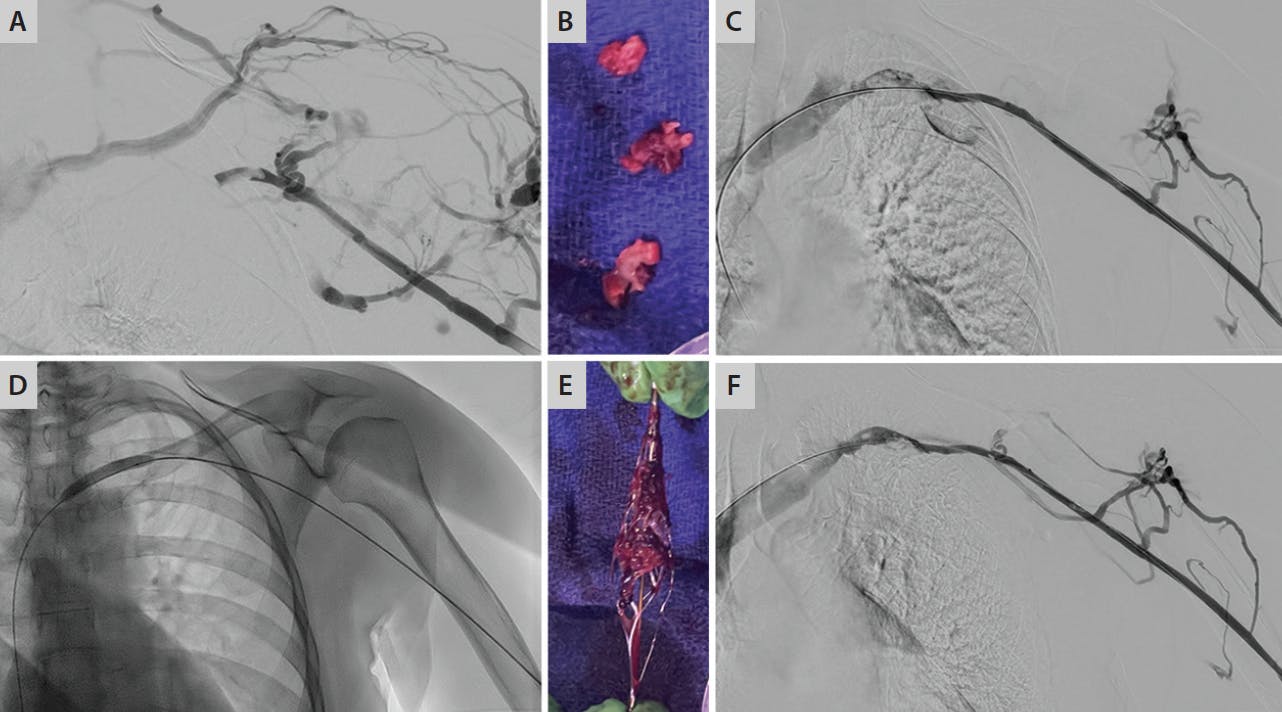
Figure 1. Preprocedure venogram demonstrated occlusive thrombus in subclavian and left axillary veins with substantial collaterals (A). After removing primarily acute thrombus in the first three passes with the InThrill thrombectomy catheter, highly organized thrombus was removed on the fourth pass (B). Repeat venography showed that additional thrombus remained (C). Angioplasty of the subclavian and axillary veins was performed (D). A fifth pass with the InThrill thrombectomy catheter yielded substantial thrombus (E). Postprocedure venogram confirmed restored distal flow (F).
A 0.035-inch, 260-cm angled tip stiff Glidewire (Terumo Interventional Systems) was advanced into the subclavian vein and positioned beyond the location of the thrombus. The access point was predilated, and the sheath was exchanged for an 8-F InThrill sheath. The InThrill sheath was advanced over the guidewire until the tip of the integrated dilator was positioned proximal to the thrombus. The funnel was then deployed without incident, and the InThrill thrombectomy catheter was introduced over the guidewire and advanced distal to the thrombus. Mechanical thrombectomy was then performed. The self-expanding element was deployed and retracted, yielding acute thrombus over each of three passes. A fourth pass was then performed, which removed large pieces of firm, highly organized thrombus (Figure 1B). Repeat venography demonstrated that additional thrombus remained (Figure 1C). A 7- X 40-mm Mustang balloon (Boston Scientific Corporation) was then introduced, and the subclavian and axillary veins were dilated for three inflations at 20 atm (Figure 1D). A fifth pass with the InThrill thrombectomy catheter was then performed, extracting additional thrombus (Figure 1E). A final venogram was performed, showing excellent results with TIMI 3 (thrombolysis in myocardial infarction 3) distal flow (Figure 1F). A filling defect consistent with laminated thrombus remained; however, it was determined to be nonobstructive. All devices were then removed, and manual compression was used to obtain hemostasis. The total procedure time was 55 minutes, with a device time of 15 minutes and total fluoroscopy time of 14 minutes. Estimated blood loss was inconsequential at 25 mL.
The patient tolerated the procedure well and stated that her arm felt better shortly afterward. She was moved to a room on a standard floor and was discharged the following day.
DISCUSSION
This case confirms that thrombus chronicity can be underestimated in patients with upper extremity deep vein thrombosis (DVT).1 Although this patient presented within 2 days of the onset of symptoms, large pieces of highly organized thrombus were ultimately extracted along with acute thrombus, indicating that the obstruction had been developing for weeks or longer. Anticoagulation or thrombolytics would likely not be effective in relieving her symptoms—anticoagulation has the potential to prevent thrombus from forming but cannot break it down, and thrombolytics can break down acute thrombus but lose effectiveness as the thrombus becomes more chronic.2
The minimally invasive InThrill Thrombectomy System was able to successfully remove acute to chronic thrombus from the upper extremity peripheral vasculature with negligible blood loss. The device was easy to use and efficient. Device and procedure times are unparalleled when compared with thrombolytic-based procedures. Additionally, the patient’s symptoms improved significantly postprocedure, and she was discharged the following day without being admitted to the ICU. She will remain on apixaban for 6 months and will seek evaluation for a left rib resection from a vascular surgeon.
1. Maldonado TS, Dexter DJ, Kado H, et al. Outcomes from the ClotTriever outcomes registry show symptom duration may underestimate deep vein thrombus chronicity. J Vasc Surg Venous Lymphat Disord. 2022;10:1251-1259. doi: 10.1016/j.jvsv.2022.04.015
2. Kakkos SK, Gohel M, Baekgaard N, et al. Editor’s choice—European Society for Vascular Surgery (ESVS) 2021 clinical practice guidelines on the management of venous thrombosis. Eur J Vasc Endovasc Surg. 2021;61:9-82. doi: 10.1016/j.ejvs.2020.09.023
In-Line Flow Restored From the Posterior Tibial Vein to the Inferior Vena Cava Using the InThrill and ClotTriever Systems

CASE PRESENTATION
A man in his mid-60s was referred to interventional radiology with progressively worsening left lower extremity pain that began 5 months prior. The patient characterized his pain as an aching and burning sensation from his mid-thigh to his proximal calves, with pain greater on the left side and increasing with activity. He had a history of recurrent DVT, and a bilateral lower extremity venous ultrasound was ordered, which ultimately confirmed thrombus in the left lower extremity.
He was on apixaban but had no other previous treatments. We evaluated the patient, and the decision was made to proceed with left lower extremity venography with possible intervention.
PROCEDURAL OVERVIEW
Sonographic guidance was used to identify the left popliteal vein, which was revealed to be partially compressible. The vein was accessed; however, the wire could not be advanced more than a few centimeters, consistent with an occluded popliteal vein.
Attention was then turned to the left ankle region to attempt access from below. Sonographic guidance was again used to identify and access the left posterior tibial vein (PTV). The outer cannula of the micropuncture access kit was then exchanged for an 8-F vascular sheath. Initial ultrasound images taken the previous day demonstrated what was assumed to be a patent PTV; however, venography at present revealed an occluded PTV with several collaterals (Figure 1A). This was an indication that the ultrasound taken the previous day was likely imaging collateral vessels rather than true PTVs.
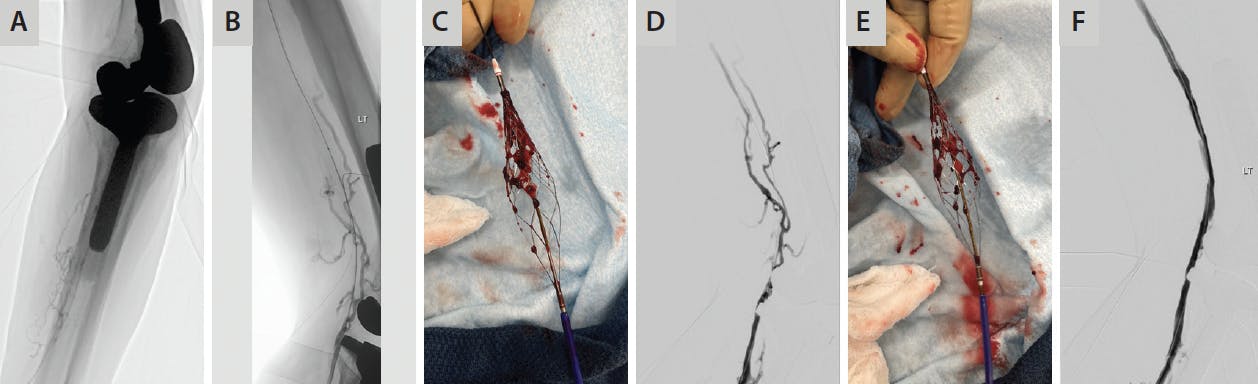
Figure 1. Preprocedure venography demonstrated occluded proximal posterior tibial and popliteal veins and collaterals (A, B). The InThrill device was placed, and a first pass yielded thrombus (C). The posterior tibial and popliteal vein lumens were now visible following the first pass; however, some residual thrombus remained (D), and a second pass was completed (E). Following mechanical thrombectomy with the InThrill device and prolonged balloon dilatation, repeat venography confirmed flow of the posterior tibial through distal femoral veins (F).
Although the popliteal vein was partially patent, venography confirmed an occlusion at the location of the popliteal vein access point noted previously. In addition, there was thrombus within the femoral, common femoral, and external iliac veins, and numerous collateral vessels were present. A high-grade stenosis of the left common iliac vein was seen, suggesting external compression consistent with May-Thurner syndrome. Intravascular ultrasound confirmed a high-grade stenosis of > 75%.
A 0.035-inch stiff Glidewire and Rubicon support catheter (Boston Scientific Corporation) were navigated across the popliteal and femoral venous occlusions and positioned within the inferior vena cava (IVC). Extensive, prolonged angioplasty of the left posterior tibial, popliteal, femoral, and common femoral veins was performed initially with a 6-mm balloon catheter (Figure 1B). The femoral vein and iliac veins were then dilated to 8 mm and 12 mm, respectively. The InThrill sheath was then inserted and advanced over the guidewire, and the integrated funnel was deployed. After removing the dilator, the InThrill thrombectomy catheter was advanced over the guidewire to the proximal/mid femoral vein.
Mechanical thrombectomy of the left posterior tibial, popliteal, and femoral veins was performed with the InThrill device. The self-expanding element was deployed and retracted, extirpating thrombus (Figure 1C). Repeat venography showed residual thrombus (Figure 1D), and a second pass with the InThrill device was performed, yielding additional thrombus (Figure 1E).
Following mechanical thrombectomy of this region, repeat venography confirmed patency of the posterior tibial through distal femoral veins (Figure 1F). Collaterals and occlusions were seen from the common femoral to the common iliac veins (Figure 2A). The popliteal vein was now free of thrombus, therefore enabling a 13-F ClotTriever sheath (Inari Medical) to advance through the initial popliteal vein access after serial dilatation. The ClotTriever catheter was inserted through the sheath and advanced beyond the level of thrombus in the external iliac vein, and the nitinol coring element and mesh collection bag were expanded. The ClotTriever catheter was then retracted, capturing acute, subacute, and highly organized thrombus from the iliofemoral segment in three passes (Figure 2B and Figure 2C). The proximal femoral vein was then dilated to 10 mm.
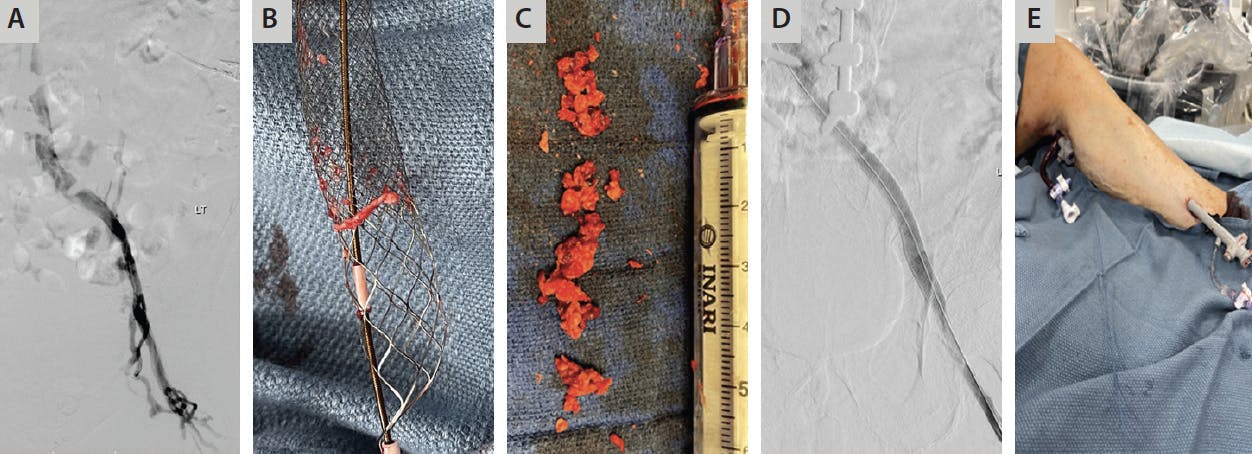
Figure 2. Collaterals and occlusions were seen from the common femoral to the common iliac veins (A). Following a first pass with the ClotTriever device, highly organized webbing was seen on the coring element (B). After two more passes, extensive organized thrombus was removed (C). Following thrombectomy, angioplasty, and stenting, repeat venography demonstrated restored flow within the left common iliac and left external iliac segments (D). The InThrill Thrombectomy System was engaged at the left posterior tibial access point and the ClotTriever System at the left popliteal access point (E).
Repeat venography of the left lower extremity demonstrated restoration of in-line flow from the ankle into the IVC. Residual stenosis was seen in the iliac veins. Two Wallstents (Boston Scientific Corporation) were then deployed in the left common iliac and left external iliac veins in an overlapping fashion (14 mm X 9 cm and 12 mm X 6 cm) and postdilated to 12 mm. Venography confirmed brisk flow of contrast through the left lower extremity, as well as the iliac vein and stents with no significant residual stenosis remaining (Figure 2D).
Hemostasis was achieved with a FlowStasis device (Inari Medical) in the left popliteal region and with manual compression at the left PTV access site.
Total device time with the InThrill System was 8 minutes. Total device time with the ClotTriever System was 15 minutes. Total procedure time was 70 minutes.
The patient tolerated the procedure well and was discharged the same day.
DISCUSSION
This case demonstrates the effectiveness of the InThrill Thrombectomy System to treat thrombus of varying chronicity and to aid in restoring inflow to the remainder of the leg in patients with BTK venous thrombosis. Restoring in-line flow from the ankle to the central veins is essential to improving long-term patient outcomes. This case specifically illustrated a quick and efficient approach to the treatment of BTK occlusions, one which subsequently made it possible to access and restore flow to the left iliofemoral vessels.
The patient presented with complete occlusion of the left popliteal, femoral, and common femoral veins with elastic chronic stenosis in the left iliac veins. When it was discovered that access to the left popliteal vein was impeded by occlusive thrombus, the InThrill Thrombectomy System was utilized to clear the left posterior tibial, popliteal, and femoral segments first. This enabled access to the popliteal vein using the ClotTriever System (Figure 2E) and, together with angioplasty and stenting, these systems were able to restore in-line flow from the ankle into the IVC without significant residual stenosis.
Flow was established in a single treatment session, without the use of thrombolytics. Ease of insertion and repositioning of the InThrill device was key to the success of this case, as BTK thrombus was cleared effectively in two passes and within 8 minutes.
The InThrill device provided an option to improve blood flow for this patient throughout the lower extremities. It was used to remove subacute and highly organized thrombus below the knee to effectively restore flow to the inflow vessels from the ankle to the IVC.
This treatment addressed the iliac vein compression that was the underlying reason for the patient’s recurrent DVT and at 30-day follow-up, he reported complete resolution of symptoms and restored ability to walk without increasing pain. The patient will return for follow-up at 3 and 6 months.
Advertisement
Advertisement