Advertisement
Advertisement

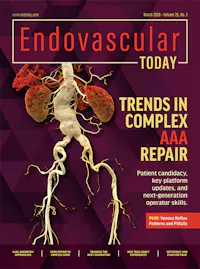
It is an honor and a privilege to serve as the guest editor of this edition of Endovascular Today, which focuses on complex abdominal aortic aneurysm repair. We begin with a discussion on determining candidacy for open versus complex endovascular repair, where Adam W. Beck, MD; Francis J. Caputo, MD; and James H. Black, III, MD, examine the key considerations that guide repair strategy selection. Their commentary explores how patient risk profiles, genetic and clinical characteristics, and aneurysm anatomy influence the decision between open surgery and advanced endovascular approaches.
Building on the theme of treatment decision-making, Darren B. Schneider, MD, shares his perspectives on the management of iliac artery aneurysms. He outlines best practices for the use of dedicated iliac branch devices and reviews how they are shaping management strategies, along with practical considerations such as device selection, bridging stents, and how prior endovascular aneurysm repair (EVAR) procedures may influence subsequent repair planning.
The focus then shifts toward a technical innovation aimed at improving outcomes in patients with chronic aortic dissection. Steven Maximus, MD, and Gustavo Oderich, MD, describe the role of septotomy using electrosurgical techniques to enlarge the true lumen, a strategy that can facilitate EVAR and improve the effectiveness of stent graft deployment in challenging anatomy.
Expanding from individual techniques to the broader therapeutic landscape, a panel of leading specialists—including Jason T. Lee, MD; Steven Maximus, MD; Gustavo Oderich, MD; Benjamin W. Starnes, MD; Carlos Timaran, MD; Kak Khee Yeung, MD; and Javairiah Fatima, MD—reviews the growing array of endovascular solutions available for complex abdominal aortic disease. Their insights highlight how evolving device design and clinical experience are reshaping treatment options for increasingly complex cases.
We conclude our cover features with a forward-looking assessment on how the field will sustain its expertise in the years to come. Eric J. Finnesgard, MD, and Andres Schanzer, MD, emphasize the importance of developing proficiency in advanced endovascular techniques while also preserving the critical open surgical skills necessary for comprehensive aortic care.
In addition to the focus on complex abdominal aortic repair, the Endovascular Today editors have assembled a subfeature on a common but often nuanced area of venous practice. Gillian J. Lee, MD, and Sherry D. Scovell, MD, examine the challenges of managing small saphenous vein insufficiency, highlighting how anatomic variability, complex reflux patterns, and procedural considerations can complicate both diagnosis and treatment planning. Complementing this discussion, venous experts Felipe Coelho Neto, MD; Zoe Deol, MD; and Nasim Hedayati, MD, share their thoughts on a practical question many clinicians face in daily practice: determining when superficial venous reflux truly warrants intervention. Their insights explore how symptom burden, imaging findings, and patient-specific factors come together to guide the decision between active treatment and continued observation.
Finally, in Endovascular Today’s ongoing interview series, Parag J. Patel, MD, talks about building a multidisciplinary collaborative vascular practice, advancing global interventional radiology, shaping the next generation of interventional radiologists, and more.
We hope that the perspectives shared here illustrate both the progress and the ongoing challenges in modern vascular practice, from patient selection and procedural techniques to innovation and training for the future.
Grace J. Wang, MD, MSCE, FACS
Guest Chief Medical Editor
Advertisement
Advertisement