Advertisement
Advertisement
November 2022
The Importance of “Backdoor” Treatment to Close Distal Entry Tears in Chronic Type B Aortic Dissection
The evolution of the candy-plug and knickerbocker techniques for distal false lumen occlusion, intervention timing considerations, and patient anatomy requirements.
By Konstantinos Spanos, MD, MSc, PhD; Fiona Rohlffs, MD, PhD; Giuseppe Panuccio, MD, PhD; Ahmed Eleshra, MD; and Tilo Kölbel, MD, PhD
Thoracic endovascular aortic repair (TEVAR) has been increasingly used for the treatment of type B aortic dissection (TBAD). It has become the first line of intervention in patients with complicated acute TBAD and is used selectively in early stages for the prevention of aortic complications in uncomplicated acute TBAD.1 Individual management is also needed in chronic TBAD, when aneurysmal degeneration sets the stage for invasive treatment in most cases. However, after standard TEVAR that covers the proximal entry tear, complete false lumen (FL) thrombosis is only accomplished in approximately 40% of patients.2 The FL remains patent due to persistent perfusion from distal entry tears and may expand during follow-up in 30% of patients, leading to additional reinterventions.3,4 FL patency is also independently associated with poor long-term survival in chronic TBAD,5 while the presence of distal entry tears is associated with late aortic events and does not allow for aortic remodeling.6
A valid strategy for further distal sealing of entry tears is fenestrated and branched endovascular aortic repair (F/BEVAR), but these procedures are more challenging, with a high rate of endoleak and a risk for spinal cord ischemia (SCI) due to long segment coverage.7,8 Persistent retrograde FL perfusion may decrease spinal cord preconditioning after TEVAR and possibly explains the higher SCI incidence in F/BEVAR in postdissecting thoracic abdominal aortic aneurysms despite staging.9-11
Backflow from the distal FL after standard TEVAR is not equivalent to a type Ib endoleak, as the endoleak classification does not cover this aneurysm-based classification. The main treatment of TBAD with TEVAR does not aim to primarily interrupt flow in the FL. Without dealing with this “backdoor” to the thoracic FL, the seal remains insufficient, and this strategy will therefore not effectively exclude the aneurysm.12 During the last decade, direct FL occlusions in chronic TBAD have led to the development of different strategies and endovascular means.13,14 However, the use of standard materials for FL occlusion is limited to patients with smaller FL diameters at the level of the diaphragm because materials for arterial embolization are not commercially available for these large diameters.
THE EVOLUTION OF THE CANDY-PLUG TECHNIQUE: FROM SURGEON-MODIFIED TO THIRD-GENERATION DEVICES
Surgeon-Modified Device
A simpler way to obstruct the distal FL in patients with descending aortic dissecting aneurysms is to implant large-diameter plugs after the catheterization of the FL. However, the largest-diameter vascular plug that is commercially available is 22 mm, which allows for sealing of vessels up to 18 mm in diameter. In 2013, our group published a technique to modify a Zenith thoracic stent graft (Cook Medical) into an extra-large vascular plug to occlude a large distal FL in chronic aortic dissection.15 This was named the candy-plug (CP) technique because the customization gives the stent graft a candy wrapper shape, with a waist just large enough to retrieve the dilator tip. After deployment in the distal thoracic FL, the remaining minor opening can be fully closed with the vascular plug to seal off the distal FL.15
CP I Device
The next step was to design a dedicated device, the CP I device (Cook Medical; Figure 1A), which mimicked the physician-modified CP and was a double-tapered, tubular stent graft constructed of woven polyester fabric sewn to self-expanding nitinol stents with braided polyester and monofilament polypropylene sutures.16 The CP I was occluded using either a 22-mm Amplatzer vascular plug type II (Abbott) or a 20-mm iliac Zip occluder (Cook Medical). After deployment of a thoracic stent graft into the true lumen (TL) to the level of the celiac artery, the CP was placed into the FL at the distal end of the TL stent graft, thereby occluding the FL proximally to the renovisceral segment to preserve flow to renovisceral arteries while preventing FL backflow to the thoracic segment.16 Rohlffs et al reported on 18 patients treated with this device and showed an excellent technical success rate of 100%.16 No deaths or reinterventions occurred. Complete distal FL occlusion occurred in most patients. Follow-up > 6 months was available in 10 patients, showing aortic remodeling in seven patients and stable aneurysm size in three patients.
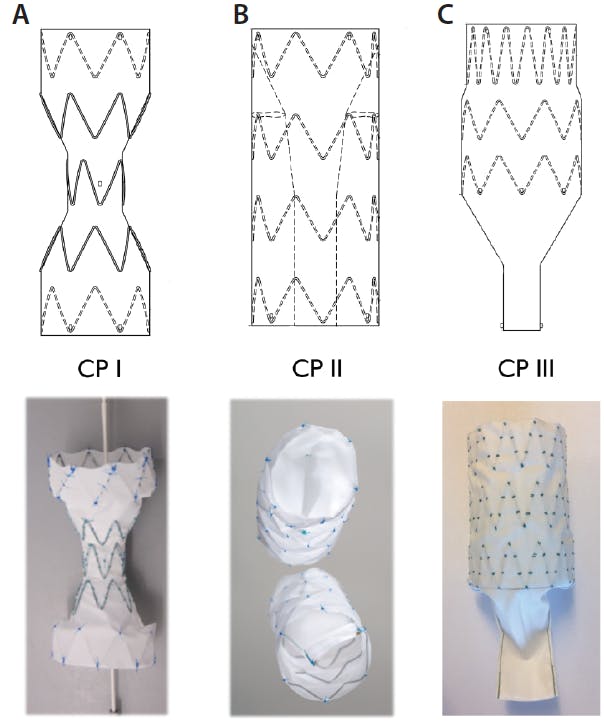
Figure 1. Three generations of the custom-made CP device: CP I (A), CP II (B), and CP III (C). Reprinted from Carta N, Salvati S, Melissano G, et al. Staged fenestrated/branched repair of postdissecting thoracoabdominal aneurysm with candy-plug false lumen occlusion for spinal cord preconditioning. J Endovasc Ther. 2020;27:221-227. Copyright © 2020 by SAGE. Reprinted by permission of SAGE Publications.
CP II Device
The second-generation CP device (Cook Medical; Figure 1B) was a significant change in design toward a self-occluding device. CP II is a short, tubular, custom-made, self-expanding nitinol stent graft (woven polyester fabric) with a small unsupported sleeve inside the graft to accommodate the central cannula and allow retrieval of the dilator tip, which closes itself when the dilator tip is removed.17 The top of CP II is covered, and the central cannula passes through a 14-mm-wide fabric sleeve fixed to the middle nitinol stent inside the graft by two opposed sutures. The fabric channel allows retraction of the dilator tip. As soon as the graft is released, the sutures are tensed by the expansion of the nitinol stent and the channel pulled from each side, thereby closing it. Because the 14-mm-wide fabric channel is unsupported by stents, it will collapse and thereby restrict flow when pressurized from distally. This device does not require an additional plug and therefore is self-occluding. The CP II is available in diameters of up to 46 mm and has a length of at least 71 mm.
Eleshra et al reported our experience on patients treated with the CP II device.18 Technical success was 100% in all 14 patients. Immediate complete FL occlusion was achieved in 12 patients; the other two patients required reintervention. Over a mean 8-month follow-up, nine patients underwent CTA, eight of whom had evidence of aortic remodeling, while one aneurysm sac was stable.
CP III Device
Recently, the third-generation CP device (CP III; Figure 1C) was developed, which combines the concept of a self-occluding device with the proven features of traditional thick Dacron fabric and stainless-steel stents. CP III is a custom-made device (CMD) consisting of three sealing stents with a diameter ranging from 26 to 46 mm and a total length of 97 to 104 mm depending on diameter, as well as a distal sleeve segment with a 14-mm-wide central fabric channel sutured outside the graft.19 The 14-mm-wide sleeve, which allows the dilator tip retraction, is tapered down from the nominal diameter of the device. The stent graft is loaded in a 16- to 20-F delivery system. The CP III differs from the previous generation because the self-occluding sleeve is an extension at the distal part of the CP rather than inside the stent graft. The CP III device is available in Europe as a CMD.
Special considerations. After implantation of a CP III device in the thoracic FL, the sleeve may obstruct a FL-originating artery. To manage this, one option may be to deploy the CP more cranially. Although we have not experienced this problem, it has become our practice to push the sleeve as far up to the distal end of the CP III device as possible while the wire remains inside the sleeve.19
In our experience of > 50 thoracic CP cases, we have aimed to place the CP III device simultaneously with a TL TEVAR at the same level of the most distal descending thoracic aorta (Figure 2). The two opposing stent grafts seem to stabilize the dissection membrane, and we have not seen any stent-induced new entry tears with this technique.20 The surrounding structures in this supraceliac segment, such as the diaphragmatic crura, may have a stabilizing impact on the dissected aorta and contribute to the high success rates of the technique even in patients with connective tissue disorders. Persistent backflow through the gutters beside the CP or through the sleeve can be addressed with adjunctive embolization using coils. The general principle of FL embolization can be further used in other segments of the aorta and its side branches when needed. However, most evidence for the CP technique thus far is in the most distal segment of the thoracic aorta. Midterm outcomes show consistently full FL regression when adhering to these principles (Figure 3).21
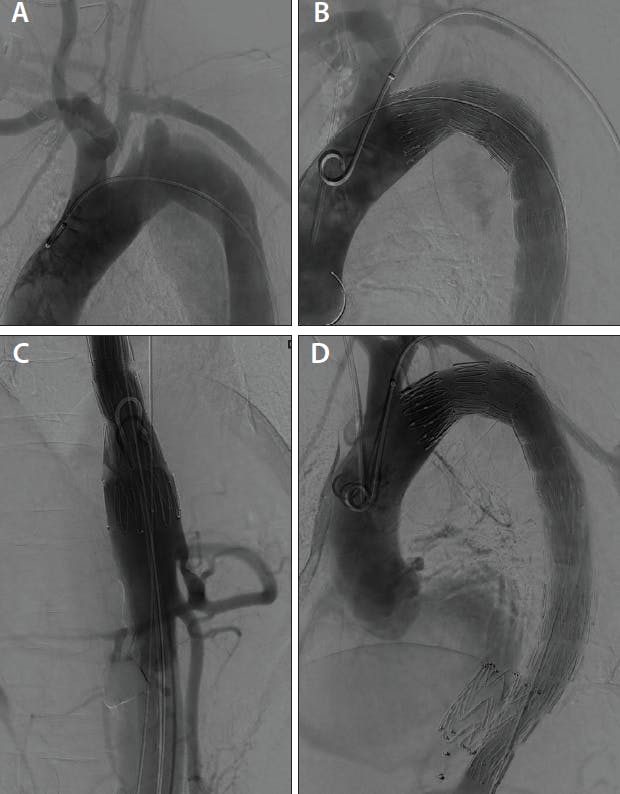
Figure 2. A woman in her early 60s with a rapidly expanding FL in chronic TBAD and left vertebral artery originating from the aortic arch. An arch angiogram showing a left carotid-subclavian bypass and left vertebral artery transposition (A). An arch angiogram after placement of a proximal TEVAR (ZTEG, Cook Medical) (B). The distal descending aorta after placement of a distal extension TEVAR (ZTEG) (C). The final angiogram after placement of a CP III device in the distal descending thoracic aorta (D).
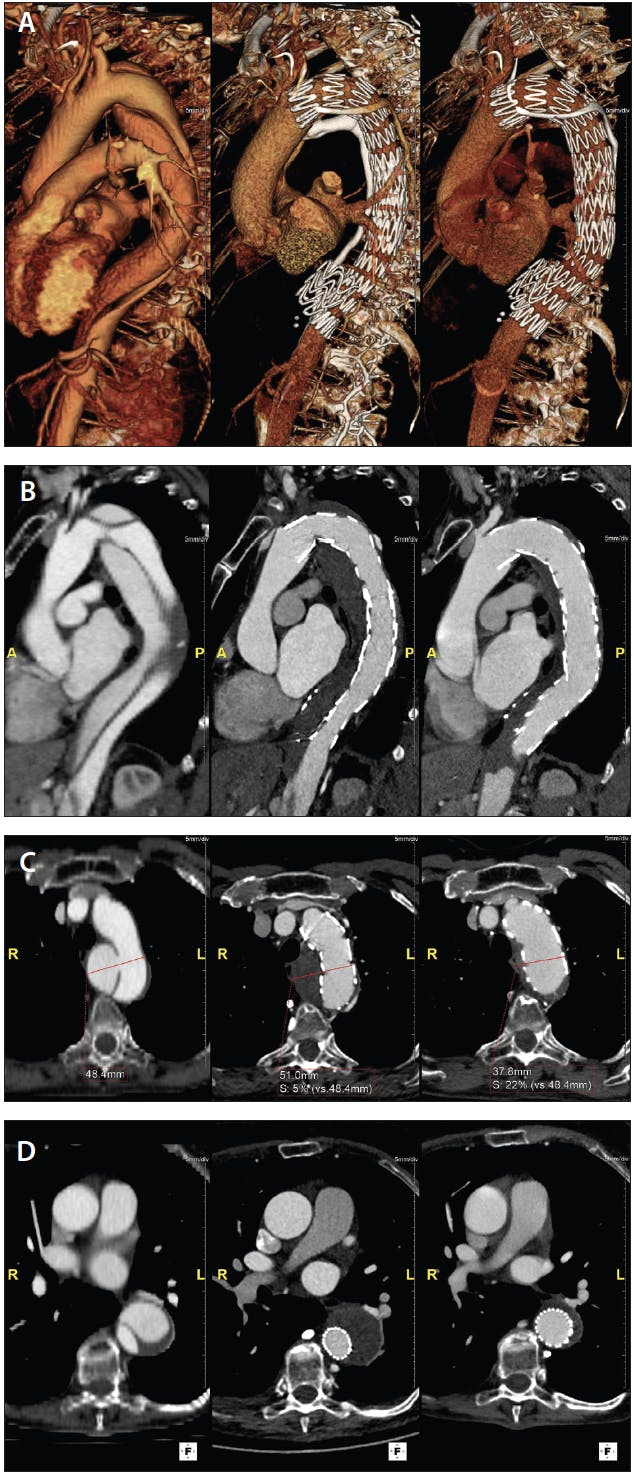
Figure 3. Preoperative and follow-up CTA 6 and 18 months after TEVAR and CP for the patient in Figure 2 demonstrating timely, full remodeling of the thoracic aorta. Three-dimensional volume rendering (A). Multiplanar reconstruction of the thoracic aorta (B). Axial images at the level of the proximal entry tear (C). Axial images at the level of the mid descending thoracic aorta (D).
THE KNICKERBOCKER TECHNIQUE
The concept of the knickerbocker technique is based on balloon dilation of the middle part of a large-diameter stent graft placed in the TL.22 A short segment of the stent graft is forcefully dilated using a compliant balloon, aiming to rupture the dissection membrane and extending the stent graft to the outer wall of the FL. The resulting shape of the stent graft is similar to knickerbocker trousers, after which it was named. Instead of an oversized standard tubular stent graft, a double-tapered graft construction with a bulbous section can be used. After stent graft placement in the right orientation, a compliant balloon is advanced to expand the bulbous section by rupturing the dissection membrane and expanding the graft to the FL. The main advantage of this technique is that it does not mandate access to the FL or additional embolization materials.
Knickerbocker Stent Graft
The Knickerbocker stent graft (Cook Medical) is a double-tapered tubular endograft and dedicated CMD.23 The Knickerbocker graft is deployed into the TL above the celiac trunk with a sufficient proximal diameter and overlap to the proximal stent graft. The asymmetric bulbous section is marked with gold markers to orient it toward the dissection membrane and allow for correct orientation. Dilatation of this expandable portion using a compliant balloon fenestrates the dissection membrane and allows expansion of the stent graft to the outer aortic wall, preventing back flow to the thoracic FL proximal to the renovisceral segment. The bulbous section has one full nontapered stent in the middle to expand to the outer aortic wall. The diameter at this level should not exceed the maximum diameter of the complete aorta at the intended sealing area. The bulbous section is planned to seal the FL about 5 cm proximal to the celiac trunk. The maximum diameter of the bulbous section is 46 mm.
Recently, we presented our experience on 16 eligible patients treated with the Knickerbocker device.23 Technical success was 94%, and overall survival after 30 days was 100%. Imaging follow-up with CTA was available in 12 patients (median imaging follow-up, 27.5 months). Nine patients showed thoracic aortic remodeling, and aneurysm size was stable in three patients. No patient showed aneurysm growth.
TIMING OF INTERVENTION AND PATIENT ANATOMY
FL thrombosis is an important landmark for aortic remodeling and to potentially avoid a future reintervention for the FL or the distal part of the dissected aorta. The timing of the application of these techniques is a matter of discussion. In our practice, treatment with the CP or knickerbocker technique is performed primarily in cases of chronic TBAD along with a proximal TEVAR.
Regarding the CP application, anatomic measurements of interest are the crescent length along the dissection membrane between the FL and TL 1 cm above the celiac trunk and the largest diameter of the FL 1 cm above the celiac trunk. The CP II and III devices should be oversized 20% to the FL diameter.
Additionally, adequate access to the FL at the iliac, infrarenal, or renovisceral level is needed. An extra-stiff wire should be advanced as far as possible into the thoracic FL to introduce the sheath and stabilize CP deployment. The compressibility of the CP allows gradual crescent-shape alignment of the plug and expansion of the TL stent graft while remodeling.
CONCLUSION
The traditional TL-centered strategy of TEVAR in aortic dissection does not attempt to interrupt the flow into the thoracic FL aneurysm, which may lead to insufficient seal and poor remodeling. It is important to intervene in patients with chronic TBAD when possible to thrombose the FL. FL thrombosis techniques have evolved during the last decade and have achieved a maturity level, providing promising outcomes.
1. Spanos K, Nana P, Behrendt CA, et al. Management of descending thoracic aortic diseases: similarities and differences among cardiovascular guidelines. J Endovasc Ther. 2021;28:323-331. doi: 10.1177/1526602820987808
2. Kusagawa H, Shimono T, Ishida M, et al. Changes in false lumen after transluminal stent-graft placement in aortic dissections: six years’ experience. Circulation. 2005;111:2951-2957. doi: 10.1161/CIRCULATIONAHA.104.480780
3. Nienaber CA, Rousseau H, Eggebrecht H, et al. Randomized comparison of strategies for type B aortic dissection: the INvestigation of STEnt Grafts in Aortic Dissection (INSTEAD) trial. Circulation. 2009;120:2519-2528. doi: 10.1161/CIRCULATIONAHA.109.886408
4. Tanaka A, Sakakibara M, Ishii H, et al. Influence of the false lumen status on clinical outcomes in patients with acute type B aortic dissection. J Vasc Surg. 2014;59:321-326. doi: 10.1016/j.jvs.2013.08.031
5. Li D, Ye L, He Y, et al. False lumen status in patients with acute aortic dissection: a systematic review and meta-analysis. J Am Heart Assoc. 2016;5:e003172. doi: 10.1161/JAHA.115.003172
6. Zhu C, Huang B, Zhao J, et al. Influence of distal entry tears in acute type B aortic dissection after thoracic endovascular aortic repair. J Vasc Surg. 2017;66:375-385. doi: 10.1016/j.jvs.2016.12.142
7. Oikonomou K, Kopp R, Katsargyris A, et al. Outcomes of fenestrated/branched endografting in post-dissection thoracoabdominal aortic aneurysms. Eur J Vasc Endovasc Surg. 2014;48:641-648. doi: 10.1016/j.ejvs.2014.07.005
8. Spear R, Sobocinski J, Settembre N, et al. Early experience of endovascular repair of post-dissection aneurysms involving the thoraco-abdominal aorta and the arch. Eur J Vasc Endovasc Surg. 2016;51:488-497. doi: 10.1016/j.ejvs.2015.10.012
9. Tsilimparis N, Debus ES, Kodolitsch YV, et al. Branched versus fenestrated endografts for endovascular repair of aortic arch lesions. J Vasc Surg. 2016;64:592-599. doi: 10.1016/j.jvs.2016.03.410
10. Carta N, Salvati S, Melissano G, et al. Staged fenestrated/ branched repair of postdissecting thoracoabdominal aneurysm with candy-plug false lumen occlusion for spinal cord preconditioning. J Endovasc Ther. 2020;27:221-227. doi: 10.1177/1526602820906856
11. Oikonomou K, Kasprzak P, Katsargyris A, et al. Mid-term results of fenestrated/branched stent grafting to treat post-dissection thoraco-abdominal aneurysms. Eur J Vasc Endovasc Surg. 2019;57:102-109. doi: 10.1016/j.ejvs.2018.07.032
12. Kölbel T. We need to secure the backdoor in aortic dissection treatment! J Endovasc Ther. 2020;27:228-230. doi: 10.1177/1526602820909167
13. Kölbel T, Diener H, Larena-Avellaneda A, Debus S. Advanced endovascular techniques for thoracic and abdominal aortic dissections. J Cardiovasc Surg (Torino). 2013;54(1 suppl 1):81-90.
14. Spanos K, Kölbel T, Rohlffs F, et al. Intentional targeted false lumen occlusion after aortic dissection: a systematic review of the literature. Ann Vasc Surg. 2019;56:317-329. doi: 10.1016/j.avsg.2018.08.086
15. Kölbel T, Lohrenz C, Kieback A, et al. Distal false lumen occlusion in aortic dissection with a homemade extra-large vascular plug: the candy-plug technique. J Endovasc Ther. 2013;20:484-489. doi: 10.1583/13-4318.1
16. Rohlffs F, Tsilimparis N, Fiorucci B, et al. The candy-plug technique: technical aspects and early results of a new endovascular method for false lumen occlusion in chronic aortic dissection. J Endovasc Ther. 2017;24:549-555. doi: 10.1177/1526602817709252
17. Rohlffs F, Tsilimparis N, Mogensen J, et al. False lumen occlusion in chronic aortic dissection: the new generation candy-plug II. Ann Vasc Surg. 2019;57:261-265. doi: 10.1016/j.avsg.2018.10.016
18. Eleshra A, Kölbel T, Tsilimparis N, et al. Candy-plug generation II for false lumen occlusion in chronic aortic dissection: feasibility and early results. J Endovasc Ther. 2019;26:782-786. doi: 10.1177/1526602819871613
19. Bertoglio L, Bilman V, Rohlffs F, et al. Self-occluding candy-plug: implantation technique to obtain false lumen thrombosis in chronic aortic dissections. J Endovasc Ther. Published online June 16, 2022. doi: 10.1177/15266028221102661
20. Furukawa T, Uchida N, Yamane Y, Yamada K. A pitfall of false lumen embolization in chronic aortic dissection: intimal injury caused by the embolization device edge. Interact Cardiovasc Thorac Surg. 2017;24:153-155. doi: 10.1093/icvts/ivw279
21. Eleshra A, Rohlffs F, Spanos K, et al. Aortic remodelling after custom-made candy-plug for distal false lumen occlusion in aortic dissection. J Endovasc Ther. 2021;28:399-406. doi: 10.1177/1526602821996722
22. Kölbel T, Carpenter SW, Lohrenz C, et al. Addressing persistent false lumen flow in chronic aortic dissection: the knickerbocker technique. J Endovasc Ther. 2014;21:117-122. doi: 10.1583/13-4463MR-R.1
23. Rohlffs F, Tsilimparis N, Panuccio G, et al. The Knickerbocker technique: technical aspects and single-center results of a new endovascular method for false lumen occlusion in chronic aortic dissection. J Endovasc Ther. Published online May 13, 2022. doi: 10.1177/15266028221090439
Advertisement
Advertisement