Advertisement
Advertisement
November 2022
Sponsored by iVascular
The New-Generation iCover BX Covered Stent to Treat Complex Iliac Artery Disease
The iCover BX covered stent is available under CE Mark only and is not approved in the United States.
In the iliac arteries, primary stenting is associated with excellent procedural success and acute outcomes for short lesions. However, diffuse, heavily calcified, and occlusive lesions continue to create the risk for technical failures. Patients with complex lesions often have multiple comorbid conditions and are poor candidates for open surgery, and practitioners are increasingly gravitating toward endovascular approaches, regardless of the lesion type.
The roles of differing stent designs (covered vs bare-metal stents and self-expanding vs balloon-expandable [BX] stents) have yet to be fully delineated for treatment of the iliac arteries. Covered BX stents may be optimal for TransAtlantic Inter-Society Consensus (TASC) C and D and calcified lesions, particularly those involving the aortic bifurcation.
The iCover BX covered stent (iVascular) is bringing something new to the market: visibility. The stent alloys (CoCr L605), together with the three tantalum radiopaque markers at each end, offer excellent visibility to see the stent deployed. iVascular has designed iCover with the aim of offering a stent that adapts to the most tortuous arteries, with high flexibility and postexpansion capacity using iVascular’s proprietary technology: CoverTech. This technology attaches the inner and outer expandable polytetrafluoroethylene layers to ensure a complete encapsulation.
The article presents a case involving use of the new-generation BX covered stent, iCover, in TASC C and D iliac lesions.
TREATMENT OF COMPLETELY OCCLUDED ILIAC AND FEMORAL ARTERIES

Peter Goverde, MD
ZNA Vascular Clinic
Antwerp, Belgium
Disclosures: Consultant to iVascular.
CASE PRESENTATION
A woman in her mid-70s presented with a complete occlusion in the iliac and femoral arteries. In the left iliac artery, a previous covered stent was implanted years before (Figure 1).
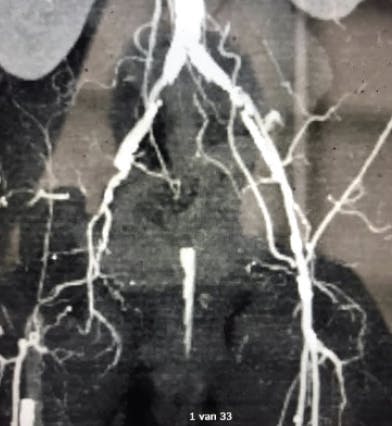
Figure 1. Initial angiogram.
PROCEDURAL OVERVIEW
First, a left common femoral artery (CFA) puncture was performed. To cross the previously implanted covered stent, an Oceanus 35 percutaneous transluminal angioplasty (PTA) balloon (iVascular) was used to open the artery.
To cross the right iliac occlusion, a Sergeant support catheter (iVascular) was needed (Figure 2). After crossing successfully with Sergeant, an Oceanus 35 PTA balloon predilated the artery and then a Luminor drug-coated balloon (DCB; iVascular) was used. Two iVolution pro self-expanding stents (iVascular) were implanted in the external iliac artery and femoral artery. The first iCover stent was implanted just after the bifurcation with the internal iliac artery; a precise placement was needed to avoid plugging the internal iliac artery. The second iCover stent was placed in the right common iliac artery, and a final iCover stent was implanted in the left iliac artery inside the previously implanted covered stent to gain more patency (Figure 3).
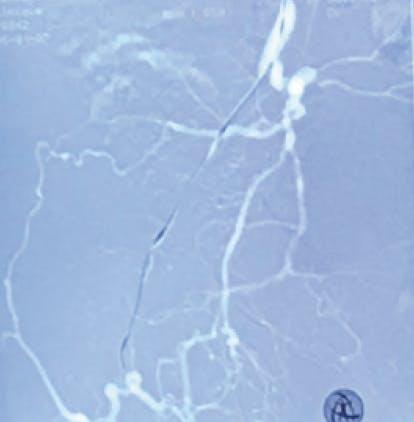
Figure 2. Crossing of the right iliac occlusion with the Sergeant support catheter.
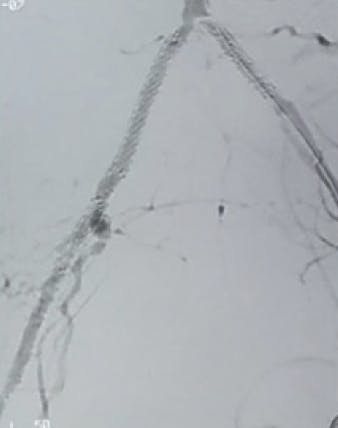
Figure 3. Final image of the iliac and common femoral arteries showing good patency.
CONCLUSION
This was a complex case, achieving excellent results combining the use of a support catheter to cross, an Oceanus 35 PTA balloon to prepare the vessel, and the treatment with Luminor DCB, iVolution pro self-expanding stent, and iCover covered stent. In these complex cases, selection of the best tools is key to success.
Advertisement
Advertisement