Advertisement
Advertisement

Iliofemoral venous stenting for obstructive disease has been around since the 1990s.1,2 However, widespread adoption of this technique became more prominent in recent years after the availability of the United States Food and Drug Administration (FDA)–approved dedicated venous stents. In early 2019, the Venovo™* (Bard/Becton, Dickinson and Company) and Vici™* (Boston Scientific Corporation) stents were the first dedicated venous stents to obtain approval from the FDA. By late 2020 and 2021, two additional stents (Zilver™* Vena™* venous stent [Cook Medical] and Abre™ venous self-expanding stent system [Medtronic]) were approved in the United States for treating iliofemoral venous obstruction, based on the results of investigational device exemption (IDE) trials. The Wallstent endoprosthesis™* (Boston Scientific Corporation) has also gained FDA approval to treat iliofemoral obstructive disease based on a wealth of feasibility, safety, and outcome data already available in the literature outside formal FDA trials.
As the initial four IDE trials (VIRTUS, VERNACULAR, VIVO, and ABRE) are complete with 3-year follow-up results published3,4 or recently released,5,6 it is essential to understand the trial similarities and differences to support an accurate interpretation of the data, facilitate discussion of the lessons learned, and continue the forward movement of the field propelled by these trials. Although the Vici stent from the VIRTUS trial is no longer commercially available, the data set is still contributory and relevant to the field and to the patients who have this stent implanted.
WALLSTENTS: THE FOUNDATION OF VENOUS STENTING
The Wallstent endoprosthesis served as the first primary stent for iliofemoral obstruction for many years prior to the development of dedicated venous stents. Now holding a venous indication, this stent continues to be utilized and maintains a strong reputation with the longest duration of use of any available venous stent.
The Wallstent has a braided elgiloy construction, which provides the advantages of flexibility and fracture resistance in the iliofemoral veins. These characteristics are important for larger-diameter venous stents, which demand greater flexibility when transversing pelvic curvature than smaller-diameter arterial stents. Conversely, the stent can foreshorten upon deployment and dilation, which is a disadvantage of the braided technology, making precise landing more difficult. Furthermore, the ends of the stent are weaker than the main body. This trait led to the recommendation for caval extension when placed in the left iliac vein to prevent the weakest cranial stent portion from landing under the crossing iliac artery. Alternatively, Cook-Z™* tracheobronchial stents (Z-stents; Cook Medical) are often used to bolster the strength of the cranial Wallstents and prevent the jailing of the contralateral iliac vein with caval extension of Wallstents.
THE ADVENT OF NITINOL VENOUS STENT TECHNOLOGY
The new generation of dedicated venous stents is all self-expanding nitinol stent platforms (Figure 1). Nitinol’s composition lends itself to the properties required of a venous stent. This metal is superelastic at body temperature and can undergo repeat deformations with a low risk of fatigue-related stent failure. Thus, while we previously relied on the braiding technology of Wallstents to achieve fracture resistance as these stents transverse the iliofemoral veins and even cross the ligament, in the newer-generation stents, nitinol itself lends to fracture resistance. This has permitted the creation of laser-cut stent designs, improving usability by creating stents with limited foreshortening and increased landing precision. Landing stents precisely enables reliable preservation of venous confluences and inflow optimization. Other advantages of dedicated nitinol stents created with laser-cut designs compared to braided stent designs include the ability to develop longer stent lengths that are needed to: (1) anchor stents used in the treatment of isolated compressive lesions, and (2) treat long-segment disease seen in most cases of postthrombotic venous obstruction. In the latter group, obstruction can extend from the iliac confluence into the common femoral vein (CFV) with diseased segments sometimes > 150 cm in length. Currently, nitinol stents are available in lengths up to 140 to 160 mm.7
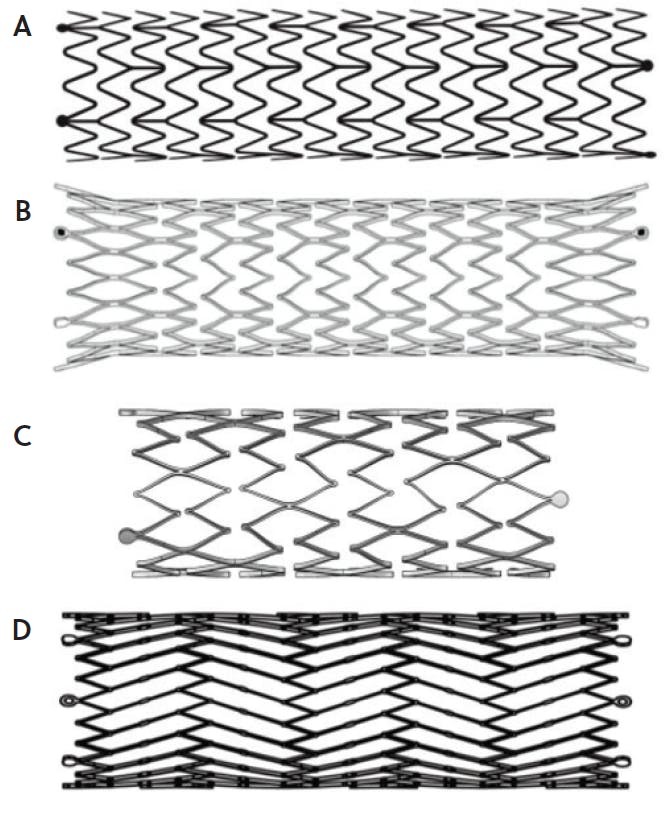
Figure 1. New generation of FDA-approved dedicated nitinol venous stents: Zilver Vena (A), Venovo (B), Abre (C), and Vici (D). Note: The Vici venous stent is no longer commercially available. Reprinted from Murphy EH. Surveying the 2019 venous stent landscape. Endovasc Today. 2019;18:56. https://evtoday.com/articles/2019-july/surveying-the-2019-venous-stent-landscape
ADDITIONAL ADVANTAGES OF FDA-APPROVED, ON-LABEL VENOUS STENTS
The advantages of having FDA-approved venous stents are beyond the obvious technologic gains. The normalization of venous stenting cannot be understated, with procedures going from the sidelines to the mainstream. Although concerns have been raised about the potential for overzealous use of stenting, there is no doubt that patients with venous diseases have been historically undertreated. Advances in stent technology that are specially tailored to address challenging venous morphology are expanding the range of treatment options for a group of patients that previously had little recourse to alleviate or correct their disease. Society guidelines now support endovenous stenting for clinically relevant cases of chronic deep venous disease.8,9 Thus, with appropriate patient selection, an uptick in stenting is a win for the venous space.
Another advantage of FDA approval is the ability to now partner with the health care technology industry for both research initiatives and educational programs. To translate recent innovations into effective practice and improve patient outcomes, practicing physicians must frequently update their knowledge base and skills through continuing medical education and training. However, continuing medical education programs are a costly undertaking and the financial resources to develop or participate in these programs are rarely provided in clinical practice.10 Industry has long been an important source for postfellowship educational platforms, physician training courses, and academic research grant support. With this collaboration, these essential programs and initiatives are more abundant. Furthermore, the arrival of new technology drives industry competition. This competition accelerates motivation for data, product improvement, and field advancement, which deliver clinical advantages for our practices and patients.
IDE TRIAL DATA: WHAT CAN WE COUNT ON?
Patency
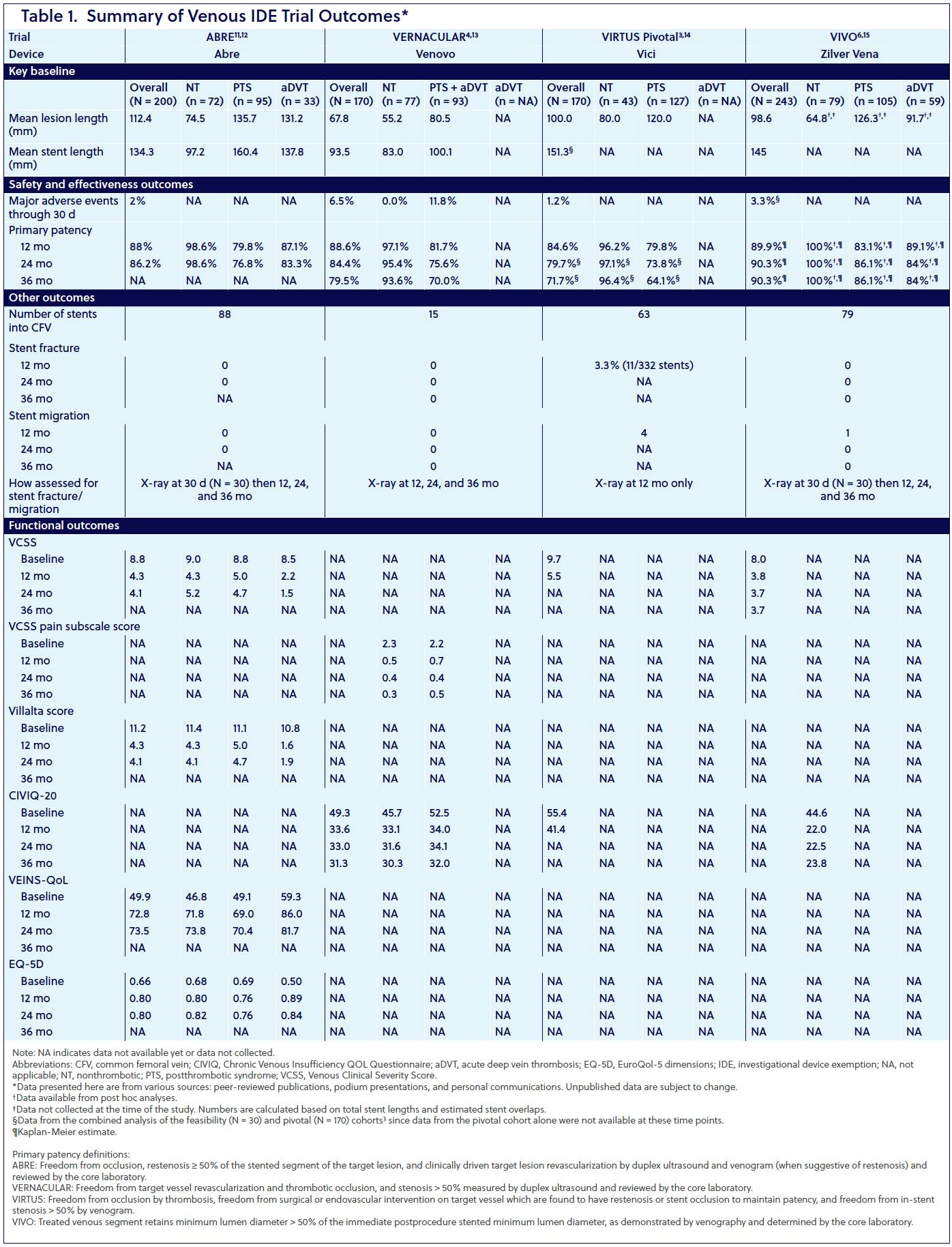
The four major IDE trials (VIRTUS, VERNACULAR, VIVO, and ABRE) have generated robust data from a total of more than 800 patients undergoing iliofemoral stenting for venous obstruction. The data clearly establish the feasibility and safety of stenting, with minimal 30-day major adverse event rates and 12-month patency rates exceeding study goals. Although patency rates decrease over time, a look at subgroup analyses provides some insight (Table 1).3,4,6,11-15 The subgroup analysis showed that in nonthrombotic patients, generally considered low risk, the stent patency was high and sustained through the 3-year follow-up (based on the available data). This is consistent with the experience reported from single-center studies, as summarized in a recent review article.16 In recent times, the greater concern in this patient subset is determining which patients have anatomic compression and which have pathologic compression requiring stenting. Notably, in all trials, postthrombotic patients had lower patency at 1 year compared with other subsets, with a continued patency decline at each subsequent follow-up. These data are consistent with data already existing in academic literature.17
A closer look at stent occlusions from the ABRE IDE study provides insight into the underlying reasons for venous stent occlusion in postthrombotic patients. These data illuminate the most common reasons for failure including: missed common femoral disease, poor-quality inflow vessels, technical errors, and anticoagulation decisions. Bolstered by the IDE trial data, an independent single-center study used these same parameters to build a classification system for the etiology of restenosis or occlusion after venous stenting.18 These separate analyses, with starkly similar results, highlight that successful outcomes in patients with postthrombotic obstructions are dependent on procedures that involved close attention to technical details, persistent long-term follow-up, and attention to anticoagulation protocols. The common reasons behind failure suggest a need for educational initiatives as a resource to allow physicians to gain expertise to match the speed of technologic progress in the field, with applicable tips and tricks on how to obtain the best outcomes from these increasingly detail-oriented procedures. Further, research production and societal involvement will aid guideline development and the standardizing of operative techniques and follow-up parameters.
Quality of Life
All four of the IDE trials demonstrated substantial improvements in venous functional assessment scores and quality of life (QOL) after venous stenting for outflow obstruction. Additionally, in all trials, these improvements spanned across all patient subgroups, including those with nonthrombotic and thrombotic initial presentations (Table 1). Venous disease has notoriously been linked with poor QOL scores, substantial short- and long-term disability claims, and high socioeconomic burden.8 In the United States alone, obstructive venous disease affects 25 million adults, including 6 million with advanced disease,19 culminating in a whopping $4.94 billion in direct medical costs in the management of deep venous disease–related venous leg ulcers.20 In addition, a study reported a significant increase in the number of work-loss days, leading to 29% higher total annual indirect costs for adults with obstructive venous disease.21 Given this outlook, improvement in functional outcomes and QOL scores after stenting could translate to significant gains for both the individual patient as well as society as a whole, with reduced economic burden and medical costs associated with this debilitating disease.
IDE TRIAL DESIGN: CAN WE COMPARE THE TRIAL OUTCOMES?
These clinical trials undoubtedly provide many insights. However, despite the trial similarities that allow us to draw overarching comparisons on safety and efficacy, these trials were not uniformly designed to enable the comparison of treatment platforms. Differences in trial enrollment criteria, patient subcategorization, and endpoint definitions and assessments exist among the four trials. Understanding the differences in these trials is essential to prevent misleading conclusions but can also guide the standardization of future venous stent trials to allow for transparent, comparable, and poolable data sets.
Enrollment Candidacy
Enrollment numbers were nearly uniform across the four IDE trials. Indications for enrollment were also identical in VIRTUS, VERNACULAR, and ABRE, and are defined as a documented iliofemoral venous obstruction > 50% in combination with a CEAP (clinical, etiologic, anatomic, pathophysiologic) classification > 3 or a Venous Clinical Severity Score for pain of at least 2. VIVO required the same clinical parameters but did not specify the need for obstruction to be > 50%. In VIRTUS, VERNACULAR, and VIVO, operators assessed the degree of obstruction using diameter differences on venography. ABRE, the most recent of the trials, additionally allowed for the inclusion of patients with a 50% area reduction on intravascular ultrasound (IVUS), reflecting the movement of the field toward IVUS assessment and away from a dependence on venography. Importantly, IVUS and venography are very different assessment tools, which makes it challenging to compare the degree of stenosis across trials. We know IVUS is better at identifying longer-segment disease as compared with venography alone.22 Likewise, IVUS is superior in detecting inflow disease, the primary etiology of stent patency loss in the literature,23 which can be missed with venography. All of these points suggest that the inconsistent use of IVUS guidelines may affect some of the trial outcomes independently of the stenting platform.
Patient Cohort Categorization
All four IDE trials included patients with symptomatic iliofemoral outflow disease. However, there were differences in the inclusion and categorization of patients. Management of acute deep vein thrombosis (DVT) patients was different in each category. VIRTUS excluded acute DVT patients completely. ABRE included acute DVT patients presenting with < 14 days of symptoms as an independent cohort but excluded DVT patients between 15 days and 6 months while the patients were in the subacute phase and transitioning to the postthrombotic cohort, which begins closer to 6 months. VERNACULAR included acute DVT patients as part of the postthrombotic cohort. VIVO included these patients initially as part of the acute cohort if they presented in < 30 days and the chronic cohort after 30 days.
ABRE, VERNACULAR, and VIRTUS separately categorized patients with chronic venous disease as nonthrombotic and postthrombotic with pre-established enrollment goals for each cohort. The initial classification of patients into acute or chronic subgroups in the VIVO trial led to a mixed patient population in the chronic group, which included nonthrombotic, postthrombotic, and subacute DVT patients. However, with the recent 3-year data release for the VIVO trial, a post hoc analysis was completed recategorizing the patients into more current categories of acute DVT, postthrombotic, and nonthrombotic disease.15 This recategorization allows for more relevant data analysis.
Importantly, disease category definitions still need to be standardized. Across the clinical trials, patient categorization of nonthrombotic or postthrombotic was primarily left up to the discretion of the enrolling interventionalist. However, definitions of these categories can vary between interventionalists.
In a real-world scenario, most patients with postthrombotic obstruction after iliofemoral DVT have disease involving the entire iliofemoral segment spanning from the CFV to the inferior vena cava. Treating this patient population would result in disease segment lengths > 150 mm (estimated length from the iliac confluence to the inguinal ligament). However, the mean stent length in the postthrombotic cohort is shorter than this in the earlier IDE trials. Whether this reflects the inclusion of nonthrombotic patients into this cohort is unknown. Alternatively, it could reflect the undertreatment of CFV disease in postthrombotic patients. The latter is certainly possible since missed CFV disease and poor inflow contributed to postthrombotic-related stent occlusions, suggesting these patients were categorized correctly but incompletely treated.11 Of note, the mean stent length was 160.4 mm in the postthrombotic cohort in the ABRE study, which is more consistent with the true posttrombotic iliac obstructive disease. The ABRE study also reported the highest number of stents placed in the CFV (Table 1), reflecting the complexity of patients enrolled in the study and/or progression of the field to better assessment methods.
Undoubtedly, progressing toward standard definitions is essential for the understanding of patient outcome data. In these trials, the variance in definitions and level of complexity of patients enrolled highlights the need to limit definitive comparisons between patient subgroups and across studies.
Endpoint Analysis
Primary patency. A critical difference between the four IDE trials was in the definitions of endpoints, especially that of primary patency, the primary effectiveness outcome at 12 months. All trials included freedom from occlusion and freedom from > 50% diameter reduction as part of the definition. Although the VIVO trial had this quantitative endpoint only, the remaining three trials included freedom from reintervention. However, ABRE defined this latter component as clinically driven reintervention, while VIRTUS and VERNACULAR did not specify the need for accompanying clinical symptoms.
Additionally, imaging modalities used to assess primary patency at 12 months differed between the trials. Primary patency was a venographic endpoint in both VIVO and VIRTUS, whereas this was a duplex ultrasound (DUS) endpoint in VERNACULAR and ABRE. A venogram in ABRE was still required if the DUS suggested failure with > 50% restenosis or occlusion.
All four trials utilized DUS follow-up for 24- and 36-month endpoints. ABRE, VERNACULAR, and VIRTUS maintained the exact definition of primary patency used for 12-month reporting. However, VIVO differed, reporting 24- and 36-month patency as binary outcomes of patent or not patent, which may have caused increased primary patency rates at 24- and 36-month compared to 12-month follow-up (Table 1).
Data analysis and reporting methods of patency outcomes were also inconsistent across trials and at different follow-up points. Both binary proportion rates and Kaplan-Meier rates have been used on various occasions. The rates tend to run higher with the Kaplan-Meier method, given that it accounts for censored patients. This added another layer to the complexity of comparing and interpreting results across venous stent trials and one must pay attention while comparing.
Nonetheless, while differences in imaging modalities, patency definitions, and reporting methods across the trials limit direct platform comparisons, patency trends in each trial are of continued value.
Stent integrity. ABRE, VIVO, and VERNACULAR evaluated stent integrity with pelvic x-rays at 12, 24, and 36 months. Additional x-rays were obtained at 30 days in the ABRE study and postprocedurally and at 6 months in the VIVO study. In the VIRTUS trial, pelvic x-rays were performed at 12 months only. ABRE, VIVO, and VERNACULAR reported zero stent fractures out to 36 months. There were 11 stent fractures reported in the VIRTUS trial. Ten of the 11 fractures occurred in patients with stents extending into the CFV, implying that stents are most at risk of this complication when stents extend past the inguinal ligament. When reviewing the other trials, ABRE had 88 stents in the CFV, VIVO had 79, and VIRTUS had 63. The VERNACULAR trial had only 15 into the CFV, which may limit an understanding of stent integrity in this location solely based on IDE trial data.
SUMMARY AND FUTURE DIRECTION
The availability of dedicated venous stents has propelled the field of endovenous stenting and provided opportunities for patients who previously did not have an option of deep venous recanalization. The completion of the four IDE trials generated a wealth of data, in addition to Wallstent data, and we are poised to start understanding the ins and outs of stenting for obstructive venous disease. However, there are variations in trial design, data collection, and definitions of the endpoints across trials that limit us from comparing these outcomes and one stent platform to another. Overall, current data are encouraging. With appropriate training for stent use, clinical data education, and standardization of procedures and definitions, venous stenting is most likely to become the method of choice to treat iliofemoral venous obstructive disease. In summary, endovenous stenting has shown promise with good long-term patency rates and improving the QOL of patients with iliofemoral obstructive venous disease.
Disclosures
Dr. Murphy: Consultant to Boston Scientific, BD/Bard, Cook, Cordis, Gore, Medtronic, Mercator, and Philips.
1. Berger A, Jaffe JW, York TN. Iliac compression syndrome treated with stent placement. J Vasc Surg. 1995;21:510-514. doi: 10.1016/s0741-5214(95)70295-4
2. Neglén P, Raju S. Balloon dilation and stenting of chronic iliac vein obstruction: technical aspects and early clinical outcome. J Endovasc Ther. 2000;7:79-91. doi: 10.1177/152660280000700201
3. Razavi MK, Gagne P, Black S, et al. Mid- and long-term outcomes following dedicated endovenous nitinol stent placement for symptomatic iliofemoral venous obstruction: three- to 5-year results of the VIRTUS study (an evaluation of the Vici venous stent system in patients with chronic iliofemoral venous outflow obstruction). J Vasc Interv Radiol. Published online September 22, 2022. doi: 10.1016/j.jvir.2022.08.028
4. Dake MD, O’Sullivan G, Shammas NW, et al. Three-year results from the Venovo venous stent study for the treatment of iliac and femoral vein obstruction. Cardiovasc Intervent Radiol. 2021;44:1918-1929. doi: 10.1007/s00270-021-02975-2
5. Black S. ABRE study 36-month outcomes. Presented at: American Vein & Lymphatic Society (AVLS) Congress; October 13-16, 2022; New Orleans, Louisiana.
6. Gagne P. The 3-year results of the VIVO trial. Presented at: Vascular InterVentional Advances (VIVA); October 4-7, 2021; Las Vegas, Nevada.
7. Murphy EH. Surveying the 2019 venous stent landscape. Endovasc Today. 2019;18:54, 56, 60, 62-64. https://evtoday.com/articles/2019-july/surveying-the-2019-venous-stent-landscape
8. O’Donnell TF Jr., Passman MA, Marston WA, et al. Management of venous leg ulcers: clinical practice guidelines of the Society for Vascular Surgery® and the American Venous Forum. J Vasc Surg. 2014;60(2 suppl):3S-59S. doi: 10.1016/j.jvs.2014.04.049
9. Mahnken AH, Thomson K, de Haan M, O’Sullivan GJ. CIRSE standards of practice guidelines on iliocaval stenting. Cardiovasc Intervent Radiol. 2014;37:889-897. doi: 10.1007/s00270-014-0875-4
10. ESC Board. The future of continuing medical education: the roles of medical professional societies and the health care industry. Eur Heart J. 2019;40:1720-1727. doi: 10.1093/eurheartj/ehy003
11. Murphy E, Gibson K, Sapoval M, et al. Pivotal study evaluating the safety and effectiveness of the Abre venous self-expanding stent system in patients with symptomatic iliofemoral venous outflow obstruction. Circ Cardiovasc Interv. 2022;15:e010960. doi: 10.1161/CIRCINTERVENTIONS.121.010960
12. Murphy E. ABRE study 24-month outcomes and subgroup analyses. Presented at: Leipzig Interventional Course (LINC); June 6-9, 2022; Leipzig, Germany.
13. Dake M, O’Sullivan G. A prospective, multicenter evaluation of the Venovo self-expanding vascular stent used to treat obstructive lesions of the iliac and femoral veins: 12-month results from the VERNACULAR trial. J Vasc Interv Radiol. 2019;30(suppl):S3. doi: 10.1016/j.jvir.2018.12.036
14. Razavi MK, Black S, Gagne P, et al. Pivotal study of endovenous stent placement for symptomatic iliofemoral venous obstruction. Circ Cardiovasc Interv. 2019;12:e008268. doi: 10.1161/CIRCINTERVENTIONS.119.008268
15. Comerota A, Hofmann L, McCann-Brown J. The VIVO clinical study evaluating the Zilver Vena venous stent in the treatment of symptomatic iliofemoral venous outflow obstruction: three-year subgroup outcomes. J Vasc Surg Venous Lymphat Disord. 2022;10:P549. doi: 10.1016/j.jvsv.2021.12.021
16. Badesha AS, Bains PRS, Bains BRS, Khan T. A systematic review and meta-analysis of the treatment of obstructive chronic deep venous disease using dedicated venous stents. J Vasc Surg Venous Lymphat Disord. 2022;10:267-282.e4. doi: 10.1016/j.jvsv.2021.04.014
17. Ferreira AM, Oliveira-Pinto J, Duarte-Gamas L, et al. Mid-term patency of iliac venous stenting for post-thrombotic syndrome. Int Angiol. 2021;40:196-205. doi: 10.23736/S0392-9590.21.04659-9
18. Pouncey AL, Kahn T, Morris RI, et al. Risk factors and classification of reintervention following deep venous stenting for acute iliofemoral deep vein thrombosis. J Vasc Surg Venous Lymphat Disord. 2022;10:1051-1058.e3. doi: 10.1016/j.jvsv.2022.03.006
19. Eberhardt RT, Raffetto JD. Chronic venous insufficiency. Circulation. 2014;130:333-346. doi: 10.1161/CIRCULATIONAHA.113.006898
20. Kolluri R, Lugli M, Villalba L, et al. An estimate of the economic burden of venous leg ulcers associated with deep venous disease. Vasc Med. 2022;27:63-72. doi: 10.1177/1358863X211028298
21. Rice JB, Desai U, Cummings AK, et al. Burden of venous leg ulcers in the United States. J Med Econ. 2014;17:347-356. doi: 10.3111/13696998.2014.903258
22. Gagne PJ, Tahara RW, Fastabend CP, et al. Venography versus intravascular ultrasound for diagnosing and treating iliofemoral vein obstruction. J Vasc Surg Venous Lymphat Disord. 2017;5:678-687. doi: 10.1016/j.jvsv.2017.04.007
23. Oropallo A, Andersen CA. Venous stenting. In: StatPearls [Internet]. StatPearls Publishing; 2022. Updated September 21, 2022. https://www.ncbi.nlm.nih.gov/books/NBK574515/
Abre™ venous self-expanding stent system Brief Statement
Intended Use/Indications: The Abre™ venous self-expanding stent system (Abre™ stent system) is indicated for use in the iliofemoral veins for the treatment of symptomatic venous outflow obstruction.
Contraindications: Do not use the Abre™ stent system with patients with known hypersensitivity to nickel titanium (nitinol), with patients who are judged to have a lesion that prevents complete inflation of a balloon dilatation catheter or proper placement of the stent or the stent delivery system, and with patients in whom anticoagulant or antiplatelet therapy is contraindicated.
Potential Adverse Effects of the Device on Health: The potential adverse effects (e.g., complications) associated with the use of the Abre™ stent system include, but are not limited to, access failure, access site infection, allergic reaction to contrast medium or procedure medications; aneurysm; AV fistula; bleeding; bruising; death; device breakage; device maldeployment; edema; embolization; fever; hematoma; hypertension; hypotension, nausea, or other vasovagal response; infection; myocardial infarction, arrhythmia, or other cardiovascular insufficiency; open surgical repair; pain; pseudoaneurysm; renal insufficiency or renal failure (new or worsening); respiratory distress or pulmonary embolism; sepsis; stent fracture; stent malapposition; stent malposition; stent migration; stroke, paradoxical embolism, transient ischemic attack, or intracerebral hemorrhage; tissue necrosis; venous occlusion, restenosis, or thrombosis, within or outside of stented segment; and vessel damage, including intimal injury, dissection, perforation, or rupture.
Warnings, precautions, and instructions for use can be found in the product labeling at http://manuals.medtronic.com.
CAUTION: Federal (USA) law restricts this device to sale by or on the order of a physician.
501196 ©2022 Medtronic. Medtronic, Medtronic logo and Engineering the extraordinary are trademarks of Medtronic. TM* third party brands are trademarks of their respective owner. All other brands are trademarks of Medtronic. For global distribution. 11/2022
Advertisement
Advertisement