Advertisement
Advertisement
November 2022
Engineer’s Corner: Perspectives in Venous Stenting
Medical device engineers discuss how their efforts translate to venous practice, key lessons learned in venous stent mechanics, what they’re working on to help improve patient outcomes, and their most important takeaways to interventionalists regarding venous stents.
With Paul Chouinard, BSBME; Conor Dillon, MSc; Sylvie Lombardi, MScA; and Jeffrey Vogel, PhD
How does what you do translate to the everyday venous practice?
Mr. Chouinard: The medical device design process is frequently depicted in diagrammatic form as a waterfall, wherein an understanding of the customers’ needs is translated into technical requirements, and a device meeting those requirements is designed (Figure 1). The resulting design is tested against its technical requirements through a process known as design verification, and the resulting product is assessed against the user needs through a process known as design validation.
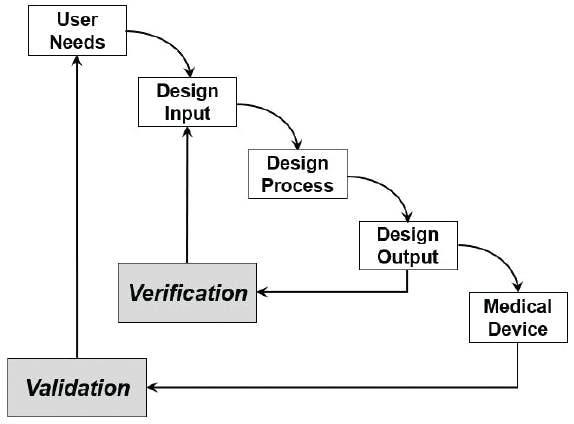
Figure 1. The medical device design waterfall. Adapted from US Food and Drug Administration. Design control guidance for medical device manufacturers. Accessed November 9, 2022. https://www.fda.gov/media/116573/download
The design waterfall depicts well the day-to-day process that engineers employ to ensure that our products meet both their technical specifications as well as the higher-level requirement of the user’s needs. What the diagram doesn’t depict is the more ethereal process of invention—the identification of concepts and technologies to provide a solution for a clinical problem. As engineers, we have an array of technologies to draw from to provide solutions. But, if necessity is the mother of invention, then we must first develop an understanding of unmet clinical needs. Thus, an effective collaboration between industry and physicians is one that helps develop an understanding and appreciation of where we can do better as well as where solutions do not yet exist. Where devices can be invented and improved, where procedures can be made more effective, and how we can employ technologies and services to enable improved outcomes—all are critical to having meaningful impact.
Ms. Lombardi: My role within BD allows me the unique opportunity to apply engineering principles to create and improve medical devices, with the ultimate goal of providing physicians with innovative and high-quality devices that lead to improved clinical outcomes. For example, when we started the Venovo stent (BD) development program in 2013, there were no approved on-label venous stents, and we used this opportunity to identify specific needs for a unique vasculature, ultimately designing a product that was well suited for the space. To accomplish this, we assembled a diverse, talented, cross-functional team of research and development, marketing, quality, clinical, and regulatory affairs team members.
To understand the unique challenges of venous stenting, we had to fully immerse ourselves into the venous disease space by partnering with physicians; capturing the voice of customers; participating in a multitude of venous case observations; conducting several human imaging studies; and performing significant preclinical work, computational modeling, extensive bench testing, and much more. After performing and assessing 26 stent design iterations, the Venovo stent was created, providing a specific balance between radial strength, compression/crush resistance, flexibility, and high placement accuracy. To date, we have tested thousands of devices on the bench and in preclinical studies to qualify and implement these characteristics.
By taking this approach, we have provided physicians with a dedicated venous stent that transforms their everyday venous practice, helping them treat a multitude of venous pathologies, all while improving patient care outcomes. The future remains exciting, as there are many unmet needs in the venous space that will benefit from a commitment to engineering. By working closely with societies and physicians, we can develop new solutions that continue to evolve venous disease treatment options.
Mr. Dillon: First-generation venous stents were developed based on what was known about venous anatomy and iliofemoral venous disease at the time. As engineers, we continue to learn about the disease state and challenges physicians may encounter in their daily practice. We thrive on generating innovative solutions to address such challenges. In doing so, we work with physicians to understand their current treatment methods, shortcomings of existing technology, and unmet clinical needs. An important part of the design process includes replicating clinical scenarios in a nonclinical setting. Thus, we continuously interact directly with physicians to hear about their needs so that we can design and develop technologies that enhance their treatment of patients with venous disease.
Dr. Vogel: I spend a significant amount of time supporting and helping train the sales team to ensure they have access to clear and accurate information about how the stent and delivery system work. I also speak regularly with many different physicians who do venous stenting to learn as much as possible about the problems and challenges they face so that we can direct our efforts at innovation as effectively as possible.
What are the hot topics in the stent engineering field?
Dr. Vogel: One topic receiving attention recently is possible adverse patient reactions to the stent material. There is a portion of the symptomatic venous patient population that may require some form of treatment and have a level of allergic reaction or sensitivity to nickel. This can be a factor for nitinol stents (the Abre venous self-expanding stent [Medtronic] is contraindicated in patients with known hypersensitivity to nickel titanium), but it really applies to any stent with the potential to release nickel ions into the body.
Another important topic is a change in expectations and best practices around stent durability testing. Historically, a test or series of tests has been designed to capture the loading conditions that the stent is likely to experience in vivo, and the stents are subjected to that test to determine if they survive. This testing approach can be described as a “test to pass.” Durability safety margins are determined by numeric analysis techniques. In the future, the best practice is likely to change from “test to pass” to “test to failure,” in which the test is escalated until stents begin to fail. This provides a more direct experimental margin of safety, which will increase confidence in the long-term durability of venous stents, frequently implanted in young patients and expected to last for dozens of years in very active patients.
Mr. Dillon: The stent engineering field is an active space right now. Physicians and engineers continue to learn more regarding basic science and venous disease, and this knowledge can help engineers consider enhancements to the biological performance of stents.
Mr. Chouinard: Since the first balloon-expandable and self-expanding stents were placed clinically in the mid 1980s, there has been an ongoing effort to design and optimize the stents to improve outcomes in a multitude of applications throughout the body. In coronary stents, this has given rise to custom metal alloys designed specifically for balloon-expandable stents, enabling ever thinner but radiopaque stents. In peripheral applications, spring alloys such as those used in the Wallstent (Boston Scientific Corporation) have been employed, and the unique shape-memory and superelastic properties of nitinol have provided for an endless array of design possibilities for engineers. Although nitinol has been in use in stents since at least the mid 1990s, continuous efforts to understand and optimize the material’s nuanced characteristics for medical applications continues to this day. Current areas of ongoing research include the optimization of mechanical working and heat treatment to optimize mechanical and fatigue performance and improving fatigue life by reducing inclusion size and density. Continued refinement of our understanding of this unique material is an area of collaboration between medical device companies, with the common goal of optimizing outcomes for our customers and their patients.
Ms. Lombardi: We are continuing to monitor topics in the stent engineering field to further understand how algorithms may adapt over time with new technologies. Some of the topics that we find especially interesting are:
- Continuing to understand the mechanism of venous stent restenosis and rethrombosis, which may lead to the development of stent drug coating with antiproliferative and/or antithrombotic agents to prolong long-term patency
- Application of regenerative medicine principles into current and future stent designs to prolong long-term patency
- Development of new bioresorbable stent materials and designs as well as new stent processing technologies such as three-dimensional printing
- Further assessing long-term clinical data on dedicated venous stents to assess long-term patency and evaluate next-generation devices
What are some of the key lessons learned in the past few years of studying venous stents from an engineering perspective?
Mr. Chouinard: The observations of deep venous stent migrations provide an opportunity to study this specific failure mode and steps that can be taken to reduce the likelihood of its occurrence. Migrations were found to occur predominantly in nonthrombotic iliac vein lesion (NIVL) cases. This raises questions about NIVL biomechanics, as well as questions around patient selection, procedure planning, and device length and diameter selection.
- Patient selection. Generally, NIVL patients are assessed for intervention based on their symptoms and the severity of stenoses. Some interventionalists employ other criteria to look for further evidence of chronic stenosis, such as vein wall thickening (perivenous fibrosis), webs or spurs, cross-pelvic collaterals, or caliber change (or lack thereof) from hydration status, Valsalva maneuvers, or respiratory variation. In any case, it is important to recognize that veins are compliance vessels and that the stenosis itself should not be relied upon solely to provide fixation for the stent.
- Procedure planning. The selection of anchor zones for the stent ends should allow for sufficient and stable purchase of the stent, both in terms of diameter and length.
- Venous compliance. As compliance vessels, healthy veins undergo changes in diameter from changes in patient hydration, respiration, Valsalva maneuvers, and posture. These changes can in turn affect the degree of apposition or interference fit between the stent and vein wall. Consideration should be given to potential changes in vein caliber when selecting stent diameters.
- Intravascular ultrasound (IVUS) vessel measurement considerations. When using IVUS to obtain diameter measurements of veins for stent sizing, be aware of the ways in which IVUS can over- or underpredict the actual diameter of the vessel. Because the IVUS catheter is not always sufficiently parallel to the vessel lumen, the image sometimes depicts an oblique cross-section, which can increase the resulting dimension if the obliquity is significant. Furthermore, the practice of estimating the diameter of a vein by calculating the average of its minimum and maximum diameter measurements, or by calculating the equivalent diameter for a given area, are prone to underestimation of the vein size if the vein is not sufficiently equiaxial (ie, flattened). These sources of variation warrant further study, but an appreciation of these factors can help to inform careful stent size selection in accordance with manufacturer’s sizing recommendations.
Ms. Lombardi: Since the introduction of dedicated venous stents, both physicians and engineers progressed through a learning curve from design to practical application. Through this, continued emphasis on proper patient selection and careful technique were identified, providing opportunities for continued collaboration and education. Through this partnership, we can help ensure optimal clinical outcomes when introducing a dedicated device for venous vasculature.
Another key lesson learned was the importance of dedicated stent design features that help mitigate the risk of poor outcomes. Through this, we evaluated anatomic differences from the arterial to venous system, such as venous distension with significant vein diameter change and the presence of external and heterogeneous forces along the veins. This required different design characteristics, such as higher radial strength and compression/crush resistance forces.
Based on these anatomic differences, we learned that venous stent migration can be a potentially life-threatening complication, and we have tried to minimize this through engineering principles. We designed flared ends on the Venovo stent to help mitigate the increasing diameter of the venous system in line with the direction of flow. Through bench testing, we were able to show that this design characteristic, when combined with high stent radial strength, created higher pull forces, ultimately showing higher resistance when trying to move a stent from its fixed position. By understanding the venous disease and making intentional design choices, we hope to improve safety and patient outcomes.
Mr. Dillon: We have learned that education specific to venous disease as well as to individual technologies used for patient treatment is critical for a technology to be successful in this space. Additionally, appropriate stent sizing and deployment accuracy are essential for successful stent placement and patient outcomes.
Dr. Vogel: Stent sizing in veins remains a challenge. Methods to determine the nominal size of the veins and landing zones are variable. However, key procedural steps, such as using complementary image modalities (including IVUS), avoiding landing a stent in a curve, and extending stents into healthy segments to ensure stent fixation, are very important considerations in the absence of a standard sizing approach.
Although most iliofemoral venous stent fractures occur in the vicinity of the inguinal ligament, we now better understand that the ligament is likely not directly involved in the mechanisms that contribute to fractures. Instead, the loading that can cause a fracture seems to be related to the way the stent is bent over the superior ramus when standing and especially during hip extension, relative to its shape during hip flexion.
We understand even better today the importance of good inflow to the stent to support patency and the lack of good solutions for physicians when good inflow is not present.
What are engineers working on to help achieve better patient outcomes in this space?
Ms. Lombardi: We are continuing to work on the key topics discussed by targeting technologies that can make the most impact when looking to improve patient outcomes. In addition to evaluating some of the new stent technologies discussed herein, we are also evaluating adjunctive therapies that can work in conjunction with venous stents. For instance, when evaluating deep vein thrombosis and thrombectomy technologies, we can look to improve vessel preparation and thrombus burden before stenting, ultimately looking to improve long-term patency and outcomes.
With this, we stay fully immersed in the peripheral vascular disease space to identify new unmet needs, witness current devices firsthand, and continue to develop new or improved solutions that positively impact physicians’ practice in the venous space.
Dr. Vogel: Some of the top ones include:
- Making it easier to treat stent occlusions, especially the difficulty of recanalizing an occluded stent given the limited options available to physicians today
- Reducing the likelihood of stent thrombosis, especially due to poor inflow or difficulties related to anticoagulation
- Improving understanding of the potential for vessel erosion or the potential for portions of the stent to eventually penetrate the vessel wall
Mr. Chouinard: To date, at least four venous stent trials have been conducted to gain premarket approval in the United States. Although direct comparisons cannot be made between the studies, all of them demonstrate a considerable difference in the patency outcomes in nonthrombotic and postthrombotic patient populations. The explanation for the difference between NIVL and postthrombotic syndrome stent patency is likely multifactorial, including considerations such as stented segment length, vein caliber, likelihood of inflow disease, and patient coagulability. However, the difference in outcomes between these patient populations represents an opportunity for industry to innovate and improve the available products and procedures for the future.
Mr. Dillon: Engineers are interested in understanding more about the biological performance of the implant and the mechanisms that can lead to complications after stent placement. This greater understanding will lay the foundation for advancing the treatment and long-term quality of life for patients with venous obstruction.
What do you most want operating/implanting physicians to understand about venous stents?
Mr. Dillon: Venous stents are intended for patients with symptomatic iliofemoral venous outflow obstruction. Care should be taken in patient selection and in planning for stent placement in each procedure to optimize stent performance and patient outcome. Additionally, continuous engagement and collaboration between industry and physicians is critical to advance the field of venous stenting. Industry should leverage existing evidence to make the best decisions around designs.
Ms. Lombardi: Compared to the arterial system, the venous system poses unique anatomic, physiologic, and pathologic challenges that need to be overcome by the stent. Characteristics specific to venous stents include stent size, stent radial strength, compression/crush resistance, and flexibility, which are all important when considering these unique challenges. However, these desired stent characteristics are often in conflict or have opposing effects with each other. Therefore, to design a dedicated venous stent, it was necessary to develop a large stent size matrix to provide physicians the ability to treat varying venous anatomy. Each size was optimized with fine adjustments to these key stent characteristics, allowing physicians to implant the right stent for the right patient.
Dr. Vogel: Here are a few of my top things:
- A high-pressure balloon at rated pressure exerts approximately 500 to 1,000 times the radial force of a venous stent. The radial force that the stent applies to the vessel wall is typically about the same magnitude as an increase in blood pressure of about 20 to 40 mm Hg, but the balloon is 500 to 1,000 times greater than that.
- Expanding a nitinol stent to its nominal diameter helps the stent fully transform the crystal structure of the nitinol to its stronger state, which can improve the radial strength of the stent. But, expanding a nitinol stent beyond its nominal diameter should not provide any benefit to the stent, because it should already, at body temperature, be at its maximum strength.
- Where nitinol stents are overlapped, the radial force and compression resistance are approximately doubled, but the flexibility is reduced by much more than half. Overlap zones should be avoided where the stents are expected to flex a lot, such as at the superior ramus, near the inguinal ligament.
Mr. Chouinard: If we look at the arc of medical device history, we generally see a story of continuous improvement, resulting in the specialized devices in use today. This is especially apparent if you examine the history of interventional devices in coronary or peripheral artery interventions. The development and refinement of venous stents is arguably at an earlier stage than that of stents used in peripheral or coronary artery disease. With an ongoing collaboration between industry and the physician community, we can continue to drive the development of increasingly beneficial products, driven by an evolving understanding of the unmet needs, and development of technologies and differentiated products to meet those needs.
Advertisement
Advertisement