Advertisement
Advertisement
September 2022
Current Status of Sirolimus Devices in SFA Disease
A summary of device platforms and a close look at clinical study experiences to date as well as new randomized trials underway.
By Edward T.C. Choke, MBBS, FRCS, PhD, and Tjun Y. Tang, MBBChir(Cantab), MD, FRCS, FAMS
In the coronary arena, the role of sirolimus as an antirestenotic agent is well established. In contrast, for the peripheral vasculature, the role of sirolimus has only begun to gain traction in the past few years. Sirolimus has a broad therapeutic range and excellent inhibition of smooth muscle cell migration,1 and it reversibly puts cells into the G0 resting phase (cytostatic) while having anti-inflammatory and immunosuppressive properties,1 having first been developed for this purpose. As such, sirolimus has attractive prospects in the setting of peripheral artery disease (PAD) and atherosclerosis.
DEVELOPMENT OF SIROLIMUS-COATED BALLOONS
Due to its differences in biophysical properties compared to paclitaxel, novel techniques are required to package sirolimus onto a stentless balloon platform that can directly deliver the drug to the vessel wall in an adequate quantity to achieve sustained inhibition of neointimal hyperplasia (NIH). There are currently two commercially available sirolimus-coated balloons (SCBs) in Europe and Asia, which have promising pilot data for their efficacy in superficial femoral artery (SFA) disease. These are the MagicTouch PTA (Concept Medical) and the Selution sustained limus release (SLR) device (MedAlliance).
The MagicTouch PTA is a novel SCB that utilizes proprietary nanolute technology designed to improve the bioavailability of sirolimus. Sirolimus is transformed into submicron-sized particles and encapsulated in phospholipid-drug nanocarriers. The Selution SLR SCB utilizes a biodegradable polymer poly(lactic-co-glycolic acid) that, when mixed with sirolimus, forms microreservoirs, which can then regulate drug release via matrix degradation. This allows a sustained release over a 90-day period and is beneficial for inhibiting the NIH process, which typically only begins 2 to 3 months after the barotrauma of angioplasty.
SCB PILOT TRIALS FOR SFA
Currently, there are two published first-in-human (FIH) SCB trials for SFA disease—the XTOSI Trial (MagicTouch PTA)2 and the SELUTION SLR trial,3 both of which reported promising efficacy data.
The XTOSI FIH Trial
The XTOSI pilot study was a prospective, single-arm, open-label, single-center trial (Sengkang General Hospital, Singapore) evaluating the MagicTouch PTA SCB. A total of 20 patients underwent SCB treatment for SFA disease. The primary endpoint was primary patency at 6 months (duplex ultrasound–defined peak systolic velocity ratio [PSVR] ≤ 2.4). The majority of patients (18/20, 90%) had chronic limb-threatening ischemia (CLTI). Mean SFA lesion length treated was 277 mm, of which 45% were chronic total occlusions. Excellent 6-month SFA primary patency was reported at 88.2%. At 12 months, freedom from target lesion revascularization (TLR) was 94.1%, amputation-free survival was 90%, and limb salvage success was 94.4%. Figure 1 shows a patient from the XTOSI trial with a patent SFA and ulcer-free foot at 24 months after the index procedure.
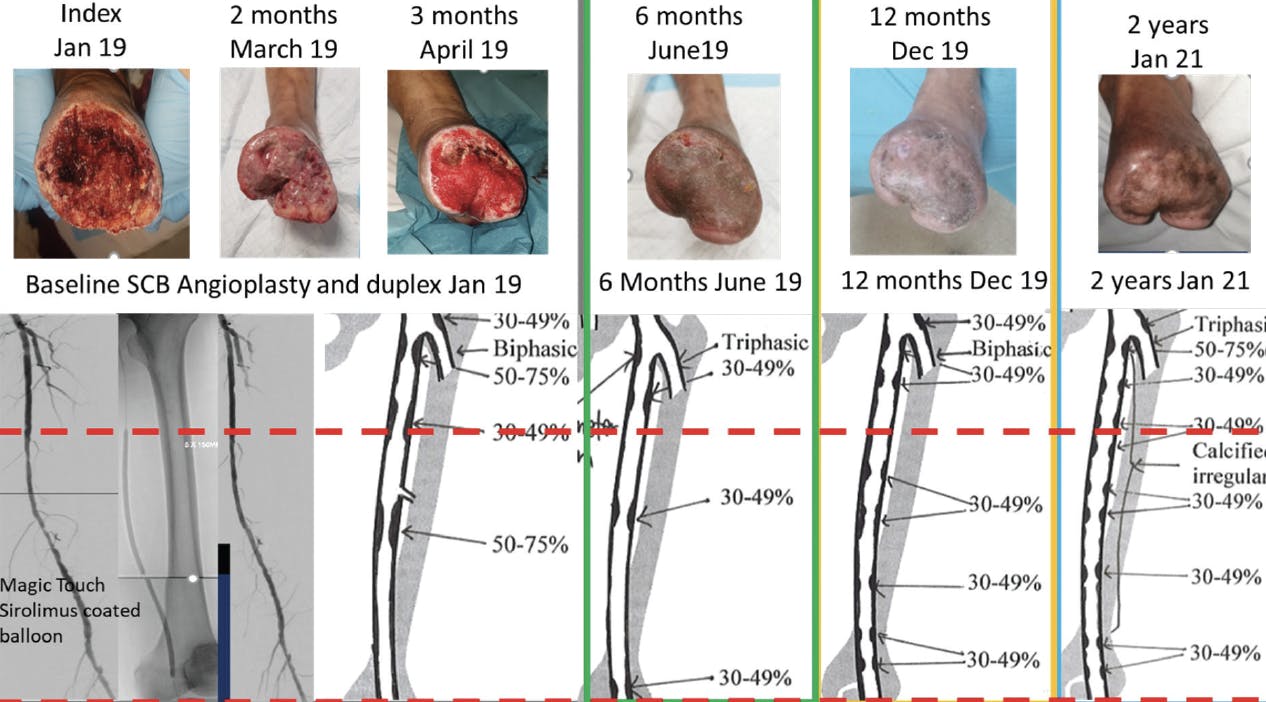
Figure 1. A patient from the XTOSI trial who received MagicTouch PTA to SFA. At 6 months, the wound was completely healed. At 2 years, the patient remained ulcer-free and duplex ultrasound demonstrated that the treated segment of SFA remained patent.
SELUTION SLR FIH Trial
The SELUTION SLR FIH trial recruited 50 patients with claudication at four German centers. The primary trial endpoint was SFA angiographic late lumen loss (LLL) at 6 months after SELUTION SLR SCB treatment. At 6 months, the median angiographic LLL (n = 34) was excellent at 0.19 mm and the mean angiographic LLL was only 0.29 mm. Primary patency by duplex ultrasound was 88.4%, and freedom from binary restenosis was 91.2%.
Perspectives
The 6-month primary patency for SFA lesions for both the XTOSI and SELUTION SLR studies were remarkably similar (88.2% and 88.4%, respectively). The SCB data were also similar to paclitaxel-coated balloons (PCBs) in previous studies, which used the same binary restenosis duplex ultrasound–defined endpoint—6-month primary patency rates of 87% and 90% were reported by RANGER SFA and LEVANT 2 studies, respectively.4,5 Even more encouragingly, when using angiographic criteria, the SELUTION SLR SCB study reported superior mean angiographic LLL of 0.29 mm compared with 0.46 to 0.51 mm (PCBs) and 1.04 mm (uncoated balloon angioplasty).
However, any comparison with other trials should be interpreted with caution and considered only as a broad guide. It is worth noting that promising results were reported and achieved despite the XTOSI trial having a predominant challenging CLTI group of patients who had high prevalence of diabetes and kidney disease, compared with claudicant-dominant cohorts in the SELUTION femoropopliteal study, RANGER SFA, and LEVANT 2 trials.
SIROLIMUS-ELUTING STENTS/SCAFFOLD FOR SFA
SIROCCO Trial
SIROCCO, the first sirolimus-eluting stent trial for SFA, was a randomized study comparing the sirolimus-eluting SMART stent (n = 47) to the bare SMART nitinol stent (n = 46) (both Cordis).6 The investigators reported similar restenosis rates at 24 months, with 22.9% in the sirolimus group versus 21.1% in the bare stent group (P > .05) and no difference in cumulative in-stent restenosis at 6, 9, 18, and 24 months. The SIROCCO trial showed that the sirolimus-eluting SMART stent, compared to the bare nitinol stent, did not demonstrate any superiority in freedom from restenosis for SFA lesions.
ILLUMINA and ESPRIT I Trials
Since the publication of SIROCCO in 2006 on the equivocal utility of sirolimus drug-eluting stents (DESs) for SFA, further data on the clinical utility of sirolimus DESs have remained scarce. Nevertheless, recent technologic advances have suggested that novel limus-based stents may still have a place in optimizing the treatment algorithm of SFA lesions.
The 24-month data from the ILLUMINA trial on the Nitides sirolimus DES (Alvimedica) for SFA lesions were presented in 2019 with encouraging results.7 The Nitides sirolimus DES is a self-expanding, polymer-free nitinol stent. Sirolimus is combined with fatty acid in a novel amphilimus formulation. The ILLUMINA FIH study of 100 SFA patients reported promising 24-month primary patency of 83.4% and freedom from TLR of 93.1%.
The ESPRIT I trial was an FIH study of a limus bioresorbable vascular scaffold, which used a different limus agent known as everolimus.8 A total of 31 SFA lesions were included. At 1 and 2 years, the authors reported low restenosis rates of 12.1% and 16.1%, respectively, and low TLR rates of 8.8% and 11.8%, respectively.
ONGOING TRIALS FOR SCBs FOR SFA
FUTURE SFA Trial
The FUTURE SFA trial (NCT04511234) is the first trial comparing an SCB (MagicTouch PTA) versus conventional uncoated balloon for SFA lesions.9 Recruitment is currently ongoing from four countries in Asia (Singapore, Taiwan, Thailand, and South Korea). The target enrollment is 279 patients, with 2:1 randomization to receive a MagicTouch PTA SCB or a placebo uncoated balloon, respectively. The primary endpoint is primary patency at 6 months, defined by duplex ultrasound PSVR of < 2.4 and absence of TLR. Both severe claudicants (Rutherford class 3) and CLTI patients (Rutherford class 4-6) are included. Compared with other SFA trials that mostly recruited claudicants, it is anticipated that the majority of patients recruited for FUTURE SFA will be CLTI patients, given that in Asia the indications for lower limb angioplasty are mostly for CLTI. The findings from this trial will be important because at its most fundamental level, we need proof that SCB is superior to conventional balloon angioplasty. It will also provide proof of whether SCBs are better at maintaining patency than conventional uncoated balloon angioplasty in the setting of challenging CLTI patients.
SIRONA Trial
The SIRONA trial (NCT04475783) is a head-to-head trial comparing SCBs (MagicTouch PTA) versus PCBs for SFA lesions.10 A total of 478 patients with claudication will be recruited from 30 sites in Austria and Germany to receive either MagicTouch PTA or PCB. Any of the 10 PCBs currently available in Europe can be used in the trial, so the head-to-head results will give a good understanding of whether MagicTouch PTA SCB can perform as well as paclitaxel in general. It is a noninferiority trial, with two primary endpoints at 1 year—an efficacy endpoint and a safety endpoint. The noninferiority margin is defined as < 10%. The recruitment is at 90% completion, and it is anticipated that 1-year primary endpoint results should become available at the end of 2023. This is an important trial because proof of noninferiority to paclitaxel would provide interventionalists with a valuable alternative in the treatment of SFA lesions.
SELUTION SLR IDE SFA Study
Selution SLR SCB recently received conditional FDA investigational device exemption (IDE) approval to initiate a pivotal clinical trial to demonstrate superiority of the device versus plain old balloon angioplasty for the treatment of occlusive disease of the SFA. This trial plans to enroll 300 patients at > 20 centers in the United States and an additional 20 centers around the world.
PREVISION Trial
The interest in using sirolimus in PAD has been heightened by the recent announcement by BD Interventional of the start of enrollment of an FIH trial of their peripheral SCBs. According to the company, the PREVISION trial is a prospective, multicenter, single-arm, nonrandomized study designed to evaluate the safety of the BD Interventional SCBs in the treatment of PAD in the femoropopliteal arteries. PREVISION is being conducted across multiple sites in Australia, New Zealand, and Singapore. The trial will enroll and follow approximately 50 patients over the coming months.
CONCLUSION
Sirolimus as an antirestenotic agent for SFA disease is rapidly gaining traction. Currently, the main focus is on its role as a medicinal agent via drug-coated balloons. Early FIH studies using two different SCB devices (XTOSI and SELUTION SLR) have yielded nearly identical and promising 6-month primary patency results. These preliminary data suggest that the SCB is superior to uncoated balloon angioplasty and is as effective as paclitaxel, but these need to be confirmed or refuted by large and adequately powered randomized trials. The results of the FUTURE SFA, SIRONA, and SELUTION SLR IDE SFA randomized trials will provide valuable insights on whether SCBs will become the standard of care in the treatment of SFA lesions. With the likelihood of more players using SCBs in the PAD arena, the vascular community awaits with interest whether this will change practice over the next few years.
1. Wessely R, Schömig A, Kastrati A. Sirolimus and paclitaxel on polymer-based drug-eluting stents: similar but different. J Am Coll Cardiol. 2006;47:708-714. doi: 10.1016/j.jacc.2005.09.047
2. Choke E, Tang TY, Peh E, et al. MagicTouch PTA sirolimus coated balloon for femoropopliteal and below the knee disease: results from XTOSI pilot study up to 12 months. J Endovasc Ther. Published online December 15, 2021. doi: 10.1177/15266028211064816
3. Zeller T, Brechtel K, Meyer DR, et al. Six-month outcomes from the first-in-human, single-arm SELUTION sustained-limus-release drug-eluting balloon trial in femoropopliteal lesions. J Endovasc Ther. 2020;27:683-690. doi: 10.1177/1526602820941811
4. Bausback Y, Willfort-Ehringer A, Sievert H, et al. Six-month results from the initial randomized study of the ranger paclitaxel-coated balloon in the femoropopliteal segment. J Endovasc Ther. 2017;24:459–467. doi: 10.1177/1526602817710770
5. Rosenfield K, Jaff MR, White CJ, et al. Trial of a paclitaxel-coated balloon for femoropopliteal artery disease. N Engl J Med. 2015;373:145-153. doi: 10.1056/NEJMoa1406235
6. Duda SH, Bosiers M, Lammer J, et al. Drug-eluting and bare nitinol stents for the treatment of atherosclerotic lesions in the superficial femoral artery: long-term results from the SIROCCO trial. J Endovasc Ther. 2006;13:701-710. doi: 10.1583/05-1704.1
7. Langhoff R, Scheinert D. Alvimedica: Thinking different for SFA lesions: the NiTiDES solution. Presented at: Cardiovascular and Interventional Radiology Society of Europe (CIRSE) Annual Conference; September 7-11, 2019; Barcelona, Spain.
8. Lammer J, Bosiers M, Deloose K, et al. Bioresorbable everolimus-eluting vascular scaffold for patients with peripheral artery disease (ESPRIT I): 2-year clinical and imaging results. JACC Cardiovasc Interv. 2016;9:1178-1187. doi: 10.1016/j.jcin.2016.02.051
9. Sirolimus coated balloon versus standard balloon for SFA and popliteal artery disease (FUTURE-SFA). Clinicaltrials.gov website. Accessed August 16, 2022. https://clinicaltrials.gov/ct2/show/NCT04511234
10. Sirolimus- vs. paclitaxel-drug coated balloons in patients with peripheral artery disease (SIRONA). Clinicaltrials.gov website. Accessed August 16, 2022. https://clinicaltrials.gov/ct2/show/NCT04475783
Advertisement
Advertisement