Advertisement
Advertisement
September 2022
Post-PTA Dissection in the SFA: The DISFORM Classification
A closer look at DISFORM, from reporting standards to use as a decision aid for peripheral procedural dissections.
By Michiel T. Voûte, MD, PhD, FEBVS, and Alexandra O. Stathis, BAdvSci(Hons), MBBS, MS
When dealing with peripheral arterial occlusive disease, percutaneous transluminal angioplasty (PTA) is fundamental for endovascular treatment. After vessel preparation using balloon angioplasty, a variety of increasingly popular adjunctive treatments can be applied, such as atherectomy, lithotripsy, drug-coated balloon angioplasty, or drug-eluting stenting. In some lesions, balloon angioplasty alone may provide definitive treatment, especially when other therapies are not considered preferable.
Although the list of possible strategies and adjuncts is long, the main requirement for a successful revascularization is, simply put, luminal gain by PTA.1 The mechanism behind this is controlled dissection: small microscopic tears in the intima or media to allow for adventitial stretch and plaque shift or redistribution.2 When such tears lead to uncontrolled dissection, this can negatively affect procedural outcome. Acute occlusion and early restenosis are detrimental adverse events that can follow an intervention in which an uncontrolled dissection was created.
In an attempt to control outcomes after endovascular treatment, several classification systems have been developed to describe angioplasty-induced dissections. Classifying these lesions can help evaluate, guide additional treatment, and possibly predict prognosis in individual patients.
EARLIER DISSECTION CLASSIFICATION SYSTEMS
There are a number of classification systems in common use. A large proportion of these have arisen from percutaneous coronary intervention (PCI), and while there is some crossover with peripheral angioplasty, the applicability and relevance of these systems to peripheral arteries remains an area of controversy.3
The National Heart, Lung, and Blood Institute Percutaneous Transluminal Coronary Angioplasty (NHLBI PTCA) registry published its manual of operations in 1985, describing the morphologic presentations of arterial dissections that occur during PCI.4 The classification is a reflection of the technology available at the time (cine-loop fluoroscopy), and there have been significant imaging advances since its publication. Nevertheless, the NHLBI has remained the predominant classification system in use for peripheral artery dissection for almost 40 years. NHLBI distinguishes six categories, from simple linear to spiral morphologies, with contrast extravasation as a separate category. The system is complex, and some have argued it is too detailed for everyday use. Furthermore, there are features of the classification that, while highly relevant in coronary intervention, bear little consequence in a peripheral angioplasty procedure.
A need for simplification saw the advent of another classification system based on angiography by Kobayashi et al.5 This system looks at three categories: no dissection, mild dissection, and severe dissection. The categories allow for ease of use in everyday practice, but the system’s simplicity limits its ability to distinguish key prognostic factors and its use in clinical research.
Intravascular ultrasound (IVUS) has grown in popularity as an adjunctive imaging modality and presents several advantages over angiographic assessment, including the ability to determine depth and degree of arterial injury. IVUS was investigated by van de Lugt et al to evaluate arterial dissection, and they proposed a classification incorporating the depth and circumference of dissection.6 The system provides a solid framework to classify the extent of dissection, but it is limited in its description of other features thought to be clinically important, such as length, luminal diameter reduction, and spiral morphology.
The iDissection grading system proposed by Shammas et al in 2018 comprises six dissection grades based on depth and circumference of dissection.7 As with the system proposed by van de Lugt et al, iDissection lacked key prognostic features, including length of dissection, presence of thrombus, and spiral morphology. Furthermore, the limitation of these systems is that IVUS is not a universally adopted imaging modality in angiography labs around the globe.
THE DELPHI CONSENSUS STUDY
The lack of a universally adoptable and dedicated classification system for femoropopliteal dissections is why the latest Delphi consensus study was conducted. The goal of the study was to provide a universally adoptable classification that is specific to femoropopliteal angioplasty–induced dissections. It was intended to serve as a reporting standard, replacing nonspecific or overly simplistic classification systems, and could guide individual interventionalists in their choice of treatment for these adverse procedural findings.
To serve this purpose, a Delphi consensus panel (n = 17) was assembled from several key opinion leaders representing the fields of vascular surgery, interventional radiology, and interventional cardiology (five panelists for each field), as well as vascular medicine (two panelists).8 The consensus process was conducted in three rounds in which online questionnaires were used to gather input from the panelists separately.
Round 1
In this first round, an executive committee of two vascular surgeons and two interventional cardiologists were asked to draft a list of potential angiologic features of procedural dissections that could be related to adverse outcomes (acute failure or early restenosis). The committee agreed on a list of eight features of angioplasty-induced dissection that could be relevant to procedural outcomes in the femoropopliteal segment. The final list from this round comprised luminal diameter reduction ≥ 50%, spiral shape, degree of flow impairment, dissection length, multiplicity of dissections, contrast extravasation, double-lumen lucency (contrast behind the lamella or in the wall), and pressure gradient over the lesion measured by a pressure wire or catheter-based manometer system.
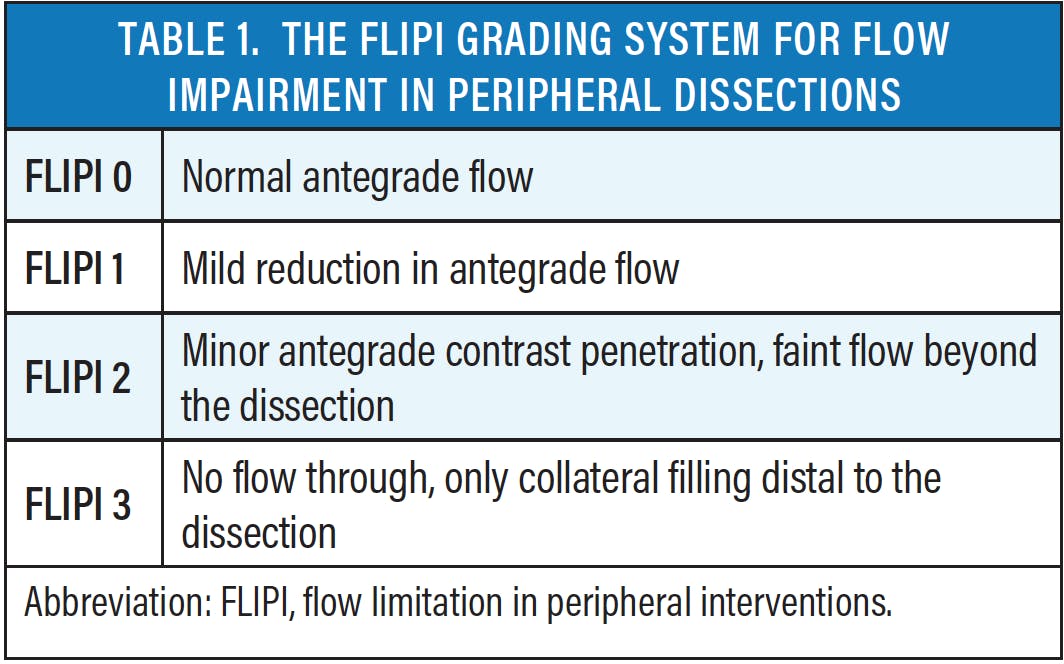
The committee provided three methods of assessing flow impairment for the Delphi panel to consider during the second round. The first method was comparing flow between the superficial femoral artery and the deep femoral collaterals, the second was measuring the time of contrast filling and washout through the dissected lesion, and the third was using a flow grading system modified from the TIMI (thrombolysis in myocardial infarction) grading system used in coronary angiography. This was dubbed the FLIPI (flow limitation in peripheral interventions) grading system (Table 1).
Round 2
In the second round, the 17 experts of the Delphi panel were asked to score each of the listed features on a scale of 1 to 9 for their predictive value of either acute procedural failure or early restenosis (< 6 months), in separate questions. Angiographic images with a ruler were provided to illustrate the morphology of different possible dissections. For the pressure gradient as well as for all morphologic features, several cutoffs were suggested, and a field for free text response was allowed with each question. For flow impairment, the panel was asked to choose from the three previously mentioned options. Significant consensus among the panel was defined as ≥ 70% agreement within a 3-point bandwidth, and a mean score ≥ 6 was considered a positive predictive value for the adverse outcome in question.
By consensus, the features that were deemed predictive of acute failure were ≥ 50% diameter reduction, spiral shape, and flow impairment. The latter was judged to be assessed best by using the FLIPI grading system. In predicting early restenosis, the same features were selected, with the addition of multiplicity, length of dissections, and pressure gradient over the dissection. The pressure gradient over a dissection was excluded before the third round because no consensus was reached as to what constituted a significant gradient and whether the use of pressure gradients was validated in clinical trials for the purpose of developing a universally applicable scoring system (eg, independent of the availability of pressure wires).
Round 3
In the final round, the expert panel was asked to cast judgment on a wide range of case scenarios. The scenarios consisted of each possible combination of the following four clinically relevant morphologic features: (1) a ≥ 50% diameter reduction, (2) a spiral-shaped dissection, (3) a multitude of dissections, and (4) any dissection ≥ 2 cm in length. Because these are all dichotomous variables, there were 16 different combinations (2 × 2 × 2 × 2 = 16). The panel agreed that no spiral-shaped dissection can occur at a length < 2 cm, thus excluding those four combinations and leaving a total of 12 possible morphologic scenarios.
An illustrated graphic representation of these 12 scenarios, as well as an exemplary angiographic image with a ruler for clarification, was paired with a FLIPI score for flow impairment, ranging from 0 to 3. It was suggested that the presented dissection was present even after prolonged ballooning, which is a generally accepted first response to procedural dissections. For each of the 48 questions in this round, the panelists were asked whether they would either (1) leave the dissection as is or (2) introduce an additional scaffold (eg, a tack or stent). Very few scenarios were found to be “nonexistent” by individual panelists, but in such events, those panelists (never more than 4 of the 17) were excluded from statistical calculations.
Unanimously, the panel found that an additional scaffold was necessary in any scenario with a diameter reduction of ≥ 50%. By large majority, a spiral dissection, multiple ≥ 2-cm-long dissections, and scenarios with severe flow impairment (FLIPI score of 2 or 3) were also best treated with scaffold. In contrast, only one panelist (6%) would advise additional scaffolding of a visible but short (< 2 cm) dissection without a 50% diameter reduction or flow impairment (FLIPI 0). The complete panel response is presented in Figure 1.
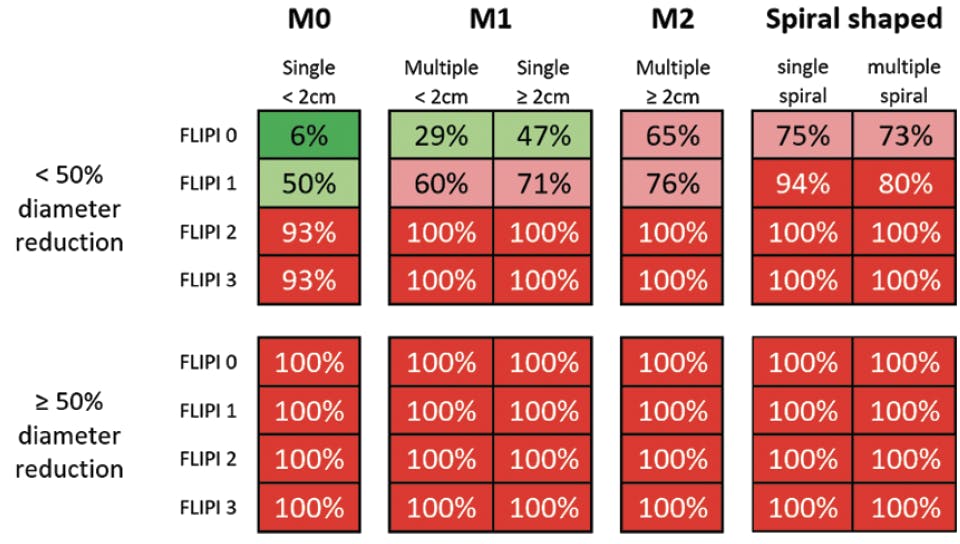
Figure 1. Delphi panel recommendations for scaffolding per the scenario in the third round. The proportion of the Delphi panel that would recommend scaffolding is presented as percentages. Red boxes correspond to a strong recommendation (≥ 80%) to scaffold and pink to a moderate recommendation (> 50%-80%). Dark green boxes represent a strong recommendation against scaffolding (≤ 20% recommend to scaffold), and light green boxes represent a moderate recommendation against scaffolding (> 20%-50% would scaffold). Reprinted from JACC: Cardiovascular Interventions, Vol 14, Voûte MT, Stathis A, Schneider PA, et al, Delphi consensus study toward a comprehensive classification system for angioplasty-induced femoropopliteal dissection: the DISFORM study, 2391-2401, 2021, with permission from Elsevier.
THE DISFORM CLASSIFICATION SYSTEM
As a result of this consensus study, a reporting standard was drafted where a peripheral procedural dissection could be categorized by its degree of diameter reduction (D), the presence of a spiral shape (S), its flow impairment (F), or its morphology (M) in terms of lesion length and multiplicity. This led to the DXSXFXMX classification (Table 2), which has four separate descriptors very much like the CEAP (clinical, etiologic, anatomic, pathophysiologic) classification for venous insufficiency or the TNM (tumor, node, metastasis) classification for tumors.
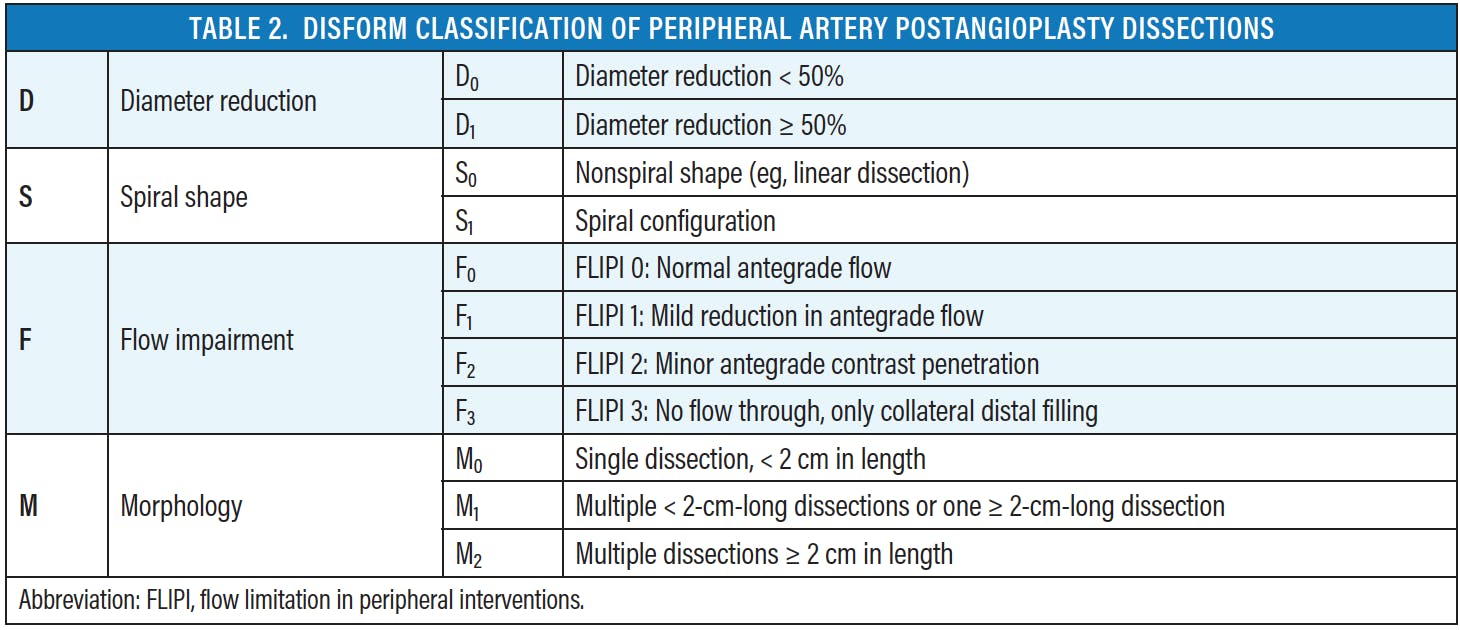
The DISFORM system makes for an easily applicable, reproducible method of describing dissections, providing a dedicated reporting standard for peripheral artery dissection. Subsequently, for each DSFM classification, one of four degrees of severity can be extrapolated from the Delphi panel’s recommendations.
This leads to the following DISFORM grading systems:
- DISFORM I (dark green box, Figure 1) is defined as a single, short peripheral dissection without significant diameter reduction or flow impairment (D0, S0, F0, M0). These lesions are recommended for scaffolding by < 20% of the panel experts.
- DISFORM II (light green boxes, Figure 1) lesions have no significant diameter reduction or spiral aspect but can show either mild flow impairment through a single short lesion (D0, S0, F1, M0) or no flow impairment but multiple short lesions or a single longer lesion (D0, S0, F0, M1). A minority of experts (20%-50%) recommend scaffolding these lesions.
- DISFORM III (pink boxes, Figure 1) lesions also have no significant diameter (D0) but either a spiral aspect without flow impairment (D0, S1, F0, MX) or multiple long lesions without or with limited flow impairment (D0, S0, F0-F1, M2). Areas with multiple short dissections or a single long dissection but with mild flow impairment classify as DISFORM III also (D0, S0, F1, M1). The majority of experts (50%-80%) recommend scaffolding these lesions.
- DISFORM IV (red boxes, Figure 1) lesions are any lesion with ≥ 50% diameter reduction (D1), those with at least a strongly reduced antegrade flow impairment (F2 or F3), and spiral dissections with at least mild flow impairment (D0, S1, F1, MX). Nearly all experts (≥ 80%) recommend scaffolding these lesions to prevent adverse outcomes.
A DECISION AID IN CLINICAL PRACTICE
As a reporting standard, DISFORM could serve any angiography lab without the presence of additional tools such as IVUS, pressure wires, or other adjuncts. However, for the individual interventionalists faced with a dissection after successful revascularization and balloon angioplasty, a more practical decision aid was created from the DISFORM data: a flowchart that can be followed when dealing with periprocedural dissection (Figure 2). It requires the key features of the dissection to be assessed in order of severity, resulting in a management recommendation from the experts in the field.
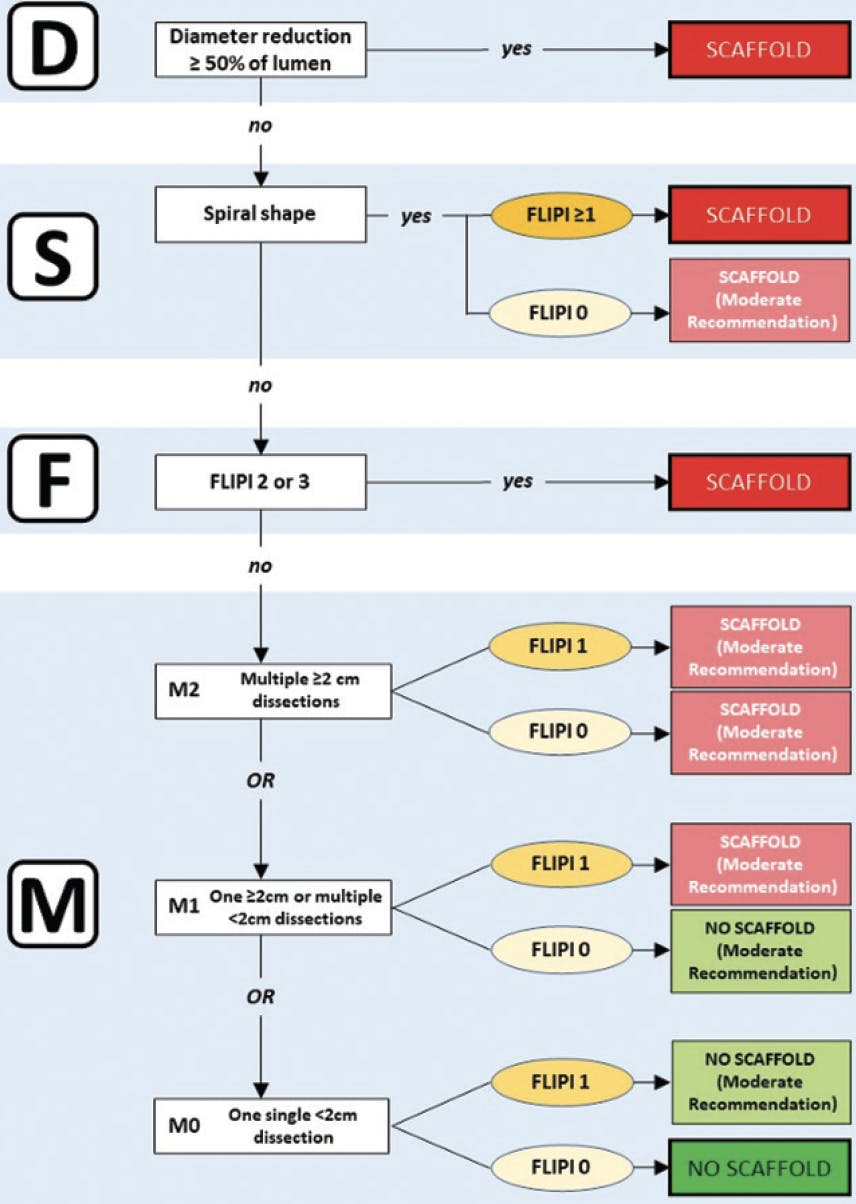
Figure 2. A decision aid for management of angioplasty-induced dissections in peripheral arteries. Reprinted from JACC: Cardiovascular Interventions, Vol 14, Voûte MT, Stathis A, Schneider PA, et al, Delphi consensus study toward a comprehensive classification system for angioplasty-induced femoropopliteal dissection: the DISFORM study, 2391-2401, 2021, with permission from Elsevier.
SUMMARY
As with any Delphi consensus study, DISFORM is based only on expert opinion. However, DISFORM has been able to provide a clear, concise decision aid to the individual interventionalist who is faced with any type of procedural dissection. Furthermore, having reached consensus on what characteristics really matter in peripheral artery dissections, DISFORM provides the world’s first dedicated classification system for peripheral artery dissections based on the universally available technology of angiography. Future steps could include validation studies and extending the same methodology to provide classification and management tools for below-the-knee lesions.
1. Bosiers M. Is vessel prep necessary before treating the superficial femoral artery? J Cardiovasc Surg (Torino). 2019;60:557-566. doi: 10.23736/S0021-9509.19.11037-3
2. Castaneda-Zuniga WR, Amplatz K, Laerum F, et al. Mechanics of angioplasty: an experimental approach. Radiographics 1981;1. doi: 10.1148/radiographics.1.3.1
3. Stathis A, Voute MT, Varcoe RL. Vessel compliance, barotrauma and dissections with endovascular therapy of the PAD patient. In: Shammas NW, ed. Peripheral Arterial Interventions: Evolving Therapeutic Strategies. Springer Cham; 2022.
4. National Heart, Lung, and Blood Institute. Coronary artery angiographic changes after percutaneous transluminal coronary angioplasty. Manual of Operations: NHLBI PTCA Registry. Bethesda, MD: National Heart, Lung, and Blood Institute; 1985.
5. Kobayashi N, Hirano K, Yamawaki M, et al. Simple classification and clinical outcomes of angiographic dissection after balloon angioplasty for femoropopliteal disease. J Vasc Surg. 2018;67:1151-1158. doi: 10.1016/j.jvs.2017.08.092
6. van der Lugt A, Gussenhoven EJ, Mali WP, et al. Effect of balloon angioplasty in femoropopliteal arteries assessed by intravascular ultrasound. Eur J Vasc Endovasc Surg. 1997;13:549-556. doi: 10.1016/s1078-5884(97)80063-9
7. Shammas NW, Torey JT, Shammas WJ. Dissections in peripheral vascular interventions: a proposed classification using intravascular ultrasound. J Invasive Cardiol. 2018;30:145-146.
8. Voûte MT, Stathis A, Schneider PA, et al. Delphi consensus study toward a comprehensive classification system for angioplasty-induced femoropopliteal dissection: the DISFORM study. JACC Cardiovasc Interv. 2021;14:2391-2401. doi: 10.1016/j.jcin.2021.07.056
Advertisement
Advertisement