Advertisement
Advertisement
April 2023
Embolization in the Mainstream: Building Public and Health Care System Awareness
The current state of public awareness of interventional radiology and embolotherapies, resources from the Interventional Initiative, advice for increasing awareness, and potential pitfalls.

How would you characterize current public awareness of embolotherapies?
Public awareness of embolotherapies is poor, which is no surprise given that public awareness of interventional radiology (IR) in general is poor. According to our research, 65% of patients in a radiology waiting room (some of them there for IR procedures!) had never heard of IR, and 72% did not recognize an interventional radiologist to be a physician.1 Embolotherapies are even harder for the lay public to understand because they are not really covered in the media or in entertainment and involve rather complex concepts.
In which embolization procedures is the need for awareness outside of IR and other vascular specialties the greatest? In which applications is awareness the strongest?
I believe that the most headway has been made in public outreach for uterine fibroid embolization (UFE), prostate artery embolization, and, increasingly, geniculate artery embolization. Patients with liver cancer do not come asking about embolotherapies in most cases, but we strive to educate them about these options, when appropriate. It is important that patients gain a good understanding of their options so they can make the best health care decisions for themselves.
Programs such as the Interventional Initiative have put great effort and resources into fostering public awareness of interventional capabilities, including those of IR. What gains have you seen with the program to date?
The Interventional Initiative started with the production of the docuseries Without a Scalpel, which raises public awareness about minimally invasive, image-guided procedures (MIIPs). We have had excellent engagement and feedback related to the docuseries. During the pandemic, we pivoted and focused on producing bilingual, plain-language patient decision aids (PDAs) that we tested in clinical trials at Stanford and University of California San Diego. We found that they improved patient understanding of the MIIP they are being consented for and improved their satisfaction with their experience overall, citing that they felt they had spent more time with the physician, even though time was not extended.2 We are growing our library of bilingual PDAs and are developing a curriculum called iCONSENT to help IRs use PDAs and other tools and strategies to improve the consent conversation. We have received positive feedback on these efforts.
What is your advice for fellow interventionalists looking to increase awareness among their administrators and/or other specialties in their facility or those nearby?
First and foremost, get a seat at the table. This means attending tumor boards, being accessible to referring physicians (give them your cell phone number, contact them personally after cases), and serving on hospital committees. If you create opportunities to interact with the decision-makers, it becomes easier to make a case for the value of MIIPs. You can also give talks to other departments and focus on collaborations and ways that IR can solve problems and facilitate care overall. Finally, interventional radiologists can share the Interventional Initiatives’ PDAs with referring physicians, both for their use with their patients when they are deciding whether to refer them to IR and for their own education. We know referring physicians are not aware of the myriad procedures we offer and the many ways we can support patients.
And, with patients in their local areas? With local media?
Many interventional radiologists have had success giving talks to local lay groups or doing media segments. Others, like my friend Dr. Sid Padia, have produced successful short videos and posted them on YouTube, which has dramatically increased referrals. Dr. John Lipman is very active on social media, especially Twitter, in communicating the value of UFE for fibroids. The Interventional Initiative has hosted viewing parties for the episodes and invited lay people in addition to members of the medical community. These have been very positive experiences.
What are some of the pitfalls that should be avoided in generating awareness and referrals?
One of the biggest pitfalls is not knowing when to say no. If you’re out there hustling to get every case and accepting cases that are ultimately not appropriate for whatever MIIP you’re considering, then you are going to lose the trust of your referring physicians. Being careful in patient selection also ensures better outcomes. This also means being comfortable talking about end-of-life issues and the topic of futility. Just because you can complete the procedure technically does not mean you should. Showing that you are sensitive to that can go a long way in establishing your reputation as a solid, ethically minded interventional radiologist who puts patients’ interests above their own (as we all should).
Another pitfall is using social media to spread awareness but being unclear on who your audience is. If the posts are intended to be public-facing, then the language must be at the Centers for Disease Control and Prevention’s recommended sixth- to eighth-grade health literacy level. Images have to be clear and well annotated. The posts must be respectful and not boastful. It is unprofessional to disparage other specialties or overclaim. Showing the one pretty picture without discussing the real follow-up is also deceptive. Social media has democratized the ability to speak to large swaths of people, but this comes with great responsibility and the opportunity to make big mistakes. If your practice can afford it, hiring someone to help with patient-facing initiatives can ensure that they are done effectively and appropriately.
When you speak with patients and their families, what are some of the more common and important questions they bring to the office? How can the interventional community make this kind of information easily accessible online?
Very few patients come to me with any inkling of what I am going to offer them and their alternatives. However, they almost universally express a desire to pursue less invasive treatment options, so they are intrigued by MIIPs. I make every effort to explain their condition, the treatment options (including but not limited to the appropriate MIIPs), and the risks and benefits. Using PDAs from the Interventional Initiative can ensure that patients receive comprehensible, balanced, accurate information in a format that they can understand. Giving the PDAs to patients to review before the office visit can promote a richer consent conversation, as it brings the patients up to speed much faster, inviting them to ask more salient questions and make better decisions. The PDAs are available online at www.theii.org/procedures (Figure 1).
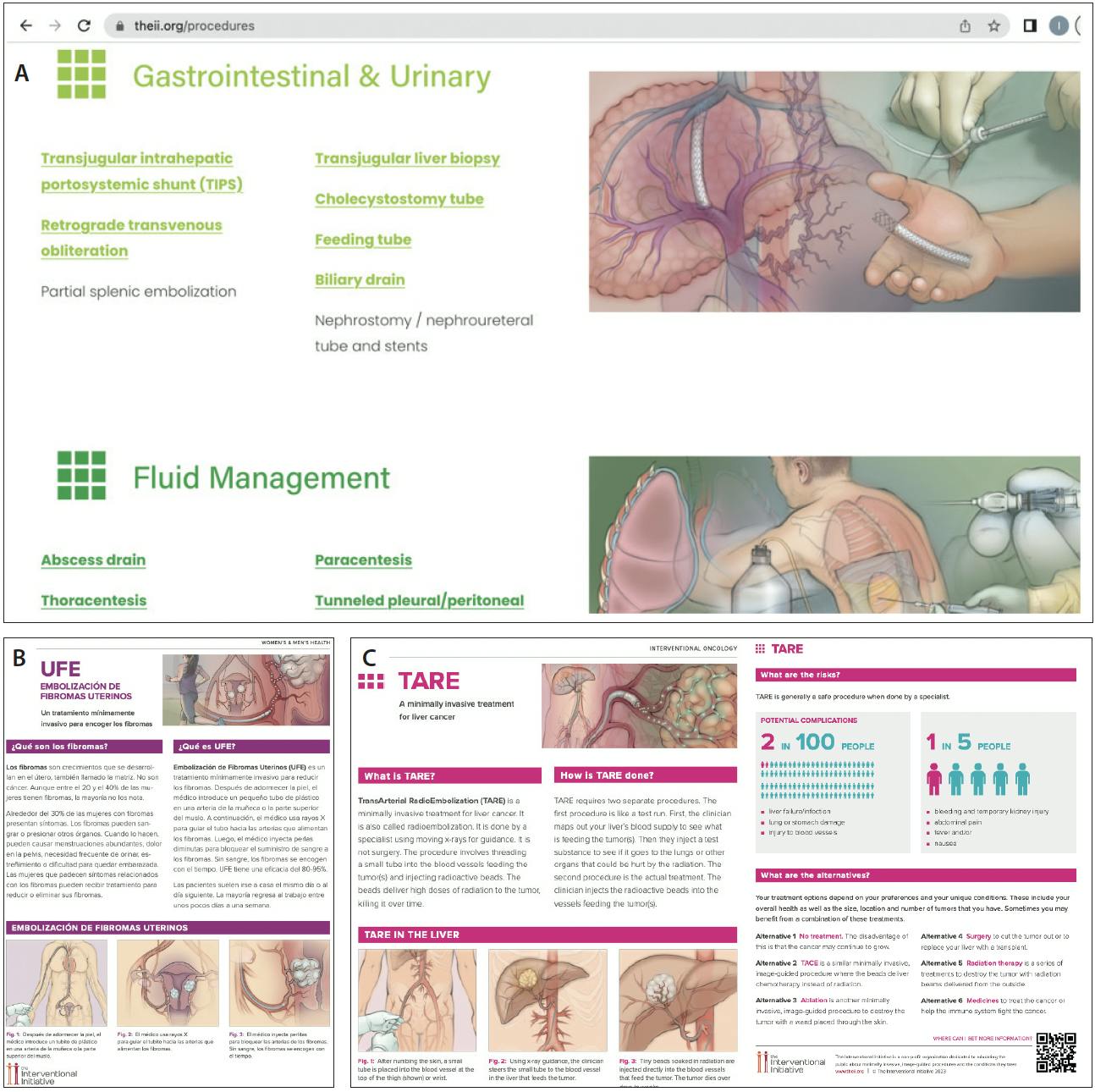
Figure 1. The Interventional Initiative has numerous PDAs available on its website (A). Sample Spanish-language PDA on UFE (B). Sample English-language PDA on transarterial radioembolization (C).
1. Heister D, Jackson S, Doherty-Simor M, Newton I. An evaluation of trends in patient and public awareness of IR. J Vasc Interv Radiol. 2018;29:661-668. doi: 10.1016/j.jvir.2017.11.023
2. Srinivas S, Newton IG, Waradzyn M, et al. Patient decision aids before informed consent conversations for image-guided procedures: controlled trials at two institutions. AJR Am J Roentgenol. 2022;220:272-281. doi: 10.2214/AJR.22.28165
Advertisement
Advertisement