Advertisement
Advertisement
February 2023
Ask the Experts: What Is Your Treatment Algorithm for Massive Pulmonary Embolism?
Experts share their stepwise approaches to treating patients with acute, high-risk pulmonary embolism.
With Osman Ahmed, MD; Jonathan Paul, MD; Maidah Yaqoob, MD; and Andrew J.P. Klein, MD


Acute high-risk (massive) pulmonary embolism (PE) is a life-threatening entity with an associated mortality as high as 65%.1 Defined as acute PE with sustained hypotension (systolic blood pressure [SBP] < 90 mm Hg for > 15 minutes) and/or requiring vasopressor support, high-risk PE is triaged and treated emergently due to significant morbidity and mortality. In most centers, options include systemic thrombolysis, catheter-directed thrombolysis/thrombectomy (CDT), and surgical embolectomy.
At the University of Chicago, high-risk PE results in prompt activation of the PE response team (PERT). Through the PERT, patients are triaged by using metrics such as presence of cardiac arrest or severe obstructive shock, followed by degree of hypoxia, evidence of pulmonary infarction (ie, hemoptysis), and severe symptoms of dyspnea and chest pain. In the acutely decompensating patient with no absolute contraindications, systemic thrombolysis is administered through a peripheral intravenous line. Simultaneously, the PERT evaluates the patient for venoarterial extracorporeal membrane oxygenation (VA-ECMO), which may bridge the patient to further therapy, such as catheter-based treatment or surgery. Although administration of systemic thrombolytic therapy increases the risk of major vascular bleeding, it does not preclude ECMO use.
For patients deemed stable for intervention, an endovascular strategy is now our preferred approach for immediate reperfusion therapy. Large, central obstructing emboli can be removed relatively quickly using large-bore mechanical aspiration devices, which often results in significant improvement in hemodynamics and oxygenation. Right heart catheterization is performed prior to intervention in all patients, both to understand the degree of shock and assess for improvement during the procedure. In patients with a large clot burden that affects both central and peripheral vessels, catheter-directed thrombolysis may be used either as an adjunct to thrombectomy or in place of it based on factors such as clot chronicity, stability of the patient, and initial hemodynamic findings. Patients are subsequently closely monitored in the cardiac intensive care unit (ICU) for ongoing supportive care and weaning of mechanical circulatory support (MCS) if necessary.
1. Chatterjee S, Chakraborty A, Weinberg I, et al. Thrombolysis for pulmonary embolism and risk of all-cause mortality, major bleeding, and intracranial hemorrhage: a meta-analysis. JAMA. 2014;311:2414-2421. doi: 10.1001/jama.2014.5990

PE is the third most common cardiovascular cause of death after myocardial infarction and stroke. Sudden death is the first symptom in 25% of people with PE. It is estimated that 60,100 to 100,000 Americans die of deep vein thrombosis/PE, and 20% to 30% of the people die within 1 month of diagnosis.1 Given this mortality risk and need for emergent and effective treatment, PE has been stratified into low, intermediate, and high risk, which determines both diagnostic and therapeutic strategies. The first step in risk stratification is identification of patients who would be considered high risk. High risk or unstable PE portends a risk of mortality of 19% as opposed to 5.7% with stable PE.2
Patients with hemodynamic instability, defined by a SBP < 90 mm Hg for > 15 minutes in the absence of hypovolemia, sepsis, or arrhythmia and/or the need of vasopressors in combination with end-organ hypoperfusion, are considered high risk.3
Time is of the essence in high-risk PE, and management of high-risk/massive PE requires a multifaceted approach. The PERT—usually comprising emergency medicine, pulmonary/critical care, interventional cardiology, interventional radiology, and hematology—should be consulted as soon as massive PE is suspected (Figure 1). The PERT assists with developing a plan based on clinical judgement, availability of resources, and multidisciplinary discussion.
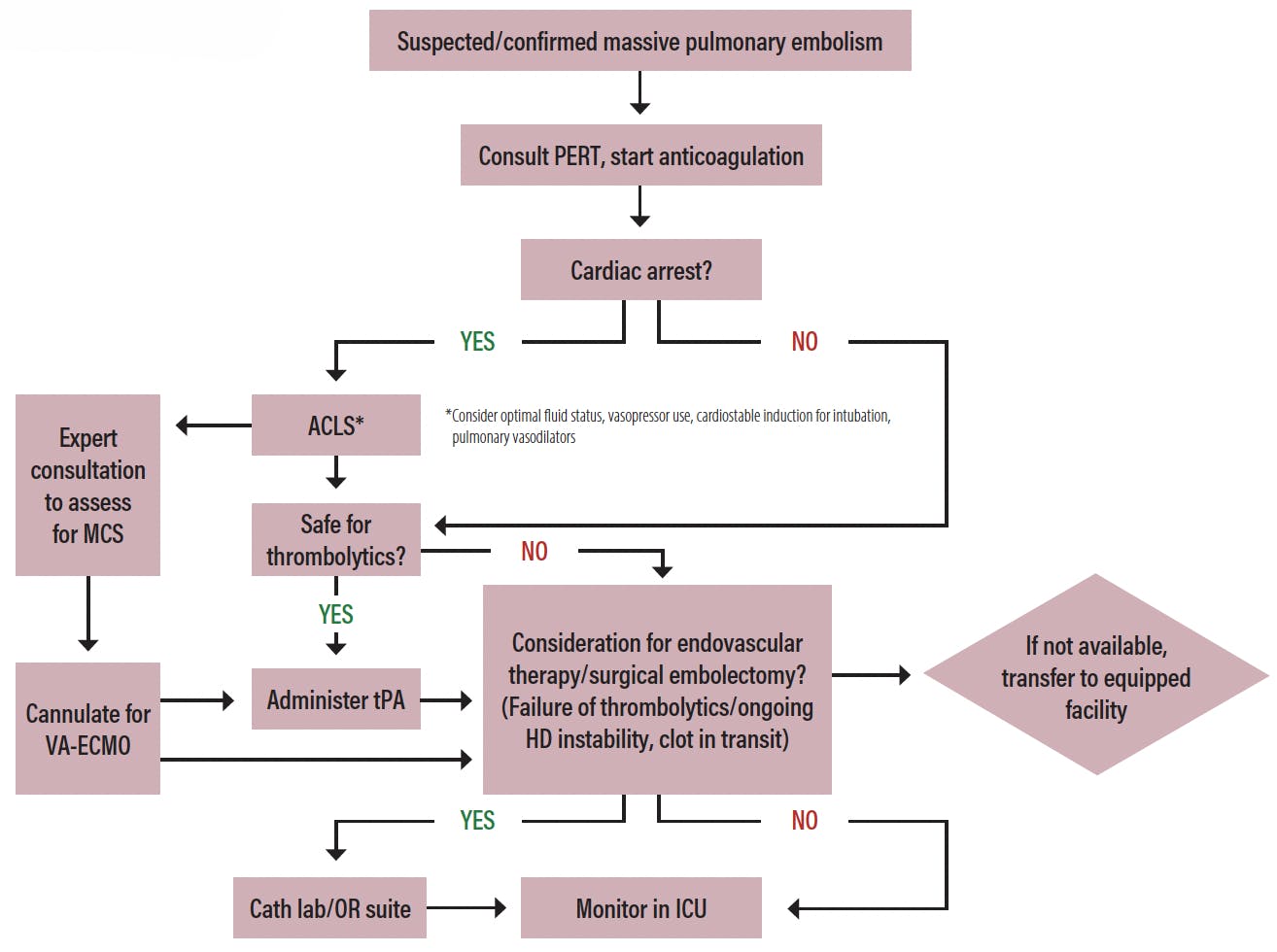
Figure 1. Massive PE algorithm. ACLS, advanced cardiac life support; HD, hemodynamic; OR, operating room; tPA, tissue plasminogen activator.
Resuscitation and treatment go hand in hand. Rapid diagnostic modalities should be utilized, including bedside transthoracic echocardiography or transesophageal echocardiography if expertise is available, in concert with clinical suspicion based on presentation, laboratory biomarkers (troponin, brain natriuretic peptide, lactate), radiologic evidence with ventilation/perfusion scans, single-photon emission CT, CT scans, and lower extremity ultrasound if possible.
Anticoagulation with heparin and thrombolysis with recombinant tissue plasminogen activator or tenecteplase is the cornerstone of therapy. Systemic thrombolytics have been shown to decrease mortality and are reportedly underused due to the fear of bleeding.4 The dosing for thrombolytics is extrapolated from its use in myocardial infarction and stroke. Half-dose thrombolytics are an effective treatment strategy in patients with relative contraindications to thrombolytics. The European Society of Cardiology 2019 guidelines recommend 50 mg alteplase bolus with an option to repeat the bolus in 15 minutes or single-dose, weight-based tenecteplase followed by systemic anticoagulation.3
Patients with contraindications or failure to thrombolytics should be considered for emergent surgical embolectomy or endovascular therapy via mechanical thrombectomy or catheter-directed thrombolysis.
Lower doses of lytics can be administered locally via a pigtail catheter or with an Ekos EkoSonic catheter (Boston Scientific Corporation) for ultrasound-assisted catheter-directed thrombolysis. Alternatively, mechanical thrombectomy (Indigo system [Penumbra, Inc.], FlowTriever [Inari Medical]) can be performed in isolation or in combination with lytic therapy.
Surgical embolectomy is first-line therapy for clot in transit or right ventricular (RV) thrombus. It has a class IIa indication for high-risk PE with contraindications to or failure of thrombolysis. The SPEAR working group showed an operative mortality of 11.7% in experienced centers.5
MCS with VA-ECMO should be considered early as standby for high-risk stable patients or instituted early as a bridge to definitive therapy with surgical embolectomy or endovascular therapy. VA-ECMO provides oxygenation and ventilatory support and reduces RV preload and distension by bypassing the pulmonary circulation. Soliciting expertise early during presentation (with assistance of the PERT) with planned cannulation is imperative. MCS can also be used as a bridge to recovery.6
Centers unable to offer these treatments should urgently and safely transfer patients to a center where these services are available. These centers should be identified in advance, so the transfer process is efficient and timely.
Resuscitation requires careful consideration so as to avoid hypoxia or hypercapnia, achieve optimal fluid balance, and institute cardiostable induction for intubation. Rapid-sequence intubation and invasive mechanical intubation can exacerbate physiologic derangements of obstructive shock by eventual increased pulmonary vascular resistance. If intubation is required, hemodynamics should be monitored with a preinduction arterial line. Awake bronchoscopic intubation should be considered by the most experienced operator to minimize sedative and paralytic use. Vasopressors and pulmonary vasodilators should be available at the bedside. Norepinephrine and vasopressin are the preferred vasopressors. Epinephrine can also be used. Inotropes such as dobutamine can be used if there is evidence of persistent right heart failure. Pulmonary vasodilators such as inhaled nitric oxide and epoprostenol should be used to offload the right ventricle concurrently.
MCS should be used as an adjunct therapy early to support the delivery of other modalities of treatment as above. Meticulous post-ICU care with close monitoring of hemodynamics, anticoagulation, ventilator weaning, and MCS weaning has an important role in the recovery of these patients.
At Cedars Sinai Medical Center, the PERT is consulted and responsible for paving the path for the treatment plan. Early consideration for MCS with prompt cannulation, utilization of endovascular therapies, and discussion of potential advanced therapies such as surgical embolectomy is done in tandem while safely resuscitating the patient.
1. Centers for Disease Control and Prevention. Data and statistics on venous thromboembolism. Accessed January 11, 2023. https://www.cdc.gov/ncbddd/dvt/data.html
2. Quezada CA, Bikdeli B, Barrios D, et al. Meta-analysis of prevalence and short-term prognosis of hemodynamically unstable patients with symptomatic acute pulmonary embolism. Am J Cardiol. 2019;123:684-689. doi: 10.1016/j.amjcard.2018.11.009
3. Konstantinides SV, Meyer G, Becattini C, et al. 2019 ESC guidelines for the diagnosis and management of acute pulmonary embolism developed in collaboration with the European Respiratory Society (ERS). Eur Heart J. 2020;41:543-603. doi: 10.1093/eurheartj/ehz405
4. Stein PD, Matta F. Thrombolytic therapy in unstable patients with acute pulmonary embolism: saves lives but underused [published correction appears in Am J Med. 2012;125:e13]. Am J Med. 2012;125:465-470. doi:10.1016/j.amjmed.2011.10.015
5. Keeling WB, Sundt T, Leacche M, et al. Outcomes after surgical pulmonary embolectomy for acute pulmonary embolus: a multi-institutional study. Ann Thorac Surg. 2016;102:1498-1502. doi: 10.1016/j.athoracsur.2016.05.004
6. George B, Parazino M, Omar HR, et al. A retrospective comparison of survivors and non-survivors of massive pulmonary embolism receiving veno-arterial extracorporeal membrane oxygenation support. Resuscitation. 2018;122:1-5. doi: 10.1016/j.resuscitation.2017.11.034

Patients with massive or high-risk PE are at the highest risk for death, with mortality rates between 25% and 65%.1 This high-risk cohort includes patients presenting with PE with sustained hypotension (SBP < 90 mm Hg for ≥ 15 minutes or requiring ionotropic support) not due to a cause other than PE, such as arrhythmia, hypovolemia, sepsis or left ventricular dysfunction, pulselessness, or persistent profound bradycardia (heart rate ≤ 40 bpm with concomitant shock).2 These patients are in a dire situation, and time is of the essence in their stabilization and treatment. Traditionally, patients with high-risk PE have been treated with emergent systemic thrombolysis, given the relative ease of administration and broad availability of these medications. However, with the advent of PERT, CDT for PE, and MCS devices, we are seeing a shift in therapy for these patients. Of note, in most institutions lacking the aforementioned systems of care, systemic thrombolysis (in the absent of contraindications) should remain the gold standard.
At large centers across the world, including our own, we are now approaching high-risk (massive) PE by first considering whether MCS should be initiated. By initiating MCS first, we then have time to decide what the next best therapy may be for the patient. At our institution, ECMO is the preferred MCS strategy given its ability to be placed at the bedside in an efficient and safe fashion. To determine if a patient is a candidate for ECMO, we routinely use the SAVE score3 simultaneously with multidisciplinary discussions within our PERT team. ECMO cannulation can be accomplished without intubation (which we generally want to avoid in these patients) through additional local anesthesia along with ketamine. Early cannulation can often preclude the “on-table” crash these patients may experience, even if “preaccess” for ECMO is already obtained. Additionally, the vasopressor needs of these patients often decrease once they are on circuit, which mitigates the risk of adverse effects of these drugs.
Once ECMO is initiated, we can then help correct the metabolic derangements that the PE has induced, as well as consider if systemic thrombolysis, CDT, open thrombectomy, or medical therapy alone is indicated within the PERT team model. For patients who continue to be unstable, systemic thrombolytic therapy is administered only after the patient is on circuit given the high risk of access bleeding if ECMO is placed after the administration of thrombolytics. For patients who can be transported to the catheterization suite, mechanical thrombectomy is most often chosen as the primary strategy given its ability to rapidly remove large amounts of thrombus quickly and thus stabilize the patient faster. CDT is also a viable option, especially in patients with distal clot that is impairing oxygen exchange. For select patients who improve on ECMO alone, systemic heparin has also been chosen while the right ventricle rests on circuit. All of these decisions are made within the PERT team model, which permits true multidisciplinary input to optimize the patient’s outcome. Patients with high-risk (massive) PE are at the highest risk of death secondary to the impact of the PE on the right ventricle, and by initiating ECMO first, we hope to lower the associated mortality.
In patients with a massive PE who are not candidates for MCS or when ECMO is not available, we often proceed with systemic thrombolysis (if they are too unstable to transfer or arrest while in transfer) or emergent CDT, usually implementing mechanical thrombectomy to reduce clot burden and subsequently reduce the work of the right ventricle the fastest with or without additional ad hoc intrapulmonary administration of lower-dose thrombolysis to expedite the process. The critical aspect of care is trying to offload the right ventricle as soon as possible and normalize any metabolic derangements to help stabilize the patient. Massive PE patients are “on the edge of the cliff,” and our goal is to get them back from the edge as quickly as possible, using a systematic multidisciplinary PERT approach to address each patient individually to optimize their care and outcome.
1. Jaff MR, McMurtry MS, Archer SL, et al. Management of massive and submassive pulmonary embolism, iliofemoral deep vein thrombosis, and chronic thromboembolic pulmonary hypertension: a scientific statement from the American Heart Association. Circulation. 2011;123:1788-1830. doi: 10.1161/CIR.0b013e318214914f
2. Becattini C, Agnelli G, Lankeit M, et al. Acute pulmonary embolism: mortality prediction by the 2014 European Society of Cardiology risk stratification model. Eur Respir J. 2016;48:780-786. doi: 10.1183/13993003.00024-2016
3. Extracorporeal Life Support Organization. SAVE score for VA ECMO. Accessed January 16, 2023. https://www.elso.org/savescore/index.html
Advertisement
Advertisement