Advertisement
Advertisement
February 2023
New Developments in Intravascular Imaging and Sensing Technologies
The current status of the Vis-M HF-OCT neurovascular probe that acquires artifact-free, high-resolution images of the cerebrovasculature and a novel laser angioscopy platform for intravascular imaging from “head to toe.”
With Demetrius Lopes, MD; Matt Gounis, PhD; and Luis Savastano, MD, PhD
High-Frequency OCT


What is high-frequency optical coherence tomography (HF-OCT), and what unmet clinical need is most likely to be addressed using OCT/HF-OCT?
OCT is an intravascular imaging technique used for more than a decade in the peripheral/coronary circulation to characterize and guide treatment of vascular pathologies such as atherosclerosis. It is similar to ultrasound, but instead of using sound waves, it uses near-infrared light to achieve images with unparalleled spatial resolution. Vis-M HF-OCT (Gentuity, LLC) is a new neurovascular probe designed specifically to navigate the small, tortuous vasculature of the brain. It has a significantly reduced profile, similar to commonly used microwires for neurovascular procedures, and an optical engine that acquires 250 images per second. It can acquire images along vessel segments up to 10 cm and produce high-resolution images (approaching 10 µm) in as little as 2 seconds. HF-OCT represents a fundamental advancement in imaging vascular anatomy and better characterizing the relationship between pathology and the devices used to treat these diseases. With support from the National Institutes of Health and the Massachusetts Life Sciences Center, the HF-OCT technology has been studied in preclinical models in preparation for human studies.
Current commercially available OCT devices were not designed to be operated in the tortuosity of the intracranial circulation. Vis-M is specifically designed to be navigated into the cerebrovasculature and acquire artifact-free images of the brain’s blood vessels. The high resolution of the Vis-M serves numerous clinical unmet needs, including it: (1) accurately characterizes cerebrovascular pathologies such as intracranial atherosclerosis and brain aneurysms, (2) accurately sizes devices intended to treat these diseases, (3) helps optimize a treatment strategy for the most efficacious, complication-free outcomes, and (4) monitors the vascular response to treatment.
Recently, imaging through the blood vessel wall into the structures of the subarachnoid space has been described, with implications to study these structures and their function with regard to numerous neurologic diseases.1
What is the burden of proof necessary to demonstrate utility of this modality (ie, what specific clinical improvement differential)? When proven, what outcome will drive adoption?
In the initial first-in-human study performed at St. Michael’s Hospital in Toronto, Canada, by Professor Vitor Pereira and his team, HF-OCT altered the fundamental understanding of cerebrovascular pathology and treatment response and, ultimately, the interventional strategy as well. These initial findings are encouraging but require multicenter experience to generalize the impact of intravascular HF-OCT. Preliminary evidence suggests that Vis-M is simple and safe to use and has minimal alteration of workflow. We believe that future clinical studies will show that Vis-M safely and reliably produces artifact-free imaging of the target lesion, which we predict will be sufficient to drive adoption. Although some in the community are already encouraged that this is an excellent research tool, we believe the important clinically actionable information provided will drive widespread routine adoption.
Preclinical studies have shown that Vis-M imaging correlates with vascular histology and thus may eliminate complex diagnostic studies with insufficient resolution for accurate diagnosis. Preclinical studies have further shown that imaging the device-pathology relationship (eg, communicating malapposition of flow diverters used to treat aneurysms) is predictive of an early efficacious treatment effect.2-9
What is the overall status of OCT research in this setting?
For > 5 years, HF-OCT has undergone extensive preclinical in vitro, in vivo, and ex vivo testing. It is highly studied for neurovascular applications in models prior to clinical introduction. Its current status is the translation to clinical studies. At present, the system has been used in three patients and was presented this year at the 2023 ABC WIN meeting in Val d’Isère, France, by Prof. Pereira. Additional sites are in the final stages of regulatory approval to expand acquisition of clinical data. As previously mentioned, these initial studies are designed to demonstrate artifact-free, optically clear imaging of the intended vessel. A cloud-based artificial intelligence platform (Gentuity, LLC) is in early use among researchers and collaborators. This is designed to facilitate interpretation and sharing of the HF-OCT images for quantitative data analysis. Automatic segmentation of the vessel, pathology, and treatment devices is under research development and represents a significant opportunity to assist physicians. It is anticipated that these tools will be used to provide better procedural guidance and improved intraoperative decision-making.
Aside from data, what hurdles to greater use might need to be cleared?
Widespread adoption requires proper usage of the device and interpretation of the data. The former is addressed by training in a simulated-use environment. Contrast injection, similar to a rotational angiogram, is required to clear the blood for OCT. Coupling device operation with blood clearance is essential for outstanding image quality. The first-in-human experience showed that this training adequately prepares physicians and technologists to successfully acquire images. Interpretation of the data for a field that is previously unfamiliar with most intravascular imaging techniques represents a larger hurdle. To alleviate that, we have formed an HF-OCT working group, which includes Dr. Pedro Lylyk (Buenos Aires, Argentina); Drs. Vania Anagnostakou, Ajit Puri, and Gounis (Worcester, Massachusetts); Dr. Lopes (Chicago, Illinois); Dr. Ricardo Hanel (Jacksonville, Florida); Dr. Conrad Liang (Oakland, California), and Prof. Pereira (Toronto, Canada). The group is preparing numerous guides and presentations to educate the community on proper interpretation of HF-OCT data and drive consensus on utilization. As previously mentioned, automated computer-assisted image interpretation is an active area of research to further reduce this barrier to adoption.
What is your best guess as to the time horizon for when this modality will be widely adopted?
We predict that by the end of the decade, almost all neurointerventional surgeries will include some form of intravascular imaging. Given the ease of use and preliminary safety profile, coupled with the three-dimensional intravascular anatomy reconstruction depicting the exquisite vessel wall detail, pathology, and devices, it feels like we were working blindly before. HF-OCT will undoubtedly advance our understanding of neurovascular disease and consequently promote safer and better interventions.
1. Anagnostakou V, Epshtein M, Ughi GJ, et a. Transvascular in vivo microscopy of the subarachnoid space. J Neurointerv Surg. 2022;14. doi: 10.1136/neurintsurg-2021-018544
2. King RM, Peker A, Anagnostakou V, et al. High-frequency optical coherence tomography predictors of aneurysm occlusion following flow diverter treatment in a preclinical model. J Neurointerv Surg. Published online August 24, 2022. doi: 10.1136/jnis-2022-019275
3. Anagnostakou V, Ughi GJ, Puri AS, Gounis MJ. Optical coherence tomography for neurovascular disorders. Neuroscience. 2021;474:134-144. doi: 10.1016/j.neuroscience.2021.06.008
4. Vardar Z, King RM, Kraitem A, et al. High-resolution image-guided WEB aneurysm embolization by high-frequency optical coherence tomography. J Neurointerv Surg. 2021;13:669-673. doi: 10.1136/neurintsurg-2020-016447
5. Caroff J, King RM, Ughi GJ, et al. Longitudinal monitoring of flow-diverting stent tissue coverage after implant in a bifurcation model using neurovascular high-frequency optical coherence tomography. Neurosurgery. 2020;87:1311-1319. doi: 10.1093/neuros/nyaa208
6. King RM, Langan ET, Ughi GJ, et al. Acute thrombus burden on coated flow diverters assessed by high frequency optical coherence tomography. Cardiovasc Intervent Radiol. 2020;43:1218-1223. doi: 10.1007/s00270-020-02482-w
7. Ughi GJ, Marosfoi MG, King RM, et al. A neurovascular high-frequency optical coherence tomography system enables in situ cerebrovascular volumetric microscopy. Nat Commun. 2020;11:3851. doi: 10.1038/s41467-020-17702-7
8. King RM, Marosfoi M, Caroff J, et al. High frequency optical coherence tomography assessment of homogenous neck coverage by intrasaccular devices predicts successful aneurysm occlusion. J Neurointerv Surg. 2019;11:1150-1154. doi: 10.1136/neurintsurg-2019-014843
9. Gounis MJ, Ughi GJ, Marosfoi M, et al. Intravascular optical coherence tomography for neurointerventional surgery. Stroke. Published online November 29, 2018. doi: 10.1161/STROKEAHA.118.022315
Laser Angioscopy

What is the unmet clinical need most likely to be addressed using angioscopy?
Noninvasive imaging tools such as ultrasound, CT, and, more recently, MR have remarkably improved our capacity to screen and/or diagnose many cardiovascular diseases on a large scale. Despite the unquestionable value of these imaging platforms, the complexity and heterogeneity of many cardiovascular conditions demand imaging approaches with much higher spatial and temporal resolution than the ones enabled by noninvasive techniques. A few examples of structural abnormalities of atherosclerosis such as plaque erosions, fissures, and ulcers are beyond the resolution of mainstream imaging technologies and are therefore often ignored or neglected, and thus, the degree of vulnerability cannot be precisely estimated. Similarly, we still cannot be certain of what tissue is making up a lesion or an occlusion (eg, white vs red emboli, thromboatheroma, occlusive dissecting flap), much less accurately characterize the architecture of vascular lesions.
To provide maximal spatial resolution, several intravascular platforms have emerged in the last 3 decades, including intravascular ultrasound (IVUS) and OCT. Despite their significant clinical and research value for very specific indications, they have imaging and technologic limitations. First, the side-view design of these devices requires crossing the imaging target back and forth (with automated rotational pullbacks for OCT) to reconstruct images of vascular segments after postprocessing. Second, the inability of these devices to look forward precludes their use in high-degree stenosis or total luminal occlusion, both of which are frequent and clinically relevant scenarios, and perform poorly at bifurcations points where atherosclerotic disease is overwhelmingly concentrated. Third, IVUS images have very poor resolution, limiting the capacity to interpret complex lesions, and OCT images are significantly limited by artifacts. Neither monochrome imaging platforms are intuitive for the human eye as they are based on sound waves and near-infrared light backscattering. Poor resolution and/or artifacts make the interpretation of images extremely challenging and reserved for highly trained and experienced individuals.
Video 1. Laser angioscopy demonstrating superselective wiring.
Laser angioscopy was developed to be a “set of intravascular eyes” and enable the interventionalists to “truly” see inside arteries and veins. This technology is based on scanning fiber endoscopy (Figure 1) and can provide a direct, real-time, high-resolution, true-color image of the intravascular space. Images from the whole endoluminal environment (circumferentially and with large depth of field) are generated at a video rate (30 Hz) with no perceptible delay, and with a spatial resolution of approximately 12 μm at typical imaging distances (> 250,000 pixels). This resolution translates into videos with unsurpassed sharpness and definition, which enables the visualization of tiny targets and improved recognition of the hallmarks of cardiovascular lesions. Moreover, real-time forward videos of the intraluminal space (or “down the pipe”) can guide interventions under direct endoluminal visualization.
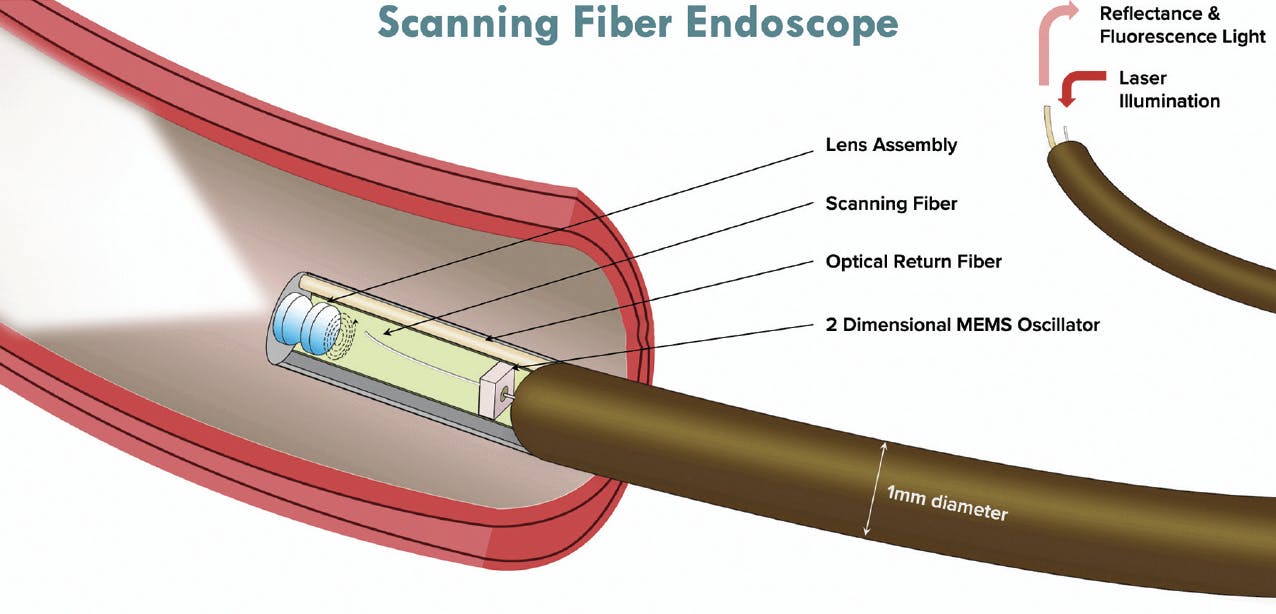
Figure 1. Illustration of a scanning fiber endoscope (VerAvanti).
Courtesy of VerAvanti.
Laser angioscopy is a platform technology for intravascular imaging from “head to toe.” Just to provide a practical example of the multiple and tangible implications in the management of patients that angioscopy could have, consider the case of emergent large vessel occlusion strokes. In these patients, the presence and location of the arterial occlusion is usually identified in CTAs of the head and neck. Angioscopy performed as part of the mechanical thrombectomy procedure could likely improve the management of these patients intracranially by showing what is causing the occlusion, such as red (Figure 2A) or white (Figure 2B) embolus, a complicated plaque with intraluminal thrombus (Figure 2C), or a dissection (Figure 2D). Angioscopy of the extracranial carotid artery could guide the selection of the most suitable revascularization strategy (eg, chronic calcified atheroma in Figure 2E vs acute thromboatheroma in Figure 2F), help crossing critical stenosis and total occlusion (Figure 2G), diagnose acutely symptomatic nonstenotic carotids (Figure 2H), and inform about the incidental nature of a noncomplicated, nonsymptomatic plaque despite causing > 50% stenosis (Figure 2I).
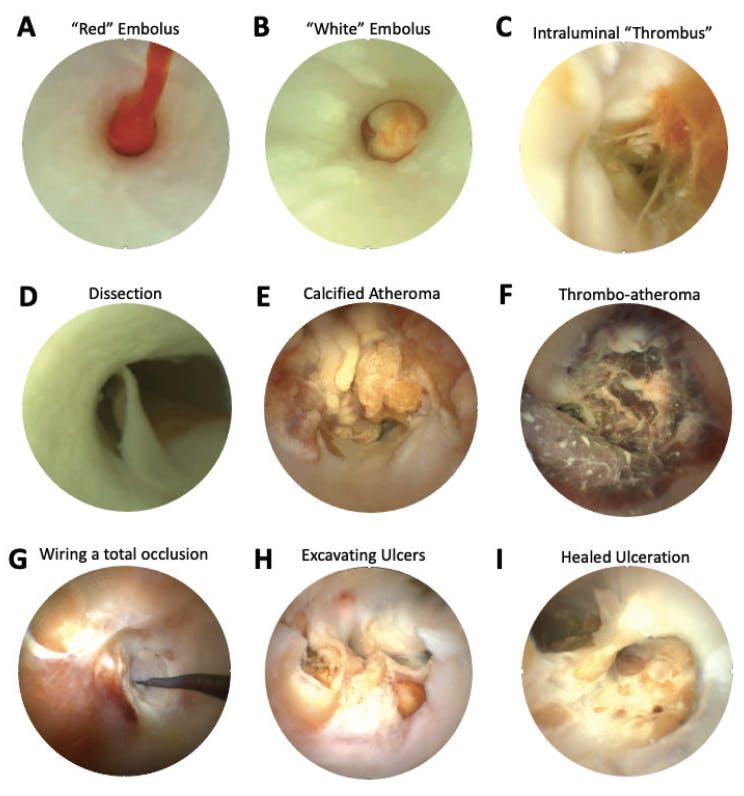
Figure 2. Examples of distinct phenotypes as seen with laser angioscopy. Intracranial view includes red (A) and white (B) emboli, intraluminal clot in a ruptured atheroma (C), dissection (D), calcified atheroma (E). Extracranial shows plaque characterization in the setting of tandem occlusion (F, G), guide plaque characterization in SYNC (H), and asymptomatic carotid stenosis (I).
What is the burden of proof necessary to demonstrate utility of this modality (ie, what specific clinical improvement differential)? What outcome, when proven, will drive adoption?
At a personal level, I don’t think we still understand the full scope and potential for this novel imaging platform. We have been working in the endovascular shadows of angiography for so long—let’s see the true colors of angioscopy!
Endoscopy has certainly revolutionized many medical fields with a much deeper and broader impact than ever anticipated. Gastroenterology, urology, and pulmonology are good examples of the tremendous impact that scopes with sufficient resolution can have. Regarding endovascular endoscopy, or angioscopy, what has mostly prevented the adoption and widespread use has been the terribly poor image quality (up to 10,000 pixels), poor illumination, and excessive stiffness of marketed fiber bundle angioscopes based on technology from the 1970s. The images generated through these scopes are often lacking in quality. Modern laser angioscopes based on scanning fiber endoscopy can generate vastly superior images (in order of magnitude) and are soon to be in the hands of thousands of endovascular interventionalists.
Although this imaging tool will likely find uses throughout the cardiovascular system, rapid adoption is expected to be driven by its unprecedented capacity to show previously occult lesions (critical in myocardial infarction with nonobstructive coronary artery and cryptogenic stroke), inform which plaque-modifying strategy may be of benefit for improved angioplasty and stenting (eg, calcific lesions needing lithotripsy), and provide real-time intravascular visualization during complex endovascular procedures (eg, crossing of chronic total occlusions).
What is the overall status of angioscopy research in this setting?
Laser angioscopy based on scanning fiber endoscopy is expected to receive 510(k) clearance by the FDA this year followed by commercial launch. Currently, major efforts are undergoing to generate standard nomenclature, usage guidelines, image interpretation criteria with a laser angioscopy classifier with histologic validation, and reporting standards of laser angioscopy results.
Aside from data, what hurdles to greater use might need to be cleared?
Similar to other imaging modalities using light like OCT, angioscopy requires a clear field of view to visualize the intravascular environment. This is accomplished by stopping anterograde blood flow by inflating a balloon and flushing distally the stagnated blood with crystalloid solution (occlusive technique), or by injecting a saline or contrast bolus (nonocclusive technique). Balloon guide catheter systems have become broadly available and mainstream in different interventions such as carotid stenting and mechanical thrombectomy for stroke. This significantly facilitates angioscopy with an occlusive technique in large high-flow arteries, such as the carotid and iliofemoral arteries. In addition, due to the forward-view approach and large depth of focus (> 5 cm) of scanning fiber angioscopy, a single image can be diagnostic in just one video frame of 0.015 seconds. Therefore, nonocclusive angioscopy is enabled by much smaller bolus of saline or contrast than OCT and allows nonocclusive images in coronary and other medium size vessels.
What is your best guess as to the time horizon for when this modality will be widely adopted?
We are very optimistic in the adoption rate of laser angioscopy and we believe that it will become a mainstream tool within the next decade. There are solid data (mostly generated in the coronary space) showing that intravascular imaging may improve outcomes. In addition, the rate of use of OCT/IVUS has more than doubled in the last 5 years and is expected to keep rising with progressive training and a cultural change striving for excellence. These factors provide a fertile ground for angioscopy adoption. Laser angioscopy provides useful and intuitive images that can directly affect the clinical management and has the unparalleled capacity to guide intravascular interventions.
Advertisement
Advertisement