Advertisement
Advertisement
February 2023
PE-TRACT: A Closer Look
Principal Investigator Dr. Akhilesh Sista provides a glimpse into the upcoming NIH-sponsored PE-TRACT trial, including its place among the PE trial landscape, insight into trial design, potential challenges, and why the trial is a necessity for the future of PE care.

How would you summarize the pulmonary embolism (PE) data landscape and the role of PE-TRACT within it? What are the unanswered questions that necessitate these randomized controlled trials (RCTs) and PE-TRACT’s design in particular?
The landscape now is very different than it was 6 years ago when we first began applying to the National Institutes of Health (NIH) for PE-TRACT. Back then, we had a few single-arm studies and a few devices, including the PE-indicated Ekos catheter (Boston Scientific Corporation). Fast forward 6 years, and we have approval of two mechanical thrombectomy devices: the FlowTriever (Inari Medical) and the Indigo aspiration system (Penumbra, Inc.), along with a large number of other companies entering the thrombectomy space for PE.
Many single-arm studies are trying to figure out the preliminary efficacy and safety of these devices. This is exciting for the field, but it doesn’t get to the fundamental question of whether or not we should be removing thrombus. Now, there is a trend toward more randomized trials. We’ve all heard of HI-PEITHO, a rigorous study that is looking at short-term outcomes following intermediate-risk PE. There’s also PEERLESS, a trial sponsored by Inari Medical that is comparing thrombectomy to catheter-directed thrombolysis (CDT) but does not have a control group. Finally, Penumbra is sponsoring the currently underway STORM-PE, a randomized trial looking at short-term endpoints.
The difference between these studies and PE-TRACT is several-fold. First, PE-TRACT is the only independent, investigator-initiated trial of this group. It also comes with the rigor of NIH funding. When it comes to recommendations from societies, the trial will carry great weight because of its independence.
Second, PE-TRACT is addressing the unanswered question of whether CDT improves outcomes in the medium to long term (ie, over the course of a year rather than in the first 7 days). By removing thrombus up front, is there benefit in the medium to long term? We don’t yet have the answer.
PE-TRACT is well positioned in today’s PE space to get back to the fundamentals and help us understand the natural history of PE and identify associations with outcomes, baseline characteristics, and effectiveness of the initial procedure. It will also give us badly needed information about what happens to individuals who undergo CDT over the course of the year postprocedure and how that compares to patients who receive anticoagulants alone.
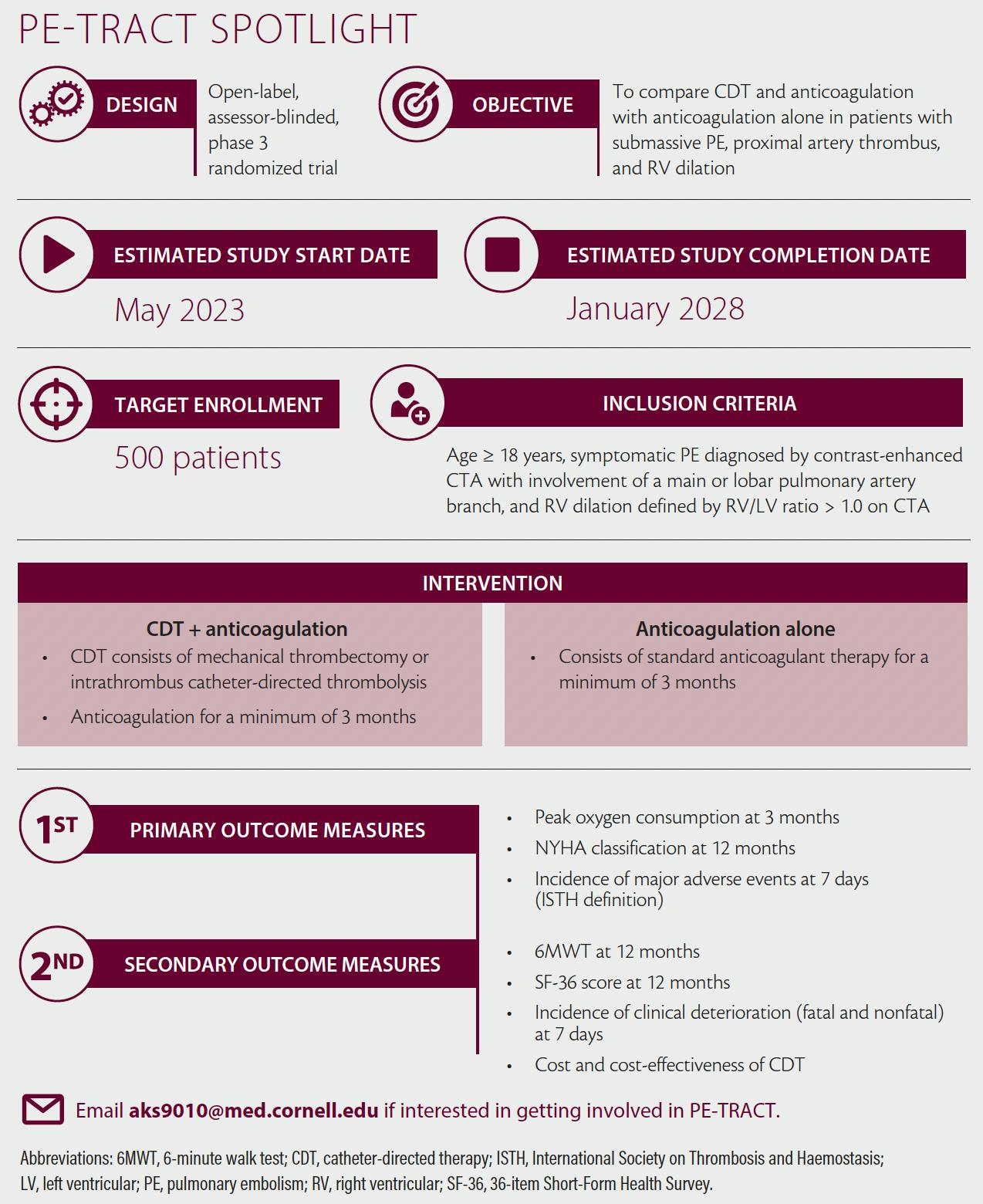
What are the broad strokes of the trial design that has now been approved for funding and commencement?
PE-TRACT is a parallel-group, open-label, phase 3 RCT. Patients will be randomized 1:1 to receive either CDT or no therapy (ie, anticoagulants alone), with assessments at 1, 3, and 12 months. The 1-month assessment is a remote visit. The 3-month assessment is an in-person visit, at which time cardiopulmonary exercise testing will be performed for the first primary outcome, peak oxygen uptake. Quality-of-life (QOL) surveys will be given at those time points as well. At 12 months, patients will return for an in-person visit for the second primary assessment, New York Heart Association (NYHA) class, as well as the QOL questionnaires and a 6-minute walk test (6MWT).
Our understanding of PE endpoints continues to evolve. What are the primary and secondary endpoints of PE-TRACT? And importantly, how and why are they selected?
Selecting endpoints for PE trials is not easy; there’s not much precedent when we’re talking about this, at least in the medium to long term. In the short term, we have things like clinical deterioration, bleeding, recurrent venous thromboembolism, death, and length of hospital stay. Those are pretty standardized short-term assessments. However, there’s very little prior literature to guide the determination of primary endpoints in a medium- to long-term trial. Beyond those I just described, PE-TRACT’s primary objective is to understand whether CDT improves cardiopulmonary health in the year following PE. To that end, we are using two primary assessments that are linked by a gatekeeping approach: (1) peak oxygen consumption at 3 months and (2) NYHA class at 12 months.
These are linked through a gatekeeping approach via adaptive methodology. We’re conducting interim analyses at 250 patients and every 50 patients thereafter, for maximum of 500 patients. The gatekeeping assessment essentially links peak oxygen consumption to NYHA class. NYHA class is a patient-reported outcome that considers how well a person feels going about their daily activities. Because it is subject to bias, we’re linking it with the 3-month peak oxygen consumption. Now, what does “linking it” mean? Basically, if the peak oxygen consumption is positive, meaning it’s better in the CDT group, then we will only analyze NYHA class. It would be nonsensical if the NYHA class was higher without an improvement in a physiologic measure like peak oxygen consumption. We chose this dual-outcome strategy that is linked by a gatekeeping approach to comprehensively assess all of what post-PE syndrome represents.
Our secondary outcomes are both fatal and nonfatal short-term clinical deterioration, generic QOL at 12 months with the Short Form Health Survey (SF-36), and 6MWT.
We have several exploratory outcomes as well, including refined modified Miller Index and right ventricular/left ventricular ratio at baseline and 48 hours. This is unique because it is the first time we’ll be able to directly compare anticoagulation alone versus CDT for these specific imaging outcomes. We’re also doing blood biobanking, designing a net benefit analysis, and studying disease-specific QOL with the PEmb-QOL Questionnaire. We will evaluate the change in these health-related QOL scores over time. The Mid America Heart Institute will be used as our health economics core lab so we can study the cost and cost-effectiveness in the CDT group and compare it to the no-CDT group.
Can you briefly summarize the planned subset analyses?
Although we can’t adequately power for differences in CDT technique, we do want to try to tease that out and describe it to the best of our ability in standard subgroup analyses. We’ll also probably perform subgroup analyses on intermediate-high–risk versus intermediate-risk patients because PE-TRACT is not requiring an elevated blood biomarker for inclusion.
The subgroup analyses will be conducted with an eye toward things that would actually be helpful to the community.
Have you put together a protocol for aftercare?
Fortunately, we’re in an era where we commonly follow-up on patients over the course of the next year. We’ve designed PE-TRACT to be a very real-world study in the sense that we feel the PE space is evolved enough for physicians to take care of these patients comprehensively—and better than we used to. The only thing we’re mandating per se is that sites follow societal guidelines for standard-of-care anticoagulant use and duration. Obviously, if there’s clinical deterioration, regardless of the group, any and all means are allowed to rescue that patient from clinical deterioration. Our overall design is to give sites autonomy. We trust that these are good medical sites that know how to care for PE patients after the fact. That being said, we are giving precise directions to sites on how to assess the outcomes of interest, which will in itself impart rigor to the follow-up.
While previously registry-heavy, the PE field has recently seen the launch of several new RCTs, with industry responding to the demand for randomized data. Although beneficial for the advancement of the field, from a practical standpoint, will the start of several RCTs in similar timeframes pose a challenge to each other’s enrollment and to PE-TRACT?
I think that there would’ve been no competition a while ago. But as we discussed, there’s certainly competition now. All of the studies will have to grapple with this. I’m biased, but I think that PE-TRACT is the most important study of these, so I’m hopeful that the PE community will support it. It’s an NIH-sponsored trial as well, which comes with prestige. I very much hope that this drives patients to the trial. That being said, if sites are enrolling into multiple trials, it will be important to have a clear plan for how that will be handled. For PE-TRACT, we’re going to prioritize sites that will prioritize PE-TRACT.
It’s wonderful to see so much attention in the PE endovascular space right now, but we need to make sure we don’t put the cart before the horse. We need the data from PE-TRACT before we go too far in this direction.
What other challenges are encountered in the modern PE trial enrollment landscape?
Enrollment will likely be the biggest challenge. You’re presenting a patient who has an acute and life-threatening illness with the option of receiving medical versus interventional therapy. That’s always going to be challenging. Harkening back to the ATTRACT days, we’re talking about two dissimilar therapies, albeit both standard of care. The follow-up care in each group should be pretty homogeneous and synchronized. Having patients understand the trial and its rationale and then be willing to be randomized will be a challenge.
The second will be keeping patients in the trial and ensuring they present for their 3-month follow-up and cardiopulmonary exercise test. We know from physicians who have tried to do this in the past that it is a challenge. We need to have very good follow-up at the clinical centers to make sure we are getting these patients back. It’s one thing to enroll, but it’s another to really get that data. We think PE-TRACT has an overall low burden to sites and patients. We only have two in-person assessments after the initial hospitalization, but it will really behoove the sites to stay in touch with their patients.
What’s next in terms of the timeline to commence?
We’ve reached out to about 60 sites across the country with an initiation email. Our project manager and staff are working through all of the initiation, credentialing, and contracting. The protocol and informed consent forms have been approved by the institutional review board. We’ve made good progress on that level. We expect the first site to be activated by early to mid-March 2023 hopefully, with the first patient enrolled soon thereafter.
Is there anything else you would like to add?
This is a very exciting time for PE. We’ve been waiting for this for a long time, and a lot of people have put a lot of work into making this happen. It is important to our patients and to what we’re trying to accomplish as a group of physicians to complete PE-TRACT. There’s so much to be learned, and that’s really exciting to me. Hopefully the PE community will enjoy these next 7 or 8 years of PE-TRACT, particularly the amount data that will come out of this to inform future research and help us determine how to best treat PE patients.
Advertisement
Advertisement