Advertisement
Advertisement
January 2023
Limb Preservation Beyond Revascularization: Multidisciplinary Approaches to Ensuring Sustained Outcomes
The path to establishing the multidisciplinary Limb Preservation Program at Washington University School of Medicine, bringing together key collaborators, and using teamwork to extend care beyond the acute episode.
By Patrick Geraghty, MD, RPVI, DFSVS; John Kirby, MD, FACS; John Felder, MD, FACS; and Jerry Liddell, DPM, DABFAS, FACFAS
Although revascularization certainly plays an indispensable role in the treatment of the threatened limb, the collaborative efforts of the limb preservation team extend well before and after the revascularization procedure and ultimately deliver a far greater benefit than any solitary specialty can offer. This article highlights factors that motivated us to establish the multidisciplinary Limb Preservation Program (LPP) at Washington University School of Medicine (WUSM) in St. Louis, Missouri. We discuss the challenges of assembling and maintaining a multidisciplinary team and examine how our collaboration has allowed us to extend our spectrum of care from the preventive/prehospital setting through acute care episodes to continued surveillance and long-term care. Functional limb preservation remains the primary goal of our LPP team, but we’ve also streamlined the arc of rehabilitation, prosthesis fitting, and functional recovery for the minority who suffer limb loss.
OUR PATH TO DEVELOPING A MULTIDISCIPLINARY LPP
Barnes-Jewish Hospital (BJH) is a 1,400-bed institution that is the primary practice location for WUSM faculty. BJH serves as the largest city hospital in St. Louis, the flagship institution for the affiliated network of local hospitals managed by the Barnes-Jewish Corporation (BJC), and the primary safety net/quaternary referral center for the catchment basin extending across the entire state of Missouri, central and southern Illinois, and portions of Iowa and Arkansas. This combination of urban, suburban, and rural referral sites delivers the broadest-possible mix of patients to our care. In the following paragraphs, we highlight several factors that convinced us of the need for a collaborative LPP and note some of the strategies we employed to garner the necessary resources from our hospital and university leadership.
Increasing Incidence and Recurrence of Limb-Threatening Disease
One of the primary drivers for forming our team was the realization that we were losing the battle against the dramatic increase in patients presenting with lower extremity complications of diabetic vasculopathy and neuropathy, tobacco-induced peripheral artery disease (PAD), and the synergistic combination of these disorders. Despite our best efforts, we increasingly saw patients present to our hospital with fulminant infections and advanced gangrene that precluded limb salvage—and equally frustrating was recognizing that our initial treatment successes were prone to frequent recurrence of neuropathic and ischemic foot complications.
Socioeconomic and Public Policy Factors Driving Disparities in Patient Outcomes
During our years in practice, it was evident that patients with the least socioeconomic resources—both urban and rural—were most severely afflicted in terms of presentation with advanced disease and poor outcome. Public awareness of the risks posed by diabetes and chronic limb-threatening ischemia (CLTI) is broadly deficient but most notably lacking in the same high-risk communities. In addition, there are disparities among medical providers regarding their knowledge of optimal medical management of diabetic and ischemic limb disease and prophylactic limb care measures, and available resources for treatment of limb-threatening disease are also quite variable. Thus, patient and provider understanding of this complex disease state, personal and institutional financial hardships, and regional variations in availability of care all contribute to uneven outcomes.
Accelerating Pace of Practice Specialization and Therapeutic Innovation
As the medical knowledge base continues its exponential growth, the ability of practitioners to deliver timely and up-to-date care across a broad range of practice domains has become increasingly limited. Specialization allows physicians to maintain the requisite expertise within one or more related practice domains but also mandates that the specialized physician forms collaborative care relationships with providers whose expertise complements their own.
Hospital Practice Patterns Impacted by Limb-Threatening Disease
Although our hospital administrators were slow to recognize the importance of a collaborative LPP, we were able to leverage local practice factors to provide impetus for the formation of a multidisciplinary team. Without a visible multidisciplinary team to claim ownership of these complex patients, emergency department (ED) transit times were often excessive. Default ED admissions to hospitalist services created potential delays of definitive care, as well as process dissatisfaction among our ED and medical colleagues. In addition, patients with limb-threatening disease have some of the highest rates of hospital readmission, which can place hospital revenues at risk. These related problems created the opportunity for us to bring together a collaborative group of physicians that could address these local hospital concerns while building the foundation for a broad-ranging multidisciplinary LPP.
BRINGING TOGETHER THE KEY COLLABORATORS FOR A MULTIDISCIPLINARY LPP
There is recognized institutional variability in the specialties that coalesce to form multidisciplinary limb salvage teams. Successful teams are built upon a "coalition of the willing"—providers with the requisite skills who are willing to commit to the acute and long-tern care of these complex patients—and local availability of committed providers varies from site to site. The desired outcome remains the same: the ability to provide coordinated expertise across the multiple domains of care necessary to achieve the best outcomes for patients with limb-threatening disease. At WUSM, the core services of our multidisciplinary LPP are vascular and endovascular surgery, acute and critical care surgery, podiatry, and plastic surgery. LPP codirectors from each of these services (Drs. Geraghty, Kirby, Liddell, and Felder) jointly supervise program and patient care conferences, and the responsible service lines provide salary support for an LPP nurse coordinator.
Limb preservation specialists are acutely aware that the care of these complex patients requires the tiered support of multiple medical specialties, inpatient/outpatient nursing and allied health professionals, vascular laboratory technicians, and wound care providers, to name a few. Educating other specialties and referring physicians as to the benefits of multidisciplinary limb care is a key step in building lasting referral pathways.
HOW HAVE WE EXTENDED OUR MULTIDISCIPLINARY CARE BEYOND THE ACUTE EPISODE?
Addressing Inequities in Preventive Limb Care
In collaboration with Dr. Prateek Grover of The Rehabilitation Institute of St. Louis (TRISL) and the BJH Social Work Service, we prepared a grant application that highlighted the inability of many of our patients to pay for preventive footwear, bracing, and assistive devices. The Barnes Jewish Foundation awarded us $250,000 over a 3-year period to assist in the purchase of these devices. Our goal is to prevent the primary formation of pedal ulcerations in at-risk patients and extend ulcer-free remission periods after acute care episodes.
Championing Protocol-Driven Care
All new patients referred to the LPP receive noninvasive arterial studies and saphenous vein mapping to provide objective stratification of limb perfusion and assess their endovascular and open surgical treatment options. The recent publication of the BEST-CLI trial data confirmed the role of saphenous vein bypass in operative candidates with adequate saphenous conduit1 and reinforced our policy of intake screening. Our protocol also ensures that patients are receiving appropriate antiplatelet/anticoagulant medications and high-intensity statin therapy, which reduce adverse limb events and improve systemic cardiovascular outcomes.
Bringing Care to the Patient: Coordinating a Regional Network of Outpatient Clinic Sites
Our nurse coordinator assists with the scheduling of patient intake and follow-up appointments. The latter assistance is particularly helpful when patients will be seeing multiple members of our limb preservation team. The geographic reach of our program extends well beyond our flagship hospital. Indeed, our core LPP physicians and podiatrists run co-located outpatient clinics at six regional BJC sites, which facilitates the ability of patients to establish and sustain care with our multidisciplinary team.
Tracking Outcomes for Quality Improvement
No single database or registry provides comprehensive tracking of the full spectrum of care encounters inherent to a multidisciplinary LPP. However, our department has agreed to support participation in the relevant Vascular Quality Initiative modules, and we have constructed an institutional registry to capture additional data on LPP patients.
Innovating to Improve Revascularization and Accelerate Wound Closure
Our vascular surgeons (led by Dr. Geraghty) have conducted multiple studies assessing novel treatments for PAD and CLTI, while our plastic surgeons (led by Dr. Felder) have developed deep expertise in free tissue transfer. We have been able to leverage these complimentary skill sets to treat a series of no-option CLTI patients with combined revascularization and free tissue transfer (Figure 1). Free tissue transfer is an invaluable resource for patients with complex forefoot and mid foot wounds as it allows immediate and complete coverage of the underlying bony and tendinous structures and diminishes total time to wound healing. Our acute and critical care surgery team members (led by Dr. Kirby) perform timely initial debridement of fulminant soft tissue infections, providing source control that sets the stage for revascularization and subsequent wound closure/healing.
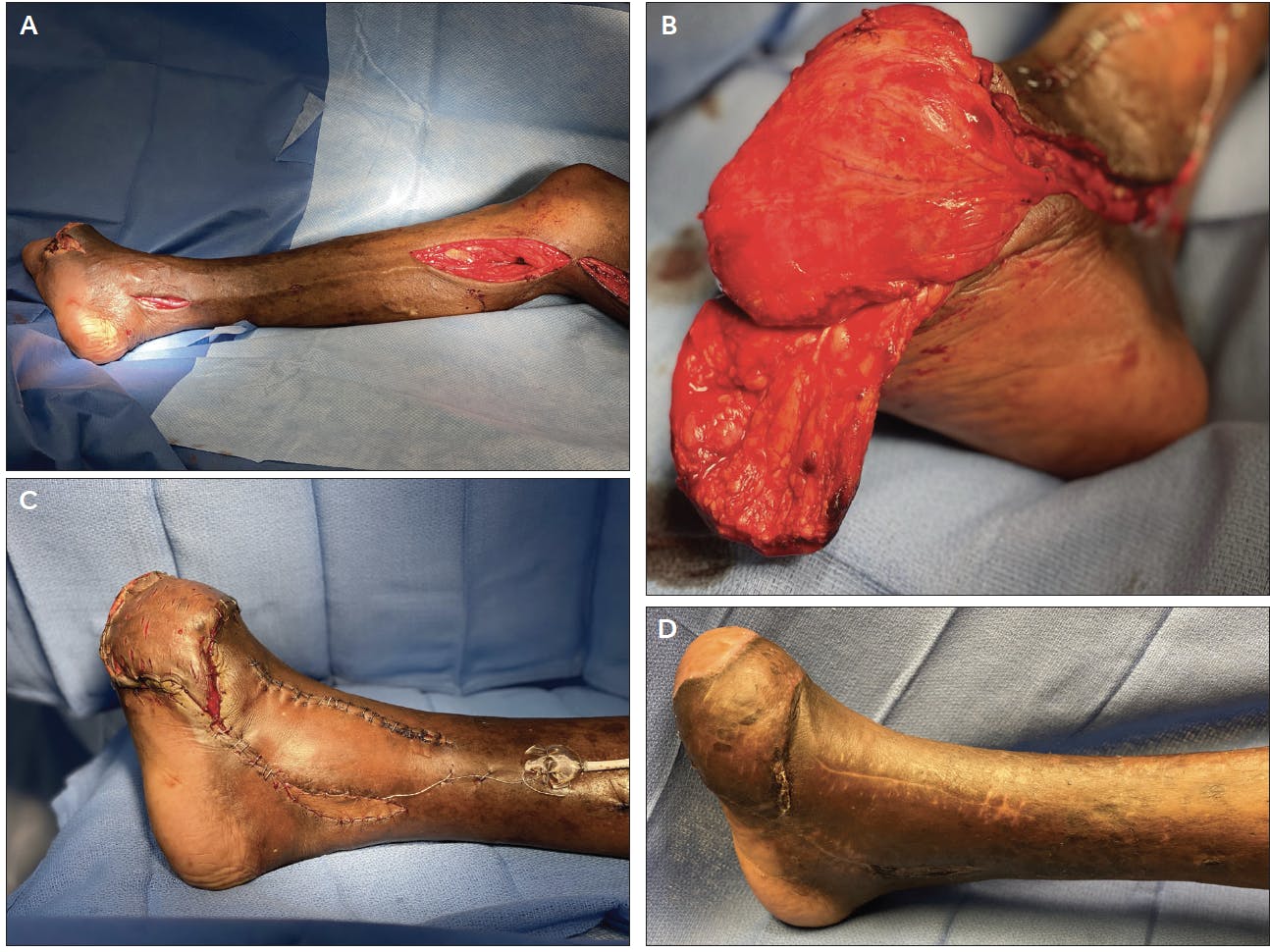
Figure 1. Case example demonstrating multidisciplinary revascularization and free tissue transfer for closure of complex midfoot wound. Popliteal-distal posterior tibial bypass with saphenous vein performed after debridement of midfoot wound (A). Free tissue transfer with arterial inflow taken from the distal bypass hood (B). Early postoperative image (C). Fully healed wound; patient is an independent community ambulator (D).
Extending the Arc of Care
Recognition of care gaps that cause delays in prosthesis fitting and rehabilitation after major amputation led us to establish a promising collaboration with our physical medicine and rehabilitation colleagues at TRISL. Dr. Grover heads the amputee program at TRISL and collaborates with our team to minimize the time course to successful prosthesis fitting and usage. Dr. Felder’s expertise in functional amputation techniques and targeted muscle reinnervation for reduction of postamputation neuralgia were a natural fit for collaboration with our TRISL colleagues, and he now leads one of the amputation clinics at TRISL. Our podiatrists (led by Dr. Liddell) are critical to the delivery of prophylactic foot care, appropriate footwear/bracing, and podiatric surgical intervention and advanced wound care. We were pleased to add our third podiatry team member this year, and we will continue to recruit additional podiatrists to meet the growing demand.
SUMMARY
Our multidisciplinary program has allowed us to work synergistically for the benefit of our patients. By working together, we have been able to extend the reach of our team across the entire spectrum of limb preservation care. This shared endeavor has been a source of both personal and professional satisfaction, and we encourage you to pursue collaborative care at your institution—the team is indeed greater than the sum of its parts!
1. Farber A, Menard MT, Conte MS, et al. Surgery or endovascular therapy for chronic limb-threatening ischemia. N Engl J Med. Published online November 7, 2022. doi: 10.1056/NEJMoa2207899
Advertisement
Advertisement