Advertisement
Advertisement
January 2023
Panel Discussion: Perspectives on Applying BEST-CLI in Practice
Experts discuss the study’s findings, its strengths and limitations, and clinical implications, as well as lessons learned regarding optimal medical therapy and what needs to be explored further.
With Daniel Clair, MD; Sanjay Misra, MD; Leigh Ann O'Banion, MD; and Mehdi H. Shishehbor, DO, MPH, PhD




How would you summarize your interpretation of the findings and conclusions of the BEST-CLI trial?1
Dr. Clair: The BEST-CLI trial found that for patients with chronic limb-threatening ischemia (CLTI) who have adequate length of single-segment great saphenous vein (SS-GSV) and who are healthy enough to undergo surgical bypass, the need for repeat intervention and risk for major adverse limb events (MALE) is lower with bypass surgery than for interventional therapy. This is an important finding that reinforces the value of surgical bypass and the importance of having a capable vascular surgeon to perform these procedures as part of the team caring for these patients. However, it is important to recognize that there are a limited number of patients who meet all of these characteristics, and for those patients who do not have SS-GSV, decision-making may still be complex. Additionally, as our population ages, patients are increasingly frail and this also impacts decision-making.
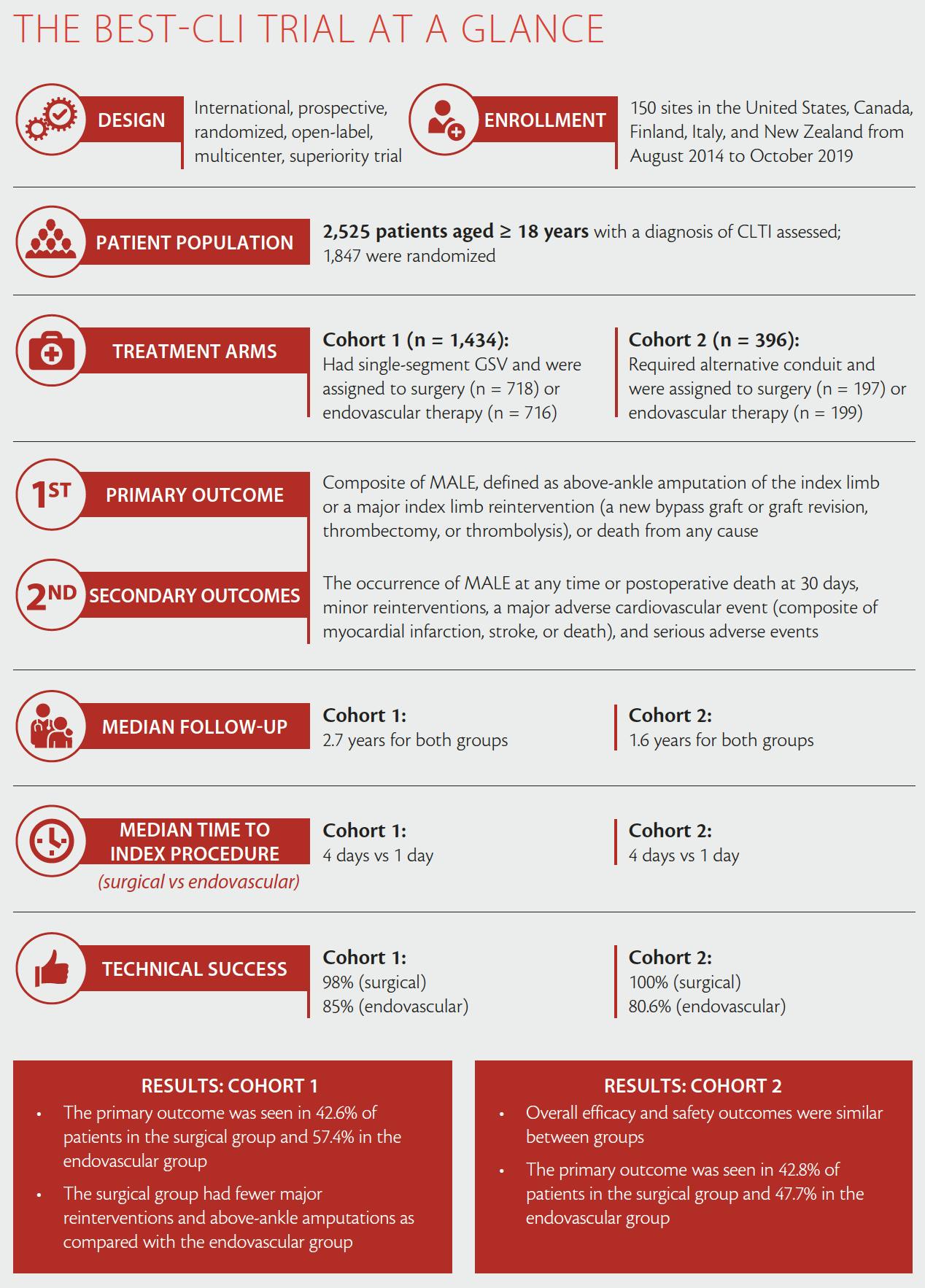
Dr. Misra: BEST-CLI is a National Institutes of Health–funded randomized clinical trial that investigated the clinical outcomes of patients with CLTI who were candidates for both surgery and endovascular treatment. Cohort 1 enrolled patients with an adequate GSV conduit, and patients were randomized to either surgical bypass or endovascular treatment. Cohort 2 enrolled patients without an adequate saphenous vein conduit; however, this cohort did not enroll the required number of patients, and therefore it is hard to draw conclusions from it.
Dr. O’Banion: The authors have published what is sure to be a landmark trial for decades to come. This international, prospective, multicenter, multispecialty trial enrolled two cohorts of patients: 1,434 patients with SS-GSV and 396 patients without suitable SS-GSV as determined by preoperative duplex ultrasound. After two investigators at the respective enrolling institutions with expertise in both open and endovascular techniques predetermined clinical equipoise, patients were randomized to either open or endovascular revascularization. The primary outcomes of MALE or death overwhelmingly favored the surgical arm in cohort 1 (P < .001), with major reinterventions and above-knee amputations significantly higher in the endovascular arm (P < .001 and P = .04, respectively). In cohort 2, there was no significant difference between the primary outcome in the two arms, although time to major reintervention appeared to favor open surgery. Ultimately, the authors present us with compelling data that while open and endovascular revascularization are both safe options, bypass with adequate SS-GSV should be considered as first-line therapy in CLTI patients of appropriate surgical risk.
Dr. Shishehbor: In relatively low-risk patients with CLTI who are eligible for both endovascular and surgical bypass and have a SS-GSV, surgical bypass may lead to fewer repeat revascularization procedures. However, the study design favored bypass due to the high number of patients who failed the initial endovascular attempt and subsequently underwent bypass.
What do you consider to be the strengths of the trial? Its limitations?
Dr. O’Banion: The BEST-CLI trial was executed at 140 international sites with excellent detailed follow-up data. The methodology of the trial accounted for the inherent biases toward treatment algorithms in CLTI by mandating two-provider clinical equipoise. The separation of the cohorts into those with suitable SS-GSV and those without in addition to the stratification by degree of ischemia (rest pain vs tissue loss) and complexity of disease (presence or absence of tibial disease) is also a major strength of the study. Some may say that the results were driven by early failure in the endovascular group; however, the authors did due diligence in performing a sensitivity analysis, excluding those with technical failure or who were censored within 30 days and noted continued significance of the primary outcome as well as the major reintervention outcome in cohort 1.
There were a few inherent limitations specifically related to the endovascular arm that are important to highlight. The study period included a time when paclitaxel-coated devices were drastically reduced due to a meta-analysis published by Katsanos et al in 2018.2 We expect to see further details from the investigators on the specific utilization of drug-coated and -eluting devices on a per-limb, as-treated basis. Additionally, recent technologies such as drug-eluting stents, intravascular lithotripsy, dissection tacking devices, intravascular ultrasound, and the use of retrograde access all have increased in utility within the last few years, with data demonstrating improved outcomes in the endovascular space. However, little if any of these data are specific to the CLTI population, with most study cohorts composed primarily of patients with intermittent claudication. I personally do not believe these new technologies would change the overall results of the trial, but perhaps the gaps would be narrowed, particularly in reintervention rates. Lastly, no hemodynamics beyond trial entry or patency data were collected, limiting the ability for WIfI (Wound, Ischemia, foot Infection) re-staging and further investigation into long-term, limb-based patency and technical success of interventions.
Dr. Misra: The strengths were its randomized design, the large data set, and long-term (2-year) follow-up. Some limitations include (1) the use of intention-to-treat analysis with a high endovascular technical failure rate; (2) endovascular failures were the driver of the composite endpoint because mortality was similar between endovascular therapy and bypass; (3) the high early reintervention rate raises the possibility of poor initial endovascular strategies; (4) the heterogeneity of endovascular techniques used, with limited drug-coated therapies; and (5) there was poor medical optimization.
Dr. Shishehbor: A strength of the trial is that it enrolled a large number of CLTI patients. However, there are several limitations:
- Nonselective enrollment. This important selection bias likely excluded TransAtlantic Inter-Society Consensus (TASC) A and B endovascular cases. There were only 2,800 screened patients and 1,830 subsequently enrolled in 100+ sites over > 5 years.
- The design favored bypass, as approximately 15% to 20% of patients failed endovascular treatment and subsequently underwent bypass. Unfortunately, this rate of failure is not reflective of true CLTI experts and indicates low endovascular competency among operators.
- Enrolled patients had low- to moderate-risk CLTI and the mean age was much younger than the national and global CLTI population.
- Underserved patients were not well represented.
- Endovascular therapy was significantly suboptimal, with nominal drug-coated balloon and drug-eluting stent use.
- Over two-thirds of the operators were vascular surgeons, which is not representative of the physician groups that treat CLTI.
- There was no angiographic core lab adjudication.
Dr. Clair: I believe the strengths of the trial are its prospective, randomized format and its “real-world” design. Additional funding was obtained to allow for 2-year follow-up in the cohort with adequate GSV, which allowed excellent insight into the real outcomes for these patients with good surgical and interventional options and outcomes. The picture is not quite as rosy as we might have guessed, showing that even with excellent interventions, 10% (surgery) and 15% (intervention) of patients will lose their limb within 2 years of treatment. Some of the limitations of the trial include the poor initial success rates with interventional therapy, the minority of patients being treated with drug-coated devices as part of an interventional strategy, and the likely differences between patient groups because of the methods utilized to determine clinical equipoise. Despite these limitations, I do believe the real-world nature of the trial provides dramatic value.
What are some of the practical implications of these results in real-world settings?
Dr. Clair: Patients with CLTI should have an assessment of their surgical risk, the availability of venous conduit, and an assessment of how complex any intervention would be. It will be helpful over time to determine if the types of cases that initially failed with endovascular therapy could be categorized or at least determine the characteristics that might make success with an endovascular-first approach less likely, particularly if venous conduit is available. From a patient care perspective, I think this trial justifies a more significant role for surgical revascularization in patients with adequate and available conduit, particularly if the intervention is complex (and we do have some understanding of what makes an intervention more complex). For those of us treating CLTI regularly, I don’t believe this is a dramatic shift in what we have been doing already.
Dr. Shishehbor: We need to continue to improve technical skills for endovascular intervention, enroll underserved patients, and better understand the clinical and frailty risk for surgery.
Dr. O’Banion: With the various specialties treating CLTI, often multidisciplinary collaboration in the care of these patients is lacking. The BEST-CLI trial highlights the importance of shared decision-making in this complex patient population. All patients with CLTI should undergo preoperative vein mapping, irrespective of the treating physician, and surgeons should work closely with interventional cardiology and interventional radiology to allow for the best possible intervention for the patient based on the availability of SS-GSV and patient risk profile. There has been recent exponential growth in the “endovascular-first” approach to patients with CLTI, and this landmark study hopefully will compel treating physicians to rethink algorithms based on these high-quality data. If these data are put into real-world practice, I suspect the volume of lower extremity bypasses performed will increase significantly, and we must balance this with the training we are providing for our future vascular surgeons to ensure competency across both open and endovascular treatment methods, irrespective of the complexity of disease.
Dr. Misra: The results of this study show that surgical revascularization is an ideal option for patients with CLTI and adequate GSV conduit who are good surgical candidates. The authors of this study need to be congratulated for the enormous amount of hard work and dedication needed to accomplish this study.
How does the BEST-CLI patient population compare with those you treat in your practice?
Dr. O’Banion: Fresno, California, has one of the highest rates of CLTI and one of the most underserved and disadvantaged vascular communities in California and the United States. Our patient population has a higher proportion of Hispanics, diabetic patients, and dialysis patients, which equate to a patient population that inherently presents with heavily calcified below-the-knee (BTK) disease. The BEST-CLI trial investigators acknowledged the need for further investigation of revascularization outcomes across the spectrum of infrapopliteal anatomic complexity in this patient population. This will become increasingly important in determining the best treatment algorithm for these patients as we continue to push the limits of revascularization into the below-the-ankle (BTA) space. I will be looking forward to more data from the study investigators as to the anatomic complexity of disease treated and its influence on the outcomes.
Dr. Shishehbor: I was enrolling patients at two institutions for BEST-CLI. At one location, we screened almost 100 patients but not one qualified. Unfortunately, a significant portion of our patients are frail, lack a single-segment autologous saphenous vein graft, and have already failed previous bypass. Other important anatomic factors also exclude patients for BEST-CLI. A significant portion of our patients (approximately 40%) have BTK and BTA disease.
Dr. Misra: Our patients tend to be older with a higher percentage on dialysis. In addition, our patients are typically not surgical candidates and do not have adequate vein conduits.
Dr. Clair: Overall, the population is similar to what I see in practice on a regular basis except for one important area—patients with CLTI and prior failed stents. This is an increasing part of the group of patients with CLTI, and I believe the reason they have been excluded from the trial is because of the overall poor outcomes in reinterventions in this population. Additionally, the exclusion of patients who are poor surgical candidates alters the population from those with CLTI who are more frequently seen.
Which data points would you like to see explored and explained further?
Dr. Clair: Because a significant component of the increased MALE in the endovascular group was related to early technical failures, I am interested in the characteristics of the failed lesions, modes of failure, and treatment methods. A wide range of therapies is reflected in the endovascular group, and this provides incredibly important information regarding the varied therapies and their success (or failure) rates and modes and timing. It is unfortunate that the issues with paclitaxel arose during the performance of this trial, as this clearly reduced the use of drug-eluting technologies in this patient population.
Dr. Shishehbor: We need a lot more information about the baseline angiogram, mechanism of endovascular failure, and number and type of patients treated during the 5-year trial at these centers. Clearly, this raises the concern of selection bias here, and we need to better understand the overall CLTI population in these sites over the 5 years. This will help with generalizability and patient selection.
Dr. Misra: We need to have TASC classification of the data. In addition, we need to understand why there was such a high rate of reinterventions in a short period of time in the endovascular arm. The 85% technical success rate in the endovascular arm is lower than what is reported in larger studies and should have been higher.
Dr. O’Banion: As stated previously, BTK disease is an area of great interest, not only due to our heavy volume here in Fresno but also given the recent explosion of endovascular technology in this space. Understanding outcomes specifically related to advanced infrapopliteal GLASS (Global Limb Anatomic Staging System) staging and how the pedal descriptor affects these outcomes is of particular interest. I am also interested to see results of the quality-of-life and cost-effectiveness analyses and more information on the impact of reinterventions on patients in the trial.
How might these findings affect limb preservation patient workup and decision-making in your practice?
Dr. Shishehbor: Obtaining venous mapping is important information for consideration.
Dr. O’Banion: Because of our younger, Hispanic patient population presenting with advanced WIfI stages, we typically take an “open first” approach in the presence of adequate SS-GSV, appropriate anatomy, and suitable patient risk. However, I do think that, like most, we have become accustomed to treating less severe patients (rest pain, lower GLASS staging) with an endovascular-first approach, specifically those with isolated femoropopliteal lesions. These data have already made an impact on our decision-making, reversing this endovascular-first approach, and hopefully we will in turn see an improvement in overall outcomes in our patient population.
Dr. Misra: This has the potential to limit treatment in underserved populations and high-risk populations. With limited resources, the ability to obtain vein mapping and a medical examination for clearance will hurt those who are high-risk patients.
Dr. Clair: For the majority of vascular surgeons in practice, CLTI is an increasing portion of our practice, particularly in the South. Bypass is an important part of our treatment, and endovascular therapy is used in cases where vein is inadequate or the patient is a high-risk surgical candidate. Hybrid therapies make up an important component of what we do as well, and I don’t think there is a way to reflect that in a trial like this. Overall, I believe bypass may experience a bit of a “comeback,” but in reality, this valuable method of revascularization has never lost favor among surgeons experienced in this technique. My own “return” to bypass happened years ago, and it remains one of my favorite operations because of its successful outcomes.
What are the important lessons from this trial regarding optimal medical therapy (OMT)?
Dr. O’Banion: I think the trial has really highlighted the need for increased focus on OMT for patients with CLTI. Based on the Global Vascular Guidelines, all CLTI patients should be on antiplatelet therapy (level 1A evidence). Additionally, there is compelling evidence from both the VOYAGER and COMPASS trials advocating for rivaroxaban 2.5 mg in the CLTI patient population, and this is further reiterated in the Global Vascular Guidelines as level 2B evidence. In the BEST CLI trial, 72% of patients were on antiplatelet therapy and 3.9% prescribed rivaroxaban, and while this increased to 82.9% and 6.7%, respectively, at 30-day follow-up, these statistics have clear room for improvement. It’s also a little sobering to see that the long-term mortality in the CLTI population remains at approximately 10% per year, with little change in the literature over decades despite advances in vascular medicine.
Dr. Clair: We still have a long way to go to successfully optimize medical therapies for these patients. Over one-third of patients were still smoking at the time of the procedure, and just 70% of patients were treated with statins. Although there are no data on overall use of antiplatelet therapy (ie, percentage of patients on at least one antiplatelet agent), only two-thirds of patients were taking aspirin, and < 5% were taking any form of direct oral anticoagulant. Finally, just 6.8% of patients had any prior intervention for smoking cessation. We need to improve our performance in these areas to ensure we achieve best outcomes for these patients.
Dr. Shishehbor: Overall, we must do much better with OMT in patients with peripheral artery disease and CLTI. We have opportunities and our patients can benefit from aggressive guideline-directed medical therapy.
Dr. Misra: The low rate of medical management is alarming despite many papers and guidelines recommending medical management.
Beyond the endpoints and conclusions, what are some of the larger learning points from this trial?
Dr. Shishehbor: As noted previously, we need angiographic data and a better understanding of the endovascular failures.
Dr. Misra: Core lab and clinical adjudication of crossover should have occurred. In future trials, the endovascular treatment and use of technologies also need to be defined better, and clear guidelines should be established on technical success and failure. We also need increased participation from interventional cardiologists and interventional radiologists.
Dr. Clair: There are several other major findings in this trial. First, there is not as large a difference in periprocedural mortality and cardiac risk between the two therapeutic arms as I would have predicted. Although endovascular therapy does offer some early advantage, it is not as dramatic as one might have expected. Much of the difference in primary endpoint advantage for surgery was driven by early (< 30 day) complications in the endovascular arm. Improving this is critical to success for these patients.
Dr. O’Banion: One of the major take-home messages of this study should be that CLTI is an ever-evolving field requiring multidisciplinary dedication to the care of these vulnerable patients. Patients with the highest rates of success across all outcome measures are those offered the best therapy given availability of conduit, anatomic complexity of disease, and patient risk profile, all concepts highlighted in the Global Vascular Guidelines. BEST-CLI also demonstrates that despite technology and advancements in the endovascular space, there still is no adequate replacement for a well-done SS-GSV bypass, and I think this drives home the importance of adequate training of our future vascular surgeons across both open and endovascular techniques.
What new questions does it raise? What would you like to see in future analyses of this data set or subsequent trials?
Dr. O’Banion: It will be important to have greater clarity as to the anatomic and physiologic complexity of the patients enrolled in the trial. Subanalyses on this study’s cohort of patients based on WIfI and GLASS staging will be revealing to further guide the best treatment for patients with the most advanced clinical presentation and the highest anatomic complexity of disease. We need to continue to evaluate the hemodynamics necessary for individual patients and investigate which revascularization strategies will allow for the best outcomes given the disease burden and clinical presentation. Additionally, future studies examining trends in endovascular and open revascularization will be telling to monitor the impact of BEST-CLI on our real-world practices, as well as monitor our commitment to improving best medical therapy in this patient population.
Dr. Misra: We need more data on who was treated, why the endovascular arm failed at a high rate, and lesion characteristics before we can decide on how future studies should be undertaken.
Dr. Clair: Several additional questions arise from any good trial, and this one is no exception. I previously pointed out some of these, but beyond those are issues related to medical therapy and its optimization for these patients. How can we do better in this regard? Is there a way we can predict who would truly benefit from one approach or another? Are there some predictive findings that would make one approach favorable in specific patients? Although I appreciate the efficacy of randomized trials in identifying the optimal therapy for patients, this trial in particular highlights the heterogeneity in a population, the physicians treating them and the approaches taken, and the ability to withstand a procedure. There are myriad other factors that impact outcomes for these patients, including patient genetics, frailty, and responses to specific surgical or interventional approaches. All of these factors are specific for individual patients, and while this trial is valuable, it is not as though every patient fits nicely into these patient groups. As I noted earlier, hybrid therapies and innovative techniques not assessed here also will have an impact on caring for these patients. We still have much to learn and a long way to go to improve outcomes for these patients, but this is a large step in the right direction to help answer some of these questions and identify others that will move the needle in terms of improving care and patient outcomes.
Disclosures
Dr. Clair: Consultant to Boston Scientific, Endologix, Inc, Elastimed, Inc., Medtronic, Inc., LimFlow, Inc., Vesteck, Inc., Nectero, Inc., and Caeli Vascular, Inc.
Dr. Misra: Principal Investigator for HL098967 grant and Regenerative Minnesota Medicine grant; consultant to Medtronic; founder, Pavaj Vascular; equity in Inova Vascular; data and safety monitoring board, Humacyte and Penumbra.
Dr. O’Banion: Research grants from Abbott, Shockwave, and Medtronic.
Dr. Shishehbor: Global advisor and consultant for Medtronic, Boston Scientific Corporation, Abbott Vascular, Terumo, Philips, ANT, and Inquis Medical.
1. Farber A, Menard MT, Conte MS, et al. Surgery or endovascular therapy for chronic limb-threatening ischemia. N Engl J Med. 2022;387:2305-2316. doi: 10.1056/NEJMoa2207899
2. Katsanos K, Spiliopoulos S, Kitrou P, et al. Risk of death following applications of paclitaxel-coated balloons and stents in the femoropopliteal artery of the leg: a systematic review and meta-analysis of randomized controlled trials. J Am Heart Assoc. 2018;7:e011245. doi: 10.1161/JAHA.118.011245
Advertisement
Advertisement