Advertisement
Advertisement
June 2023
Assisted pAVF Maturation: When, Why, and How I Do It
Differentiating between physiological and clinical pAVF maturation and the approach to nonmaturation based on flow, lesion, and location.
Percutaneous arteriovenous fistula (pAVF) creation has been available for several years, with two different CE Mark– and FDA-approved devices existing on the market for commercial use: the Ellipsys (Medtronic) and WavelinQ (BD Interventional) pAVF systems. Similar to the surgical proximal forearm (Gracz-type) fistula, both devices utilize the antecubital deep communicating vein (perforator) to direct the AVF flow from the endovascularly created AVF anastomosis toward the superficial upper arm cephalic and/or basilic veins.1 However, there are several significant differences in where and how the endovascular AV anastomosis is created.2,3 Although both systems have demonstrated high technical procedural success—as well as satisfactory short- and midterm results regarding patency, maturation, usability, and functionality, with low rates of complications4-7—pAVFs may not mature without secondary interventions. Secondary interventions to assist maturation are necessary in some patients to achieve successful dialysis. To understand when, why, and how maturation procedures are required for pAVFs, it is crucial to understand each pAVF’s anatomy; have clear definitions of maturation (and hence nonmaturation); identify the possible reason, type, and even anatomic location of the lesion responsible for the pAVF nonmaturation; and differentiate between the secondary interventions needed.
PHYSIOLOGICAL AND CLINICAL pAVF MATURATION
The anatomic criteria for both pAVF systems have been previously described in detail.2-5,8 The WavelinQ pAVF creates the anastomosis between the proximal radial or ulnar artery and concomitant vein using radiofrequency energy slightly peripheral to the perforator vein, and the Ellipsys system utilizes the proximal radial artery and the junction of the perforator vein into the proximal radial vein as an anastomosis site using thermal energy.
pAVF maturation can be differentiated into physiological (meeting certain defined physiological criteria) and clinical (eg, being able to use the pAVF successfully for dialysis) maturation. One important anatomic criterion is that pAVFs usually do not have a single-vessel outflow, but instead they are multiple-vessel outflow AVFs. Therefore, flows are possible not only in the upper arm cephalic and/or basilic veins but also in the brachial(s) and even retrograde forearm veins. Hence, simply identifying a mature pAVF is not always easy. Although different maturation criteria for surgical AVFs have been adopted for pAVFs, the definitions of physiological maturation are not standardized (or even identical) in every practice—different countries and interventionalists define their own maturation criteria. Some might consider the rule of 6s (6 weeks after creation, 6-mm vein diameter and depth, 600 mL/min flow), yet there is no scientific evidence behind it, especially for pAVFs. Physiologically, a volume flow (Qa) of > 500 to 600 mL/min, measured in the inflow brachial artery (or axillary artery in patients with high axillary bifurcation), with target vein diameter > 5 mm and target vein flows > 300 mL/min are considered as mature pAVF and sufficient for (potential) successful dialysis in our practice in Hamburg, Germany, given that dialysis flows typically range from 250 to 350 mL/min. However, more important is the clinical maturation of pAVFs (eg, the usability) with repeated successful two-needle cannulations. The latter can vary significantly depending on the experience of cannulating personnel, dialysis flow expectations, and readiness to use ultrasound (US) guidance as point-of-care US (POCUS). Thus, if the pAVF is considered mature in one country and one dialysis unit, it can be regarded as insufficiently matured in another.
In our center, we perform a 4-week US evaluation of maturation after every AVF creation. In our > 5-year experience with > 200 pAVF creations, if the pAVF is not physiologically (and clinically in dialysis patients) matured at 4 weeks after the creation, then waiting longer most likely will not achieve it. When a pAVF is not matured, secondary interventions are necessary to make it usable for hemodialysis. Hence, if the Qa is < 500 to 600 mL/min, or if it ranges > 500 to 600 mL/min yet the target vein(s) flow (the cannulation zone) is < 300 mL/min (eg, significant flow is “lost” to either basilic > cephalic in dual outflow pAVFs or into the deep veins), the maturation is considered failed. Clinically, failure is apparent with weak thrill and either cannulation or dialysis flow difficulties.
APPROACH TO FAILED pAVF MATURATION BY TYPE, LESION, AND LOCATION
Although every pAVF (similarly to surgical AVF) consists of inflow, outflow, and a conduit, there are different types of failed maturation in pAVFs. Therefore, the failed maturation can be divided in two types: (1) insufficient total Qa and (2) sufficient Qa but no sufficient flow in the superficial target vein. Both types are attributed to different lesions in different locations. Hence, various strategies are required, either separately or combined, to assist maturation in pAVFs.
The secondary maturation procedures can be divided into those for an arterial inflow, AV anastomotic, juxta-anastomotic or outflow vein stenoses, or a combination of these for type 1 failed maturation and flow-diverting procedures (either separately or in addition to the previously mentioned) for type 2 failed maturation. We do not consider a thoracic central vein outflow stenosis/occlusion, because in our experience, it doesn’t prevent maturation but typically leads to a venous congestion of the AVF arm. Obtaining flow measurements with US during and at the end of every intervention procedure is imperative.
Arterial Inflow Stenosis
Arterial inflow stenosis is rarely a reason for failed maturation in pAVFs, especially if the preoperative planning and mapping were performed thoroughly. However, it is sometimes possible, mostly in combination with other lesions. Depending on the peripheral arterial status, a retrograde arterial transradial/transulnar access from the wrist using US guidance (and in rare occasions angiography) is performed with a subsequent percutaneous transluminal angioplasty (PTA). Most commonly, a 3-mm high-pressure balloon is used for the radial artery and 4-mm balloon for the ulnar trunk.
Anastomotic and Juxta-Anastomotic Stenoses
Anastomotic stenoses have not been seen in WavelinQ pAVFs and are rarely seen in Ellipsys pAVFs, but if so, they are most commonly in combination with juxta-anastomotic stenoses in our experience. Juxta-anastomotic radial/ulnar vein stenoses for WavelinQ pAVF and perforator vein stenosis for Ellipsys pAVF are the most common reasons for maturation failure, and these are almost always identified with US. As opposed to WavelinQ pAVFs where Qa is low when juxta-anastomotic stenosis occurs, in Ellipsys pAVFs, the Qa typically does not decrease, but the flow in the superficial outflow vein(s) is low and directed toward the big brachial vein(s). A retrograde wrist transradial/transulnar venous (if possible) or arterial approach for WavelinQ and a transradial arterial approach for Ellipsys is preferred, and angioplasty of the stenosis demonstrates high technical success and outcomes. This approach allows simultaneous angioplasty of the inflow artery as well as the AV anastomosis, if necessary. If distal wrist access is not feasible, transvenous retrograde access is also possible. However, in nonmatured pAVFs, the size of the (fragile) vein is small and risk for damage with the sheath should be considered. In those cases, we prefer the median cubital vein against the cephalic vein for an access (especially in dual outflow pAVFs). Using POCUS is possible in almost all pAVFs, reducing the use of radiation (Figure 1). The choice of the balloon is left to the operator’s decision. Our preference as first choice is a 4- or 5-mm high-pressure or scoring balloon and always prolonged angioplasty (> 3 minutes up to rated burst pressure) in combination with drug-coated balloon (> 3-minute inflation time). In tougher lesions, an ultra-high–pressure balloon is used instead. In rare cases, a juxta-anastomotic vein occlusion occurs within the first 4 weeks, preventing the maturation. If detected early, US-guided sharp recanalization and PTA are easily performed in Ellipsys pAVFs to salvage the pAVF (see video).
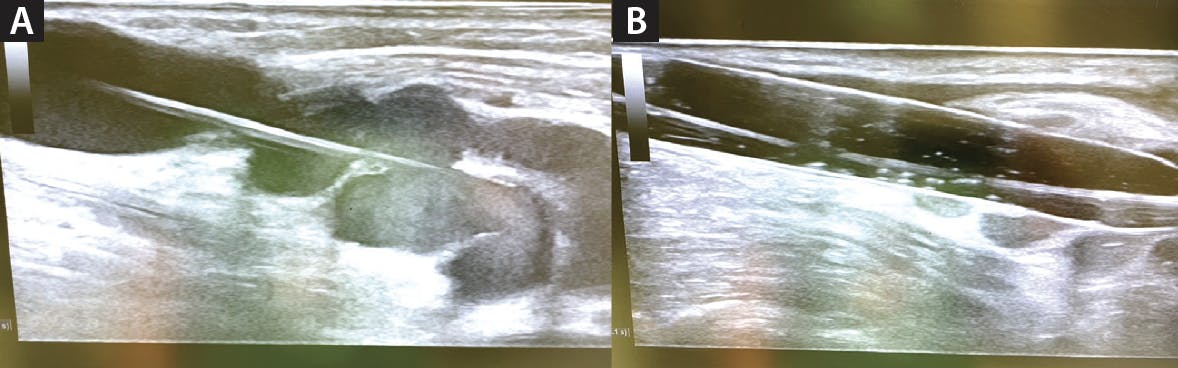
Figure 1. US-guided balloon angioplasty of a juxta-anastomotic vein stenosis in pAVF. Introduction of the needle (A) and completely inflated balloon (B).
Perforator Vein and Outflow Vein Stenosis
Perforator vein stenosis for WavelinQ and outflow vein stenoses for both pAVF systems are possible but uncommon. In those situations, the Qa remains high but the flow diverts into the deep veins for both pAVFs if a single, superficial outflow vein exists and is stenosed (typically in the cubital region). As previously mentioned, a transradial/transulnar access is preferred, with PTA of the stenosis using a similar choice of balloons. In limited cases, when the passage of the stenosis fails, a local patchplasty is possible using a vein or bovine pericardium, although it is a second choice given that it eliminates the possibility of (at least temporary) cannulations in the area and can also lead to recurrent stenoses (Figure 2).
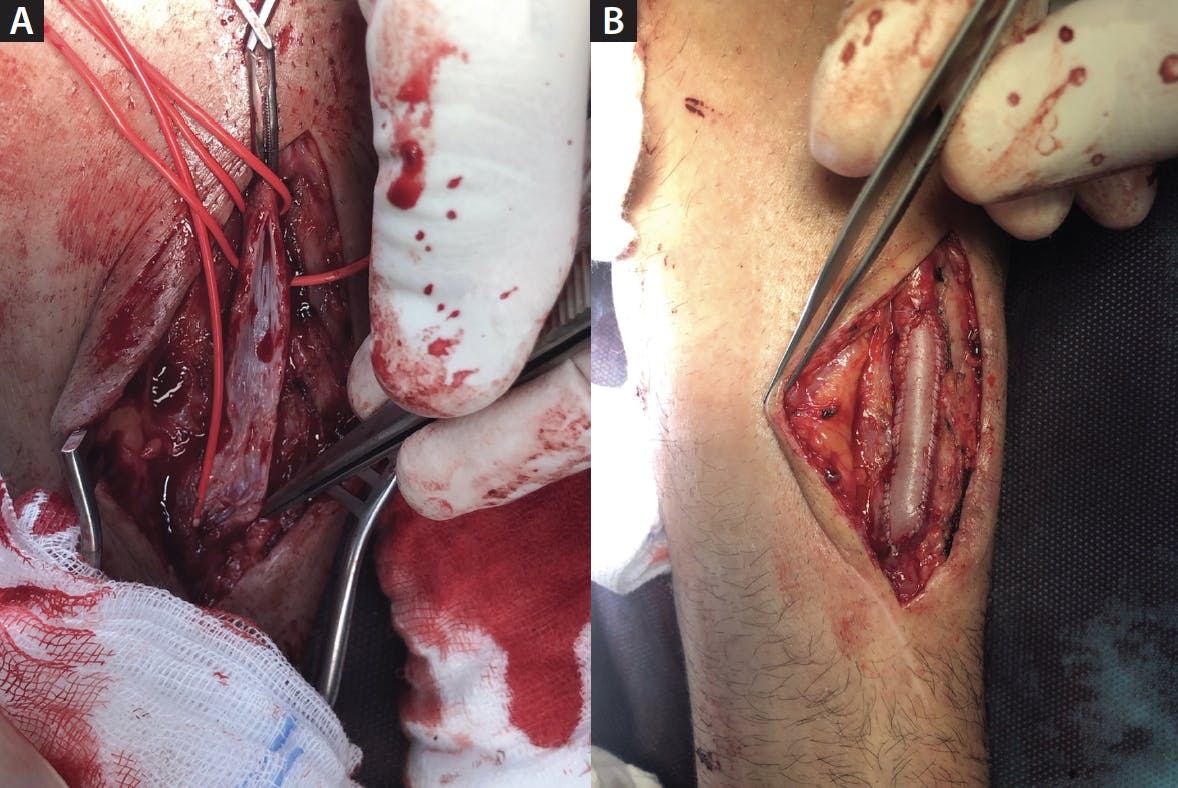
Figure 2. Patchplasty of the stenosed cephalic vein. Exposure of the stenosis (A) and finalized patchplasty using bovine pericardium patch (B).
Split Flow and Flow Diversion
Finally, it might be necessary to perform secondary coiling or ligation of venous branches to assist maturation, most commonly the deep brachial vein(s) and/or the basilic vein for dual outflow pAVFs. In our experience, a non-AVF branch usually does not “drain” AVF flow to prevent maturation, but it does “drain” the flow from the outflow superficial vein because of an existing high resistance (eg, stenosis). Thus, identifying and treating the stenosis is highly recommended beforehand. Simultaneously, a dominant brachial vein (or rarely peripheral to the anastomosis ulnar or radial veins) can be coil embolized or ligated at the level of the elbow crease, which we prefer to do under local anesthesia, when the vein becomes or stays large due to an existing superficial outflow stenosis and thus is a significant “competing” branch. This strategy does not negatively affect the brachial veins for future vascular access possibilities (eg, brachial vein AVF or AV graft creation). Small venous branches are not an issue for maturation and are not treated to divert the flow. If coil embolization is preferred, we recommend strongly considering the “maturation” of the brachial vein with a high flow, which can lead to migration of the coil.
For pAVFs with dual outflow and significant basilic vein flow but a preoperatively good cephalic vein, we always recommend banding of the median cubital vein right before its junction with the forearm basilic vein down to a 2-mm diameter under local anesthesia (instead of ligating or especially coiling) to “redirect” the flow to the cephalic vein and assist the cephalic vein maturation, either separately or in combination with angioplasty. This keeps the basilic vein patent for future surgical Gracz or brachiobasilic AVF options and allows the option of median cubital vein cannulations (Figure 3).
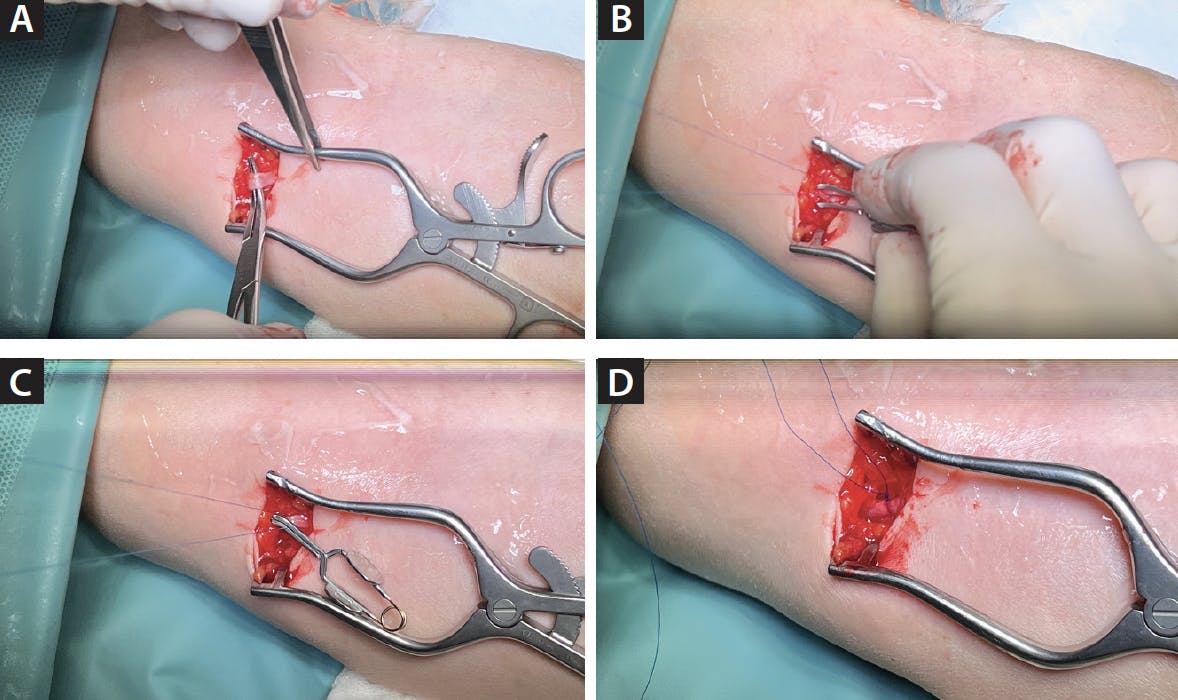
Figure 3. Banding of median cubital vein to divert the flow from the basilic toward the cephalic vein. Exposure of the median cubital vein (A); using 5-0 Prolene suture and a bulldog clamp, a banding is placed around the median cubital vein (B, C); final shot of banding placed around the vein (D).
SUMMARY
Both available pAVF systems demonstrate high technical procedural success, with satisfactory cumulative patency, maturation, usability, and functionality rates. However, secondary interventions to assist maturation and usability of pAVFs are necessary and vary depending on the total volume flow, location of a lesion, and type of pAVF. Angioplasty at different locations is the most frequent procedure to assist maturation (most commonly at the juxtaanastomotic vein), with or without a combination of flow-diverting procedures (coil embolization, ligation, or banding), and demonstrates high rates of success. Planning of pAVF and understanding each individual’s anatomy, as well as identifying the reason for failed maturation, are the most crucial steps for successful maturation of pAVFs.
1. Gracz KC, Ing TS, Soung LS, Armbruster KF, et al. Proximal forearm fistula for maintenance hemodialysis. Kidney Int. 1977;11:71-75. doi: 10.1038/ki.1977.9
2. Lok CE, Rajan DK, Clement J, et al. Endovascular proximal forearm arteriovenous fistula for hemodialysis access: results of the prospective, multicenter novel endovascular access trial (NEAT). Am J Kidney Dis. 2017;70:486-497. doi: 10.1053/j.ajkd.2017.03.026
3. Hull JE, Elizondo-Riojas G, Bishop W, Voneida-Reyna YL. Thermal resistance anastomosis device for the percutaneous creation of arteriovenous fistulae for hemodialysis. J Vasc Interv Radiol. 2017;28:380-387. doi: 10.1016/j.jvir.2016.10.033
4. Hull JE, Jennings WC, Cooper RI, et al. The pivotal multicenter trial of ultrasound-guided percutaneous arteriovenous fistula creation for hemodialysis access. J Vasc Interv Radiol. 2018;29:149-158.e5. doi: 10.1016/j.jvir.2017.10.015
5. Shahverdyan R, Beathard G, Mushtaq N, et al. Comparison of outcomes of percutaneous arteriovenous fistulae creation by Ellipsys and WavelinQ devices. J Vasc Interv Radiol. 2020;31:1365-1372. doi: 10.1016/j.jvir.2020.06.008
6. Mallios A, Bourquelot P, Franco G, et al. Mid-term results of percutaneous arteriovenous fistula creation with the Ellipsys vascular access system, technical recommendations and an algorithm for maintenance. J Vasc Surg. 2020;72:2097-2106. doi: 10.1016/j.jvs.2020.02.048
7. Berland TL, Clement J, Griffin J, et al. Endovascular creation of arteriovenous fistulae for hemodialysis access with a 4 Fr device: clinical experience from the EASE Study. Ann Vasc Surg. 2019;60:182-192. doi: 10.1016/j.avsg.2019.02.023
8. Mallios A, Jennings WC, Boura B, et al. Early results of percutaneous arteriovenous fistula creation with the Ellipsys vascular access system. J Vasc Surg. 2018;68:1150-1156. doi: 10.1016/j.jvs.2018.01.036
Advertisement
Advertisement