Advertisement
Advertisement
June 2023
Tips, Tricks, and Pitfalls for Thrombosed AVFs
Arteriovenous fistula thrombosis can be managed with careful consideration of treatment options and patient-specific factors.
By Troy Sanders, MS; Mark L. Lessne, MD, FSIR; Brian Holly, MD; and Jessica K. Stewart, MD
More than 400,000 patients are currently treated with hemodialysis (HD) in the United States according to the National Kidney Foundation.1 In 2017, the Fistula First Initiative reported that they reached their goal of 66% of patients on HD using an arteriovenous fistula (AVF).2 Despite the benefits of AVF accesses over grafts and catheters, AVF thrombosis can prevent successful dialysis and lead to a patient becoming catheter dependent for HD, which is associated with an increased risk of infections, hospitalizations, and central venous occlusions.1,3 Although surgical thrombectomy may still be indicated in situations such as mega-fistula thromboses, minimally invasive techniques can more commonly mitigate the need for open surgery. This article shares data and practical tips for AVF thrombectomy techniques, AVF thrombosis prevention, and the contraindications and outcomes of procedures used to manage thrombosed AVFs.
THROMBOSIS PREVENTION
The most effective method of AVF thrombectomy is to avoid thrombosis altogether. Many problems that affect an AVF are easily identified via the “look, feel, and listen” approach, including venous stenoses, aneurysms, pseudoaneurysms, infection, and HD access–induced distal ischemia.4 To test for venous stenosis, an arm elevation test can be performed by holding the arm with the fistula above the heart for a period of time; the examiner should notice fistula collapse, except in rare cases of high blood flow giving a false-positive result.4 If venous stenosis is present, the fistula will collapse central to the lesion because blood return is obstructed peripheral to the stenotic segment.
Pulse augmentation is useful for determining the location of a stenotic lesion. Increased pulsatility may be a sign of outflow stenosis versus a less pulsatile thrill, which would be indicative of normal high flow through the AVF. Decreased palpable pulse or thrill in the AVF may indicate an inflow stenosis. Auscultation of the normal AVF with a stethoscope or Doppler will reveal a classic “thrill” secondary to turbulent flow of blood in the circuit; the audible bruit produced can be high pitched or lack a diastolic component in stenotic fistulas.5 Routine screening with ultrasound in asymptomatic AVFs is not currently standard practice, but there is evidence that its use to evaluate for clinical signs of dysfunction could provide a patency benefit for AVFs.6 Patients should be taught to examine their fistula to understand the feel of a healthy thrill and look for any redness or swelling that indicates an infection to expedite treatment interventions to save the fistula and avoid the morbidity of surgery and potential loss of a valuable access site.
TREATMENT OF THE THROMBOSED AVF
The surgical approach for AVF thrombectomy involves making an incision overlying the venous outflow limb of the AVF and using an embolectomy catheter to remove clot from the venous and arterial aspects of the fistula.7 Surgical repairs require general anesthesia, which may be a limiting factor in this patient population given the high incidence of comorbidities. There are limited data comparing surgical to endovascular treatments of thrombosed AVFs, but a recent meta-analysis reviewing outcomes of surgical and endovascular repair of arteriovenous grafts showed no significant differences in primary nonpatency rates for endovascular and surgical therapy at 1, 2, and 3 months, but did show significantly higher 1- and 2-year primary nonpatency rates for endovascular therapy (rate ratio [RR], 1.22; P < .01 and RR, 1.26; P < .01, respectively).8 Endovascular therapies did have a significantly higher technical failure rate compared to surgical thrombectomy (RR, 1.58; P = .03).
The decision of whether to perform endovascular salvage or surgical intervention for thrombosed AVF relies on the expertise of the center, but if percutaneous options are available, the surgical approach should be reserved for failed or high-risk (ie, very high clot burden) percutaneous treatments.9
With respect to endovascular salvage techniques for thrombosed AVFs, a few studies have focused on long-term outcomes. One study by Nikam et al included 410 endovascular salvage procedures performed on thrombosed/occluded AVFs or grafts. The success rate for endovascular salvage was 94% for fistulas, with primary patency rates of 82%, 64%, 44%, 34%, and 26% and secondary patency rates of 88%, 84%, 74%, 69%, and 61% at 1, 6, 12, 24, and 36 months, respectively.10 Haage et al observed similar findings in an investigation of 81 endovascular salvage procedures, demonstrating similar success and patency rates.9 Success rates for surgical management have been reported from 70% to 90%, with primary patency rates ranging from 51% to 84% at 6 months and 75% at 1 year, showing no significant difference compared to endovascular interventions.11,12
The decision of when to perform thrombectomy for a clotted AVF can be confusing for physicians, particularly in the setting of repeated episodes of fistula occlusion. Repetitive declots on the patient’s access over a short period of time is one sign that a referral for surgical revision or new access would be the better option. The patient’s comorbidities and time since last dialysis are also considerations. Mega-fistula declots or those with very large aneurysms with major clot burden may be treated surgically; however, interventionalists can successfully perform thrombectomy in these situations using tissue plasminogen activator (tPA), external massage, and copious aspiration to mitigate embolic burden, albeit with lower success rates.13
In Brooke et al, payer cost average creating a new AVF after first open intervention was $3,519 versus $3,922 after the fourth open intervention. For percutaneous interventions, these costs were $2,134 and $3,922, respectively. This study concluded that the clinical effectiveness of percutaneous interventions in AVFs diminishes after each reintervention and that creating a new AVF is cost-effective after the second open reintervention.14
Lyse and Wait
The “lyse-and-wait” technique involves injecting thrombolytic directly into the thrombosed AVF. As the name of the technique alludes to, patients will wait from 20 minutes up to 24 hours prior to additional interventions.15 The downsides of the “lyse-and-wait” technique include longer hemostasis times and increased bleeding complications.
Balloon Maceration
A variety of devices may be employed as a solution for rapid clearance of thrombus from AVFs. For balloon maceration, an angioplasty balloon is inserted into the thrombosed segment and is inflated to compress the clot against the wall of the vessel. This can be repeated until blood flow is restored to the fistula. This method is most effective when performed soon after thrombosis onset. It is best for a small clot burden localized to one portion of the fistula.16
Push-Pull Thrombectomy
If thrombosis is too extensive for balloon maceration or the AVF is completely occluded, the push-pull thrombectomy technique can be used. Push-pull thrombectomy involves passing a guidewire through the affected portion of the vessel and then using a balloon occlusion catheter to “push” the thrombus from the AVF toward the venous outflow tract, followed by a “pull” of the arterial plug toward the outflow tract. It is common practice to inject a thrombolytic into the thrombus prior to thrombectomy with this technique, typically 4 to 10 mg of tPA, because this thrombus is being sent to the pulmonary circulation.17 Studies have shown that push-pull thrombectomy can be an effective method for restoring blood flow in thrombosed AVFs.18,19 Some physicians choose to access the AVF via a venous access, such as the internal jugular vein, which allows for push-pull thrombectomy of the entire length of the thrombosed fistula from a single access site.
It should be noted that the push-pull technique puts patients at risk of serious complications, including pulmonary, cerebral (in the setting of right-to-left shunts), and other arterial embolizations. Arterial emboli occur in up to 6.3% of cases, although symptomatic emboli are rare.20 Studies report low incidence of pulmonary embolism (PE) in the range of 0% to 10% during pharmacomechanical and mechanical thrombolysis, but most occurrences of PE would be asymptomatic.20 However, cases of death and cardiac arrest secondary to large PE do exist in the literature, and clot burden and underlying cardiopulmonary reserve of the patient must be considered before the procedure.21,22
Mechanical Thrombectomy
Mechanical thrombectomy for AVF thrombosis may involve the use of one of many devices currently on the market to remove thrombus. Aspiration thrombectomy devices use suction to remove the thrombus (Figure 1). Rheolytic catheters use a high-pressure saline jet to fragment the thrombus, creating a vacuum for clot aspiration. These techniques can be used with or without tPA, but the use of thrombolytics increases the cost. Mechanical thrombectomy techniques have a risk of distal intra-arterial emboli to the hand, especially if careful technique is not adhered to.23 There is also risk that these devices can cause endothelial damage to the native vessels.19 In situations of distal embolization to the hand, a technique described by Trerotola et al can be used.24 This involves occluding the proximal feeding artery to a thrombosed AVF and results in back-bleeding (ie, reversal of blood flow distal to the thrombosed artery), allowing the thrombus to move out of the distal vasculature into the AVF.
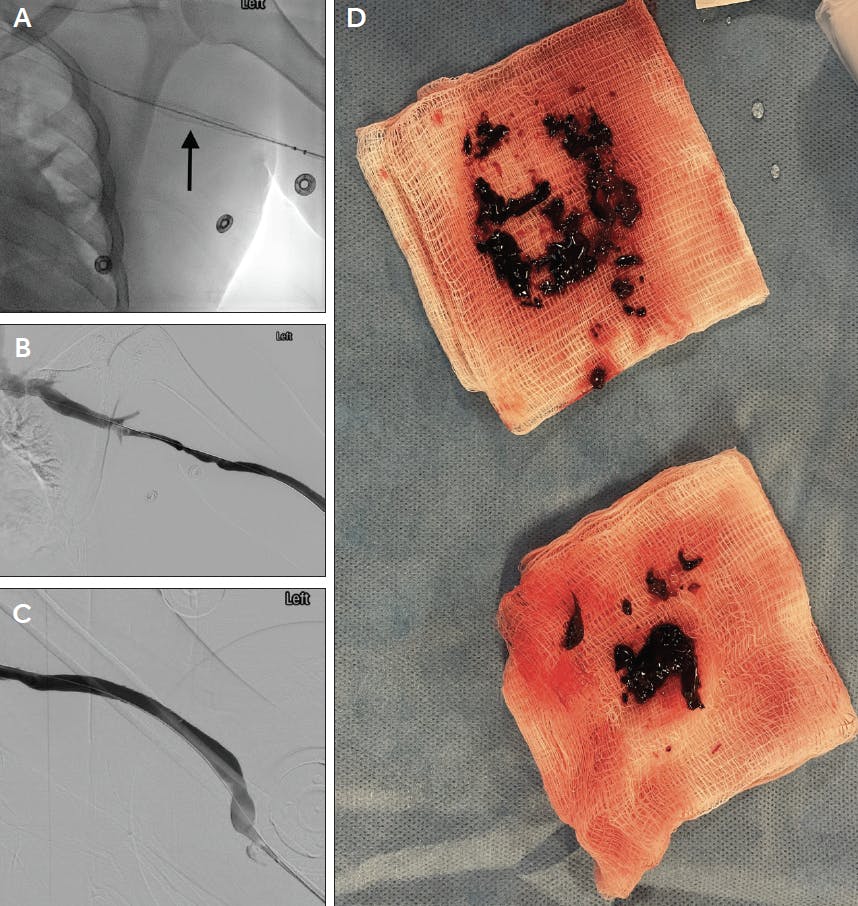
Figure 1. A patient in their early 20s with a thrombosed AVF. The InThrill device (Inari Medical) was advanced to the central-most aspect of the thrombus, and the thrombectomy element was deployed (black arrow) (A). Digital subtraction angiography after two passes with the InThrill device through the venous aspect of the fistula (B, C). There was minimal residual thrombus, and tPA administration was not required. A large amount of thrombus was successfully removed from the AVF using the device (D).
(Courtesy of Jessica K. Stewart, MD.)
MANAGING RISKS
All manipulation of thrombus poses risks of intra-arterial emboli to the hand or larger, clinically significant PE. To mitigate risks associated with these complications, gentle catheter and wire manipulation when navigating across the AV anastomosis into a feeding artery can help prevent emboli; similarly, saline or contrast injection through a juxta-anastomotic sheath should be avoided until thrombus is clear and blood is aspirated. Even then, gentle injection with external compression of the anastomosis can decrease risk of refluxing thrombus across the AV anastomosis. Maximal removal of clot prior to any angioplasty of arterial inflow stenosis is prudent. With respect to PE, these are usually well tolerated when they do occur during AVF thrombectomy; however, care should be taken in patients with diminished cardiopulmonary reserve (ie, known pulmonary hypertension) and in patients with large thrombotic burden, as can be seen with mega-fistulas.23
CONTRAINDICATIONS
Endovascular interventionalists should be aware of when not to intervene on thrombosed AVFs. Contraindications include recent access creation (< 30 days), severe ipsilateral steal syndrome, right-to-left shunt, access infection, moderate to severe pulmonary hypertension, or efforts in futile salvage.25 Avoiding intervening on patients with these conditions helps prevent potential complications or low chance of success in some cases. One of the most important factors for success in AVF thrombectomy is the length of duration of the access occlusion. Longer duration of stenosis and thrombosis allows further organization and integration of the clot into the intima, making it more difficult to pass a wire and more difficult to remove thrombus; in fact, prolonged thrombosis of AVFs can lead to irreversible ischemic changes to the autologous vein. The time that has passed since AVF creation additionally determines success and safety of intervention. Nikam et al conducted a randomized trial of 299 AVF thrombosis procedures utilizing AngioJet (Boston Scientific Corporation) or Arrow-Trerotola (Teleflex), maceration/angioplasty, or pharmacomechanic techniques. The authors found that salvaging an AVF < 30 days after creation was not beneficial for long-term patency, and the AVF should undergo surgical revision.10
Large clot burden is most often found in upper arm fistulas, AVFs associated with central vein stenosis, and large dilated aneurysmal AVFs called “mega-fistulas.”26 The risks associated with high thrombus burden make mega-fistulas a higher risk to repair by endovascular means but do not represent an absolute contraindication. Right-to-left shunts can pose especially high risks during AVF thrombectomy. Patent foramen ovale are present in roughly 27% of the general population, and paradoxical emboli can be possible in dialysis patients after mechanical thrombectomy.27,28 Another contraindication that should be considered for thrombosed AVF is if the thrombus could be a nidus for infection. The thrombus may contain immune cells and microbes that, if released into the circulation during endovascular thrombectomy, could lead to septic shock or other infectious sequelae. Clinical signs of access infection may contraindicate thrombectomy. Finally, it is important to be cognizant of the possibility of a futile salvage procedure. In other words, accesses with repeated thrombosis over a short term, accesses with extensive “full-metal jacket” stents with recurrent thrombosis, atretic outflow veins, and procedures in which no progress is being made despite good technical efforts should be considered for abandonment, followed immediately by new access planning.
ALTERNATIVE APPROACHES
In rare cases, AVF thrombectomy can be complicated by the presence of strongly adherent thrombus that has likely been present for weeks or months. This can make the thrombus very resistant to removal with any of the techniques outlined previously. For this reason, a hybrid technique of surgical removal of the thrombus paired with angioplasty has been shown to be extremely effective.29
Traditional access for endovascular treatment of AVF thrombosis involves direct retrograde and/or antegrade puncture of the fistula. The transradial approach (TRA) has been rising in popularity for other interventional procedures due to advantages including decreased hospital stay, time to ambulation, and higher patient preference.30 The TRA has been used to successfully treat dysfunctional or thrombosed dialysis.31-34 When dialysis access shows signs of juxta-anastomotic stenosis, numerous proximal venous outflow stenosis, or lesions in both limbs of the AVF, the TRA can be advantageous. It additionally enables the operator to stand farther away from the image intensifier, reducing radiation exposure.33 In a study of 511 fistulograms, TRA was used for 37 AVFs and showed a technical success rate of 88% for all TRA procedures, with patency rates of 88.5%, 84.2%, and 83% at 1, 6, and 12 months, respectively.33
Figure 2 shows a case of an AVF thrombectomy with the TRA approach.
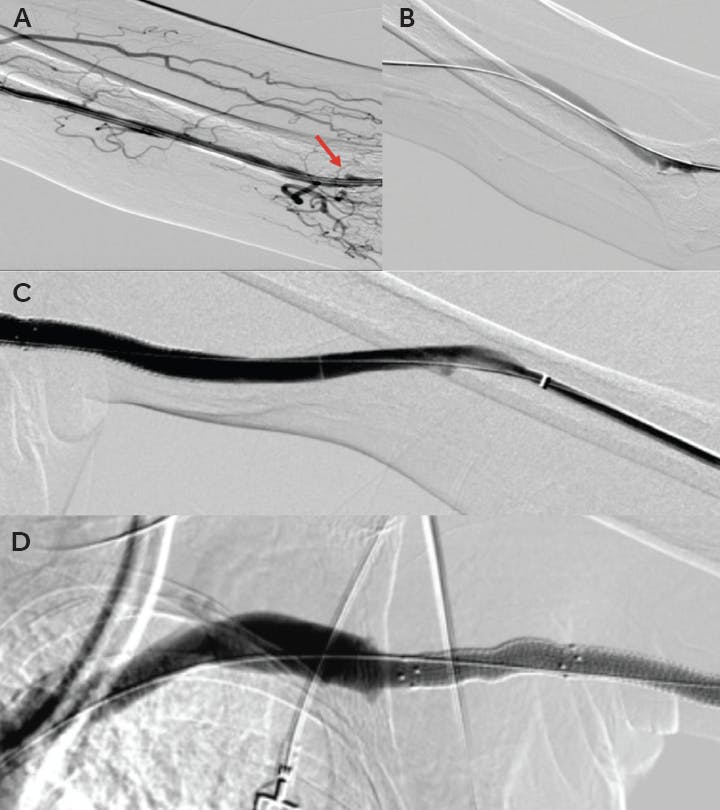
Figure 2. A TRA approach for the treatment of a thrombosed AVF (red arrow) (A). A guidewire was passed from the artery through the anastomosis, and push-pull mechanical thrombectomy was performed (B). Two stents that required larger access were placed via a direct AVF access (C, D). The entire procedure took approximately 15 minutes.
(Courtesy of Mark L. Lessne, MD.)
CONCLUSION
The management of AVF thrombosis can be challenging, requiring careful consideration of the options and indications for treatments. A variety of endovascular treatment options are available that have been shown to have good outcomes.9 With careful consideration of the available therapeutic options and patient-specific factors, successful outcomes can be achieved and the long-term patency of the AVF can be maintained. It is important to note that the choice of treatment modality should be individualized based on the patient’s unique clinical situation, including the location and extent of the thrombus, presence of comorbidities, and overall health status of the patient. In addition, careful attention must be paid to postprocedural monitoring to minimize the risk of recurrence.
1. National Kidney Foundation. KDOQI clinical practice guideline for hemodialysis adequacy: 2015 update. Am J Kidney Dis. 2015;66:884-930. Published correction appears in Am J Kidney Dis. 2016;67:534. doi: 10.1053/j.ajkd.2015.07.015
2. Lee T. Fistula First Initiative: historical impact on vascular access practice patterns and influence on future vascular access care. Cardiovasc Eng Technol. 2017;8:244-254. doi: 10.1007/s13239-017-0319-9
3. Tessitore N, Bedogna V, Poli A, et al. Should current criteria for detecting and repairing arteriovenous fistula stenosis be reconsidered? Interim analysis of a randomized controlled trial. Nephrol Dial Transplant. 2014;29:179-187. doi: 10.1093/ndt/gft421
4. Sidawy AN, Spergel LM, Besarab A, et al; Society for Vascular Surgery. The Society for Vascular Surgery: clinical practice guidelines for the surgical placement and maintenance of arteriovenous hemodialysis access. J Vasc Surg. 2008;48(5 suppl):2S-25S. doi: 10.1016/j.jvs.2008.08.042
5. Ota K, Nishiura Y, Ishihara S, et al. Evaluation of hemodialysis arteriovenous bruit by deep learning. Sensors (Basel). 2020;20:4852. doi: 10.3390/s20174852
6. Pietryga JA, Little MD, Robbin ML. Sonography of arteriovenous fistulas and grafts. Semin Dial. 2017;30:309-318. doi: 10.1111/sdi.12599
7. Ghaffarian AA, Sarfati M, Kraiss LW, et al. Open thrombectomy of arteriovenous fistulas: worth the effort or is it time to move on? J Vasc Surg. 2017;66:e45-e46. doi: 10.1016/j.jvs.2017.05.051
8. Chan N, Wee I, Soong TK, et al. A systematic review and meta-analysis of surgical versus endovascular thrombectomy of thrombosed arteriovenous grafts in hemodialysis patients. J Vasc Surg. 2019;69:1976-1988.e7. doi: 10.1016/j.jvs.2018.10.102
9. Haage P, Vorwerk D, Wildberger JE, et al. Percutaneous treatment of thrombosed primary arteriovenous hemodialysis access fistulae. Kidney Int. 2000;57:1169-75. doi: 10.1046/j.1523-1755.2000.00944.x
10. Nikam MD, Ritchie J, Jayanti A, et al. Acute arteriovenous access failure: long-term outcomes of endovascular salvage and assessment of co-variates affecting patency. Nephron. 2015;129:241-246. doi: 10.1159/000375500
11. Palmer RM, Cull DL, Kalbaugh C, et al. Is surgical thrombectomy to salvage failed autogenous arteriovenous fistulae worthwhile? Am Surg. 2006;72:1231-1233. doi: 10.1177/000313480607201217
12. Ponikvar R. Surgical salvage of thrombosed arteriovenous fistulas and grafts. Ther Apher Dial. 2005;9:245-249. doi: 10.1111/j.1774-9987.2005.00264.x
13. Falk A, Trerotola SO, Valji K. Roundtable: Addressing the clotted access. Endovasc Today. 2013;12:52-54, 56, 58.
14. Brooke BS, Griffin CL, Kraiss LW, et al. Cost-effectiveness of repeated interventions on failing arteriovenous fistulas. J Vasc Surg. 2019;70:1620-1628. doi: 10.1016/j.jvs.2019.01.085
15. Ates OF, Taydas O. Modified lyse and wait technique for the treatment of dialysis fistula thrombosis: percutaneous thrombolytic therapy with a 27-G dental needle. Semin Dial. 2022;35:522-527. doi: 10.1111/sdi.13047
16. Almehmi A, Sheta M, Abaza M, et al. Endovascular management of thrombosed dialysis vascular circuits. Semin Intervent Radiol. 2022;39:14-22. doi: 10.1055/s-0041-1740941
17. Webb A, Zacharias K, Ciolek P, et al. Dialysis shunt thrombectomy utilizing a rotational thrombectomy device in patients with pseudoaneurysms. Arab J Interv Radiol. 2020;4:87-091. doi: 10.4103/AJIR.AJIR_8_20
18. Çildağ BM, Köseoğlu KÖ. Percutaneous treatment of thrombosed hemodialysis arteriovenous fistulas: use of thromboaspiration and balloon angioplasty. Clujul Med. 2017;90:66-70. doi: 10.15386/cjmed-686
19. Quencer KB, Friedman T. Declotting the thrombosed access. Tech Vasc Interv Radiol. 2017;20:38-47. doi: 10.1053/j.tvir.2016.11.007
20. Ash S, Weng FL, Berns JS. Complications of percutaneous treatment of thrombosed hemodialysis access grafts. Semin Dial. 2003;16:257-62. doi: 10.1046/j.1525-139x.2003.16049.x
21. Shah A, Ansari N, Hamadeh Z. Cardiac arrest secondary to bilateral pulmonary emboli following arteriovenous fistula thrombectomy: a case report with review of the literature. Case Rep Nephrol. 2012;2012:831726. doi: 10.1155/2012/831726
22. Ng KK, Rozental T. Lethal pulmonary embolism following left upper extremity angiogram/angioplasty with thrombectomy at malfunctioning arteriovenous fistula. Cureus. 2020;12:e7197. doi: 10.7759/cureus.7197
23. Wu V, Kalva SP, Cui J. Thrombectomy approach for access maintenance in the end stage renal disease population: a narrative review. Cardiovasc Diagn Ther. 2023;13:265-280. doi: 10.21037/cdt-21-523
24. Trerotola SO, Johnson MS, Shah H, Namyslowski J. Backbleeding technique for treatment of arterial emboli resulting from dialysis graft thrombolysis. J Vasc Interv Radiol. 1998;9:141-143. doi: 10.1016/s1051-0443(98)70496-8
25. Redmond JW, Clark TWI. When not to perform percutaneous thrombectomy of a clotted native fistula. Endovasc Today. 2014;13:43-44, 46-47.
26. Sangeetha B, Chaitanya V, Reddy MH, et al. Mega-fistula. Indian J Nephrol. 2016;26:385-386. doi: 10.4103/0971-4065.175979
27. Briefel GR, Regan F, Petronis JD. Cerebral embolism after mechanical thrombolysis of a clotted hemodialysis access. Am J Kidney Dis. 1999;34:341-343. doi: 10.1016/s0272-6386(99)70365-3
28. Ward R, Jones D, Haponik EF. Paradoxical embolism. An underrecognized problem. Chest. 1995;108:549-558. doi: 10.1378/chest.108.2.549
29. Won JH, Bista AB, Bae JI, et al. A venotomy and manual propulsion technique to treat native arteriovenous fistulas occluded by thrombi. AJR Am J Roentgenol. 2012;198:460-465. doi: 10.2214/AJR.10.6230
30. Caputo RP, Tremmel JA, Rao S, et al. Transradial arterial access for coronary and peripheral procedures: executive summary by the Transradial Committee of the SCAI. Catheter Cardiovasc Interv. 2011;78:823-839. doi: 10.1002/ccd.23052
31. Chen SM, Hang CL, Yip HK, et al. Outcomes of interventions via a transradial approach for dysfunctional Brescia-Cimino fistulas. Cardiovasc Intervent Radiol. 2009;32:952-959. doi: 10.1007/s00270-009-9625-4
32. Kawarada O, Yokoi Y, Nakata S, et al. Transradial intervention for native fistula failure. Catheter Cardiovasc Interv. 2006;68:513-520. doi: 10.1002/ccd.20751
33. Le L, Brooks A, Donovan M, et al. Transradial approach for percutaneous intervention of malfunctioning arteriovenous accesses. J Vasc Surg. 2015;61:747-753. doi: 10.1016/j.jvs.2014.10.004
34. Jeon UB, Kim CW, Chung SW. Percutaneous treatment of thrombosed prosthetic brachial-basilic access by the transradial approach. J Vasc Surg. 2009;49:1057-1059. doi: 10.1016/j.jvs.2008.12.034
Advertisement
Advertisement