Advertisement
Advertisement
March 2023
IMA Embolization During Index EVAR: Is It Worthwhile?
Indications, currently available data, and considerations for future studies.
By Harry Hok Yee Yu, MBBS, FRCS(Edin), and Kevin Mani, MD, PhD
Endovascular aneurysm repair (EVAR) has been adopted widely for treatment of abdominal aortic aneurysms because of its lower short-term mortality and less invasiveness as compared with open repair, but lifelong surveillance is necessary. Type II endoleaks are the most common reason for continuous follow-up and reintervention after EVAR and remain a key challenge in the post-EVAR phase. The importance of type II endoleaks for EVAR failure is controversial. Still, most operators would agree that presence of type II endoleaks combined with significant sac expansion is worrisome, as it may result in EVAR failure. However, the indication for type II endoleak treatment varies among different centers, and guidelines from major vascular societies are not concordant.1,2
The most common sources of type II endoleaks are the inferior mesenteric artery (IMA) and lumbar arteries. Interestingly, secondary intervention for type II endoleaks often fails. In a multicenter study from Japan evaluating long-term outcomes of 315 patients treated for type II endoleaks, the majority of the cases had continued sac expansion at 5 years after intervention.3 In view of suboptimal treatment success, some advocate preemptive embolization of aortic side branches before or during index EVAR procedure. Compared with lumbar artery embolization, IMA embolization is less technically demanding and has a higher technical success rate.3
IMA EMBOLIZATION DURING INDEX EVAR
Indications and Procedure
Preemptive embolization of the IMA has been studied in several retrospective studies, as well as one randomized trial. In most studies, the indication for IMA embolization is a patent IMA, with a diameter at the aortic orifice of ≥ 2 mm. Importantly, if the patient has had prior colonic resection, patent colonic arterial circulation along the arc of Riolan and marginal artery of Drummond should be confirmed to avoid colonic ischemia. In patients whose internal iliac artery patency cannot be achieved, prophylactic IMA embolization could increase the risk of colonic ischemia.4
Although performed as a separate procedure before EVAR in earlier studies, IMA embolization has been more often performed during the index EVAR procedure in more recent studies. In the modern literature, the IMA is cannulated using angiogram guidance or by image fusion and three-dimensional patient-specific roadmap, usually through groin access prior to deployment of EVAR stent grafts (Figure 1). The length and bifurcation of the IMA are then confirmed by angiography. Embolization of the main trunk of the IMA can be completed using coils or vascular plugs, followed by standard EVAR procedure. Vascular plugs have the advantage of reduced metal artifact during follow-up CT when compared to coils. If coils or plugs are more effective remains to be investigated. Based on the reported studies, preemptive IMA embolization generally adds 15 to 20 minutes to the total operative time.
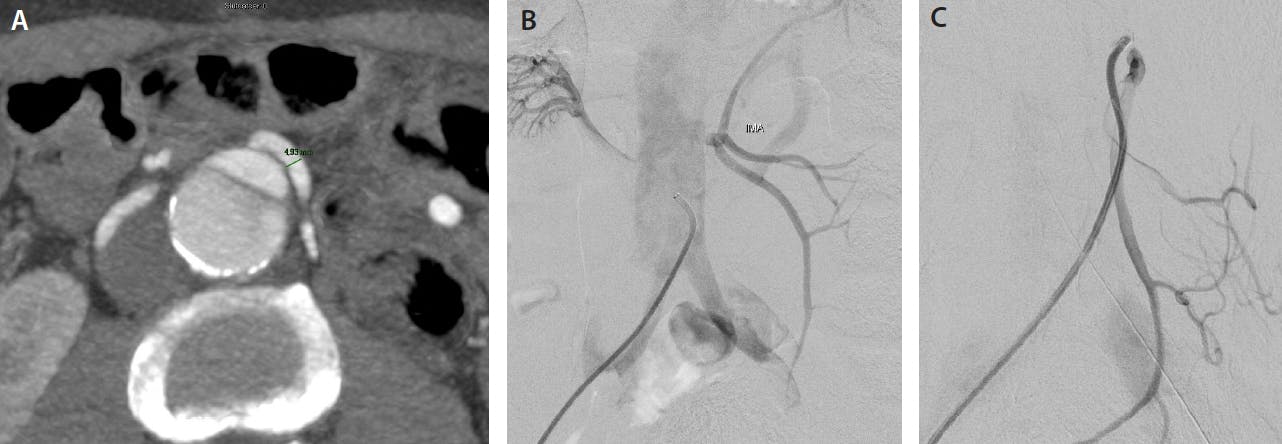
Figure 1. A patient with a thoracoabdominal aortic aneurysm related to chronic dissection. Endovascular repair was planned. Preoperative imaging showed a 5-mm IMA (A), which was verified on angiography (B). Note the presence of a right lower polar renal artery on the angiogram. The IMA was plugged with an 8-mm Amplatzer Vascular Plug 4 (Abbott) prior to endovascular branched thoracoabdominal repair (C).
Currently Available Data
In our recent systematic review and meta-analysis including 17 comparative studies of preemptive embolization of aortic side branches, technical success of IMA embolization was 85.3%.5 We found that preemptive embolization of aortic side branches before the EVAR procedure decreased incidence of sac size enlargement, type II endoleaks, and its reintervention. In 10 studies that focused on IMA embolization alone, the incidence of sac size enlargement was 5.3% in the embolization group compared with 12.3% in the control group (odds ratio [OR], 0.40; 95% CI, 0.25-0.66). The incidence of type II endoleaks was 22.6% versus 40% (OR, 0.42; 95% CI, 0.32-0.53), and the incidence of reintervention for type II endoleaks was 1.2% versus 10.6% (OR, 0.11; 95% CI, 0.05-0.24).
Ward et al reported 10 minor complications among 108 (9.3%) embolization patients who experienced nonspecific abdominal pain. All underwent sigmoidoscopy to confirm absence of ischemic changes, and their symptoms resolved after overnight intravenous hydration.6 However, one patient with previous extended right hemicolectomy experienced colonic infarction after IMA embolization and subsequently died 72 hours after the index operation. Otherwise, there have been no reports on embolization-specific complications, including colonic ischemia.4,5
Although most previous studies indicate a positive effect of preemptive IMA embolization on incidence of type II endoleaks and reintervention, it is important to underline that these studies are often retrospective, with risk for bias in case selection, and do not evaluate hard endpoints such as aortic rupture or overall survival. Additionally, there is no health economic evaluation of the cost-effectiveness of the preemptive embolization strategy. Preemptive embolization adds to the cost of the primary EVAR procedure, but it may also reduce cost for reinterventions and follow-up, and the overall effect of this intervention on the lifelong cost of EVAR treatment needs to be adequately assessed.
Possibly due to these shortcomings of the available evidence, preemptive embolization is not yet widely adopted and is not recommended in current societal guidelines. Rokosh et al reported 15,060 patients in the Society for Vascular Surgery Vascular Quality Initiative database between January 2009 and November 2020. Only 272 (1.8%) patients underwent preemptive embolization followed by standard EVAR.7 The only randomized controlled study of preemptive IMA embolization was reported by Samura et al in which 106 patients were randomized in the intention-to-treat analysis. Compared with controls, the embolization group had a significantly lower incidence of type II endoleaks (25.5% vs 49.1%; P = .009) and sac enlargement (3.8% vs 17.0%; P = .030).8
CONSIDERATIONS FOR FUTURE STUDIES
More evidence on IMA embolization during EVAR is required before the approach should be widely adopted in practice. Although studies of preventive embolization cannot be blinded to investigators, clearer indications for reintervention of type II endoleaks should be available. A longer follow-up period is required to evaluate for delayed presentation of type II endoleaks and/or persistent type II endoleaks. Additionally, in future studies, it would be valuable to include important clinical endpoints such as aortic rupture. Although preventive IMA embolization appears to be safe, complications can occur, as noted by the one death we found upon literature review. There is also possible risk of aneurysmal thrombus dislodgement during cannulation of IMA, which could result in an embolic event.
A thorough health economic model would provide a better understanding of the cost-effectiveness of type II endoleak management and prevention. The number needed to treat to prevent reintervention of type II endoleaks and/or sac enlargement; additional cost of coils, plugs, and associated devices; and cost of extended operative time for high-risk patients to develop type II endoleaks need to be calculated against the cost of current management of type II endoleaks. Other strategies to prevent type II endoleaks are also available, including coil embolization of the aortic sac during the primary EVAR procedure (instead of branch vessel embolization). There is also a need to identify which strategy is best for patients with different demographics and aneurysm morphology. More comparative studies and high-level evidence are required.
1. Wanhainen A, Verzini F, Van Herzeele I, et al. Editor’s choice—European Society for Vascular Surgery (ESVS) 2019 clinical practice guidelines on the management of abdominal aorto-iliac artery aneurysms. Eur J Vasc Endovasc Surg. 2019;57:8-93. doi: 10.1016/j.ejvs.2018.09.020
2. Chaikof EL, Dalman RL, Eskandari MK, et al. The Society for Vascular Surgery practice guidelines on the care of patients with an abdominal aortic aneurysm. J Vasc Surg. 2018;67:2-77. doi: 10.1016/j.jvs.2017.10.044
3. Iwakoshi S, Ogawa Y, Dake MD, et al. Outcomes of embolization procedures for type II endoleaks following endovascular abdominal aortic repair. J Vasc Surg. 2023;77:114-21.e2. doi: 10.1016/j.jvs.2022.07.168
4. Yu HYH, Lindström D, Wanhainen A, et al. Systematic review and meta-analysis of prophylactic aortic side branch embolization to prevent type II endoleaks. J Vasc Surg. 2020;72:1783-1792. doi: 10.1016/j.jvs.2020.05.020
5. Yu HYH, Lindström D, Wanhainen A, et al. An updated systematic review and meta-analysis of pre-emptive aortic side branch embolization to prevent type II endoleaks after EVAR. J Vasc Surg. Published online November 15, 2022. doi: 10.1016/j.jvs.2022.11.042
6. Ward TJ, Cohen S, Fischman AM, et al. Preoperative inferior mesenteric artery embolization before endovascular aneurysm repair: decreased incidence of type II endoleak and aneurysm sac enlargement with 24-month follow-up. J Vasc Interv Radiol. 2013;24:49-55. doi: 10.1016/j.jvir.2012.09.022
7. Rokosh RS, Chang H, Butler JR, et al. Prophylactic sac outflow vessel embolization is associated with improved sac regression in patients undergoing endovascular aortic aneurysm repair. J Vasc Surg. 2022;76:113-121. doi: 10.1016/j.jvs.2021.11.070
8. Samura M, Morikage N, Otsuka R, et al. Endovascular aneurysm repair with inferior mesenteric artery embolization for preventing type II endoleak. Ann Surg. 2020;271:238-244. doi: 10.1097/SLA.0000000000003299
Advertisement
Advertisement