Advertisement
Advertisement
March 2023
How I Do It: Laser-Assisted Transendograft Coil Embolization
An overview of the techniques and devices used for the LATE approach to target vessel cannulation and coil delivery.
The anatomy of type II endoleaks is highly variable. In the infrarenal aorta, common sources include lumbar arteries, the inferior mesenteric artery (IMA), and, occasionally, accessory renal arteries. Thoracic aortic type II endoleaks, which are comparatively rare, originate from intercostal arteries. Thoracoabdominal aneurysms (or degenerated thoracoabdominal dissections) may exhibit type II endoleaks (or type R entry flow) involving any combination of the above. In many cases, the laser-assisted transendograft (LATE) approach affords equally advantageous direct access to the orifices of all these sources, providing an optimal angle of attack for target vessel cannulation and coil delivery.
The postulated advantage of this approach is predicated on the assumption that cannulation of endoleak source vessels and luminal occlusion at or near the origins is superior to simply filling the endoleak cavity with coils. Other approaches (eg, transarterial, transcaval, translumbar) suffer from lack of control once catheter access has been established inside the sac. Operators who are unable to cannulate the target vessels often resort to filling the sac with coils, a maneuver that is both unlikely to truly stop the endoleak and creates so much scatter artifact on subsequent CT imaging that the presence or absence of persistent endoleak may be impossible to determine. Conversely, the LATE approach introduces a deflectable tip sheath into the aneurysm sac that, once positioned, is advanceable and torqueable, providing superior maneuverability.
TECHNIQUE
When selecting the location for a laser fenestration, three-dimensional (3D) reconstruction of CT images is mandatory. This permits preoperative visualization and understanding of the endograft stent structure, including areas of stent overlap (eg, gate/limb overlaps) where laser fenestration may be more challenging, and ensures that fenestrations are created in locations where sufficient proximal and distal seal is achievable with a limb or cuff at case completion. I always plan fenestrations with at least 15 mm of seal zone proximal and distal to the fenestration location. Areas I would avoid performing fenestration are within 15 mm of the endograft flow divider (such areas would not be sealable with simple limbs or cuffs) or in areas of stent overlap where metal struts may be so congested that they prevent passage of a catheter or sheath. I always select a spot where the endograft wall is far enough away from the aneurysm sac wall to avoid an iatrogenic aneurysm rupture and on the side of the graft that is most likely to yield a direct approach to the target. I generally enter inferior to the target so that once the sheath has transited the fenestration and advanced cephalad, its tip may be deflected caudad at an ideal vertical level for vessel cannulation. If more than one vessel is being targeted, I compromise so that the access site to the sac provides equally advantageous access to all targeted vessels. In cases where the target vessels are far apart, I occasionally access the sac twice with laser fenestrations in different locations.
To begin, percutaneous common femoral access is achieved on the side corresponding to the limb to be fenestrated. I predeploy two Perclose ProGlides (Abbott) and insert a 12-F DrySeal sheath (Gore & Associates) that is suture-secured to the patient (Table 1). Using either preoperative or on-table CT fusion technology, the planned location for the fenestration is virtually marked and overlaid on the live fluoroscopic image.
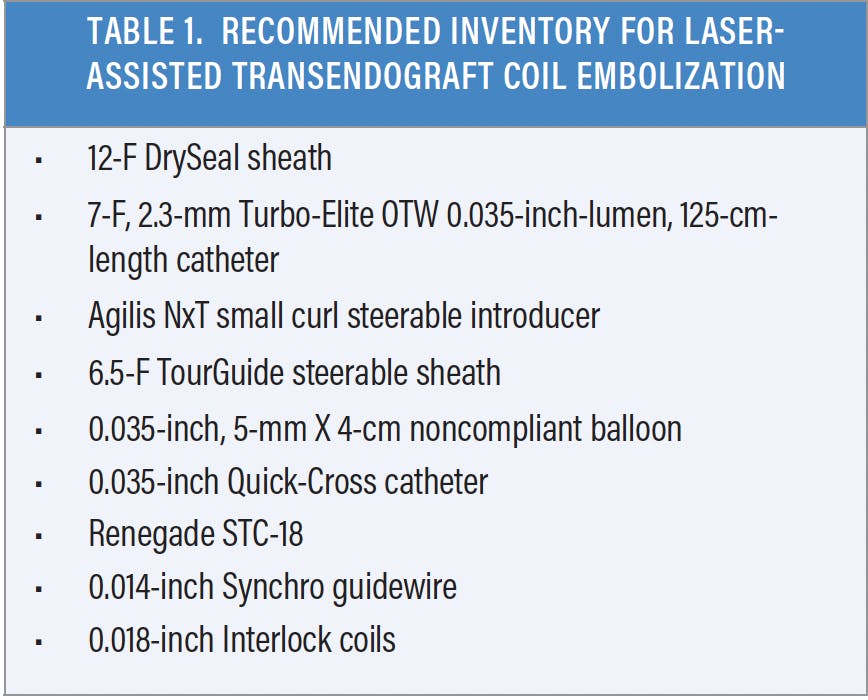
The laser system I use is the 7-F, 2.3-mm Turbo-Elite OTW 0.035-inch-lumen, 125-cm-length catheter (Philips), powered by the CVX-300 Excimer laser system (Philips). The CVX-300 system is powered on early to warm and is calibrated once ready. Generally, the machine is set to catheter output fluence of 60 mJ/mm2 and cadence (repetition rate) of 60 Hz. All individuals in the room are instructed to wear laser safety glasses, and a warning sign is posted on all doors and entryways to the operating room whenever the catheter is attached to the laser generator.
Because the laser catheter is quite stiff, a strong deflectable tip sheath is required to bend it sufficiently to achieve perpendicular orientation of the laser tip to the graft wall. True perpendicular orientation is essential to ensure that the catheter does not skive away from the intended access point. I use an Agilis NxT small curl steerable introducer (Abbott) for this purpose. Catheter positioning and orientation are confirmed in both side and end-on views. Once appropriately positioned, the laser is set to “Ready” mode. Gentle forward pressure is applied to the laser catheter, and the foot pedal is actuated to apply laser beam energy to the endograft. Generally, if the laser is going to successfully pass through the graft, no more than 1 to 2 seconds of laser firing is necessary. When successful, the laser jumps forward across the endograft wall into the aneurysm sac. Once this occurs, the laser should be immediately deactivated and set to “Standby” mode to prevent further inadvertent use.
If the catheter fails to pass through the graft fabric, it is most likely because the blunt tip of the catheter is impacted against a metal strut. In this case, there is still a possibility that enough laser energy has been applied to the graft fabric to create a fenestration. A stiff wire, such as an Amplatz wire with a short transition tip, can be advanced through the laser catheter lumen and hopefully passes easily into the aneurysm sac. If this does not occur and the wire tip fails to transit the endograft wall, an adequate fenestration has not been created. Gentle vertical or horizontal adjustment of the Agilis introducer is typically sufficient to slightly reposition the laser catheter tip and achieve metal-free catheter contact with the fabric.
Once access has been achieved to the aneurysm sac, a long stiff wire is inserted. I exchange the Agilis and laser catheter for a 6.5-F TourGuide steerable sheath (Medtronic) and a 0.035-inch, 5-mm X 4-cm noncompliant balloon. The balloon is used to dilate the laser fenestration, and during balloon deflation, the TourGuide is advanced to swallow the balloon and transit into the aneurysm sac. When the TourGuide is inside the aneurysm sac, the operator has achieved a superior modicum of control, directability, and pushability for intrasac manipulation. Digital subtraction angiography through the sheath may be used to find target vessels; or in more challenging situations, a repeat on-table CT scan, now with intrasac contrast injection, may be used to map out endoleak targets with 3D fusion. For target vessel cannulation, through the TourGuide I would advance a 0.035-inch Quick-Cross catheter (Philips) or 4-F Glidecath catheter (Terumo Interventional Systems); a Renegade STC-18 (Boston Scientific Corporation), Renegade Hi-Flo (Boston Scientific Corporation), or Lantern microcatheter (Penumbra, Inc.); and a 0.014-inch Synchro guidewire (Stryker). This coaxial system is generally very good at cannulating even diseased vessels and achieving secure stable access for coil delivery. For coils, I am partial to the 0.018-inch Interlock or Embold coils (Boston Scientific Corporation) or Ruby coils (Penumbra, Inc.).
After coiling is complete, the system is withdrawn from the aneurysm sac. Stiff wire access is achieved in the thoracic aorta, and a covering stent graft (ie, aortic cuff for a main body fenestration, iliac limb for a limb fenestration) is deployed with sufficient proximal and distal seal length to close the fenestration and obviate type III endoleak.
In my opinion, this approach can be used with any commercially available endograft system. I have used it with the Zenith (Cook Medical), Endurant (Medtronic), AFX (Endologix), and Gore Excluder (Gore & Associates) systems. In every case, coverage of the fenestration at case completion was successful, with no postoperative type III endoleak; however, caution should be exercised if performed in the AFX 2 system. Because this device’s fabric lies externally and unattached to the endograft stent structure, creation of a fabric defect may not be subsequently sealable by simple relining with a cuff or limb. In this case, the safest choice at case completion is to reline the entire device with a bifurcated endograft system extending from the proximal to distal seal zones.
DISADVANTAGES
Cost is a major downside to the LATE approach. First, there is the up-front capital investment in a laser generator, which is in the hundreds of thousands of dollars. Second, there is the elevated technical procedural cost spent on laser catheters and aortic endograft components (ie, cuffs, limbs, bifurcated devices) needed to seal the laser fenestration. Such cost is absent from the other commonly used endoleak approaches.
Because of the cost factor, we tend to reserve this approach for cases in which clear transarterial access to a singular endoleak source (ie, superior mesenteric artery to IMA or hypogastric to lumbar) is not readily visible on CTA. If such a pathway is visible, we will often use a transarterial approach first. However, I would note that intraoperative sac angiography often reveals previously unappreciated secondary endoleak sources, which are virtually impossible to address via transarterial collateral pathways. Conversely, a laser approach offers a greater prospect of synchronously ablating additionally identified endoleak sources.
Finally, theoretical concerns have been raised, specifically with Gore & Associates’ medical devices, about the toxicity of polytetrafluoroethylene (PTFE) and combustion byproducts that may be generated by the application of laser energy to graft material. Although vaporized PTFE polymer and its numerous breakdown products are known to be highly toxic when inhaled as pyrolytic gases, no data exist to my knowledge of clinically identifiable toxicity when PTFE fabric is thermally ablated by laser energy in vivo. Additionally, because PTFE is insoluble in water, concern exists that circulating PTFE particles may become lodged in the filtration system of the kidney or liver; however, no clinical evidence of measurable renal or hepatic toxicity from laser fenestration has thus far been documented.
CONCLUSION
LATE coil embolization represents an important option for the treatment of type II endoleak. It offers several key advantages that may make it the best, or even the only, minimally invasive option in some cases for cannulation and occlusion of endoleak sources.
Advertisement
Advertisement