Advertisement
Advertisement

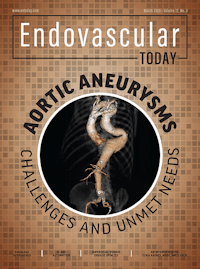
Free up some time, find a comfortable space, pour yourself a tea or coffee, and dive into this exciting issue. You won’t be disappointed. In this edition, we have taken a different approach. Instead of providing state-of-the-art device, data, and outcome reviews, we’ve asked global experts to show us where the gaps are. To move endovascular aortic technologies forward, what are the needs and opportunities in each aortic segment, from the aortic root to the iliacs? The authors do not disappoint. They provide thoughtful discussions of how we can reinvigorate the endovascular revolution and bend the curve of progress toward a steep inflection point. If you are in practice, an investigator, involved in technology development, or simply enjoy learning about innovation, this is an issue you will want to read cover to cover and save for repeated future reference. It holds many of the keys that will unlock the next chapter of minimally invasive aortic treatment progress.
First, Tilo Kölbel, MD, and Joseph Bavaria, MD, discuss ascending and arch disease and weigh in on early diagnosis, areas of concern, and the future of treatment. Tara M. Mastracci, MD; Bijan Modarai, PhD; and Chandler A. Long, MD, then share perspectives on needed innovations for thoracic aortic care, including solutions for common or critical complications and devices to address specific anatomic challenges. Next, Tim Resch, MD; Sara L. Zettervall, MD; and Carlos Timaran, MD, discuss the future of thoracoabdominal management, prioritizing better understanding of patient selection, equipment optimization, regulatory approvals, and improved access to care. Moving into infrarenal repair, Javairiah Fatima, MD, and Nuno V. Dias, MD, consider outward forces exerted by available devices, hostile anatomies leading to inadequate seal, and endoleaks resulting in reintervention. Giovanni Pratesi, MD; Martina Bastianon, MD; Sara Di Gregorio, MD; Gaddiel Mozzetta, MD; and Kimberly Malka, MD, then address unmet needs in iliac branch disease, including reduced delivery system sizes to allow navigation in highly tortuous iliacs and broader size ranges to avoid hybrid, open, or off-label repair for patients unfit for surgery.
We’ve also asked for perspectives on endoleak access and treatment techniques. Kristina Giles, MD, and Aarathi Minisandram, MD, address the management of type II endoleak with a transcaval approach, while Jessica P. Simons, MD, offers technical, anatomic, and equipment selection considerations for percutaneous translumbar approaches to type II endoleak embolization. David Kuwayama, MD, explores laser-assisted transendograft coil embolization to target vessel cannulation and coil delivery, and Harry Hok Yee Yu, MBBS, and Kevin Mani, MD, consider when and whether inferior mesenteric artery embolization during index EVAR is worthwhile.
To close our cover feature, Dominique Fabre, MD, PhD; Thomas J. Postiglione, MD; and Prof. Haulon discuss artificial intelligence (AI) and automation in aortic aneurysm care. AI-assisted algorithms with accurate and automated tools for diameter and volumetric monitoring of the aorta have the potential to improve clinical outcomes and patient follow-up after repair.
Also in this issue is a focus on superficial venous disease. Investigators Benjamin Cher, MD, and Andrea Obi, MD, discuss their analysis of the association between sex and clinician- and patient-reported outcomes after endovenous ablation. In addition, experts Ramona Gupta, MD; Suman M. Wasan, MD; and Avianne Bunnell, MD, are asked how they each treat recurrent varicose veins. A comprehensive approach to varicose vein recurrence requires an understanding of the etiology of recurrence patterns, proper technique and imaging use, consistent follow-up, and patient education and compliance. This edition wraps up with an interview with Elika Kashef, MBBS, who discusses patient safety, staff well-being, trauma and women’s health interventions, and ensuring future generations’ exposure to interventional therapy.
We are now routinely performing endovascular repairs that no one envisioned 20 years ago. Pioneering physicians had to think outside of the box to develop these minimally invasive aortic treatments to initially treat patients who could not be treated with standard open surgery. With major contributions from our industry partners’ research and development teams, imaging and endograft technologies have reached a state of maturity where large-scale clinical studies must be performed to obtain regulatory approval; this process paves the way for validation and reimbursement for these new options. Continued effort is needed to broaden access to aortic endografting for our patients—there is no alternate route. We give our deepest gratitude and appreciation to all the authors who have contributed to this special issue of Endovascular Today. They have shared their unique experience and provided insights on how future devices and endovascular strategies should be developed. The aortic root is the next challenge; will we wait another 20 years before endo-Bentall and acute type A dissection endografting become routine treatments?
Andres Schanzer, MD, FACS
Stéphan Haulon, MD, PhD
Guest Chief Medical Editors
Advertisement
Advertisement