Advertisement
Advertisement
November 2023
Sponsored by Medtronic
Roundtable Discussion: Paclitaxel Safety and What We Have Learned
With William A. Gray, MD; Sahil A. Parikh, MD; and Peter A. Schneider, MD



Since the publication of a study-level meta-analysis describing a potential increase in late mortality in patients treated with paclitaxel-coated devices,1 several randomized studies, observational registries, and claims database studies were conducted but were unable to replicate the original mortality signal.2 Recognizing the need for definitive data, the FDA and paclitaxel device manufacturers partnered with a physician Steering Committee (Drs. William Gray, Sahil Parikh, and Peter Schneider) to conduct an updated patient-level meta-analysis.3 This updated meta-analysis, in concert with the totality of the data available over the last 5 years, led the FDA to revise their statement on July 11, 2023, and remove the restrictions on paclitaxel use.4 In this article, the Steering Committee discusses the updated meta-analysis, the importance to the medical community, how these data align with the known mechanism of action of paclitaxel, and what we have collectively learned from this experience.
What were the limitations of the prior meta-analyses that were the impetus for the original 2019 FDA statement?
Dr. Schneider: The math as it was constructed did show a numerical increase in mortality in the paclitaxel group in the initial evaluation.1 However, there were many problems with the circumstances from which the numbers were derived. In a typical situation, a summary-level meta-analysis with lots of missing data would only be used to generate hypotheses and not to make conclusive judgments. In retrospect, a sweeping conclusion about it in 2018 seems out of place, but we had never been through this kind of challenge before in the vascular field.
Causation and association are two really different entities. Was a small dose of paclitaxel in the femoropopliteal artery possibly responsible for mortality years later? Now it seems farfetched, especially given the massive doses of paclitaxel that are routinely given as adjuvant chemotherapy in breast cancer, where every expectation is that it prolongs survival. To show causation of death, we should have a mechanism of action, a dose response or biologic gradient, and a consistent signal of mortality. None of these were ever shown.
The original analysis1 was a summary-level meta-analysis and not a patient-level meta-analysis. It started out with > 2,000 patients with 2-year follow-up and concluded with > 800 patients at 4- to 5-year follow-up from only three studies. None of the individual studies nor the pooled data from these studies were powered for assessment of mortality since all were powered for 1-year patency. They included relatively small control groups, which leads to unstable estimates.
There were quite a few patients who were withdrawn or lost to follow-up, up to one-third of patients in some studies. A tremendous effort was undertaken to find these patients. It turned out that patients who were treated with drug-coated balloons (DCBs) were much more likely to drop out after 1 year compared to control patients.5 Even though patients were randomized upon entry to the study, they were not randomized when they dropped out or were lost to follow-up. As these patients were identified and their vital status ascertained, it became apparent that the difference in the mortality curves also diminished. This is clear evidence of ascertainment bias in the follow-up.
In addition, it is not clear whether both groups were treated equally after randomization. Follow-up appeared to be better in the control group,6 and this may have led to more opportunities for better medical management. The signal was not consistent and varied quite a bit across geographies and across studies. There was never any dose effect proven on mortality after numerous patient-level evaluations. Unfortunately, none of these studies were designed to gather two extremely important pieces of information that we will always gather going forward. One was that the consistency and quality of medical management were not monitored. This, of course, has a direct effect on patient outcome. The other key piece of information was crossover data. Many “control” patients were exposed to paclitaxel after the index procedure. Whenever crossover data were available, any numeric difference in mortality between the groups appeared to diminish.3
How is this updated meta-analysis different than the meta-analyses published between 2018 and 2020?
Dr. Parikh: Compared with the prior VIVA Foundation analysis,6 this updated analysis includes the following additions: (1) the RANGER SFA and RANGER SFA II studies were added, (2) an additional 3,355.5 patient-years were added, (3) 163 new deaths were captured and analyzed, and (4) more detailed statistical analyses of paclitaxel dose effects, covariate interactions, and the impact of crossovers were included. With these additions, this updated analysis was not only the most comprehensive patient-level meta-analysis to date but also the most expansive with respect to understanding crossovers and dosing effects.3
What were the most important outcomes of the updated meta-analysis?
Dr. Parikh: Overall, our analysis demonstrated that no matter how we analyzed the data, there was no statistically significant increased risk of mortality when comparing patients treated with paclitaxel-coated devices versus uncoated devices (Figure 1). The intention-to-treat analysis, considered the gold standard, found a hazard ratio (HR) of 1.14 with a 95% CI of 0.93 to 1.40, suggesting no statistically significant interaction between paclitaxel-coated device use and mortality. In a typical clinical trial, once the primary endpoint is negative, all subsequent analyses are considered exploratory, and despite that, we went on to conduct prespecified crossover analyses. In fact, as we drilled down on the patient’s potential exposure to paclitaxel more thoroughly, the HRs for the “as-treated” (HR, 1.13), “as-treated with late crossover censored” (HR, 1.07), and “as-treated with crossover as time-varying covariate” (HR, 1.04) analyses showed even lower HRs. The analysis also demonstrated that control patients with longer lesions had a higher risk of mortality irrespective of paclitaxel exposure, suggesting that higher burdens of atherosclerosis were associated with higher mortality independent of paclitaxel exposure. Finally, we identified no dose response with respect to paclitaxel-coated device exposure and mortality.
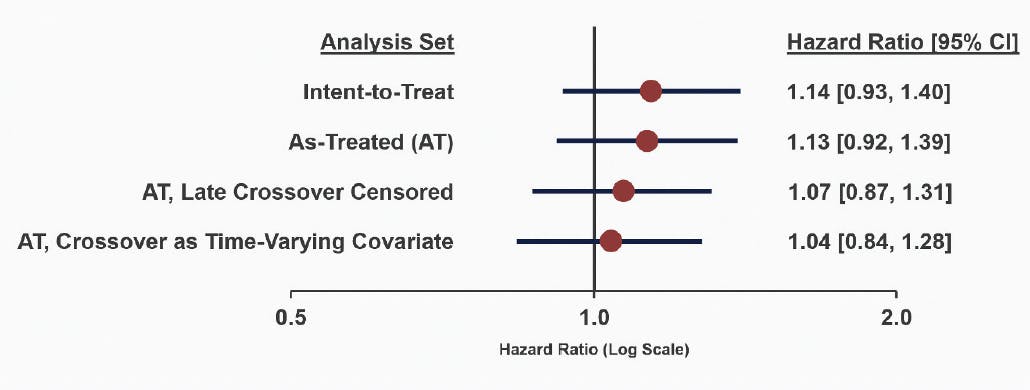
Figure 1. Risk of mortality in paclitaxel-coated versus uncoated devices among four prespecified analysis sets. Intent-to-treat = as randomized (primary analysis set); as-treated (AT) = based on the treatment the patient actually received at the index procedure; AT, late crossover censored = control patients with known paclitaxel exposure in the target lesion or vessel during study follow-up were censored from the analysis at the time of exposure; AT, crossover at time-varying covariate = control patients with known paclitaxel exposure in the target lesion or vessel during study follow-up crossed to the paclitaxel group from the date of their first exposure.
How do these results align with what we know about the mechanism of paclitaxel and its use in DCBs?
Dr. Gray: When a balloon or stent is deployed, it causes mechanical injury to the inner lining, including the media, of the artery. In the acute phase, that injury triggers an inflammatory response to heal the damaged tissue, which attracts the cellular elements of macrophages and fibroblasts. Next, proliferating cells produce the extracellular matrix components that drive tissue remodeling and repair. However, when that normal healing process becomes excessive, it can lead to neointimal hyperplasia and narrowing of the treated area (restenosis).
Paclitaxel is an antirestenotic drug and works by binding to microtubules during the cellular division phase of mitosis, providing both anti-inflammatory and antiproliferative effects. However, to ensure an effective antirestenotic response when delivered using a balloon, an excipient that both optimizes drug delivery from the balloon but also maintains the drug in the tissue at therapeutic levels throughout the duration of the restenotic cascade is required. The concentration of the antirestenotic drug in the vessel wall depends on multiple factors, including the drug dose, excipient, balloon architecture, and arterial morphology. Add to these factors the method of passage through a valve or Tuohy-Borst and transit time to the lesion, and it becomes evident that it would be hard to predict—in any given patient—the amount of drug delivered.
The excipient and coating process can materially affect the drug transfer to the tissue upon balloon inflation as well as the tissue retention time. For example, the FreePac coating of the IN.PACT™ Admiral™ drug-coated balloon (Medtronic) uses a naturally occurring urea excipient to deliver a therapeutic dose of solid-phase paclitaxel in crystalline form. This creates reservoirs of drug in the arterial wall that slowly break down in a controlled manner, providing a prolonged effect throughout the restenotic window (out to 180 days). The crystalline coating also ensures that while paclitaxel is detectable in the target area tissue over 180 days, no drug is detectable in plasma after 48 hours, contributing to both safety and efficacy.7
Studies of the IN.PACT Admiral DCB support the safety and efficacy of paclitaxel with no overall difference in mortality compared to uncoated balloons, no dose effect on mortality, and sustained efficacy to 5 years.5,8,9
What lessons can be learned from the paclitaxel story over the past 5 years?
Dr. Schneider: There were positive aspects of this exercise. One first-time event for our field is that we worked together as physicians, research personnel, industry sponsors, and regulatory agencies across specialties and across countries to answer a key question facing our field. Key learnings were that we needed to have longer-term follow-up, much more complete follow-up, analysis of medical management, and a better understanding of tracking patients through various treatments so that we understand when a crossover event occurs. We also learned that we should not overreact to a summary-level meta-analysis on incomplete data. The real cost of this was the many thousands of patients who were treated with less efficacious devices over the past 5 years.
Dr. Gray: I completely agree with Dr. Schneider’s assessments. The challenges existed primarily in acquiring enough data with long enough and complete enough follow-up to properly analyze the potential for a mortality signal. Unfortunately, this was a process that could not be sped up, thus the extended time to what appears to be a final answer. Although lengthy and somewhat tedious, the process of determining the final assessment is nevertheless all the more trustworthy as a result.
Disclosures
Dr. Gray: Consultant to Alucent, Boston Scientific, Cagent, Conformal Medical, Contego Medical, Edwards LifeSciences, eFemoral, Encompass Medical, Medtronic, Philips, ReValve, Sonovascular, Surmodics, Xenter; holds stock with eFemoral, Encompass Medical, Reflow Medical, and Xenter.
Dr. Parikh: Institutional research support, Abbott, Boston Scientific, TriReme, Reflow Medical, Acotec, Concept Medical, Shockwave Medical; advisory board/consulting, Abbott, Boston Scientific, Canon, Cordis, Inari, Medtronic, Philips, Terumo; equity, Encompass Vascular, Advanced NanoTherapies, eFemoral.
Dr. Schneider: Consultant to Acotec, Boston Scientific, Cagent, Endologix, LimFlow, Medtronic, Philips, Silk Road Medical, and Surmodics.
1. Katsanos K, Spiliopoulos S, Kitrou P, et al. Risk of death following application of paclitaxel-coated balloons and stents in the femoropopliteal artery of the leg: a systematic review and meta-analysis of randomized controlled trials. J Am Heart Assoc. 2018;7:e011245. doi: 10.1161/JAHA.118.011245
2. Raja A, Secemsky EA. Late mortality and paclitaxel-coated devices: has the controversy finally come to an end? JSCAI. 2023;2:100981. https://doi.org/10.1016/j.jscai.2023.100981
3. Parikh SA, Schneider PA, Mullin CM, et al. Mortality in randomised controlled trials using paclitaxel-coated devices for femoropopliteal interventional procedures: an updated patient-level meta-analysis. Lancet. Published online October 23, 2023. doi: 10.1016/S0140-6736(23)02189-X
4. US Food and Drug Administration. Update: paclitaxel-coated devices to treat peripheral arterial disease unlikely to increase risk of mortality—letter to health care providers. July 11, 2023. Accessed October 30, 2023. https://www.fda.gov/medical-devices/letters-health-care-providers/update-paclitaxel-coated-devices-treat-peripheral-arterial-disease-unlikely-increase-risk-mortality
5. Schneider PA, Brodmann M, Mauri L, et al. Paclitaxel exposure: long-term safety and effectiveness of a drug-coated balloon for claudication in pooled randomized trials. Catheter Cardiovasc Interv. 2020;96:1087-1099. doi: 10.1002/ccd.29152
6. Rocha-Singh KJ, Duval S, Jaff MR, et al. Mortality and paclitaxel-coated devices: an individual patient data meta-analysis. Circulation. 2020;141:1859-1869. doi: 10.1161/CIRCULATIONAHA.119.044697
7. Peterson S, Hasenbank M, Silvestro C, et al. IN.PACT™ Admiral™ drug-coated balloon: durable, consistent and safe treatment for femoropopliteal peripheral artery disease. Adv Drug Deliv Rev. 2017;112:69-77. doi: 10.1016/j.addr.2016.10.003
8. Schneider PA, Laird JR, Doros G, et al. Mortality not correlated with paclitaxel exposure: an independent patient-level meta-analysis of a drug-coated balloon. J Am Coll Cardiol. 2019;73:2550-2563. doi: 10.1016/j.jacc.2019.01.013
9. Laird JA, Schneider PA, Jaff MR, et al. Long-term clinical effectiveness of a drug-coated balloon for the treatment of femoropopliteal lesions. Circ Cardiovasc Interv. 2019;12:e007702. doi: 10.1161/CIRCINTERVENTIONS.118.007702
IN.PACT™ Admiral™ Paclitaxel-coated PTA Catheter
Brief Statement
Indications for Use:
The IN.PACT™ Admiral™ Paclitaxel-coated PTA Balloon Catheter is indicated for percutaneous transluminal angioplasty, after appropriate vessel preparation, of de novo, restenotic, or in-stent restenotic lesions with lengths up to 360 mm in superficial femoral or popliteal arteries with reference vessel diameters of 4-7 mm.
Contraindications
The IN.PACT Admiral DCB is contraindicated for use in:
- Coronary arteries, renal arteries, and supra-aortic/cerebrovascular arteries
- Patients who cannot receive recommended antiplatelet and/or anticoagulant therapy
- Patients judged to have a lesion that prevents complete inflation of an angioplasty balloon or proper placement of the delivery system
- Patients with known allergies or sensitivities to paclitaxel
- Women who are breastfeeding, pregnant or are intending to become pregnant or men intending to father children. It is unknown whether paclitaxel will be excreted in human milk and whether there is a potential for adverse reaction in nursing infants from paclitaxel exposure.
Warnings
- Use the product prior to the Use-by Date specified on the package.
- Contents are supplied sterile. Do not use the product if the inner packaging is damaged or opened.
- Do not use air or any gaseous medium to inflate the balloon. Use only the recommended inflation medium (equal parts contrast medium and saline solution).
- Do not move the guidewire during inflation of the IN.PACT Admiral DCB.
- Do not exceed the rated burst pressure (RBP). The RBP is 14 atm (1419 kPa) for all balloons except the 200 and 250 mm balloons. For the 200 and 250 mm balloons the RBP is 11 atm (1115 kPa). The RBP is based on the results of in vitro testing. Use of pressures higher than RBP may result in a ruptured balloon with possible intimal damage and dissection.
- The safety and effectiveness of using multiple IN.PACT Admiral DCBs with a total drug dosage exceeding 34,854 µg of paclitaxel in a patient has not been clinically evaluated.
Precautions
- This product should only be used by physicians trained in percutaneous transluminal angioplasty (PTA).
- This product is designed for single patient use only. Do not reuse, reprocess, or resterilize this product. Reuse, reprocessing, or resterilization may compromise the structural integrity of the device and/or create a risk of contamination of the device, which could result in patient injury, illness, or death.
- Assess risks and benefits before treating patients with a history of severe reaction to contrast agents.
- The safety and effectiveness of the IN.PACT Admiral DCB used in conjunction with other drug-eluting stents or drug-coated balloons in the same procedure or following treatment failure has not been evaluated.
- The extent of the patient’s exposure to the drug coating is directly related to the number of balloons used. Refer to the Instructions for Use (IFU) for details regarding the use of multiple balloons and paclitaxel content.
- The use of this product carries the risks associated with percutaneous transluminal angioplasty, including thrombosis, vascular complications, and/or bleeding events
- Vessel preparation using only pre-dilatation was studied in the clinical study. Other methods of vessel preparation, such as atherectomy, have not been studied clinically with IN.PACT Admiral DCB.
- This product is not intended for the expansion or delivery of a stent.
Potential Adverse Effects
- The potential adverse effects (e.g. complications) associated with the use of the device are: abrupt vessel closure; access site pain; allergic reaction to contrast medium, antiplatelet therapy, or catheter system components (materials, drugs, and excipients); amputation/loss of limb; arrhythmias; arterial aneurysm; arterial thrombosis; arteriovenous (AV) fistula; death; dissection; embolization; fever; hematoma; hemorrhage; hypotension/hypertension; inflammation; ischemia or infarction of tissue/organ; local infection at access site; local or distal embolic events; perforation or rupture of the artery; pseudoaneurysm; renal insufficiency or failure; restenosis of the dilated artery; sepsis or systemic infection; shock; stroke; systemic embolization; vessel spasms or recoil; vessel trauma which requires surgical repair.
- Potential complications of peripheral balloon catheterization include, but are not limited to the following: balloon rupture; detachment of a component of the balloon and/or catheter system; failure of the balloon to perform as intended; failure to cross the lesion.
- Although systemic effects are not anticipated, potential adverse events that may be unique to the paclitaxel drug coating include, but are not limited to: allergic/immunologic reaction; alopecia; anemia; gastrointestinal symptoms; hematologic dyscrasia (including leucopenia, neutropenia, thrombocytopenia); hepatic enzyme changes; histologic changes in vessel wall, including inflammation, cellular damage, or necrosis; myalgia/arthralgia; myelosuppression; peripheral neuropathy.
- Refer to the Physician’s Desk Reference for more information on the potential adverse effects observed with paclitaxel. There may be other potential adverse effects that are unforeseen at this time.
- Please reference appropriate product Instructions for Use for a detailed list of indications, warnings, precautions and potential adverse effects. This content is available electronically at www.manuals.medtronic.com.
CAUTION: Federal (USA) law restricts this device to sale by or on the order of a physician.
501379 ©2023 Medtronic. Medtronic, Medtronic logo are trademarks of Medtronic. TM* third party brands are trademarks of their respective owner. All other brands are trademarks of Medtronic. For global distribution. 11/2023
Advertisement
Advertisement