Advertisement
Advertisement
October 2023
Advancements Across Interventional Oncology

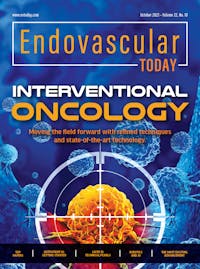
It is an exciting time across the broad clinical spectrum of interventional oncology (IO) applications, and we are delighted to share this IO-themed edition with the readers of Endovascular Today. Practice paradigms are shifting as our understanding continues to grow, the technologies at our disposal expand, and new data emerge to help guide our decisions. However, as you will see throughout this edition, there remain as many questions as answers, if not more, and plenty of progress yet to be made in the depths of our clinical understanding and capabilities.
To open our feature, Suvranu Ganguli, MD, collaborates with Ammar Sarwar, MD, to provide a review of essential IO literature from the past year. Drs. Ganguli and Sarwar detail five can’t-miss papers and what they mean for today’s practices.
Next, Thierry de Baere, MD; Nadine Abi-Jaoudeh, MD; Robert J. Lewandowski, MD; Edward Kim, MD; Raul N. Uppot, MD; Amanda Smolock, MD; David Wang, MD; and Daniel Sze, MD; each share technical pearls for procedural success across a variety of IO applications. This talented cast of experts details their personal essentials for conventional transarterial chemoembolization, portal vein embolization, drug-eluting embolic transarterial chemoembolization, radiation segmentectomy, parenchyma-sparing yttrium-90 with flow diversion, challenging ablations, ablation of poorly visualized hepatic tumors, and parasitized extrahepatic arteries—all in a quick-hitting and engaging format.
Drs. Abi-Jaoudeh and Smolock also join our next panel, which also includes Dr. Gandhi; Alan Alper Sag, MD; and Rahul A. Sheth, MD; to discuss what they think is the most exciting advancement in the field. Each panelist weighs in on promising new technologies and the current clinical needs they aim to fill.
We’ve also asked Alexander Kim, MD, to provide insights into starting an IO practice in an outpatient space. Dr. Kim discusses several of his lessons learned from getting started to maintaining a successful practice that meets patient needs and provides a high level of care.
As we can see throughout this edition, the IO field advances rapidly, with new therapies and techniques, trial data, and practice patterns emerging across the entire space. Our final articles in this feature focus on the intersection of IO and two of the most prominent technologic arenas—robotics and artificial intelligence (AI). On the former topic, Oleksandra Kutsenko, MD; Govindarajan Narayanan, MD; Nicole Gentile, MS; and Dr. Gandhi detail current robotics platforms and their applications and advantages within IO.
Finally, from patient identification and diagnosis to procedural guidance, Helen Zhang, BS; Shreyas Kulkarni, BS; Zhicheng Jiao, PhD; and Harrison X. Bai, MD; give a real-world look at the potential advantages and critical hurdles in implementing AI into IO clinical practices and health care systems.
Closing this edition, the Endovascular Today editors share an interview that should be an essential read for all interventional physicians regardless of their practice focus. Cardiologist and vascular medicine specialist Geoffrey D. Barnes, MD, shares his expertise regarding pulmonary embolism response, anticoagulation stewardship, implementation science, and collaborative patient care.
It is our great pleasure to present this IO-themed edition to the global vascular interventional audience. Whether your practice includes oncologic procedures several times a day or none at all, we hope this wide-ranging collection of articles is of interest in your practice and intellectual pursuits. We could not be more grateful and humbled to collaborate with this esteemed group of experts, and we thank each of them for their time and efforts.
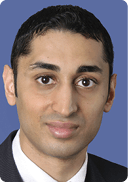
Yilun Koethe, MD, RPVI
Ripal Gandhi, MD, FSIR, FSVM
Guest Chief Medical Editors
Advertisement
Advertisement