Advertisement
Advertisement
October 2023
Robotics in Interventional Oncology: The Next Frontier in Image-Guided Interventions
A survey of robotic platforms and their contribution to innovating patient care and research.
By Oleksandra Kutsenko, MD; Govindarajan Narayanan, MD; Nicole Gentile, MS; and Ripal Gandhi, MD, FSIR, FSVM
Minimally invasive percutaneous biopsy and ablation of tumors gained a pivotal role in cancer management of solid tumors and have been widely accepted for their clinical effectiveness and safety, replacing surgical interventions in eligible patients.1,2 Both procedures require an accurate needle placement to obtain sufficient tissue samples or achieve an adequate ablation zone. Success depends on physician experience, entailing a series of mental estimations of surface-to-target distance and needle angulations.3 Achieving necessary precision can be challenging depending on lesion visualization, location, proximity to pulsating or moving structures, and patient’s work of breathing. In turn, this may mandate repetitive imaging with frequent needle adjustments, prolonged procedural time, increased exposure to radiation to the patient and operator, and increased intraprocedural risks of complications.
Multiple robotic navigational systems have been developed in the past few years to overcome these challenges and provide an accurate, reproducible, time-efficient, and radiation-cognizant approach to percutaneous procedures.3-10 Compared to traditional manual needle insertions performed under CT guidance in an axial plane, the robot's ability to consistently and three-dimensionally advance and steer the needle may enable standardized access to a lesion without requiring advanced skill. The navigation system provides real-time visualization of the needle’s path from entry point to target and in plane or out of plane, thus optimizing the trajectory. This combination may reduce the risk of damage to surrounding tissue while increasing the diagnostic yield of biopsies and ensuring adequate tumor ablation zone.
Most commercially available contemporary robotic systems are needle-guiding navigational tools that support needle path planning and its alignment with the trajectory. The needle is manually inserted through the needle guide into the targeted tissues by a physician. Fewer robots are needle driving. In addition to controlling the needle orientation, they can automatically advance the needle into the target lesion.
Early studies demonstrate that interventional robots have the potential to provide more accurate needle or probe placement, facilitate out-of-plane probe insertion, decrease learning curves for less experienced operators, and reduce radiation exposure.3-16 In addition, robotic-assisted tools include image fusion software that allows targeting lesions under CT guidance that otherwise would only be visualized on MRI, multiphase contrast-enhanced study, or positron emission tomography/CT.
These promising robotic systems represent areas for innovative patient care and research in interventional oncology (IO).
EPIONE
Epione (Quantum Surgical) is a commercially available, floor-mounted robotic system for CT-guided procedures. This 6–degree-of-freedom (DOF) robot consists of a robotic arm carried by a cart, a mobile display, a navigation camera, and a reference marker attached to the patient’s skin (Figure 1).10
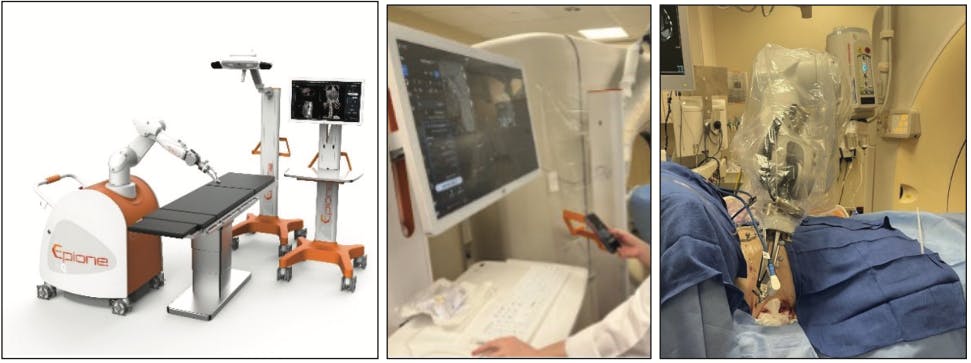
Figure 1. The floor-mounted Epione robotic system carries a 6-DOF arm with a needle holder. The mobile display allows for image processing and calculation of the needle path trajectory. A robotic arm delivers the needle holder to the position of the expected needle entry to allow for a single-pass needle insertion by a physician. Courtesy of Quantum Surgical, reprinted with permission.
After the tumor margin is defined, operators decide on the ablative modality and number of probes. A two-/three-dimensional fusion software helps visualize the ablation zone coverage. Epione allows the fusion of MRI images with intraprocedural CT images obtained on the day of the ablation, allowing targeting of lesions otherwise seen on CT alone. The robot is then registered to a patient and synchronized with a respiratory monitor. The robotic arm follows the predetermined path to the entry site. The probe is locked in the needle guide. A physician manually advances a probe in a single pass. The tumor ablation is carried out according to the standard protocol. Postprocedural CT can be overlayed with preoperative images to assess ablation versus tumor volumes.
Epione is an open robotic solution compatible with commonly used imaging systems. The medical robot allows physicians to use their preferred ablative technologies (radiofrequency ablation [RFA], microwave ablation [MWA], cryoablation, irreversible electroporation [IRE]) and decide the appropriate therapy for each patient. We used this robotic system to successfully treat > 30 patients using MWA, IRE, and cryoablation of tumors in the liver, pancreas, kidneys, and intra-abdominal soft tissues. Our initial experience is that ablations can be performed faster, especially for tumors in challenging locations (Figure 2, Figure 3, and Figure 4).
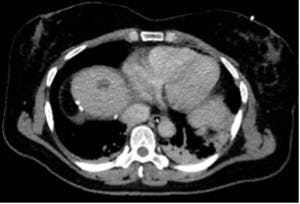
Figure 2. A woman in her early 50s with colorectal cancer and liver-dominant metastatic disease underwent yttrium-90 radioembolization, right portal vein embolization, and consequent right lobe and caudate hepatectomy 8 months earlier. She then presented with a new solitary lesion in segment 4A. The axial image of contrast-enhanced CT in the delayed phase demonstrates a 1.7-cm lesion at the dome of the liver. The image shows a challenging location with no in-plane access due to the surrounding lung, proximity to the heart, and multivectoral motion from respiration and heartbeat.
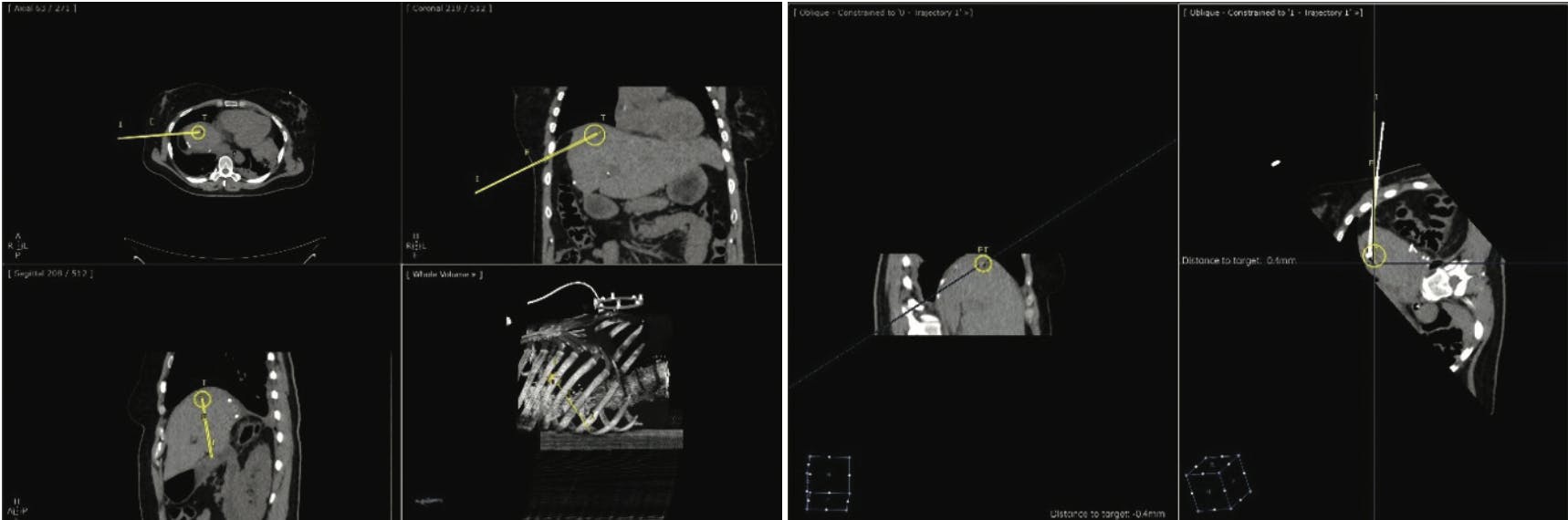
Figure 3. With the help of the Epione robot software, we effectively planned a precise trajectory for a probe requiring a challenging out-of-plane and steep superior angulation. Then, in one pass, we inserted a 20-cm Emprint microwave probe (Medtronic) into the target lesion during the patient’s breath hold. The ablation procedure used 100 W power for 10 minutes.
De Baère et al conducted a prospective clinical trial on 21 patients to assess the safety and feasibility of the Epione robotic system. This trial focused on patients with liver metastases or hepatocellular carcinoma who were undergoing CT-guided RFA or MWA. It demonstrated that ablation was feasible in 22 of 23 (95.7%) tumors; the mean number of needle adjustments per tumor treated was 0.4, there were no procedure-related complications, and the local tumor control rate was 85.7% at 6 months.17
INNOMOTION
InnoMotion (Innomedic) is a CT- and MR-compatible pneumatic robotic assistance system. The setup includes a 260° arch mounted on the patient table and a 6-DOF pneumatically driven robotic arm. A module for a sleeve needle holder provides 2 DOF in the X and Z axes. A pneumatic mechanism is designed to insert the cannula in steps ranging from 1 to 20 mm. After the access trajectory has been planned, the system moves the guiding arm, and the physician manually inserts the needle.6,18
In 2008, a clinical trial involving 12 patients was conducted using this system. The trial was successful in carrying out MR-guided percutaneous biopsy, drainage, and tumor ablation in the chest, abdomen, and retroperitoneum. All procedures were technically and clinically successful, with no intraprocedural complications reported.19
This system has various advantages, including compatibility with MR and CT imaging modalities and a firm attachment to the table to provide high accuracy. The main drawbacks are the large size of the control unit, which may prevent some interventions in limited spaces of CT or MR gantry and poor flexibility in selecting entry points compared to single-arm design solutions.
MAXIO
Maxio (Perfint Healthcare) is a CT-guided floor-mounted robotic system that provides preoperative planning assistance, intraoperative guidance, and postprocedure verification support. It consists of a stereotactic device with a 5-DOF robotic arm and multiplanar capability, software loaded on a computer, and a respiratory gating system. When the CT volume data are transferred to the workstation, tumor segmentation, needle path planning, and simulation of the ablation zone with multiple RFA or MWA probes can be executed on the software using multiplanar CT images.11,12 Several studies evaluating up to 55 patients demonstrated that the novel robotic-guided approach improved the accuracy of targeting the tumor, reduced patient dose, and increased procedural performance (which influences the procedural safety) during ablation.3,11-13
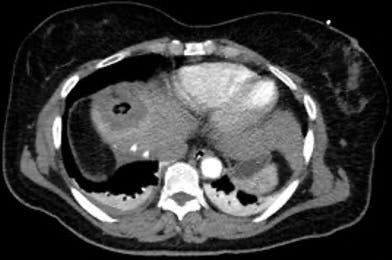
Figure 4. Postprocedural contrast-enhanced CT demonstrated an adequate ablation zone of 4.9 X 4 cm. The robotic system calculated the precise volumes of the tumor and ablation zones, which confirmed that the entire lesion was treated. CT scan revealed no hemorrhage or pneumothorax.
MICROMATE
The Micromate (Interventional Systems) is a table-mounted robotic system designed for CT-guided percutaneous procedures. The device features a 4-DOF needle-holding arm comprising two modules: one for positioning the needle in the X-Y direction and the other for adjusting its angle. Once the CT data are transferred, the trajectory is chosen and the robotic unit moves to the correct position, depth, and angle. The needle is then inserted manually through the needle guide.
Several phantom studies demonstrated needle insertion accuracy of 1.1 to 2.3 mm.20-22
NEEDLE PLACEMENT SYSTEM
The needle placement system (NPS; Demcon) is a table-mounted robot that provides automated orientation of the needle guide in CT-guided procedures. It consists of two stacked, rotatable segments and connects to a 6-DOF locking module.14 The robotic system calculates the needle trajectory and depth and aligns the needle holder with the expected entrance point. The needle is then manually inserted by an operator.
A prospective randomized controlled clinical trial by Heerink et al evaluated robotic versus freehand needle positioning in CT-guided MWA ablation of liver tumors involving 31 patients and showed reduced need for antenna repositioning and increased accuracy for out-of-plane targets in the robotic arm. However, using robotic guidance took more time than freehand targeting.14 A phantom study of an NPS robot demonstrated needle placement precision of 1.2 to 2.1 mm.15
XACT ACE
The Xact Ace (XACT Robotics) is a needle-driving robotic system. The CT-guided patient-mounted device has a 5-DOF executive arm capable of automatic needle insertion by the robot (Figure 5).16
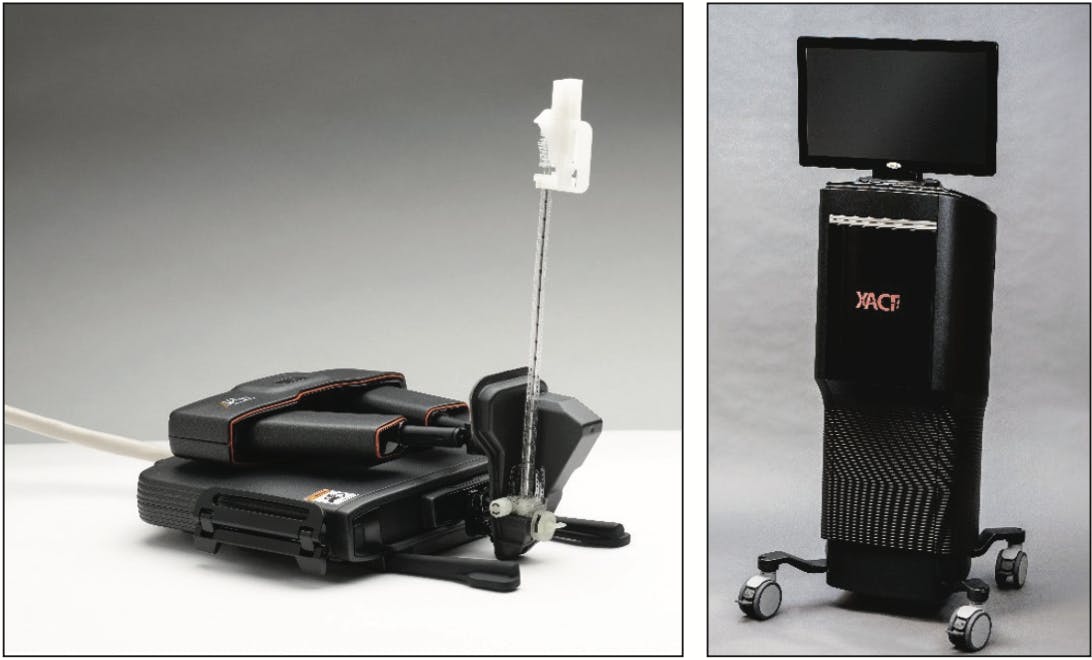
Figure 5. The platform of the Xact Ace robotic system is affixed to the patient and equipped with a motion sensor. Additionally, it features a flexible 5-DOF robotic arm with a needle holder and mobile monitor. Courtesy of XACT Robotics, reprinted with permission.
Using the Xact planning software, operators select an entry point and target. Motion and respiratory sensors adjust the needle during the insertion in real time to maintain the trajectory. The operator presses the foot pedal to advance and stop the needle, while the robot leverages its S-Drive technology to steer an instrument along a nonlinear path to reach the target (Figure 6).16
Levy et al conducted a prospective clinical trial to assess the robotic system’s performance during 32 CT-guided biopsies. The results showed that the system was feasible and had a targeting accuracy of as little as 1.6 mm.16
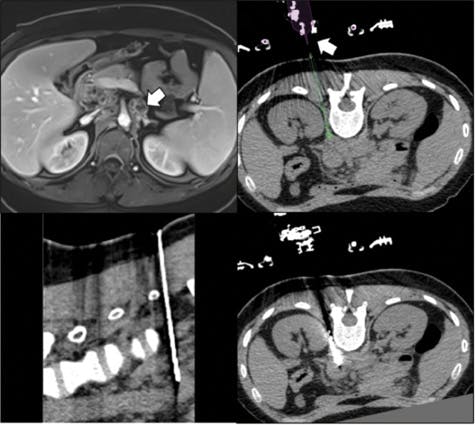
Figure 6. A CT-guided biopsy was performed using the Xact Ace patient-mounted robotic system with steering capabilities. Postcontrast T1-weighted MRI showing retroperitoneal lymph node in a woman in her early 20s (A). Preprocedural planning using robotic software showing the needle path from the entry point to target overlayed on a noncontrast CT image; the arrow is pointing toward the robot (B). Intraprocedural CT during the needle insertion demonstrating the out-of-plane trajectory (C). Intraprocedural CT showing successful needle positioning within the target (D); the biopsy was positive for tuberculosis. Images and case courtesy of Francois H. Cornelis, MD, PhD, Professor of Radiology, Radiology Department, Memorial Sloan-Kettering Cancer Center, Weill Cornell Medical College, New York, New York.
CONCLUSION
IO has undergone significant advancements in percutaneous image-guided procedures, necessitating the development of tools that augment the workflow. Although precision in reaching the target, reduction in radiation exposure, and decrease in procedural learning curve seem to be the obvious benefits, some of these devices also play a significant role in the preprocedural planning and postprocedural evaluation of the ablation zone. Several robotic systems have been under development, and some have now reached availability for clinical and commercial use. Robotic-assisted ablations are no longer an experimental option and are now moving into the mainstream interventional radiology routine. These promising robotic systems represent areas for innovative care and research in IO and can help improve patient outcomes.
1. Cardella JF, Bakal CW, Bertino RE, et al; Society of Interventional Radiology Standards of Practice Committee. Quality improvement guidelines for image-guided percutaneous biopsy in adults. J Vasc Interv Radiol. 2003;14:S227-30
2. Hasegawa T, Chatani S, Sato Y, et al. Percutaneous image-guided needle biopsy of musculoskeletal tumors: technical tips. Interv Radiol (Higashimatsuyama). 2021;6:75-82. doi: 10.22575/interventionalradiology.2020-0030
3. Koethe Y, Xu S, Velusamy G, et al. Accuracy and efficacy of percutaneous biopsy and ablation using robotic assistance under computed tomography guidance: a phantom study. Eur Radiol. 2014;24:723-730. doi: 10.1007/s00330-013-3056-y
4. Unger M, Berger J, Melzer A. Robot-assisted image-guided interventions. Front Robot AI. 2021;8:664622. doi: 10.3389/frobt.2021.664622
5. Christou AS, Amalou A, Lee H, et al. Image-guided robotics for standardized and automated biopsy and ablation. Semin Intervent Radiol. 2021;38:565-575. doi: 10.1055/s-0041-1739164
6. Cleary K, Melzer A, Watson V, et al. Interventional robotic systems: applications and technology state-of-the-art. Minim Invasive Ther Allied Technol. 2006;15:101-113. doi: 10.1080/13645700600674179
7. Kettenbach J, Kronreif G. Robotic systems for percutaneous needle-guided interventions. Minim Invasive Ther Allied Technol. 2015;24:45-53. doi: 10.3109/13645706.2014.977299
8. Arnolli MM, Hanumara NC, Franken M, et al. An overview of systems for CT- and MRI-guided percutaneous needle placement in the thorax and abdomen. Int J Med Robot. 2015;11:458-475. doi: 10.1002/rcs.1630
9. Rueda MA, Riga CT, Hamady MS. Robotics in interventional radiology: past, present, and future. Arab J Interv Radiol. 2018;2:56-63. doi: 10.4103/AJIR.AJIR_25_18
10. Kulkarni P, Sikander S, Biswas P, et al. Review of robotic needle guide systems for percutaneous intervention. Ann Biomed Eng. 2019;47:2489-2513. Published correction appears in Ann Biomed Eng. 2020;48:2370. doi: 10.1007/s10439-019-02319-9
11. Abdullah BJ, Yeong CH, Goh KL, et al. Robotic-assisted thermal ablation of liver tumours. Eur Radiol. 2015;25:246-257. doi: 10.1007/s00330-014-3391-7
12. Mbalisike EC, Vogl TJ, Zangos S, et al. Image-guided microwave thermoablation of hepatic tumours using novel robotic guidance: an early experience. Eur Radiol. 2015;25:454-462. doi: 10.1007/s00330-014-3398-0
13. Smakic A, Rathmann N, Kostrzewa M, et al. Performance of a robotic assistance device in computed tomography-guided percutaneous diagnostic and therapeutic procedures. Cardiovasc Intervent Radiol. 2018;41:639-644. doi: 10.1007/s00270-017-1841-8
14. Heerink WJ, Ruiter SJS, Pennings JP, et al. Robotic versus freehand needle positioning in CT-guided ablation of liver tumors: a randomized controlled trial. Radiology. 2019;290:826-832. doi: 10.1148/radiol.2018181698
15. Arnolli MM, Buijze M, Franken M, et al. A precision system for CT-guided needle placement in the thorax and abdomen—technical design & performance analysis. J Med Device. 2018;12. doi: 10.1115/1.4039389
16. Levy S, Goldberg SN, Roth I, et al. Clinical evaluation of a robotic system for precise CT-guided percutaneous procedures. Abdom Radiol (NY). 2021;46:5007-5016. doi: 10.1007/s00261-021-03175-9
17. de Baère T, Roux C, Deschamps F, et al. Evaluation of a new CT-guided robotic system for percutaneous needle insertion for thermal ablation of liver tumors: a prospective pilot study. Cardiovasc Intervent Radiol. 2022;45:1701-1709. doi: 10.1007/s00270-022-03267-z
18. Zangos S, Melzer A, Eichler K, et al. MR-compatible assistance system for biopsy in a high-field-strength system: initial results in patients with suspicious prostate lesions. Radiology. 2011;259:903-910. doi: 10.1148/radiol.11101559
19. Kettenbach J, Kubin K, Stadler A, et al. Abstract no. 157: pneumatically driven robotic system for MR-guided biopsie, drainage and tumorablation: first clinical experiences. J Vasc Interv Radiol. 2008;19(suppl):S60. doi: 10.1016/j.jvir.2007.12.174
20. Schulz B, Eichler K, Siebenhandl P, et al. Accuracy and speed of robotic assisted needle interventions using a modern cone beam computed tomography intervention suite: a phantom study. Eur Radiol. 2013;23:198-204. doi: 10.1007/s00330-012-2585-0
21. Kettenbach J, Kara L, Toporek G, et al. A robotic needle-positioning and guidance system for CT-guided puncture: ex vivo results. Minim Invasive Ther Allied Technol. 2014;23:271-278. doi: 10.3109/13645706.2014.928641
22. Martinez RM, Ptacek W, Schweitzer W, et al. CT-guided, minimally invasive, postmortem needle biopsy using the B-Rob II needle-positioning robot. J Forensic Sci. 2014;59:517-521. doi: 10.1111/1556-4029.12329
Advertisement
Advertisement