Advertisement
Advertisement
October 2023
Sponsored by Auxetics
The Innovative Journey of Auxetics: How a Simple Observation Led to a New Class of Venous Stents
With Mahmood Razavi, MD; Kush Desai, MD; and Stephen A. Black, MD
The first balloon-expandable stent (Palmaz, Cordis) was implanted in 1987 and received FDA approval in 1994.1 The self-expanding Wallstent (Boston Scientific Corporation) and nitinol self-expanding Smart stent (Cordis) came soon after. These stents were all developed to apply radial force and resist the recoil commonly experienced in arteries from angioplasty alone. Since then, stent innovation has been primarily incremental, focusing on improving flexibility, altering radial force/crush resistance, adding coverings like expanded polytetrafluoroethylene, and, more recently, incorporating drugs such as paclitaxel and sirolimus.
The most recent meaningful innovation in stent technology has come from a start-up called Auxetics. Auxetics originated from the Dotter Department of Interventional Radiology at Oregon Health & Science University in Portland, Oregon. The genesis of the company can be traced back to 2018 when its three founders (Ramsey Al-Hakim, MD; John Kaufman, MD; and Khashayar Farsad, MD, PhD) made an observation during venous stent placement: stent-adjacent stenosis (SAS). Dr. Al-Hakim, leveraging his background in biomechanical engineering, took the lead in exploring the convergence of medicine and engineering to investigate this phenomenon further.
By combining ex vivo, in vivo, and computational modeling approaches, the founders discovered that the underlying cause of SAS is the Poisson effect. This intriguing phenomenon, first described by French mathematician Siméon Denis Poisson more than 2 centuries ago, occurs when a material is stretched or elongated in one direction and it contracts in the perpendicular direction. This phenomenon is more pronounced in veins because they are less elastic than arteries. When a traditional stent is expanded in a vessel, it exerts radial outward force. However, due to the Poisson effect, this radial expansion also causes contraction of the vessel wall in the axial direction. Armed with this newfound understanding, the solution became evident: a stent capable of applying bidirectional forces on the vein wall, challenging the conventional notion that only radial force was needed for venous stenting. This novel concept introduced the notion of longitudinal force, leading to the development of a stent that elongates during radial expansion, with the goal of averting the Poisson effect and preventing SAS.
Benefiting from the generous support of the Dotter Rosch Innovation Fund, the founders sought the expertise of Craig Bonsignore, an experienced engineer with more than 2 decades of knowledge in nitinol devices and stent design. Through a year-long rigorous engineering process, the collaboration yielded fruitful results, culminating in the creation of the world’s first self-expanding auxetic stent prototype. To validate their groundbreaking concept, the prototype underwent testing in an acute diseased animal model, where it demonstrated its ability to apply longitudinal tension, thereby confirming the concept’s feasibility. Thus began the journey to introduce an entirely new class of stent into the endovascular space: the auxetic stent.
Building on these promising results, Auxetics was founded in 2019 and further refined the stent design to ensure optimal compatibility with the physiologic properties of veins. The company also developed a novel delivery system to ensure deliverability with accurate deployment in an operator-friendly catheter. Subsequently, the company embarked on animal survival studies, which yielded encouraging outcomes, instilling confidence in the potential of the auxetic stent.
The vision of Auxetics now looks toward the eagerly anticipated first-in-human study, representing a significant milestone in the pursuit of providing patients with an innovative venous stent solution. Through a combination of medical expertise and engineering, Auxetics stands at the forefront of advancing stent technology, with an initial focus on venous stenting to address the unique biomechanics of veins.
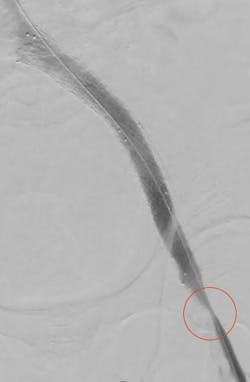
Figure 1. SAS: Venogram after iliac vein stent placement for PTS, with a resultant > 50% SAS in the adjacent common femoral vein that was not present prior to stenting.
TECHNOLOGY OVERVIEW
Previous publications have demonstrated that SAS during venous stenting occurs in peripheral and intracranial veins (Figure 1).2-6 SAS refers to narrowing of the nonstented vein next to a stent. This narrowing, which was not present before the stent placement, is a biomechanical consequence of the Poisson effect.4 SAS is problematic because it reduces the diameter of the inflow vein, and this reduction is particularly crucial because venous inflow is a key predictor of patient outcomes.7-12 Additionally, SAS results in larger areas of low shear rate within the stented segment, a flow parameter strongly linked to in-stent restenosis and need for reintervention.7,13
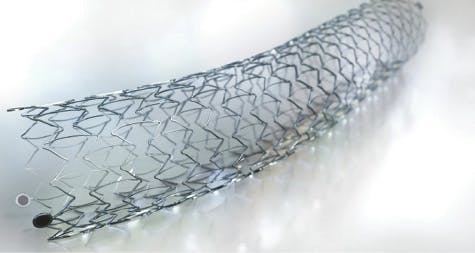
Figure 2. Auxetic venous stent (not FDA approved): The innovative design applies bidirectional forces (radial and longitudinal) to the vein wall, effectively averting SAS observed with conventional venous stents.
The auxetic venous stent, laser cut and made of nitinol, is a self-expanding stent that elongates during radial expansion (Figure 2). This unique design generates both radial and longitudinal/axial forces on the vein wall tissue, in contrast to all previous stents, which exert only radial force (Figure 3). This bidirectional application of force on the vein wall has the biomechanical result of negating the Poisson effect. Consequently, the auxetic venous stent achieves luminal gain in the stented segment without causing SAS, thereby preserving inflow and optimizing shear rate.
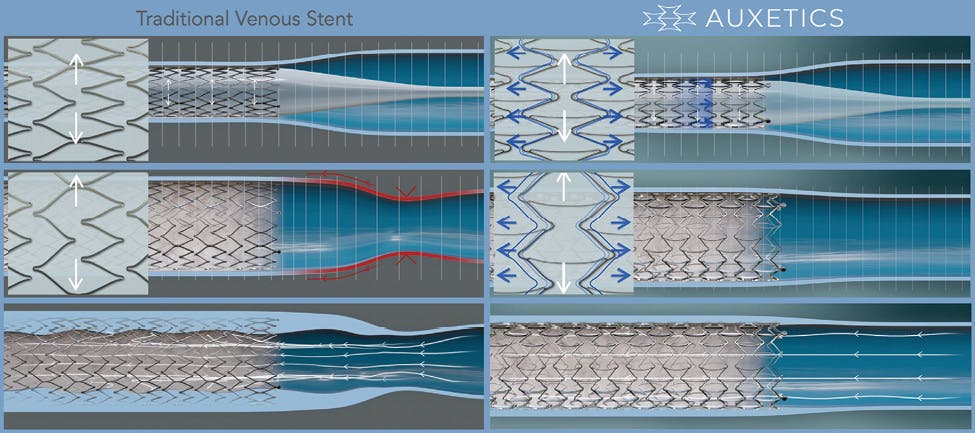
Figure 3. Optimizing flow with the auxetic venous stent: Traditional venous stents cause SAS, which creates regions of in-stent low shear rate, a hemodynamic parameter strongly associated with in-stent restenosis. The auxetic venous stent prevents SAS, thus optimizing in-stent flow hemodynamics.
The stent is delivered using a trackable 10-F delivery system over a 0.035-inch guidewire. The proprietary delivery system features a built-in longitudinal control system that actively manages stent elongation during deployment. From a user perspective, there is a single-turn wheel that ensures smooth deployment and high distal stent deployment accuracy. The delivery system also includes a built-in radiopaque marker to indicate the final location of the proximal edge of the stent after deployment. Similar to current venous stents, the auxetic venous stent provides adequate crush resistance for May-Thurner compression.
See a three-dimensional animation on the Auxetics website.
1. Palmaz J. The advent of stenting. Endovasc Today. 2004;3:45-46, 49.
2. Al-Hakim RA, Kaufman JA, Farsad K. Iliac vein stent placement: acute venographic changes and relevance to venous biomechanics. J Vasc Interv Radiol. 2018;29:1023-1027. doi: 10.1016/j.jvir.2018.02.031
3. Chait J, Leong T, Kim SY, et al. External iliac vein dimensions can change after placement of a more proximal iliac vein stent. J Vasc Surg Venous Lymphat Disord. 2023;11:373-378. doi: 10.1016/j.jvsv.2022.09.013
4. Li N, Mendoza F, Rugonyi S, et al. Venous biomechanics of angioplasty and stent placement: implications of the Poisson effect. J Vasc Interv Radiol. 2020;31:1348-1356. doi: 10.1016/j.jvir.2020.02.033
5. Fargen KM. A unifying theory explaining venous sinus stenosis and recurrent stenosis following venous sinus stenting in patients with idiopathic intracranial hypertension. J Neurointerv Surg. 2021;13:587-592. doi: 10.1136/neurintsurg-2020-017208
6. Saber H, Lewis W, Sadeghi M, et al. Stent survival and stent-adjacent stenosis rates following venous sinus stenting for idiopathic intracranial hypertension: a systematic review and meta-analysis. Interv Neurol. 2018 Oct;7(6):490-500. doi: 10.1159/000490578
7. Jayaraj A, Fuller R, Raju S, Stafford J. In-stent restenosis and stent compression following stenting for chronic iliofemoral venous obstruction. J Vasc Surg Venous Lymphat Disord. 2022;10:42-51. doi: 10.1016/j.jvsv.2021.06.009
8. Morris RI, Jackson N, Khan T, et al. Performance of open and closed cell laser cut nitinol stents for the treatment of chronic iliofemoral venous outflow obstruction in patients treated at a single centre. Eur J Vasc Endovasc Surg. 2022;63:613-621. doi: 10.1016/j.ejvs.2021.10.052
9. Hügel U, Khatami F, Muka T, et al. Criteria to predict midterm outcome after stenting of chronic iliac vein obstructions (PROMISE trial). J Vasc Surg Venous Lymphat Disord. 2023;11:91-99.e1. doi: 10.1016/j.jvsv.2022.05.018
10. Pouncey AL, Kahn T, Morris RI, et al. Risk factors and classification of reintervention following deep venous stenting for acute iliofemoral deep vein thrombosis. J Vasc Surg Venous Lymphat Disord. 2022;10:1051-1058.e3. doi: 10.1016/j.jvsv.2022.03.006
11. Sebastian T, Gnanapiragasam S, Spirk D, et al. Self-expandable nitinol stents for the treatment of nonmalignant deep venous obstruction. Circ Cardiovasc Interv. 2020;13:e009673. Published correction appears in Circ Cardiovasc Interv. 2021;14:e000081. doi: 10.1161/CIRCINTERVENTIONS.120.009673.
12. Bakas JM, Moelker A, van Montfrans C, et al. Long term follow up, causes for re-intervention, and consequences for surveillance after stenting for proximal deep vein obstruction. Eur J Vasc Endovasc Surg. Published June 28, 2023. doi: 10.1016/j.ejvs.2023.06.033
13. Li N, Ferracane J, Andeen N, et al. Impact of postthrombotic vein wall biomechanics on luminal flow during venous angioplasty and stent placement: computational modeling results. J Vasc Interv Radiol. 2022;33:262-267. doi: 10.1016/j.jvir.2021.12.006
PANEL Q&A

Mahmood Razavi, MD
St. Joseph Heart & Vascular Center
Orange, California
mrazavi@pacbell.net

Kush Desai, MD
Northwestern University
Chicago, Illinois
kdesai007@northwestern.edu

Have you observed SAS during venous stenting in your clinical practice?
Dr. Razavi: SAS, an apparent narrowing in the adjacent nonstented segments, is a common observation after venous stent placement. Depending on the degree of narrowing, it certainly impacts the inflow. To my knowledge, until recently, no one had a good explanation for this observation, and we certainly did not understand its impact on stent patency. Recently, a series of articles proposed a very plausible explanation for this finding, which is centered on the interaction between properties of the expanding stents and the vessel wall reaction to it. The explanation is based on an established physics principle called the Poisson effect. I clearly was not smart enough to come up with that, so the credit should go to Dr. Ramsey Al-Hakim and his colleagues, who first explained the reasons for the common finding of SAS.
Dr. Desai: It’s an interesting phenomenon. SAS is something we’ve seen on the nonthrombotic side, and based on computational modeling, it occurs with greater frequency on the post-thrombotic side. What is less clear is whether SAS plays a role in nonthrombotic occlusions only, because patencies are very high across multiple trials for nonthrombotics, but we have a long way to go in post-thrombotic occlusion. Multiple retrospective trials and a subsequent meta-analysis projected a 5-year primary patency rate of 60% in post-thrombotic occlusions. Then you have the investigational device exemption (IDE) trials that are now out to 3 years and show patency in the 70% range. The meta-analysis results seem unfortunately prophetic; 60% primary patency is something we will probably see. That is unacceptable as a venous practitioner because we are placing stents in relatively young patients, and we want to ensure longevity. But we haven’t quite cracked the code, so to speak, on how we can improve that. We know inflow is an issue, so if inflow can be optimized by reducing SAS in post-thrombotics, that is certainly something worth investigating. If that’s the case, it could make a big difference.
Prof. Black: The concept of SAS is not new. We’ve seen it in multiple fields where stents have been used, and it certainly exists in venous disease. Whether it is the same pathologic mechanism in venous disease has not been entirely clear. But we absolutely do see it in patients with nonthrombotic iliac vein lesions where it is probably more obvious and in the case of post-thrombotic patients.
What do you think is the potential impact of SAS on venous flow and clinical outcomes?
Dr. Razavi: Based on data from pivotal studies of the dedicated venous stents as well as the literature on previous generation of stents, there is a relatively high rate of stent failure with iliofemoral venous stents (IFVSs) in post-thrombotic patients (~30% at 1 year). Given the differences in properties of these stents, there are clearly common threads that lead to this failure rate in each of them. One of the most important factors is the adequacy of flow through the stented segments. This has been well-documented in an upcoming article authored by Dr. Houman Jalaie and coauthors. Although it is logical to assume that SAS reduces inflow, its negative impact on stent patency has not been well studied or well documented in the literature. The reason for this is that the phenomenon has only recently been described in this setting. The important lesson here is to ensure optimal inflow and post-procedural medical management and follow-up in patients who are candidates for IFVS.
Dr. Desai: Particularly with post-thrombotic syndrome (PTS) patients, we know that inflow is a critical determinant of long-term patency. We haven’t codified it yet in an objective manner (ie, with velocities or reproducible flow measurements). In most cases, when we identify an inflow lesion, we don’t really have anything that can durably treat the inflow lesions, although a lot of work is being done in this area. What if SAS impacts otherwise-good inflow? Given the general observations of poor primary patency in post-thrombotics, it might be an underappreciated issue where the type of stent, agnostic of inflow quality, can make a difference.
Prof. Black: When there is a stenosis and a stent, we typically see SAS, which occurs predominantly on the inflow side. Occasionally, SAS might be seen on the outflow side, but the stent transitions to a bigger vessel on the outflow side, so the impact is less. When encountering SAS, you tend to create aberrations in flow into the stented segment, which initially leads to thrombus buildup and later collagen deposition within the stent. Once you start to get that buildup, it is difficult to fix and reverse that process. It typically results in symptom deterioration or, in the worst cases, occlusion of the stent itself, which we know is a difficult problem to handle in venous disease.
What potential benefits do you envision by using an auxetic venous stent capable of exerting bidirectional forces on the vein wall and preventing SAS?
Dr. Razavi: As mentioned previously, given the relatively high rate of 1-year failure of IFVS in post-thrombotic patients, any improvement is meaningful. The reaction of the vessel to stenting and subsequent flow reduction is real, and hence, potential negative clinical sequelae are likely. I think the enhanced performance characteristics of the new stent mitigating SAS can potentially improve outcomes.
Dr. Desai: I think this really harkens back to the prior two questions, which is that we want to ensure we’re not damaging or compromising inflow. If this device, as suggested, reduces the impact on the inflow itself, I think we have a significant chance of improving outcomes. Because right now, through four IDE studies, we see similar outcomes in post-thrombotic patients. Clearly, there is room for improvement.
Prof. Black: I think the concept of the auxetic stent with bidirectional forces to address the Poisson effect ensures that the potential for inflow problems is reduced to an absolute minimum, thereby increasing stent patency in the long run. We know from the multiple concluded IDE studies that there is a patency drop across all patient groups, and this is most pronounced in the chronic patients. Therefore, as we wrestle with this problem, the concept of bidirectional stent force and reduction of Poisson effect will clearly play a role in a proportion of those patients who have problems with a stent. Our goals must be to (1) reduce the incidence of SAS, and (2) reduce the rate of reintervention that those patients therefore have, which is bad for the patient and for the cost-effectiveness of these procedures in the long run. Bear in mind, we need these procedures to last 50 years for the patient. We must be focused on addressing whatever we can to improve those outcomes.
Disclosures
Dr. Razavi: Consultant to Abbott Vascular, Boston Scientific, Medtronic, Terumo, Philips, and Auxetics.
Dr. Desai: Speakers bureau for/consultant to Cook Medical, Boston Scientific, Becton Dickinson/CR Bard, Medtronic, Penumbra, Tactile Medical, and Philips; consultant to W.L. Gore, Shockwave Medical, Asahi Intecc, Veryan, Cordis, Surmodics, CSI, and Auxetics.
Prof. Black: Speaker for/consultant to BSCI, Cook, Medtronic, Philips, BD, Gore, Veryan, Surmodics, and Auxetics; receives research fees from Boston Scientific, Medtronic, and Veryan.
Advertisement
Advertisement