Advertisement
Advertisement
April 2024
Sponsored by AngioDynamics, Inc
A Novel Way to Treat Patients With Radial Access
Two peripheral artery disease case examples highlight the utility of Auryon XL, a radial-length laser atherectomy device.
The Auryon Atherectomy System (AngioDynamics, Inc.) is a 355-nm, solid-state, short-pulse laser that transmits energy to the diseased artery at preset fluency levels of 50 and 60 mJ/mm2 (Figure 1). The system works over 0.014-inch wires, and there are four available catheter sizes. On January 23, 2024, AngioDynamics, Inc. announced FDA 510(k) clearance of the Auryon XL Catheter, a 225-cm radial access catheter, for use with the Auryon Atherectomy System in the treatment of peripheral artery disease (PAD).
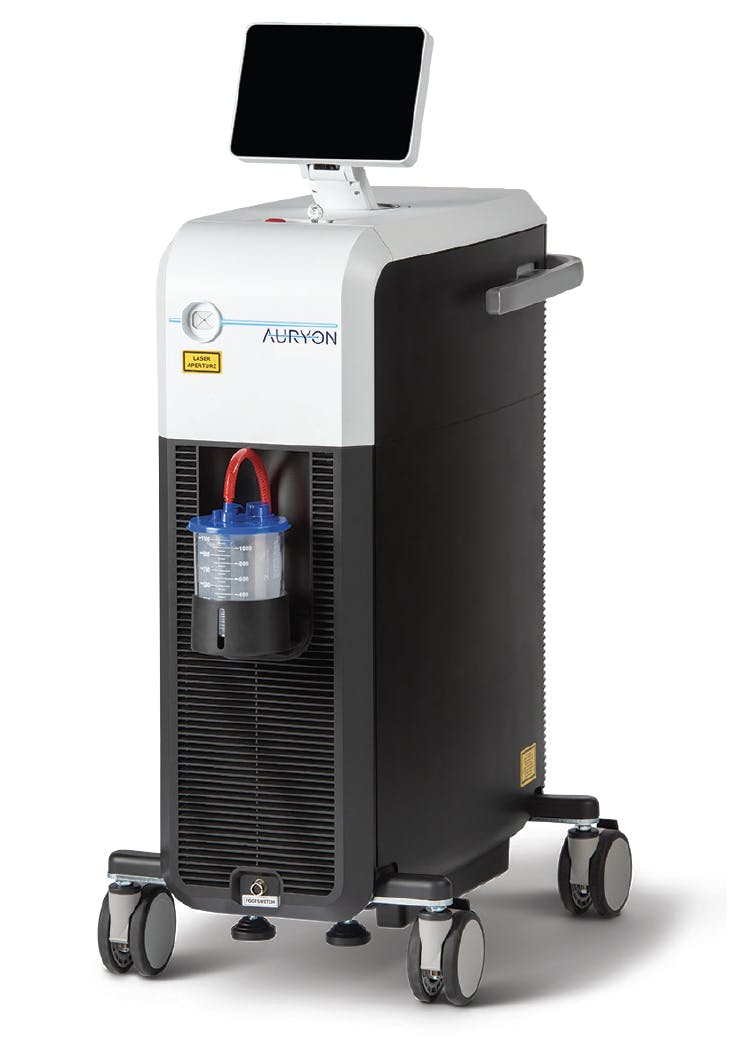
Figure 1. The Auryon laser console.
This article presents two of the first cases performed utilizing the Auryon XL Catheter.
CASE STUDY 1
Patient Presentation
A man in his mid 60s presented with a history of hypertension, dyslipidemia, congestive heart failure, former smoker, alcohol abuse, type 2 diabetes mellitus, end-stage renal disease on hemodialysis, and cerebrovascular accident. He had been treated for PAD in the past. On his left side, he underwent atherectomy and balloon angioplasty of the superficial femoral artery (SFA) and anterior tibial artery in late summer 2022. He also received treatment on his right side, with angioplasty of his right anterior tibial artery and peroneal artery 1 month later and atherectomy and angioplasty of his right SFA the following month. Two years later in early 2024, he presented to our clinic with Rutherford class 4 rest pain of his left leg and was scheduled for angiography.
Procedural Overview
Via ultrasound, access was achieved to the right radial artery with a 5-F, 11-cm sheath and exchanged for a 6-F, 150-cm Sublime Radial sheath (Surmodics, Inc.). A 5-F, 125-cm pigtail catheter was inserted, and angiography was performed. This revealed a 90% stenosis of the left anterior tibial artery and a 90% ostial stenosis of the left posterior tibial artery (Figure 2A and 2B). The decision was made to intervene, and a 1.5-mm-diameter Auryon XL Catheter was introduced over a 0.014-inch, 450-cm hydrophilic-coated wire; the posterior tibial artery was treated with one pass at a fluency of 50 mJ/mm2. Angioplasty was performed of the posterior tibial artery with a 3- X 120-mm Sublime balloon (Surmodics, Inc.) inflated to 6 atm for 1 minute. Next, the focus shifted to the anterior tibial artery, which was again treated with one pass of atherectomy using the Auryon laser. Angioplasty of the anterior tibial artery was performed using a 3- X 120-mm Sublime balloon, inflated to 6 atm for 1 minute, followed by a 2- X 220-mm Sublime balloon inflated to 6 atm for 1 minute. Posttreatment angiography revealed resolution of the stenoses in the posterior tibial artery and anterior tibial artery with brisk inline flow to the foot (Figure 2C and 2D). All catheters and sheaths were then removed, and a TR Band (Terumo Interventional Systems) was applied to the radial access site.
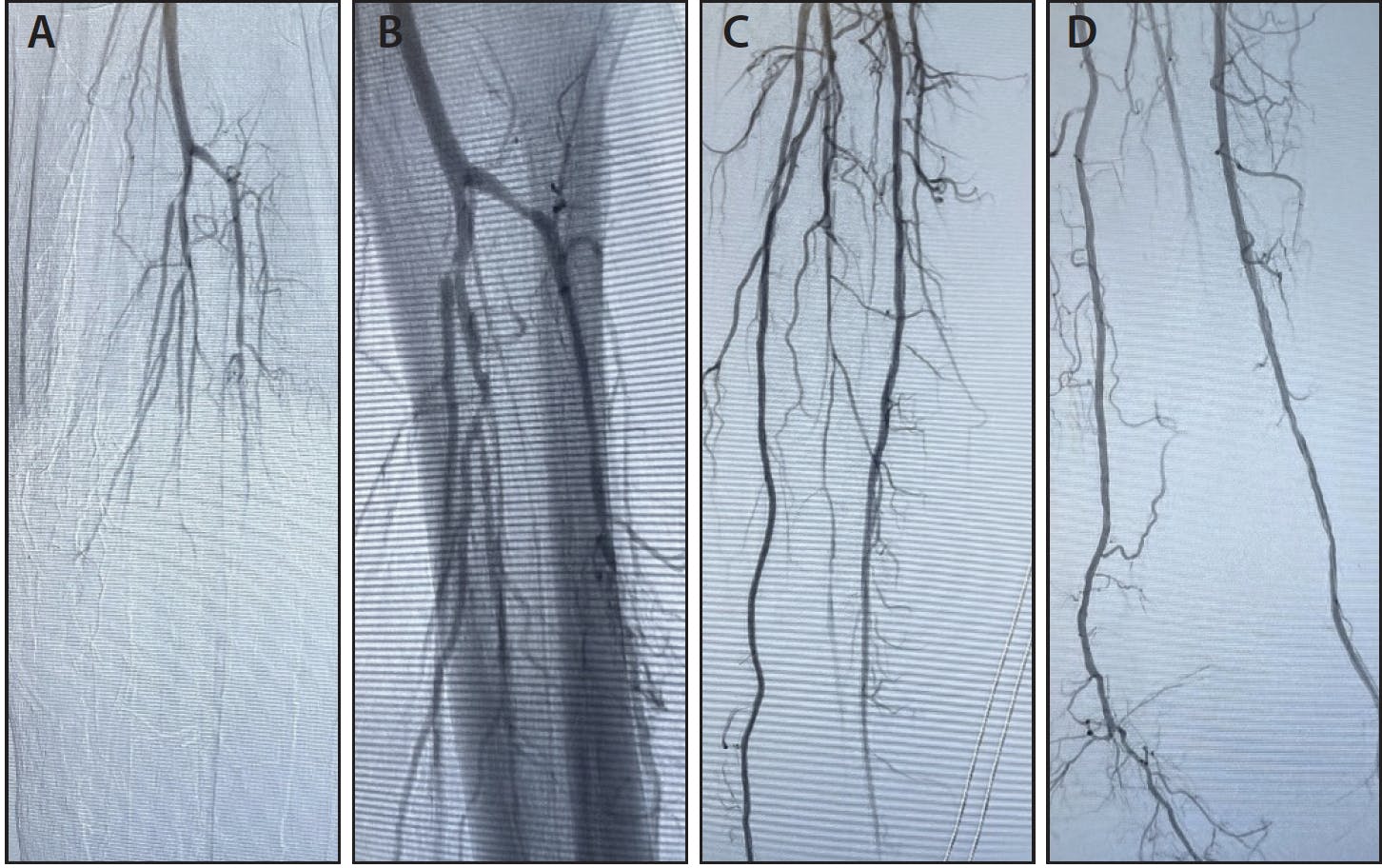
Figure 2. Pretreatment angiogram showing 90% stenosis of the left anterior tibial artery and a 90% ostial stenosis of the left posterior tibial artery (A, B). Posttreatment angiogram showing successful revascularization of the anterior and posterior tibial artery (C). Below-the-knee distal runoff showing straight line flow into the foot (D).
CASE STUDY 2
Patient Presentation
A woman in her mid 80s presented with a history of dyslipidemia, breast cancer, and active smoking. She presented to our clinic with bilateral lifestyle-limiting claudication, and an arterial duplex ultrasound revealed a > 75% stenosis of the right SFA with monophasic waveforms. Additionally, her right-sided ankle-brachial index was 0.56, consistent with moderate PAD. The patient was scheduled for lower extremity angiography.
Procedural Overview
Access was obtained using ultrasound through the left radial artery using a 5-F, 11-cm sheath. This was exchanged for a 5-F, 120-cm Sublime Radial sheath, and a 5-F pigtail catheter was used for diagnostic angiography. This demonstrated a 99% critical diffuse stenosis of the right SFA (Figure 3A). The decision was made to intervene, and a 1.5-mm Auryon XL Catheter was advanced over a 0.014-inch, 450-cm hydrophilic-coated wire through the lesion twice at a fluency of 50 mJ/mm2. Next, a 4- X 150-mm Sublime balloon was inserted, and angioplasty was performed at 12 atm for 1 minute. Postprocedure angiography revealed marked improvement in the SFA stenosis (Figure 3B), with no distal embolus noted below the knee (Figure 3C). All catheters and sheaths were then removed, and a TR Band was applied to the radial access site.
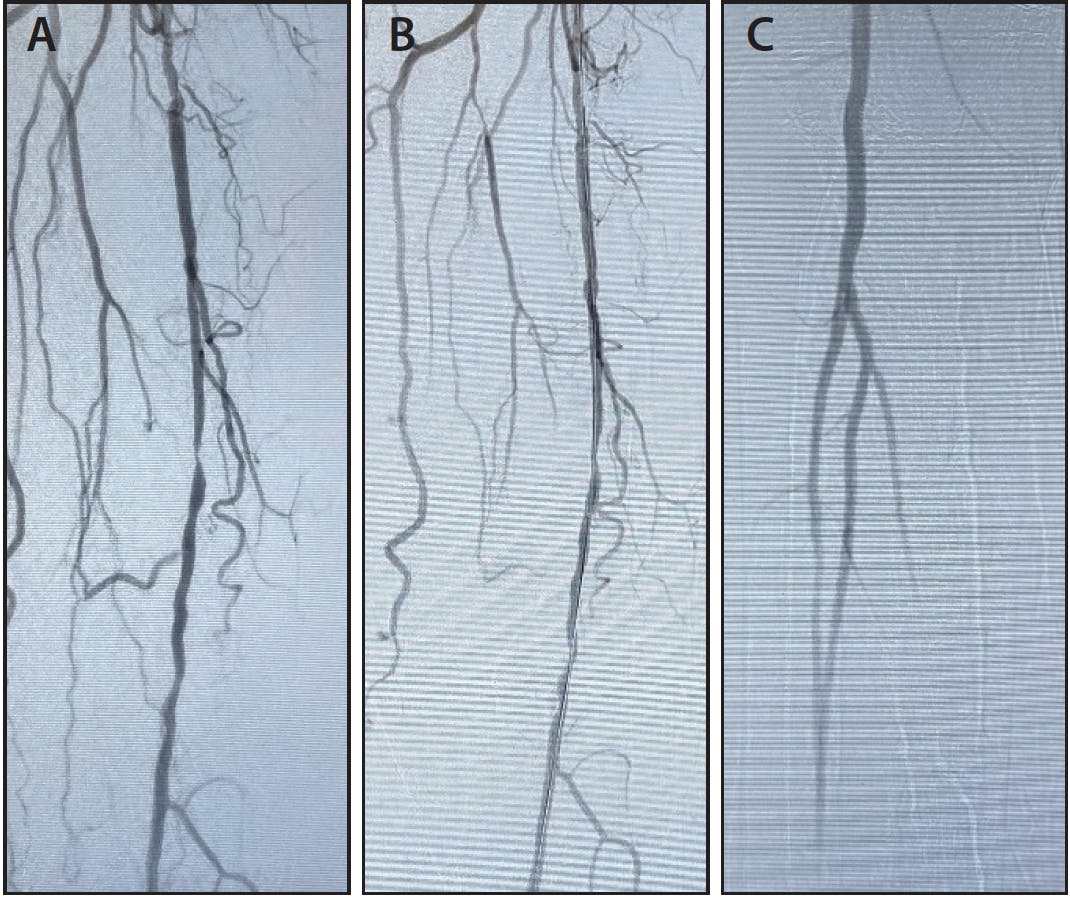
Figure 3. Preprocedure angiography demonstrating 99% critical diffuse stenosis of the right SFA (A). Posttreatment angiography demonstrating resolution of the stenosis (B). Posttreatment angiography of the below-the-knee vessels showing no evidence of distal embolus (C).
DISCUSSION
Auryon XL is the first radial-length laser atherectomy device. It has allowed us to perform peripheral atherectomy procedures safely via radial access, when previously, the only option for these cases would have been groin or pedal access. In my practice, radial access is the default as it decreases groin complication and improves patient safety. The Auryon XL Catheter, with its innovative design and ease of use brings significant advancements to radial procedures as the first nonorbital atherectomy device available in radial length—setting a new standard for laser atherectomy technology.
For risk info, visit auryon-system.com/risk-information/

Advertisement
Advertisement