Advertisement
Advertisement
April 2024
An Interview With Robert A. Lookstein, MD, MHCDL, FSIR, FAHA, FSVM
The Mount Sinai interventional radiologist and SIR President-Elect stresses the importance of subspecialization and multidisciplinary teamwork in IR, considers the potential of AI for comprehensive and inclusive care, and ponders next steps after BEST-CLI and BASIL-2.

Your practice is wide-ranging, and much of your focus in recent years has been on peripheral vascular disease, noninvasive vascular imaging, and venous thromboembolism. How did you hone in on and develop these areas of interest?
My training was primarily focused on peripheral vascular disease, and most of my mentors have been vanguards in the diagnosis and treatment of peripheral vascular disease. I consider myself lucky to have had such an exciting and fulfilling practice and career.
As the 2024 President-Elect of the Society of Interventional Radiology (SIR) with plans for a presidential term in 2025, what are some of the biggest opportunities for the interventional radiology (IR) field in the next few years? What is the greatest obstacle facing the specialty?
I have been a consistent advocate for the longitudinal clinical practice of IR. Our practice at Mount Sinai in New York is a model for many others in the region and around the country. I feel there is tremendous value in a comprehensive clinical IR practice—not just for our patients but also for our specialty and the larger health care delivery system we all work in. As more and more interventional radiologists across the world have adopted this model, it creates unprecedented opportunities to unite and advance the specialty but also challenges to reconcile the increasing divergent priorities of the clinical practice of IR with the explosion of diagnostic imaging volumes and the workforce shortage for our diagnostic radiology colleagues.
Several of your current focus areas (pulmonary embolism [PE], limb preservation, and dialysis access, to name a few) involve multidisciplinary teamwork. At Mount Sinai on the local level, how do you ensure your team works across specialties to ensure patient needs are met?
I believe that the multidisciplinary team model allows for every patient to be offered the largest selection of treatment options: medical, endovascular, and surgical. This concept and its value have been demonstrated time and time again across the health care system. Ultimately, this involves placing the patient and shared decision-making at the center of the health care encounter.
And, in your SIR leadership role?
Our specialty’s greatest strength is the diversity of our members who improve patient’s lives across the broadest spectrum of health care delivery. We collectively treat peripheral vascular disease, cancer, women’s and men’s pelvic health issues, musculoskeletal health issues, acute and chronic liver and kidney disease, and neurovascular disease and stroke, among others. What an incredible opportunity and a humbling responsibility.
We can only successfully expand our scope of practice by respecting our medical and surgical colleagues and partners, generating the evidence base to support our innovations in health care and truly identify which patients derive the greatest sustained benefits from our care. There will always be innovations in health care, whether that’s medical, surgical, or minimally invasive. We are committed to expanding the number of patients who can be treated safely and effectively.
Along with participation in trials of PE devices and techniques, you’re involved with The PERT Consortium, formerly serving as President and now as Chair of the Database Committee. What are the goals of this committee, and can you share any highlights from findings so far?
The PERT Consortium Quality Database is the largest-ever prospective database observing outcomes for acute PE patients. We have collected data for > 11,000 patients to date. There have been several peer-reviewed scientific papers reporting on this data in the American and European literature. We hope that the database serves as a resource to educate the global PE community about the current state of clinical care and to start asking questions regarding optimal treatment. We believe that the database will ultimately define what quality care is for these patients and identify evidence gaps or disparities in care. We have been working closely with the United States FDA to expand the database to allow for the collection of prospective research to address safety and efficacy concerns for medical devices as well as pharmaceuticals.
What do you see as the capabilities for artificial intelligence (AI) in vascular care? Along with current options for PE and stroke, aortic applications are coming online; do you see opportunities in interventional oncology and peripheral artery disease?
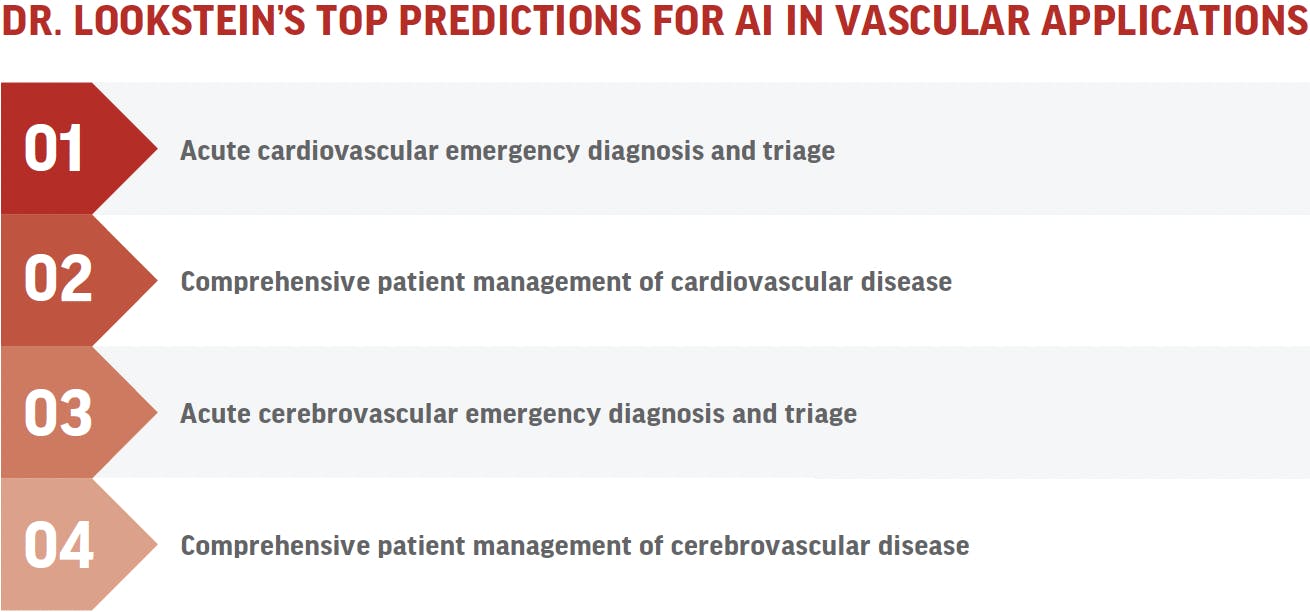
AI is changing health care delivery rapidly. One of the most profound effects has been realized in the acute diagnosis and triage of stroke and PE. Management of acute aortic pathology is rapidly emerging in the second wave of AI adoption, along with deep vein thrombosis, intra-abdominal hemorrhage, and acute vascular occlusion.
Many of the vendors are investing in comprehensive patient management software tools to allow every patient diagnosed to be seen by a specialist and minimize the risk of losing patients to follow-up. The potential of this comprehensive patient management software to improve access to care and eliminate disparities for patients with atherosclerotic vascular disease as well as cancer is unprecedented. To paraphrase the words of American Medical Association President Jesse Ehrenfeld, I firmly believe that AI won’t replace physicians. Rather, physicians who use and control AI will replace physicians who don’t use it and cannot control it.1
You worked on the Surgical and Interventional Committee of BEST-CLI and also participated in numerous discussions contextualizing the study’s findings. Now that we are a year out from that initial publication,2 how have the trial and its United Kingdom/European counterpart, BASIL-2, shaped your practice? What key questions must be addressed next, via either exploration of these data sets or future trials?
These landmark trials have demonstrated that both surgical and endovascular revascularization techniques work to improve limb-related outcomes and quality of life for patients with critical limb ischemia/chronic limb-threatening ischemia (CLI/CLTI). The unanswered questions that remain involve the potential benefit of antiproliferative balloons and stents for CLI/CLTI patients and what is the exact benefit of optimal medical therapy before, during, and after a successful revascularization. It is clear to me that in the hands of an experienced/expert vascular specialist, excellent outcomes can be realized. I believe that we need to evolve into the era of lower extremity revascularization experts and teams. The time for providers who only treat a handful of patients with this disease each year needs to be considered antiquated. We need experts to improve on these outcomes and provide relief to these patients.
Another significant collaborative effort recently is the multidisciplinary expert opinion paper on the use of intravascular ultrasound in peripheral artery/deep venous intervention.3 How do you hope to see this document impact care?
We are just now embracing the era of intravascular imaging for peripheral vascular disease. There is an emerging evidence base that demonstrates improved acute and midterm outcomes when intravascular imaging is used. Our multidisciplinary vascular practice has largely adopted this concept for renal and visceral arterial intervention, aortic intervention, below-knee intervention, and deep venous intervention. There are incredible opportunities moving forward to further define which patients derive the greatest benefit and to advocate for broader adoption to improve the outcomes for our patients.
One key question facing IR involves whether to focus one’s career in a specific clinical area or two or work more broadly. What advice do you have for those entering the IR workforce as to how to identify which approach is best for them?
I am a firm believer in the concept of subspecialization within IR, and I believe the future will support this shift toward advanced and focused training and specialization. I personally stopped accepting referrals for cancer many years ago when I chose the focus my practice on peripheral vascular disease. This is similar to a vascular surgeon who clinically focuses on venous insufficiency and stops accepting referrals for aortic dissections. Ultimately, this leads to better patient care and, I believe, better career satisfaction.
1. Schumaker E, Leonard B, Paun C, Peng E. AMA president: AI will not replace doctors. Politico. July 10, 2023. Accessed March 1, 2024. https://www.politico.com/newsletters/future-pulse/2023/07/10/ai-will-not-replace-us-ama-president-says-00105374
2. Farber A, Menard MT, Conte MS, et al. Surgery or endovascular therapy for chronic limb-threatening ischemia. N Engl J Med. 2022;387:2305-2316. doi: 10.1056/NEJMoa2207899
3. Secemsky EA, Aronow HD, Kwolek CJ, et al. Intravascular ultrasound use in peripheral arterial and deep venous interventions: multidisciplinary expert opinion from SCAI/AVF/AVLS/SIR/SVM/SVS. J Vasc Interv Radiol. 2024;35:335-348. doi: 10.1016/j.jvir.2023.11.006
Advertisement
Advertisement
Interested in reading more interviews?
To read more interviews with thought leaders in the vascular field, check out our Profiles & Perspectives hub.
Read More