Advertisement
Advertisement
April 2024
Type B Aortic Dissection Presenting as Sudden-Onset, Sharp Back Pain
A case study to emphasize a stepwise approach to diagnosing and treating TBAD.
CASE PRESENTATION
A woman in her mid 70s with a past medical history of hypertension and hyperlipidemia presented to the emergency department (ED) with acute-onset, sharp upper back pain she described as “tearing.” She also endorsed intermittent numbness of her bilateral lower extremities and mild abdominal pain. The pain was characterized as severe and radiated to her right chest and had been constant since it began 1 hour prior. The patient had no history of back pain or any recent injuries or falls. Her vital signs were significant for normal sinus rhythm of 70 bpm and a blood pressure (BP) of 195/102 mm Hg. She was combative and appeared in acute distress, asking for pain medications.
1. Highlight Point
Patients with type B aortic dissection (TBAD) most commonly present with abrupt-onset, sharp, severe pain located in either the chest, back (classically midscapular), or abdomen. The pain is often characterized as a ripping or tearing pain. Up to 20% of TBAD patients describe migrating pain with propagation of the dissection throughout the aorta. Other hallmarks of the presentation include long-standing hypertension and hyperlipidemia. Obtaining a thorough medical, surgical, social, and family history is essential. Previous cardiac or vascular interventions may influence the treatment strategy. A social history of illicit drug use is not uncommon. Family history must be screened for any connective tissue disorders or history of aortic dissection or aneurysm. Although connective tissue disorders are not immediately high on the differential, aortic disease often has some genetic component.
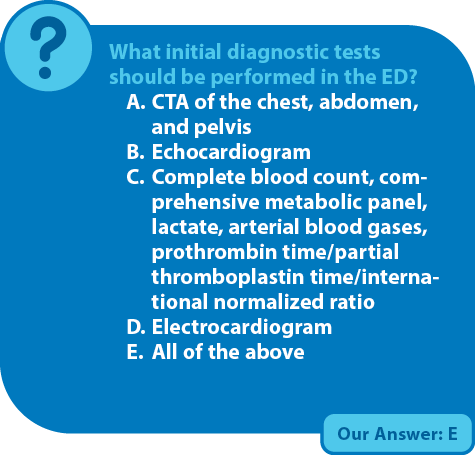
Most urgent cares facilities or EDs start with a chest x-ray, which may demonstrate a widened mediastinum or enlarged cardiac silhouette, but this is nonspecific. The first-line modalities to diagnose an aortic dissection are CT and MRI. MRI is more expensive, less time efficient, and often less available, so CTA is generally the gold standard. Echocardiography, particularly transesophageal echocardiography, can also be used, although this is invasive, less detailed, not available in some centers, and is not the first-line test. However, an echocardiogram should be obtained before any operative intervention. Once the diagnosis of TBAD has been confirmed, lab tests should be comprehensive and help determine if there is any evidence of end-organ malperfusion. Lab testing should include a complete blood count, coagulation studies, comprehensive metabolic panel, lactate, and arterial blood gas. Other testing that should be performed includes electrocardiogram, as myocardial infarction can be seen in up to 10% of TBAD patients.1
CASE CONTINUED
A CTA of the chest, abdomen, and pelvis was obtained, which demonstrated a TBAD beginning just distal to the origin of the left subclavian artery (LSA)and involving 60% of the lower thoracic and upper abdominal aorta, ending just proximal to the aortoiliac bifurcation (Figure 1). The mesenteric and renal arteries were supplied by the true lumen with no radiographic evidence of malperfusion. Laboratory testing was normal. Upper extremity, femoral, and pedal pulses were 2+ and equal bilaterally.
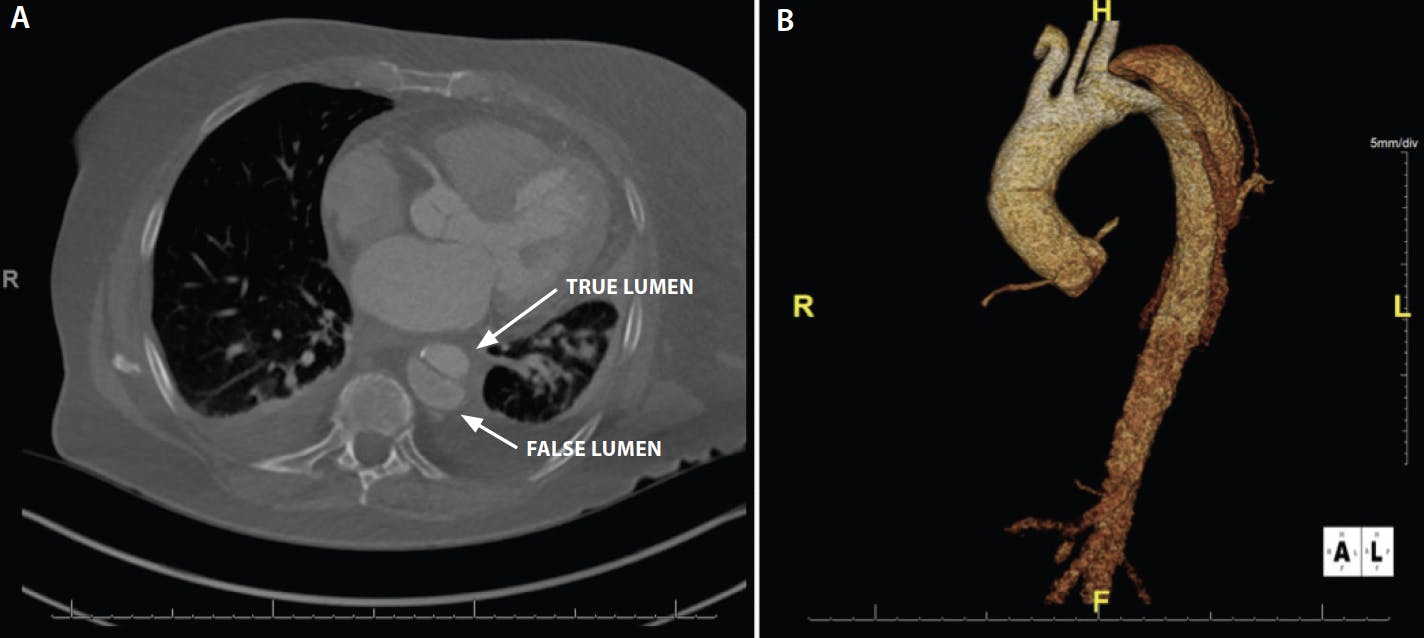
Figure 1. CTA demonstrating a TBAD in the descending thoracic aorta with a classic double barrel. The true lumen is the smaller lumen (A). Three-dimensional reconstruction demonstrating the extent of the TBAD from the distal arch down to the abdominal aorta (B).
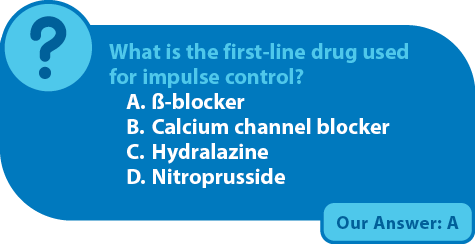
β-blockers are the first-line drug of choice for TBAD. They have a negative inotropic and chronotropic effect. This results in a prolonged diastolic filling time and increased left ventricular end-diastolic volume, which lowers BP and heart rate.
2. Highlight Point
Medical therapy is the first-line intervention for patients with TBAD. The main goal is impulse control—specifically, BP control with systolic BP between 100 and 120 mm Hg and heart rate control, ideally < 60 bpm. This reduces aortic wall shear stress to minimize dissection propagation. After β-blockade, peripheral vasodilators such as nitroprusside or calcium channel blockers are given if needed. For patients without malperfusion who can be managed medically, the optimal treatment and monitoring involves intensive care unit (ICU) admission, hourly neurovascular checks, and intravenous drips to manage BP until impulse control can be achieved with oral medications.
CASE CONTINUED
The patient was started on esmolol and nicardipine infusions and admitted to the ICU for monitoring. A radial arterial line was placed for hemodynamic monitoring. Pain was controlled with an oral pain regimen. Over 2 days, the esmolol and nicardipine infusions were able to be weaned off as an oral regimen of carvedilol, amlodipine, and captopril was added with appropriate impulse control. A repeat CTA 48 hours after the initial showed a stable dissection with no further propagation. The patient was then discharged home with plans for close follow-up with cardiac surgery and cardiology and repeat imaging at 1, 3, 6, and 12 months after discharge. The patient was counseled on BP control and warning signs of dissection propagation, to avoid strenuous exercise and heavy weight lifting, and when to seek medical care.
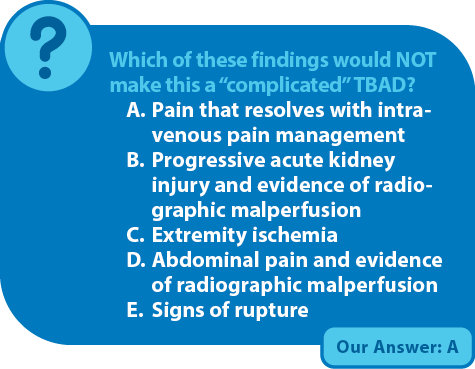
Approximately 55% of patients present with uncomplicated TBAD. Uncomplicated TBAD means there is no evidence of organ malperfusion, aortic rupture, or “high-risk” features for impending rupture.
High-risk features include an entry tear ≥ 10 mm, a primary entry tear at greater curve of distal aortic arch, short proximity of the entry tear to LSA ostium, maximum aortic diameter ≥ 40 mm, maximum false lumen diameter ≥ 22 mm, and bloody pleural effusion.
3. Highlight Point
For uncomplicated TBAD patients, aggressive medical therapy is usually sufficient. However, a complicated TBAD must be managed surgically with either thoracic endovascular aortic repair (TEVAR) or open repair. TEVAR is considered the treatment of choice when feasible.
CASE CONCLUSION
The patient did well; however, her 1-year repeat imaging showed aneurysmal degeneration of her descending thoracic aorta. She underwent a percutaneous TEVAR with a thoracic branched endograft (TBE) with a 12-mm subclavian stent. A TBE device was used due to the inadequate landing zone distal to the LSA. She did well and was discharged on postoperative day 1 in good condition.
4. Highlight Point
Patients must be counseled on all possible complications. For TEVAR, major complications include spinal cord ischemia, stroke, acute kidney injury, propagating a retrograde aortic dissection, endoleak, and access-related complications (femoral injury, femoral pseudoaneurysm, limb ischemia).
DISCUSSION
The treatment of TBAD is complex and requires an understanding of the natural history and pathophysiology in order to apply the correct treatment algorithm (Figure 2). The providers must be facile with optimizing medical therapy as well as open and endovascular surgery to provide a tailored approach to each patient.
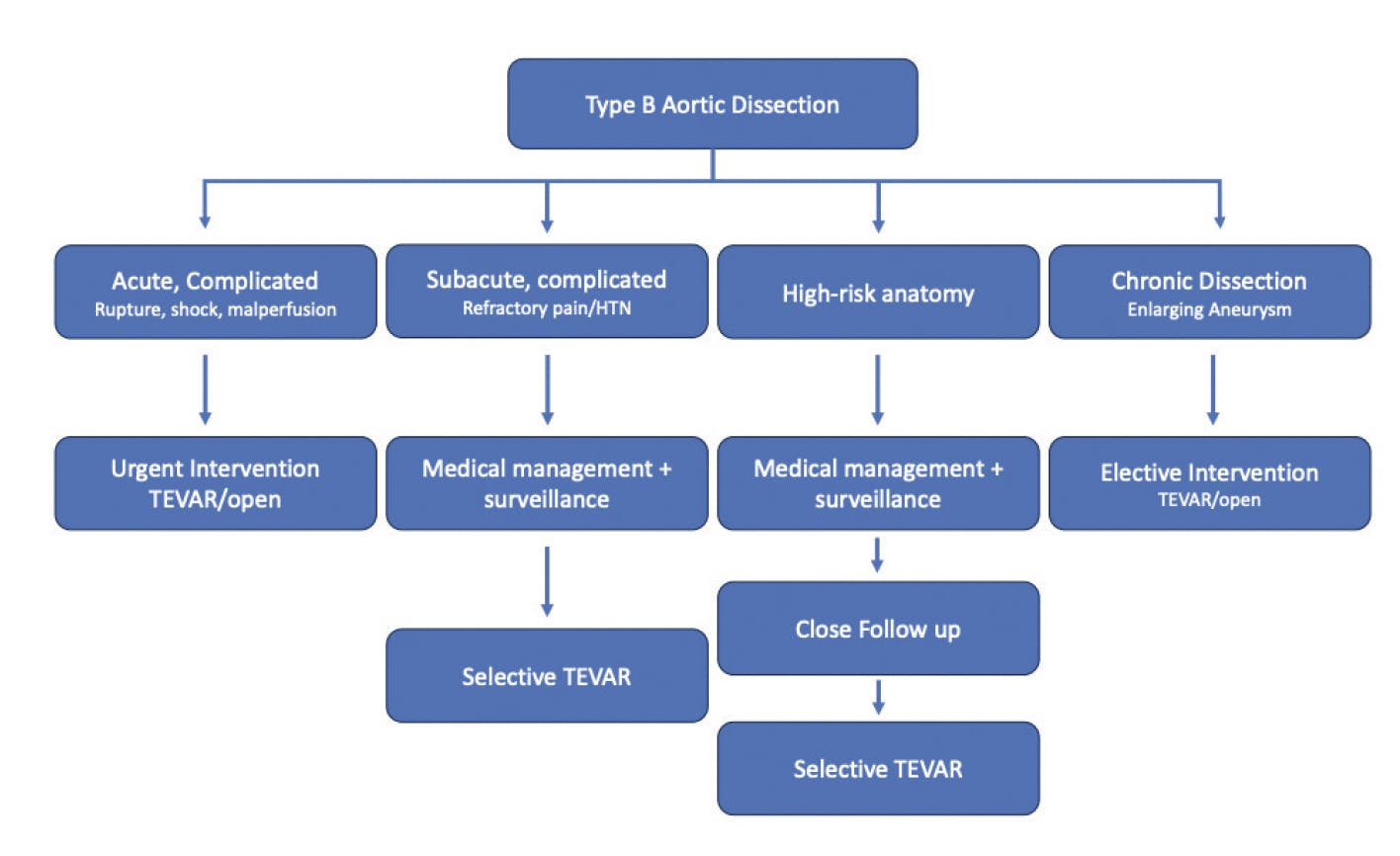
Figure 2. Treatment algorithm for TBAD. HTN, hypertension.
This case presentation discusses a patient with an uncomplicated TBAD who then had aneurysmal degeneration requiring a surgical intervention. This is not uncommon, and aortic disease must be thought of as a chronic, often progressive disease that requires regular follow-up. Furthermore, although medical management is the gold standard for an acute uncomplicated TBAD, the frequency of secondary interventions is high, reportedly between 20% and 50%.2 Therefore, there is a trend toward the prophylactic use of TEVAR for uncomplicated dissections. Two randomized trials have studied this, including the ADSORB trial, which randomized patients with acute uncomplicated TBAD to either medical therapy or medical therapy with TEVAR.3 With a follow-up of 1 year, improved aortic remodeling was observed in the TEVAR group, and the trial concluded that prophylactic TEVAR can be safely adopted for uncomplicated TBAD.4
The INSTEAD trial studied subacute and chronic TBADs and randomized patients to medical therapy versus medical therapy plus TEVAR. Long-term results demonstrated improved aortic remodeling with true lumen expansion and false lumen reduction at 5 years postoperatively. Notably, medical therapy alone demonstrated increased maximum aortic diameter with minimal aortic remodeling, and 16% of patients in the medical therapy arm required crossover to TEVAR because of adverse events.5 More studies are needed before recommending prophylactic TEVAR, but the data suggest it is safe and effective.
In conclusion, optimal medical therapy is the treatment of choice for patients with uncomplicated TBAD. In these patients, prophylactic TEVAR may be considered to reduce late aortic-related adverse events and aortic-related death. In uncomplicated TBAD, it is beneficial to delay TEVAR up to 90 days to reduce early adverse events. Finally, rigorous follow-up is imperative. If follow-up imaging demonstrates any disease progression or aortic degeneration, TEVAR or open surgery is likely indicated. For patients with a complicated TBAD, intervention is warranted. TEVAR is the gold standard if feasible.6
1. Trimarchi S, Tolenaar JL, Tsai TT, et al. Influence of clinical presentation on the outcome of acute B aortic dissection: evidences from IRAD. J Cardiovasc Surg (Torino). 2012;53:161-168.
2. Dialetto G, Covino FE, Scognamiglio G, et al. Treatment of type B aortic dissection: endoluminal repair or conventional medical therapy? Eur J Cardiothorac Surg. 2005;27:826-830. doi: 10.1016/j.ejcts.2005.02.002
3. Brunkwall J, Kasprzak P, Verhoeven E, et al. Endovascular repair of acute uncomplicated aortic type B dissection promotes aortic remodelling: 1 year results of the ADSORB trial. Eur J Vasc Endovasc Surg. 2014;48:285-291. doi: 10.1016/j.ejvs.2014.05.012
4. Brunkwall J, Lammer J, Verhoeven E, et al. ADSORB: a study on the efficacy of endovascular grafting in uncomplicated acute dissection of the descending aorta. Eur J Vasc Endovasc Surg. 2012;44:31-36. doi: 10.1016/j.ejvs.2012.03.023
5. Nienaber CA, Kische S, Rousseau H, et al. Endovascular repair of type B aortic dissection: long-term results of the randomized investigation of stent grafts in aortic dissection trial. Circ Cardiovasc Interv. 2013;6:407-416. doi: 10.1161/CIRCINTERVENTIONS.113.000463
6. MacGillivray TE, Gleason TG, Patel HJ, et al. The Society of Thoracic Surgeons/American Association for Thoracic Surgery clinical practice guidelines on the management of type B aortic dissection. J Thorac Cardiovasc Surg. 2022;163:1231-1249. Published correction appears in J Thorac Cardiovasc Surg. 2023;166:1824. doi: 10.1016/j.jtcvs.2021.11.091
Advertisement
Advertisement