Advertisement
Advertisement
August 2024
New Flow Diversion Technology: Tips and Pitfalls
Tips and pitfalls for aneurysms in small and distal vessels, flow diversion surface modification, device selection and simulation, and management of bifurcation cerebral aneurysms.
By João Victor Sanders, MD; Marion Oliver, MD; Kiffon Keigher, DNP; and Demetrius Lopes, MD
Since their introduction, flow diverters (FDs) have changed the endovascular treatment of cerebral aneurysms.1,2 For the first time, endovascular vessel reconstruction rivals the durability of open surgical repair. The initial experience with FDs was based on the treatment of giant and large wide-neck aneurysms involving the internal carotid artery (ICA).3 Over the last 15 years, we have seen incredible progress in flow diversion technology and expansion of its use for the treatment of a wider variety of cerebral aneurysms. This article outlines some tips and pitfalls for the current treatment of cerebral aneurysms with the new flow diversion technology.
TREATMENT OF ANEURYSMS IN SMALL AND DISTAL VESSELS
Tip 1 One of the areas of significant improvement in flow diversion technology is the development of low-profile devices. We recommend low-profile devices for the treatment of distal aneurysms of the circle of Willis, such as in the anterior cerebral artery/anterior communicating artery complex, the middle cerebral artery (MCA) M2 branches, and the pericallosal artery. The lower-profile FDs can be delivered from a 0.017-inch Silk Vista Baby FD system (Balt) or 0.021-inch microcatheter (Vantage [Medtronic], FRED Jr [MicroVention Terumo]), Derivo 2 [Acandis GmbH]).4 The 0.027-inch delivery system (Pipeline embolization device [Medtronic], Surpass Evolve [Stryker], p64 [Phenox], FRED [MicroVention Terumo], or Silk Vista) should be reserved for more proximal anatomy such as the ICAs, V4 segments, basilar artery, and M1 and A1 segments. The smaller microcatheters navigate the often-tortuous distal anatomy with much less difficulty, and the low-profile FDs provide a much better landing without straightening these more delicate vessels.
Pitfall 1 Sizing and perfect wall apposition are essential for successful flow diversion. The distal vessels offer a shorter runway for the delivery system wires. A common pitfall is that the distal wire can get caught in smaller branches, which has the potential to cause vasospasm or makes it extremely challenging to deploy the FD in the desired location. Consider always doing virtual, physical, and device-specific simulation of these cases (Figure 1).
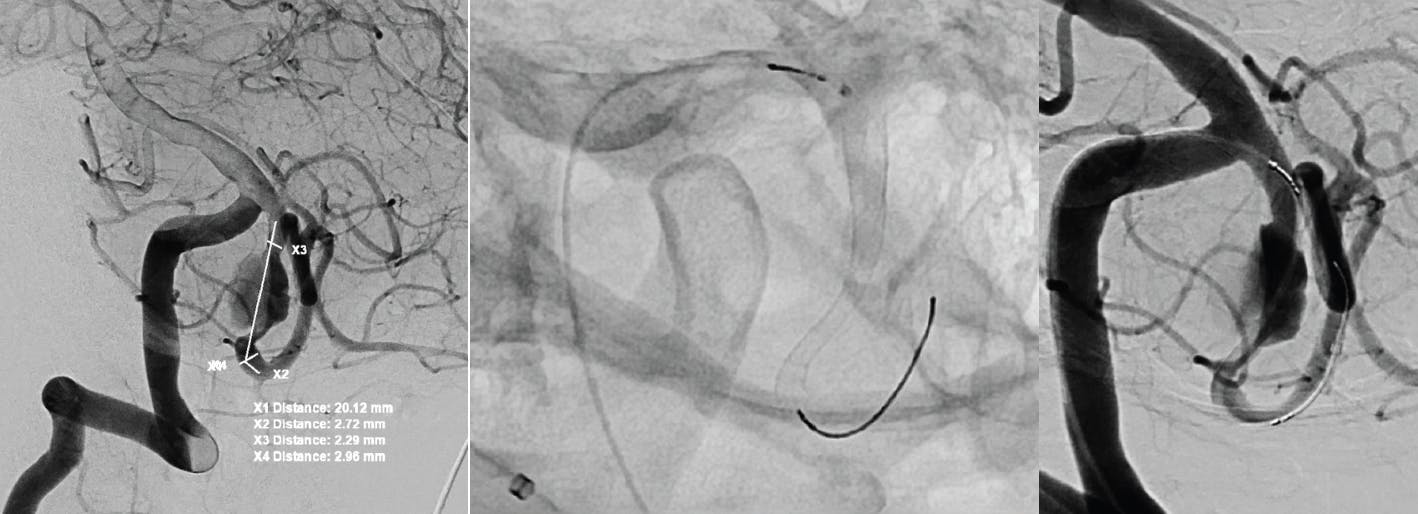
Figure 1. An example of posterior inferior cerebral artery (a small and tortuous vessel) fusiform aneurysm repaired with a surface-modified Pipeline Vantage FD to decrease the risk of a thromboembolic complication in such a challenging vessel reconstruction.
FD SURFACE MODIFICATION
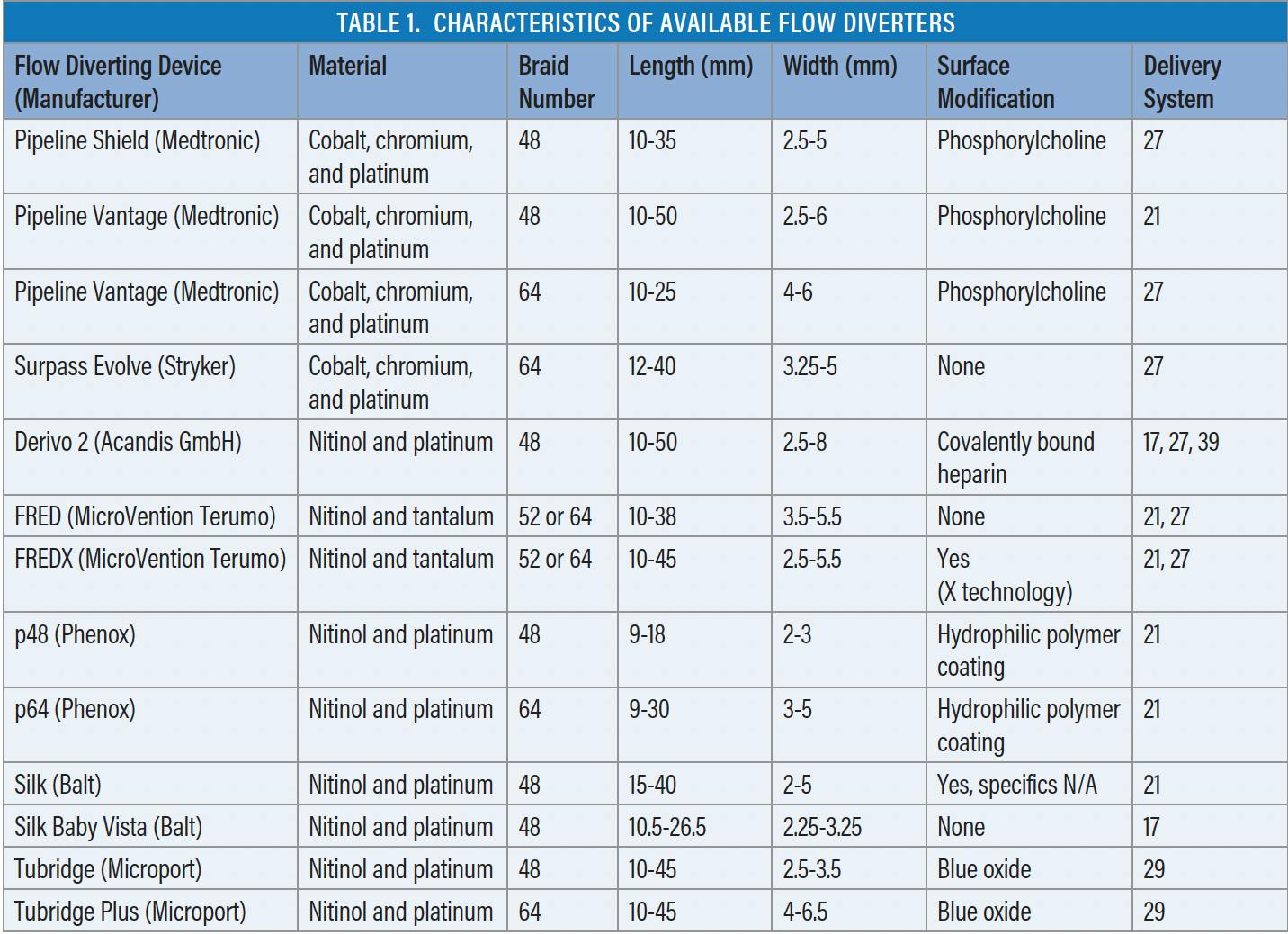
Tip 2 The new generation of FDs is designed with the mindset of using surface modification to improve their efficacy. A wide variety of strategies are available (Table 1). The new generation of surface-modified devices promises to decrease thrombogenicity, improve deployment through increased lubricity, and possibly accelerate aneurysm occlusion. Many of these observations were made in animal and in vitro studies.5
Pitfall 2 Generally, we feel at this point that it is safe and reasonable to use surface-modified devices but have not yet changed our practice regarding our traditional dual antiplatelet regimen. In cases of small distal vessels and subarachnoid hemorrhage, in theory it makes more sense to repair cerebral aneurysms with surface-modified flow diversion for the theoretical benefit of decreased thrombogenicity.
FD OPTIONS AND SIMULATION
Tip 3 The new flow diversion technology provides many options regarding material, number of braids, and sizing (width and length) (Table 1). This is extremely helpful given that aneurysms also vary widely in size and shape. The role of device-specific simulation is becoming increasingly more important to assist in selecting the best device for the condition being treated. The tendency is to use simpler constructs whenever possible. For example, one long device is likely better than multiple overlapping constructs.
Pitfall 3 It is important to be aware that different materials require significant changes in the deployment technique. In general, cobalt-chromium devices require more loading to open, whereas nitinol devices need a slow unsheathing (personal experience).
MANAGEMENT OF BIFURCATION CEREBRAL ANEURYSMS
Tip 4 With the new FDs, we have many more options for the management of bifurcation cerebral aneurysms.6 This is for sure a controversial topic. The MCA bifurcation is a classic example of anatomy that can be repaired with open surgery or various endovascular techniques, including but not limited to flow diversion. Parent vessel flow diversion with the new devices can offer a technically more straightforward repair for often-complex bifurcation lesions. The bifurcation aneurysm reconstruction with FDs usually involves bypassing the aneurysm by placing the device from the main trunk into the most anatomically eloquent branch of the bifurcation. This approach avoids dealing with the aneurysm sac and focuses on the parent vessel flow diversion.
Pitfall 4 A common concern with FDs is the need to use antiplatelets long term. Surface-modified devices are hopefully going to decrease the need for long-term use of antiplatelets and incidence of FD-related thromboembolic complications. The fate of the jailed artery is also a reasonable concern. The patency of the jailed artery depends on the presence of a flow gradient. Jailed branches with an adequate collateral arterial supply frequently undergo spontaneous, asymptomatic occlusion.7 The presence of a large, jailed branch may decrease the chances of a complete aneurysm occlusion on follow-up. In these cases, combining parent vessel flow diversion with an endovascular technique (coils, Woven EndoBridge [MicroVention Terumo], Artisse [Medtronic]) is wise to increase the chance of complete aneurysm occlusion.
1. Lylyk P, Miranda C, Ceratto R, et al. Curative endovascular reconstruction of cerebral aneurysms with the Pipeline embolization device: the Buenos Aires experience. Neurosurgery. 2009;64:632-642. doi: 10.1227/01.NEU.0000339109.98070.65
2. Fiorella D, Lylyk P, Szikora I, et al. Curative cerebrovascular reconstruction with the Pipeline embolization device: the emergence of definitive endovascular therapy for intracranial aneurysms. J Neurointerv Surg. 2018;10(suppl 1):
i9-i18. doi: 10.1136/jnis.2009.000083.rep
3. Becske T, Kallmes DF, Saatci I, et al. Pipeline for uncoilable or failed aneurysms: results from a multicenter clinical trial. Radiology. 2013;267:858-868. doi: 10.1148/radiol.13120099
4. Schob S, Hoffmann K, Richter C, et al. Flow diversion beyond the circle of Willis: endovascular aneurysm treatment in peripheral cerebral arteries employing a novel low-profile flow diverting stent. J Neurointerv Surg. 2019;11:1227-1234. doi: 10.1136/neurintsurg-2019-014840
5. Girdhar G, Ubl S, Jahanbekam R, et al. Thrombogenicity assessment of Pipeline, Pipeline Shield, Derivo and P64 flow diverters in an in vitro pulsatile flow human blood loop model. eNeurologicalSci. 2019;14:77-84. doi: 10.1016/j.ensci.2019.01.004
6. Bhogal P, AlMatter M, Bäzner H, et al. Flow diversion for the treatment of MCA bifurcation aneurysms-a single centre experience. Front Neurol. 2017;8:20. doi: 10.3389/fneur.2017.00020
7. Puffer RC, Kallmes DF, Cloft HJ, Lanzino G. Patency of the ophthalmic artery after flow diversion treatment of paraclinoid aneurysms. J Neurosurg. 2012;116:892-896. 10.3171/2011.11.JNS111612
Advertisement
Advertisement