Advertisement
Advertisement
December 2024 Supplement
Sponsored by Surmodics, Inc.
Removing Recalcitrant Arterial Emboli and Thrombi With the Pounce™ Thrombectomy Platform
A conversation with Dr. Venkatesh Ramaiah.
Vascular surgeon Dr. Venkatesh Ramaiah is Chief of Vascular and Endovascular Surgery at Osborn Hospital in Scottsdale, Arizona, and Director of Research and Innovation in the HonorHealth Network. He is also a cofounder of Pulse Cardiovascular Institute, an office-based lab and ambulatory surgical center in Scottsdale, and Chairman of the TED (Transformative Endovascular Decisions) conference. His comprehensive clinical expertise encompasses a range of vascular conditions, including peripheral artery disease and limb salvage procedures, deep vein thrombosis, complex thoracic and abdominal aortic surgeries, and advanced transcarotid artery revascularization techniques.
Since 2021, Dr. Ramaiah has included the Pounce™ Thrombectomy System (Surmodics, Inc.) in his limb ischemia toolkit. We spoke with Dr. Ramaiah about his approach to treating acute limb ischemia (ALI) and his experience with the Pounce™ System.
Has your treatment of ALI changed since you begin practicing?
It has. I began treating limb ischemia in 1997 during my fellowship. Back then, we primarily treated it with open surgery. Now, our approach is more endovascular. If the patient’s leg is in immediate jeopardy, we are still likely to go right to open surgery as the fastest route to revascularization. However, if the patient’s leg is viable and not completely insensate, we evaluate the endovascular option, or sometimes a combination of endovascular and open repair. If the endovascular approach doesn’t work, we can always proceed with an open operation.
How do you approach percutaneous thrombectomy in ALI?
Starting with the basics, we’ll usually go up and over from the contralateral leg. So, if the left leg is ischemic, we’ll access the right groin and perform angiography in the right leg for comparison, then advance across the aortic bifurcation and obtain a diagnostic angiogram. Once we get a wire across the occlusion and confirm true lumen, it’s time to decide which thrombectomy device to use. That decision depends on the patient and the acuity of the clot.
If the clot is fresh—say, less than a week old—an aspiration device may be able to suction it all out. For older clot or that sticky, fibrotic material you see in emboli associated with atrial fibrillation, I’ve found the Pounce™ Thrombectomy System works very well.1 Of course, the Pounce™ Platform also works well in removing acute thrombus. Nonetheless, some operators may choose to use aspiration to clear acute thrombus from a lesion before using the Pounce™ Platform because they’d prefer not to lose wire access. If so, clearing acute clot first opens a channel that facilitates returning a wire if needed.
Why did you first begin using the Pounce™ Thrombectomy Platform?
One of the first applications was in occluded prosthetic bypass grafts. Now, if a patient’s graft has occluded on the day of the procedure or the day before, suction thrombectomy may be all you need to remove that fresh clot. But in these types of occlusions, there is often fibrotic clot distal to the acute clot, at the anastomosis, where the wider graft meets the narrower artery. There may also be narrowing in that artery from intimal hyperplasia, with sticky, organized material stuck in the narrowing and perhaps in downstream vessels as well.
In the past, when we used the Indigo® Thrombectomy System (Penumbra, Inc.), we’d often find it would leave that sticky, more organized material sitting right at the anastomosis. We’d put in balloons, do other things, but it would never come out, just move to the side. In this situation, we found that a Pounce™ Thrombectomy device could be phenomenal, because the two baskets, which are very good, could often drag out that irritating piece of sticky clot rather easily. Eventually, we started using the Pounce™ System alone rather than using it in combination with suction.
Are there some circumstances when you would choose not to use mechanical thrombectomy for an occluded bypass?
I would hesitate to use any mechanical thrombectomy device, including the Pounce™ System, as primary treatment in a native bypass graft because I believe these grafts are susceptible to damage from mechanical thrombectomy. In these cases, I’m more likely to try rapid thrombolysis first, meaning I’ll cross the occlusion and put in an EKOS™ thrombolytic catheter (Boston Scientific Corporation) for 2 to 4 hours in the recovery room, then bring the patient back for a second look. This kind of rapid thrombolysis will often clear out 80% or 90% of the thrombus, and I can generally remove the rest with aspiration or mechanical thrombectomy. This approach helps the patient avoid an overnight stay in the intensive care unit for thrombolysis while using a much lower thrombolytic dose than standard catheter-directed thrombolysis.
Summing up, where does the Pounce™ Platform fit into your current ALI toolkit?
To me, the strength of these devices is removing clot from native vessels, particularly for emboli. Again, this is not acute clot, but fibrotic material that does not lend itself to suction thrombectomy. The Pounce™ Platform can also be very good when other approaches fail and you don’t want to convert the patient to an open operation or do thrombolysis.
1. Gray BH, Wheibe E, Dicks AB, et al. Pounce thrombectomy system to treat acute and chronic peripheral arterial occlusions. Ann Vasc Surg. 2023;96:104-114. doi: 10.1016/j.avsg.2023.05.019-
Caution: Federal (US) law restricts the Pounce™ Thrombectomy System to sale by or on the order of a physician. Please refer to the product’s Instructions for Use for indications, contraindications, warnings, and precautions. SURMODICS, POUNCE, and SURMODICS and POUNCE logos are trademarks of Surmodics, Inc. and/or its affiliates. Third-party trademarks are the property of their respective owners.
CASE REPORT
Removal of a Common Femoral Arterial Thrombus With the Pounce™ Thrombectomy System
By Venkatesh Ramaiah, MD, FACS
Patient Presentation
A female patient in her late 80s presented to the hospital with complaints of progressive claudication and rest pain in the left lower extremity. She reported worsening symptoms over the past week, with increased pain during ambulation and decreased ability to perform daily activities. Patient history included diabetes mellitus, atrial fibrillation, hypertension, and known peripheral vascular disease. Physical examination revealed diminished pulses in the left lower extremity, with the left foot observably cooler than the right. No active ischemic changes such as ulcers or gangrene were noted. Patient underwent a duplex ultrasound that confirmed near-total occlusion of the common femoral artery (CFA). Given her worsening symptoms and history, further vascular investigation was warranted.
Diagnostic Findings
A left lower extremity angiogram was performed to assess underlying arterial pathology. The angiogram revealed an acute subtotal occlusion of the CFA, with significant thrombus burden visualized at the site of the occlusion (Figure 1). Given the presence of the thrombotic occlusion, the decision was made to attempt an endovascular intervention for revascularization. An open-surgical approach was also considered.
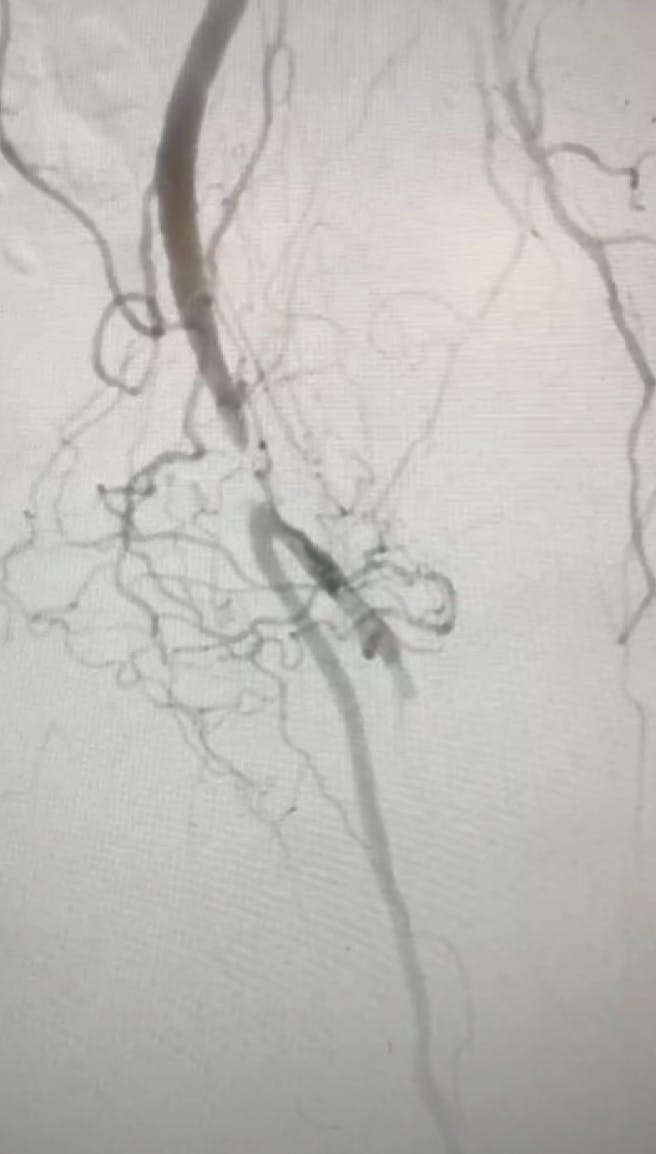
Figure 1. Angiogram revealing acute subtotal CFA occlusion with significant thrombus burden.
Treatment
A 7 Fr, 45 cm sheath was placed and the Pounce™ Thrombectomy System* (Surmodics, Inc.) was prepared. The Pounce™ System baskets were deployed in the superficial femoral artery (SFA) with the funnel proximal to the occlusion. A first pass was made, removing thrombus and establishing a degree of flow. The Pounce™ Thrombectomy System baskets were then placed in the profunda femoris artery (PFA), with the funnel again placed proximal to the occlusion, and a second pass was made. More thrombus was removed, further improving blood flow.
After the thrombus was removed, a postprocedural angiogram revealed underlying stenosis in the proximal femoral artery. This was treated with a 7 X 40 mm Evercross™ PTA Catheter (Medtronic), which was inflated to dilate the stenotic segment and restore adequate arterial flow.
A final angiogram showed improved flow through both the CFA and PFA, with no residual stenosis or thrombus and restoration of brisk flow to the lower extremity (Figure 2).
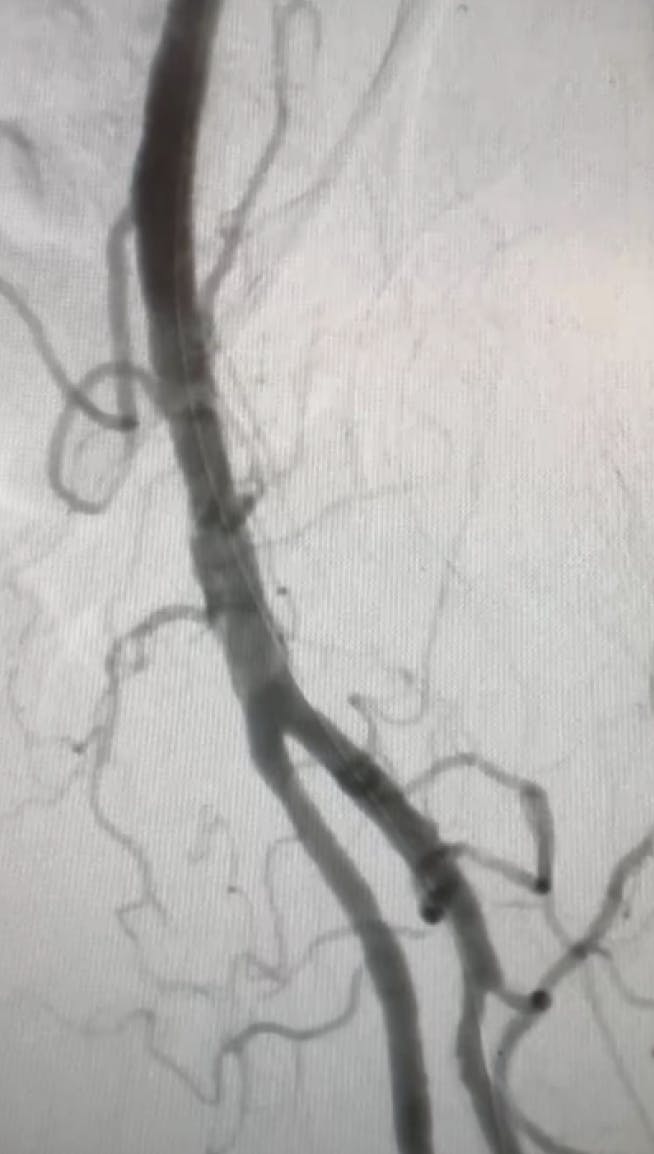
Figure 2. Final angiogram showing brisk CFA and PFA flow with no residual stenosis or thrombus.
Postprocedure Outcome
The patient was discharged the next day after the intervention with prescribed medication. Endovascular thrombectomy with the Pounce™ Thrombectomy System combined with balloon angioplasty was effective in restoring blood flow to the affected limb, with a favorable postprocedure outcome.
*The indicated vessel range for the Pounce™ Thrombectomy System is 3.5-6 mm.
Caution: Federal (US) law restricts the Pounce™ Thrombectomy System to sale by or on the order of a physician. Please refer to the product’s Instructions for Use for indications, contraindications, warnings, and precautions. SURMODICS, POUNCE, and SURMODICS and POUNCE logos are trademarks of Surmodics, Inc. and/or its affiliates. Third-party trademarks are the property of their respective owners.

Advertisement
Advertisement