Advertisement
Advertisement
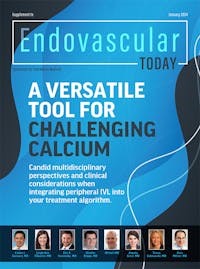
January 2024 Supplement
Sponsored by Shockwave Medical
Intravascular Lithotripsy: Cracking the Code in Peripheral Arterial Calcification

As physicians dealing with patients with peripheral artery disease are all too aware, the presence of significant vascular calcification can not only limit the chance of achieving an optimal result during revascularization procedures, but it is also linked with longer-term poor outcomes including need for major amputation. Despite utilization of a variety of plaque modification and atherectomy tools, physicians’ ability to fully address medial calcification, the predominant histopathologic disease process in lower limb arterial calcification, has hitherto remained limited.
Intravascular lithotripsy (IVL), the delivery of high-energy acoustic pressure waves to fracture plates of arterial calcification and thereby favorably alter blood vessel compliance, has been demonstrated to be effective in modifying both superficial and medial calcification, providing a potential mechanistic advantage over conventional atherectomy techniques that can only impact the superficial calcium they can physically contact. IVL, delivered through a dedicated portfolio of balloon platforms containing emitters to generate acoustic pressure “shock” waves, combines ease of use with clinical trial–demonstrated safety and efficacy in the treatment of calcific peripheral artery disease.
The versatility of IVL in calcium modification across a range of vascular beds was outlined in the DISRUPT PAD III observational study and is confirmed by the cases reported and discussed in depth by expert endovascular interventionalists in this supplement. First, Carlos Guevara, MD; Leigh Ann O’Banion, MD; and Eric Secemsky, MD, present a series of calcific femoropopliteal interventions in chronic total occlusions, highlighting the ability of IVL technology to assist not only in the acute restoration of in-line flow to the foot in these highly complex clinical scenarios, but also to achieve and maintain the long-term patency necessary for wound healing. Next, Charles Briggs, MD, and JD Corl, MD, discuss the challenges of treating heavily calcified iliac arteries with currently available techniques and outline the unmet needs that have been addressed by the new Shockwave L6 peripheral (IVL) platform, specifically designed with a compact array of six emitters in a range of larger-diameter balloons. Finally, Angela Giese, MD; Trissa Babrowski, MD; and Ross Milner, MD, present the evolving paradigm of adjunctive IVL use to treat calcified access arteries in the setting of large-caliber EVAR and TEVAR procedures and demonstrate its utility in streamlining and simplifying such interventions.
Examples such as these case discussions highlight the range of clinical scenarios in which IVL can be the difference-maker, providing a simple but highly effective therapy to address the difficult problem of lower limb arterial calcification. Our ongoing trial work in the infrapopliteal space (DISRUPT BTK II), alongside novel developments designed to enhance and evolve our current technology, to provide new solutions for different lesion types, and in different vascular beds, emphasize our commitment to the endovascular space—and to providing physicians and their patients with safe, effective, and evidence-based solutions for cracking the code of calcific vascular disease.
Nick West, MD
Associate Chief Medical Officer
Shockwave Medical
Advertisement
Advertisement