Advertisement
Advertisement
July 2024
The Critical Role of Inflammation in Deep Vein Thrombosis
Understanding the physiology and complex mechanisms involved in the development of venous thrombosis and the role of inflammation.
By Alexandra Murillo Solera, MD, and José Antonio Diaz, MD, FAHA
Venous thrombosis results from the interrelation of many complex pathologic mechanisms. Understanding basic physiology and the progressive changes into a disease state is important for researchers and clinical practitioners to advance toward new pharmacologic targets and treatments, including device development. During deep vein thrombosis (DVT), a thrombus is formed and grows inside the deep veins; these thrombi can block circulation partially or completely, and swelling, redness, warmth, and pain are part of the clinical presentation.1 There are many mechanisms involved in the development of the disease. Virchow's triad reflects the participation of the endothelium (vein wall), venous stasis, and hypercoagulability (on the lumen side). Recent discoveries highlight the role of inflammation induced by endothelial activation, which is one of the triad components.
It is known that components of the inflammatory system participate in the initial process of the innate immune system in its early acute phase, which, at first, is a protective mechanism. Additionally, similar components of the inflammatory process participate in the acute inflammatory phase followed by a chronic inflammatory phase independent of the immune system. If uncontrolled, inflammation can lead to tissue changes over time. Specifically, inflammation significantly contributes to the development and progression of venous thrombosis.1 Using experimental venous thrombosis models, we determined an acute and chronic inflammatory phase that overlaps with acute and chronic venous thrombosis using a preclinical model.2 Inflammation plays a role in venous thrombosis, and this article summarizes the inflammatory mechanisms involved in venous thrombosis (Figure 1).
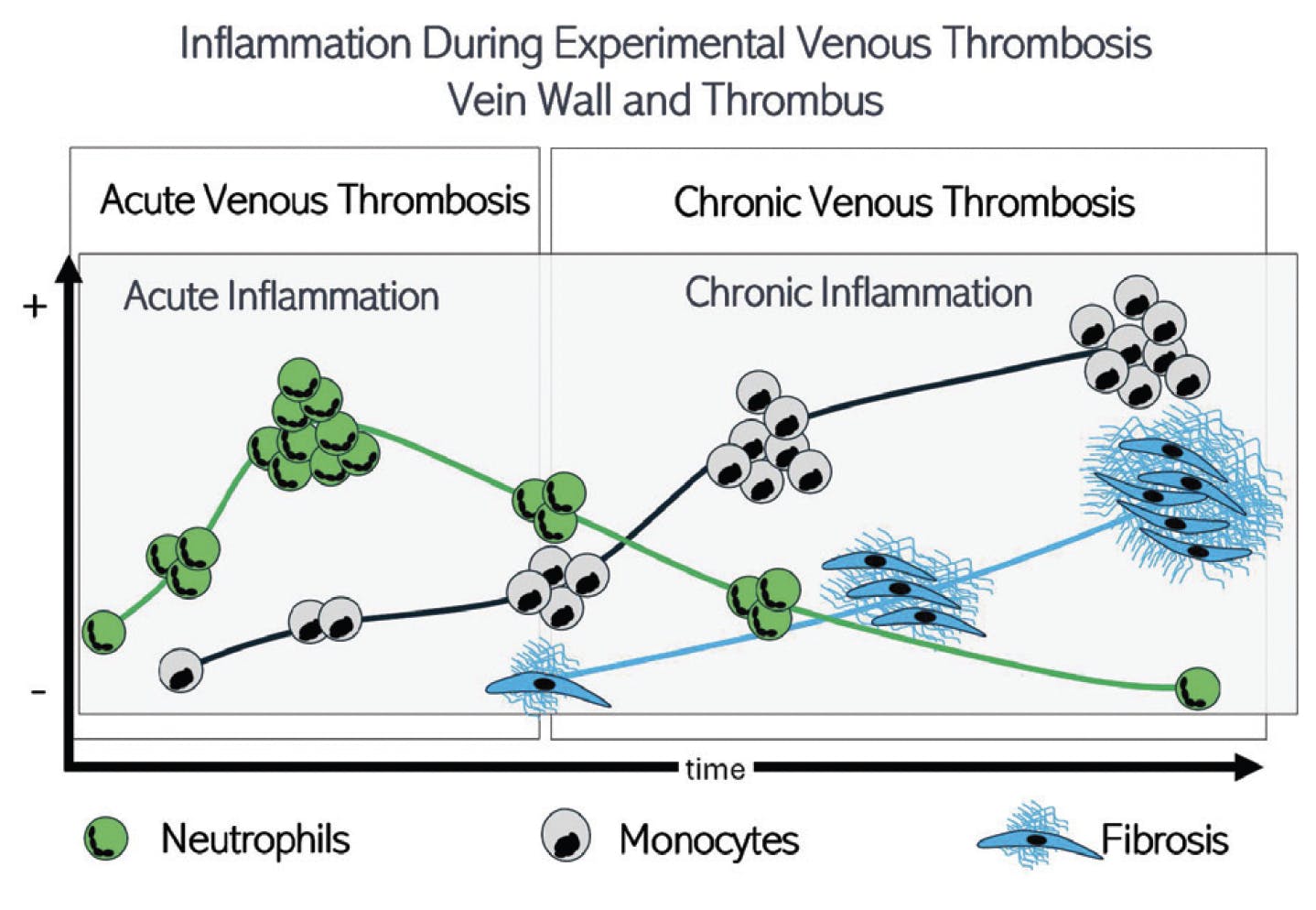
Figure 1. Inflammatory mechanisms involved in venous thrombosis. Acute inflammation led by neutrophils overlaps with acute experimental DVT. Chronic inflammation led by monocytes overlaps with experimental chronic DVT.
ENDOTHELIUM
Understanding venous thrombosis requires examination of a healthy vein, the vein wall, and the blood circulating within the lumen. The vein wall and the blood are tissues with similar constitutive elements, including but not limited to proteins, cells, water, ions, chemicals, chemical reactions, coagulation factors (in the blood), or factors that induce coagulation (in the vein wall). These elements interact metabolically under a relatively stable equilibrium maintained by physiologic processes. Disruption in this balance in the vein wall or the blood flow may trigger thrombus formation.
The surface of the vein wall in contact with the blood is the endothelium, which—when intact—plays an important role in maintaining the balance between procoagulant and anticoagulant mechanisms.1 Under normal conditions, endothelial cells play an antithrombotic role, and thrombomodulin, protein C, heparin sulfate, and dermatan sulfate—which increase antithrombin and heparin cofactor II activity—are natural anticoagulants responsible for this endothelial function.3 Additionally, nitric oxide and prostacyclin are produced, leading to vasodilation, reduced adhesion, and activation of leukocytes.3
Hypoxia Can Activate the Endothelium, Leading to Inflammation and Thrombosis
Endothelial cells are thought to have a role in a “resting” state characterized by anti-inflammatory and antithrombotic properties.4 Microenvironment changes can induce a shift in the endothelial cells from resting to active. During this “active” state, which is observed during experimental DVT, there is an increase in the expression of cell adhesion molecules like P-selectin,5 E-selectin, and ICAM-1, facilitating the adhesion and activation of leukocytes and platelets, promoting thrombosis.4 The question then is, what stimulates those endothelial cells? The answers are many. However, a hypothesis could be proposed from our current knowledge of the flow dynamics in the vein valve.4
The blood flow dynamics within the veins provide critical insights into both avoiding and promoting thrombus formation, particularly within the vein cusps.4,6 There are dual vortexes in vein valves: a primary vortex that creates a spinning motion facilitating blood movement through the vein, and a secondary smaller vortex that spins in the opposite direction distal to the primary vortex.4,6 This smaller secondary vortex is considered a “trapped” vortex. A trapped vortex could entrap red blood cells (RBCs) and create a hypoxic environment for the endothelial cells in that area.4 Hypothetically, entrapment of RBCs (the source of oxygenation for the adjacent cells, including endothelial cells) in a vortex could shift the oxyhemoglobin curve, affecting oxygen affinity.4 Under normal circulation conditions, a rightward shift of the oxyhemoglobin curve releases oxygen. However, if RBCs are trapped in a vortex and not renewed, it could be possible that the neighboring endothelial cells will be deprived of oxygen, and the pH will increase in the small vortex microenvironment.4 This creates an environment where oxygen levels are insufficient for endothelial cells, leading to their activation and dysfunction—or in other words, switching from a “resting” to an “active” state, ultimately resulting in prothrombotic processes.4
It is known that endothelial cell activation involves the exocytosis of Weibel-Palade bodies, releasing their content, including von Willebrand factor (vWF), and exposing P-selectin. This facilitates platelet adhesion (a P-selectin source in great amount) and leukocyte trafficking.2,7,8 Thus, this process induces the procoagulant mechanism engaged with inflammation and highlights the role of platelets in this initial process of venous thrombosis, a commonly forgotten component during venous thrombus formation. We cannot be too far from reality, expressing that, in this setting, platelets serve as P-selectin donors more than a hemostatic plug. This platelet–endothelial cell platform allows the interaction between the coagulation system and inflammation.
Once inflammation is initiated, we can see histologically in experimental venous thrombosis an initial inflammatory acute phase led by neutrophils in the vein wall and the thrombus that correlates with acute venous thrombosis. As time progresses, a shift of the dominant cells from neutrophils to monocytes occurs. Monocytes populate both the vein wall and the thrombus, and there are fewer neutrophils. This histologic feature defines chronic inflammation. Interestingly, we observed those chronic features in the context of chronic venous thrombosis (Figure 1).
INFLAMMATION MAY FAVOR Thrombosis but Also Recanalization
The role of inflammation is critical, but we shouldn’t think it is all bad. The role of polymorphonuclear (PMN) cells has a luminal event and a wall event. In the lumen, PMN contributes to neutrophil extracellular traps (NETs), which are actively involved in trapping elements of the circulating blood like an actual net. NETs are large webs of DNA and decondensed chromatin that can trap bacteria and bind pathogenic microbes. They can also provide a scaffold for platelets, RBCs, and procoagulant molecules, such as tissue factor and vWF. Recent studies showed that NETs can activate intrinsic and extrinsic coagulation pathways. For example, NETs can expose tissue factor under the endothelium to the vascular lumen, initiating the extrinsic coagulation pathway. NETs can also degrade tissue factor inhibitor, which is an extrinsic pathway inhibitor. In addition, NETs promote the formation of peripheral blood fibrin and thrombin through the intrinsic pathway of coagulation.9
Some PMN cells migrate into the vein wall and lead a series of events mediated by the production of cytokines and chemokines. MCP-1 attracts mononuclear cells to the wall, which will induce fibroblast stimulation and produce transforming growth factor β, leading to remodeling in the vein wall and thrombus toward fibrosis. Monocytes may lead to changes toward postthrombotic fibrosis status in the wall and thrombus or may lead to recanalization of the thrombus by phagocytosis of its components; generation of new capillaries in the thrombus (angiogenesis); and, in some instances, recanalization—the restoration of the patent vessel along the original vessel.10
If inflammatory mechanisms may help recanalize a thrombus, the inflammatory processes may have a dual role. Restoring the lumen may also be a component of the inflammatory process. Thus, the idea of "balance" in inflammation is critical. A persistent stimulation and/or excessive inflammatory response may determine a prolonged chronic inflammatory state. Macrophages are also responsible for this complex scenario, and the differentiation into M1 and M2 populations may open the door to a new understanding of the role of these two macrophage populations: The M1s or the cells that promote chronic inflammation versus the M2 or those macrophages that repair the affected tissue. More information will come about the importance of the role of those subpopulations.
CONCLUSION
A hypothesis states that the blood flow characteristics within the vein valves promote hypoxia locally. Hypoxia may be the activator of the endothelial cells. Data support that endothelial activation contributes to DVT. Once activated, the endothelial cells lead to inflammation and thrombosis. The role of inflammation should be understood as critical in determining the outcome of a DVT scenario, toward postthrombotic fibrosis or thrombus recanalization.
1. Diaz JA, Myers DD Jr, Wakefield TW. Fundamental mechanisms in venous thrombosis: New insights. In: Bergan JJ, Bunke-Paquette N, eds. The Vein Book. Oxford University Press; 2014:268-275.
2. Palmer OR, Shaydakov ME, Rainey JP, et al. Update on the electrolytic IVC model for pre-clinical studies of venous thrombosis. Res Pract Thromb Haemost. 2018;2:266-273. doi: 10.1002/rth2.12074
3. Diaz JA, Henke PK. Venous pathophysiology. In: Sidawy AN, Perler BA, eds. Rutherford’s Vascular Surgery and Endovascular Therapy. 9th ed. Elsevier; 2018:97-104.
4. Mosquera MS, Diaz JA. Back to basics: theory of thrombus formation and potential implications for therapies? Tech Vasc Interv Radiol. Published online August 6, 2023. doi: 10.1016/j.tvir.2023.100894
5. Diaz JA, Wrobleski SK, Hawley AE, et al. Electrolytic inferior vena cava model (EIM) of venous thrombosis. J Vis Exp. 2011;53:e2737. doi: 10.3791/2737
6. Lurie F, Kistner RL. On the existence of helical flow in veins of the lower extremities. J Vasc Surg Venous Lymphat Disord. 2013;1:134-138. doi: 10.1016/j.jvsv.2012.08.002
7. Diaz JA, Hawley AE, Alvarado CM, et al. Thrombogenesis with continuous blood flow in the inferior vena cava: A novel mouse model. Thromb Haemost. 2010;104:366-375. doi: 10.1160/TH09-09-0672
8. Diaz JA, Alvarado CM, Wrobleski SK, et al. The electrolytic inferior vena cava model (EIM) to study thrombogenesis and thrombus resolution with continuous blood flow in the mouse. Thromb Haemost. 2013;109:1158-1169. doi: 10.1160/TH12-09-0711
9. Zhang S, Cao Y, Du J, et al. Neutrophil extracellular traps contribute to tissue plasminogen activator resistance in acute ischemic stroke. FASEB. 2021;35:e21835. doi: 10.1096/fj.202100471RR
10. Han Z, Liu Q, Li H, et al. The role of monocytes in thrombotic diseases: a review. Front Cardiovasc Med. Published online June 2, 2023. doi: 10.3389/fcvm.2023.1113827
Advertisement
Advertisement