Advertisement
Advertisement
June 2024
Sponsored by Imperative Care, Inc.
Clinical Experience With the Zoom Stroke Solution™ at Alaska’s First Comprehensive Stroke Center
Lucy He, MD, FAANS, discusses the evolution of her stroke practice with the adoption of the Zoom Stroke Solution and outlines a case using the device in treating a large vessel occlusion in the ICA.

I am one of the partners at Anchorage Neurosurgical Associates, Inc., and practice at Alaska Regional Hospital, the state’s first comprehensive stroke center certified by Det Norske Veritas. Along with another hospital in the Anchorage area, we cover the entire state of Alaska for stroke intervention. In our estimation, we treated nearly 70% of the ischemic strokes in the state in 2023. Since I started practicing in Alaska in 2018, the number of stroke patients treated has steadily increased, and we expect to treat about 115 patients in the coming year.
The primary challenge for stroke intervention in Alaska is the extended time to treatment for our patients. About two-thirds of our stroke interventions are transferred from outside facilities, with transport times often exceeding 2 hours. As a result, we are often limited in treatment options due to the prolonged period of time between stroke onset and seeing the patient in our facility.
STROKE TREATMENT EVOLUTION
Since my training in Nashville and Boston, I have seen rapid advances in ischemic stroke treatment technology, especially with aspiration thrombectomy catheters. During my training, I exclusively employed a combination technique (ie, thrombectomy using a traditional stent retriever coupled with an aspiration catheter). These cases had longer procedure times, required more devices, and were more costly. When I started in a private practice in 2018, I had transitioned to an aspiration-first approach using large-bore aspiration catheters. By creating a protocol that was straightforward and simplified for stroke intervention, we were able to achieve a reduction in case times and cost.
Adoption of the Zoom Stroke Solution and Impact on Practice
Tortuous anatomy and large clot burden, especially in the internal carotid artery (ICA) terminus, remain the most frustrating challenges, creating the need for multiple devices and passes to retrieve the entire clot and thus increasing time to reperfusion. Because of these challenges, I had been seeking a more navigable and larger-bore stroke aspiration system. That’s when I was introduced to the Zoom devices (Imperative Care, Inc.).
At first, the approach of using angled-tip catheters and taking a large-bore 0.088-inch access catheter into the intracranial space seemed far-fetched to me. When using Zoom for the first time, I immediately noticed the softness of the tip in my hands. Not only did I find it safe to use, but I also discovered that the angled-tip improved navigability. I started by using the Zoom 71 or Zoom 55 and Zoom 35 Aspiration Catheters with a traditional long sheath placed extracranially. These early cases showed me how flexible and trackable Zoom catheters were. Then, I tried the Zoom 88 and was impressed with how easy it was to access the intracranial anatomy and the support it provided for my thrombectomy system. Intracranial access with the Zoom 88 is now foundational in setting my stroke procedures up for success.
We have also started using the Zoom POD for clot capture and have benefitted from the clear confirmation of clot ingestion in the sterile field without having to fish through canisters for the clot. Adding in the various components of the Zoom system (Figure 1) has given me an appreciation of how thoughtfully the parts have been designed to work together.
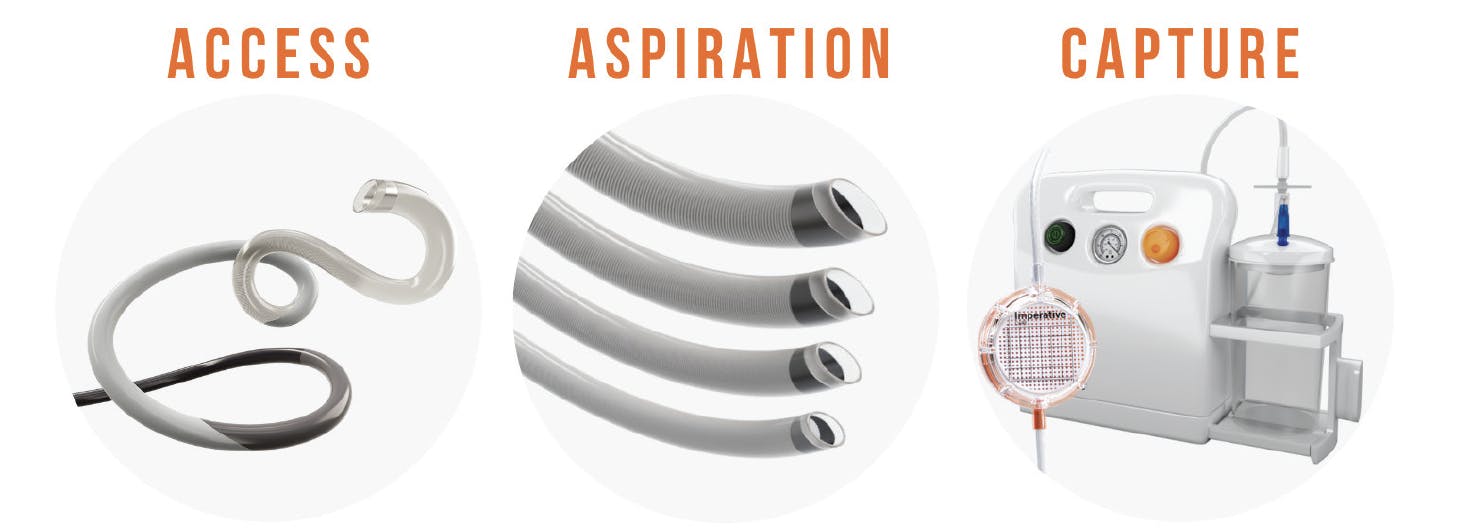
Figure 1. The Zoom Stroke Solution is a complete system for treating ischemic strokes. The Zoom 88, Zoom 88 Support, and Zoom RDL Radial Access System allow physicians to access intracranial anatomy and get closer to the clot. The Zoom 35, 45, 55, and 71 Aspiration Catheters with the angled TRX™ Tip are purposefully designed for fast and effective clot ingestion across a range of vessels. The Zoom Pump and Zoom POD™ provide the strongest-in-class vacuum pump and sterile field clot capture, providing physicians with rapid verification of clot ingestion.
ZOOM STROKE SOLUTION BENEFITS
An ischemic stroke system for mechanical thrombectomy must do two things well to successfully treat a patient: (1) It needs to be able to smoothly navigate to the clot, and (2) it needs to remove the clot quickly and effectively with the least number of attempts. Our adoption of the Zoom Stroke Solution has hit these two points and has reduced my procedure times significantly, with an average case time reduction of over 40 minutes. Other centers have also reported a reduction in procedure times with the Zoom angled-tip aspiration catheters compared to flat-tip catheters.1 Our overall cost has also been reduced as a result of not having to open multiple catheters or adjunctive devices.
In stroke cases, every turn I come across is a potential point where the clot can be lost while pulling back on the aspiration catheter. I’ve found that climbing higher into the intracranial anatomy with Zoom 88 can provide better control and flow arrest—especially in tortuous anatomy—and can limit the risk of losing clot while reducing overall procedure times.
In about half of our cases, and depending on the anatomy, I am able to simplify my setup and forgo using a microcatheter or Zoom 35 and navigate to the clot using only Zoom 88, Zoom 71, and a guidewire. I expect that we will be able to take this approach more and more as we get increasingly comfortable navigating large-bore catheters and overcome the reflexive habit of leading with something small as we learned in training.
I am impressed with how effectively the Zoom catheters can ingest clots, especially large ICA terminus clots. With other devices, I would need to do multiple passes to remove ICA terminus clots, but with the angled-tip, I’m getting better clot ingestion and can usually clear multiple clots with a single pass, which saves significant time.
CASE STUDY
A woman in her mid 60s was transferred to Alaska Regional Hospital after experiencing a stroke during physical therapy following a total knee replacement. We were fortunate to have good weather, which allowed for transportation via helicopter in < 1 hour and one of the fastest transport times I had seen from the region (standard flight time is approximately 2.5 hours minimum). Imaging showed clot all the way from the horizontal petrous to the M1 artery (Figure 2).
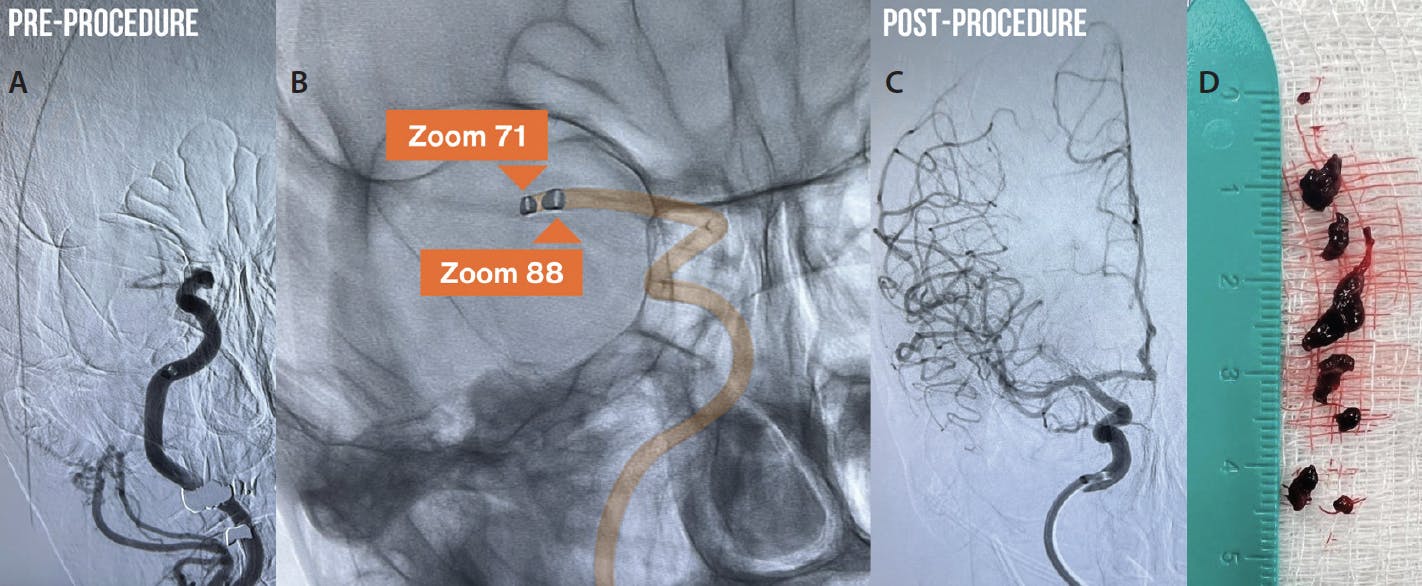
Figure 2. A Zoom Stroke Solution case study: Initial imaging showed a large vessel occlusion in the right ICA terminus (A). The Zoom 88 was deployed close to the clot, providing intracranial access in the M1 artery (B), and aspiration of the clot with Zoom 71 resulted in TICI 3 reperfusion (C). The clot recovered spanned the horizontal petrous all the way to the M1 artery (D).
We accessed the vasculature through the femoral artery using an 8-F sheath and navigated the Zoom 88 intracranial access catheter, Zoom 71, and Zoom 35 over a Fathom-14 Guidewire (Boston Scientific Corporation). Zoom 88 was able to navigate all the way to the M1 artery, providing considerable support for my aspiration system and flow arrest, and a thrombolysis in cerebral infarction (TICI) 3 result was achieved (Figure 2).
The patient showed rapid recovery, improving from a National Institutes of Health Stroke Scale score of 20 to 0 at 24 hours post-thrombectomy. Recovery went smoothly for this patient and she recently had her second knee replaced.
CONCLUSION AND THOUGHTS ON THE FUTURE
Treating stroke patients with the Zoom Stroke Solution has been overwhelmingly positive for our practice. The Zoom system has allowed for greater navigability and improved control of the procedure with intracranial access. Furthermore, clot ingestion is efficient—I’m able to get most clots with a single attempt. As a result, we have been able to complete our mechanical thrombectomy procedures faster and reduce procedure costs.
As the field moves forward, I’m excited to see how factors in patient transport, such as those recently reported in the ZODIAC trial,2 may help outcomes. Lengthening the treatment windows for thrombolytics and thrombectomies will have a large impact on my practice given the transportation hurdles in Alaska.
1. Vargas J, Majidi S, Hawk H, et al. Factors associated with improved technical outcomes when using 0.068‐ to 0.074‐inch aspiration catheters: analysis from a multicenter retrospective cohort. Stroke Vasc Interv Neurol. Published online April 18, 2023. https://doi.org/10.1161/SVIN.122.000580
2. International Stroke Conference Coverage. ZODIAC, RESILIENT-Extend and MOST late-breaking science presented. February 7, 2024. Accessed May 8, 2024. https://isc.hub.heart.org/isc-24/article/22886343/zodiac-resilientextend-and-most-latebreaking-science-presented
For important safety and risk information, visit https://bit.ly/3yWkfEJ.
Rx only.
The Zoom 88 Large Distal Platform and Zoom 88 Support Large Distal Platform are indicated for the introduction of interventional devices into the peripheral, coronary, and neurovasculature.
The Imperative Care Zoom RDL Radial Access System is indicated for the introduction of interventional devices into the peripheral, coronary, and neuro vasculature.
The Zoom Aspiration Catheters, with the Zoom Aspiration Tubing Set and Zoom Aspiration Pump (or equivalent vacuum pump), are indicated for use in the revascularization of patients with acute ischemic stroke secondary to intracranial large vessel occlusive disease (within the internal carotid, middle cerebral – M1 and M2 segments, basilar, and vertebral arteries) within 8 hours of symptom onset. Patients who are ineligible for intravenous tissue plasminogen activator (IV t-PA) or who fail IV t-PA therapy are candidates for treatment.
Results may vary.
Advertisement
Advertisement