Advertisement
Advertisement
June 2024
Sponsored by Medtronic
Proximal Embolic Protection With the Mo.Ma Ultra™ Device: A “Must Know How” for Competent Carotid Artery Stenting

Carotid artery stenting (CAS) is a minimally invasive technique in primary and secondary prevention of carotid-related stroke.1 CAS is a reasonable alternative to carotid endarterectomy for patients who are considered high risk for carotid surgery due to medical comorbidities or anatomic features. Moreover, CAS is increasingly applied in emergency endovascular treatment of acute carotid-related stroke.2,3
Because any manipulation of the atherothrombotic carotid plaque generates embolic material, both CAS and carotid surgery are embologenic. Unprotected CAS carries the risk of cerebral embolism at each key stage of the procedure, from lesion crossing with a wire and through stenosis predilatation, stent positioning and implantation, and stent postdilatation.4 Evidence from large registries indicates that patients receiving CAS without cerebral protection have a more than fourfold-higher risk of periprocedural stroke, regardless of the stenting technique used.5,6
Several cerebral embolic protection strategies have been developed to improve the safety of CAS, including distal filter devices and transient flow arrest/reversal devices.4,7 Studies indicate an important role for proximal cerebral protection by transient flow arrest or reversal in reducing the risk of cerebral embolism in both elective and emergency CAS.3,8,9
The Mo.Ma Ultra™ proximal cerebral protection device (Medtronic) is a commercially available balloon occlusion system that temporarily occludes the common carotid artery (CCA) and external carotid artery (ECA) with two compliant balloons (proximal and distal, respectively) that can be independently inflated, establishing proximal cerebral protection (Figure 1) (see instructions for use for United States10 and Europe11). The strategy of proximal brain protection with the Mo.Ma Ultra device is particularly attractive, as it enables effective prevention of cerebral embolism throughout the different CAS stages, starting from a protected crossing of the lesion with a guidewire (Figure 2, Figure 3, and Figure 4). In contrast, filter use is associated with “unprotected” crossing of the lesion and some other limitations, such as embolism with particles smaller than the filter pores (~100-180 µm), limited filter basket capacity, and the risk of suboptimal filter apposition to the arterial wall, in association with cerebral embolism risk (Figure 2).
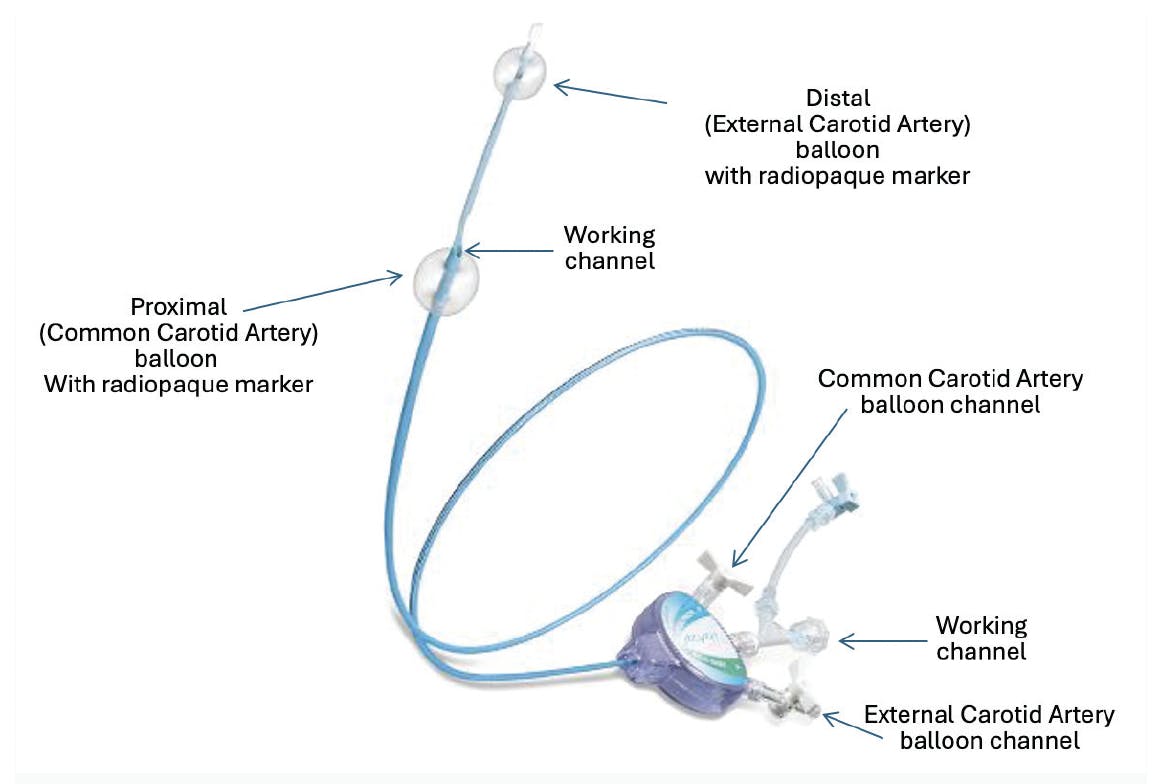
Figure 1. Mo.Ma Ultra™ proximal embolic protection system.
The safety and efficacy of the Mo.Ma Ultra device have been demonstrated in two large prospective studies in high-risk patients undergoing CAS.12,13 Although there are pros and cons for both distal filter and proximal embolic protection devices, current clinical data indicate a lower incidence of procedural cerebral events or cerebral microembolization with proximal embolic protection compared to distal filter protection (Figure 2).8,14,15 Proximal protection has some unique technical features that may contribute to these observed benefits. The most important feature is establishment of neuroprotection prior to initial lesion crossing. Furthermore, proximal protection can be used with any wire or stent and in conjunction with a distal filter. Unlike distal filters, there is no internal carotid artery (ICA) “landing zone” requirement, hence minimizing anatomic exclusion criteria. Debris of all sizes is more efficiently captured as there are no limitations on filter pore size, filter basket capacity, or filter wall apposition. However, proximal protection requires operator familiarity with the system and proficiency in its application. Therefore, a working knowledge of proximal cerebral protection is considered a “must know how” for operators embarking on today’s competent CAS.7
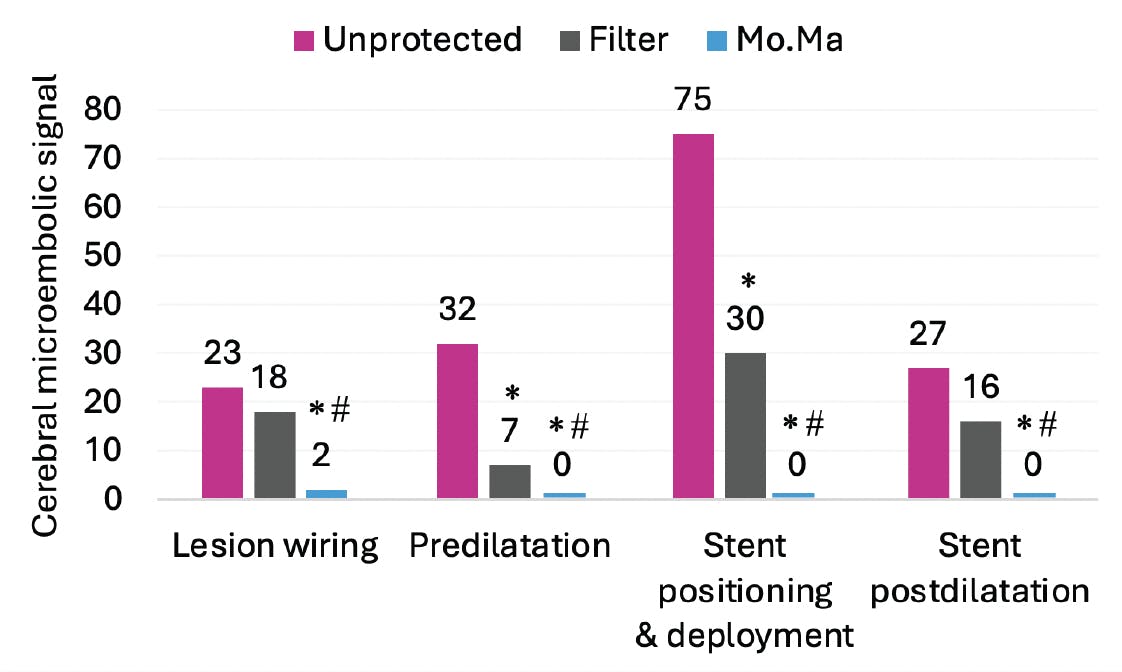
Figure 2. Number of cerebral microembolic signals during CAS in the unprotected,† distal filter–protected,‡ or Mo.Ma Ultra device proximal–protected‡ groups.
*P < .0001 vs unprotected.
# P < .0001 vs filter.
† Data for the unprotected group are derived from Al-Mubarak N et al. Circulation. 2001;104:1999-2002. They are presented as mean values and are not head-to-head comparisons with the filter or Mo.Ma groups.
‡ Data for the distal filter and Mo.Ma Ultra device groups are derived from Montorsi P et al. J Am Coll Cardiol. 2011;58:1656-1663. They are presented as median values (as reported in the paper or extrapolated from the box plot) and are head-to-head comparisons.
There is no doubt today that carotid-related strokes, which are often major and disabling, should be prevented rather than experienced by the stroke-affected individuals and their families.16 The concept of “competent CAS” incorporates the cognitive and technical skills required to produce excellent outcomes.17 Practical knowledge of how to use the Mo.Ma Ultra device to reduce embolic complications of CAS is an indispensable element of today’s competent CAS. Several Mo.Ma Ultra device training modules are now available, including simulator-based training (Figure 3).
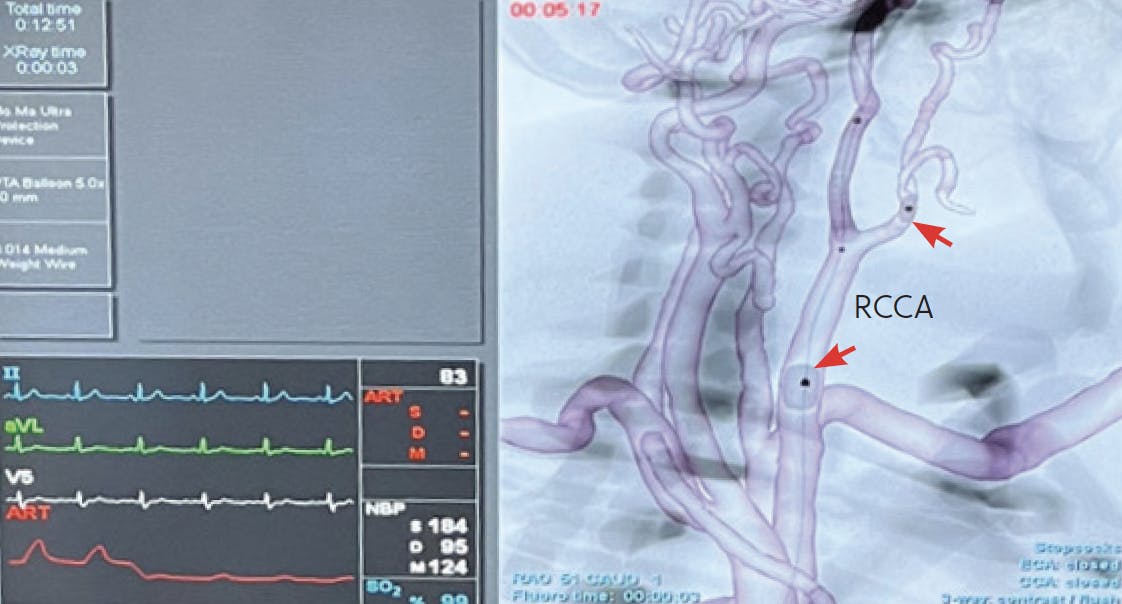
Figure 3. An example of Mo.Ma Ultra proximal cerebral protection device simulator-based training for operators. Red arrows indicate inflated Mo.Ma balloons. RCCA, right common carotid artery.
CASE PRESENTATION
A man in his mid-60s experienced a right hemispheric stroke in relation to right ICA stenosis. Figure 4A notes the multiple nodular ischemic lesions in the right cerebral hemisphere on diffusion-weighted MRI (DW-MRI) performed on acute stroke presentation. Rather than immediately—note a high risk of recurrent stroke that, with spontaneous mobilization of the large thromboembolic material, was likely to be major—the patient was referred for carotid revascularization after a 2-week delay. Endovascular treatment under transient proximal cerebral protection and with an antiembolic stent was the first-line treatment strategy per the center’s routine care. Carotid angiography confirmed a tight stenotic lesion containing a mobile thrombus at the right carotid artery ostium (Figure 4B-D).
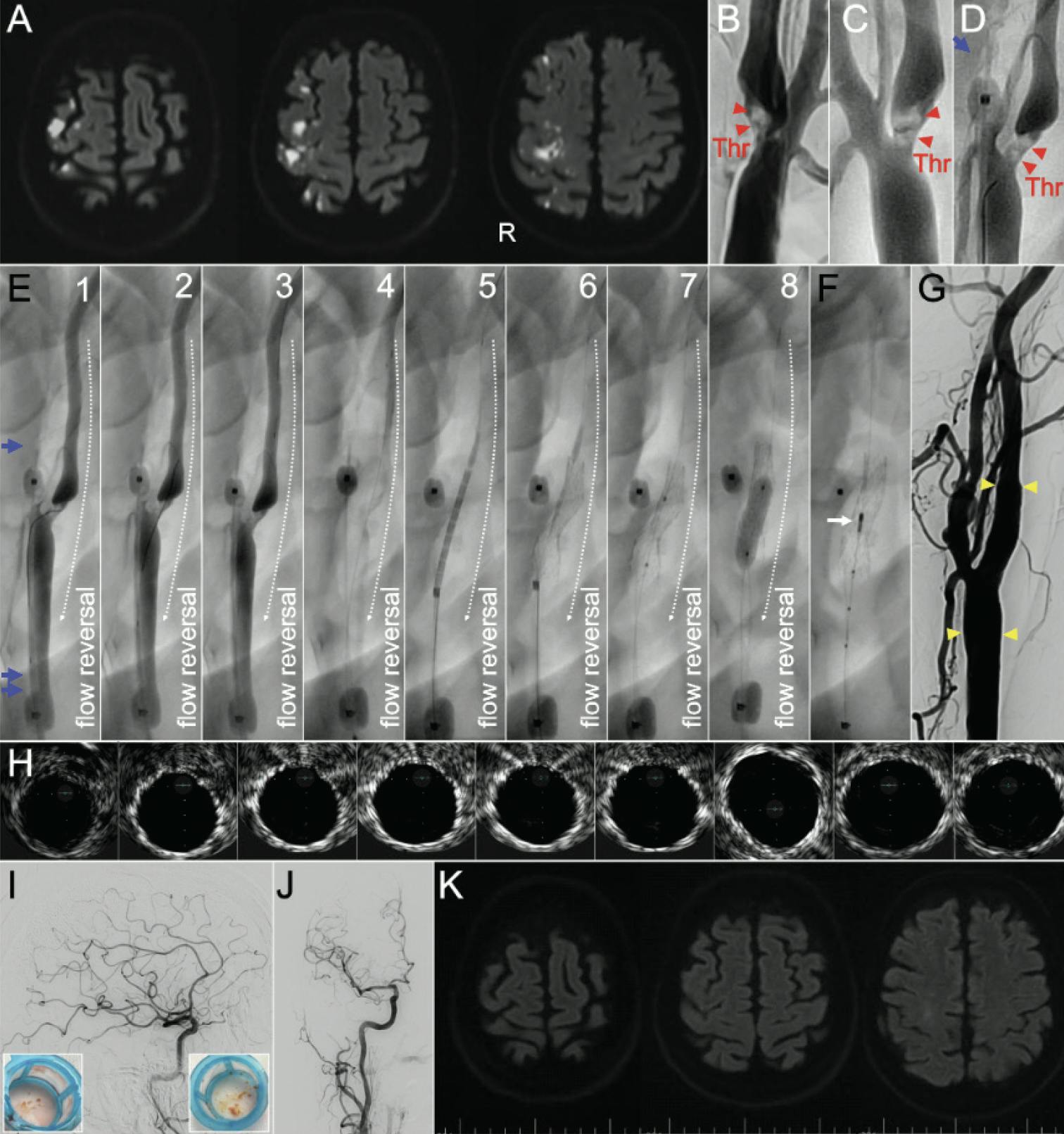
Figure 4. A case example of Mo.Ma-protected CAS in a symptomatic carotid lesion with a mobile thrombus. DW-MRI images (A). Carotid angiography showing a stenotic lesion containing a mobile thrombus (red arrowheads) (B-D); note the inflated Mo.Ma ECA balloon (blue arrow, D). Transient flow reversal with Mo.Ma and stenting (a Micro-Net covered embolic prevention stent) (E). Note the inflated CCA balloon (blue double arrow, E1) and a gradual contrast “back” washout with flow reversal (E1-E5). IVUS run (F). Angiography of the full (complete) endovascular reconstruction (yellow arrowheads, stent edges) (G). IVUS images from the distal reference segment to the proximal stent edge (H). Completion cerebral angiography (I, J). DW-MRI showing total absence of any procedure-related lesions while some prior lesions “shine through” (cf., A) (K).
The Mo.Ma Ultra proximal cerebral protection system was introduced. On flow cessation (Figure 4E1), cerebral “back” pressure was 54/46 mm Hg. The flow in the CCA/ICA was then transiently reversed from antegrade to retrograde (Figure 4E1-8). Under cerebral protection by Mo.Ma Ultra device transient flow reversal, the thrombus-containing culprit lesion was safely crossed. A Micro-Net covered embolic prevention stent was inserted (Figure 4E5), deployed (Figure 4E6), and postdilatation-optimized (Figure 4E7-8) to achieve the angiographic result of a full (complete) endovascular reconstruction (Figure 4F and 4G). On procedure completion, active aspiration of the embolic material (Figure 4I insets) was performed. Intravascular ultrasound (IVUS) visualization (Figure 4F and 4H) from the distal reference segment to the proximal stent edge showed an optimal stent expansion and apposition. IVUS also demonstrated absence of any plaque prolapse in the entire sequence (Figure 4H), consistent with an effective sequestration of the culprit lesion. Cerebral angiograms on procedure completion (Figure 4I and 4J) showed a normal flow from the right ICA to the right hemispheric vessels, in absence of any filling defects. DW-MRI performed at 48 hours postprocedure demonstrated a total absence of any new lesions, consistent with 100% efficacy of cerebral protection via Mo.Ma flow reversal in combination with a Micro-Net covered embolic prevention stent (Figure 4K).
Disclosures
Prof. Musialek: Proctor for and/or consultant to Abbott Vascular, Balton, Gore, InspireMD, and Medtronic; Polish Cardiac Society Board Representative for Stroke and Vascular Interventions; European Society of Cardiology Stroke Council Scientific Documents Task Force.
1. Musialek P, Bonati LH, Bulbulia R, et al. Stroke risk management in carotid atherosclerotic disease: a clinical consensus statement of the ESC Council on Stroke and the ESC Working Group on Aorta and Peripheral Vascular Diseases. Cardiovasc Res. Published online August 25, 2023. doi: 10.1093/cvr/cvad135
2. Dzierwa K, Capoccia L, Knapik M, et al. Saving the brain in carotid-related stroke: patient pathways, treatment strategies. J Cardiovasc Surg. In press.
3. Tekieli L, Dzierwa K, Grunwald IQ, et al. Outcomes in acute carotid-related stroke eligible for mechanical reperfusion: SAFEGUARD-STROKE registry. J Cardiovasc Surg. In press.
4. Al-Mubarak N, Roubin GS, Vitek JJ, et al. Effect of the distal-balloon protection system on microembolization during carotid stenting. Circulation. 2001;104:1999-2002. doi: 10.1161/hc4201.099224
5. Hicks CW, Nejim B, Obeid T, et al. Use of a primary carotid stenting technique does not affect perioperative outcomes. J Vasc Surg. 2018;67:1736-1743.e1. doi: 10.1016/j.jvs.2017.09.056
6. Nazari P, Golnari P, Hurley MC, et al. Carotid stenting without embolic protection increases major adverse events: analysis of the National Surgical Quality Improvement Program. AJNR Am J Neuroradiol. 2021;42:1264-1269. doi: 10.3174/ajnr.A7108
7. Musialek P, de Donato G. Carotid artery revascularization using the endovascular route. In: Ruzsa Z, Bartus S, Nemes B, eds. Peripheral Arterial Interventions: Practical Guide. Minerva Medica; 2023:142-72.
8. Stabile E, Sannino A, Schiattarella GG, et al. Cerebral embolic lesions detected with diffusion-weighted magnetic resonance imaging following carotid artery stenting: a meta-analysis of 8 studies comparing filter cerebral protection and proximal balloon occlusion. JACC Cardiovasc Interv. 2014;7:1177-1183. doi: 10.1016/j.jcin.2014.05.019
9. Baig AA, Waqas M, Turner RC, et al. A propensity score-matched comparative study of balloon guide catheters versus conventional guide catheters for concurrent mechanical thrombectomy with carotid stenting in tandem strokes: comparison of first pass effect, symptomatic intracranial hemorrhage, and 90-day functional outcomes. J Neurointerv Surg. 2024;16:124-130. doi: 10.1136/jnis-2023-020114
10. Mo.Ma Ultra Proximal Cerebral Protection Device [United States instructions for use]. Minneapolis (MN): Medtronic. Accessed May 31, 2024. https://www.medtronic.com/us-en/healthcare-professionals/products/cardiovascular/embolic-protection-devices/mo-ma.html
11. Mo.Ma™ TM Ultra Proximal Cerebral Protection Device [Europe instructions for use]. Minneapolis (MN): Medtronic. Accessed May 31, 2024. https://europe.medtronic.com/xd-en/healthcare-professionals/products/cardiovascular/embolic-protection-devices/mo-ma.html
12. Stabile E, Salemme L, Sorropago G, et al. Proximal endovascular occlusion for carotid artery stenting: results from a prospective registry of 1,300 patients. J Am Coll Cardiol. 2010;55:1661-1667. doi: 10.1016/j.jacc.2009.11.079
13. Ansel GM, Hopkins LN, Jaff MR, et al. Safety and effectiveness of the INVATEC MO.MA proximal cerebral protection device during carotid artery stenting: results from the ARMOUR pivotal trial. Catheter Cardiovasc Interv. 2010;76:1-8. doi: 10.1002/ccd.22439
14. Montorsi P, Caputi L, Galli S, et al. Microembolization during carotid artery stenting in patients with high-risk, lipid-rich plaque. A randomized trial of proximal versus distal cerebral protection. J Am Coll Cardiol. 2011;58:1656-1663. doi: 10.1016/j.jacc.2011.07.015
15. Montorsi P, Caputi L, Galli S, et al. Carotid Wallstent versus Roadsaver stent and distal versus proximal protection on cerebral microembolization during carotid artery stenting. JACC Cardiovasc Interv. 2020;13:403-414. doi: 10.1016/j.jcin.2019.09.007
16. Musialek P, Rosenfield K, Siddiqui A, et al. Carotid stenosis and stroke: medicines, stents, surgery – “wait-and-see” or protect? Thromb Haemost. Published online September 28, 2022. doi: 10.1055/a-1952-1159
17. Musialek P, Paraskevas KI, Roubin GS. Improving carotid artery stenting to match carotid endarterectomy: a task accomplished. EuroIntervention. 2024;20:e402-e404. doi: 10.4244/eij-e-24-00012
Mo.Ma Ultra™ proximal cerebral protection device
Reference Statement
Important Information: Prior to use, refer to the Instructions for Use supplied with these devices for indications, contraindications, suggested procedure, warnings and precautions.
Indications for Use: The Mo.Ma Ultra proximal cerebral protection device is indicated as an embolic protection system to contain and remove embolic material (thrombus/debris) while performing angioplasty and stenting procedures involving lesions of the internal carotid artery and/or the carotid bifurcation.
The reference diameter of the external carotid artery should be between 3-6 mm and the reference diameter of the common carotid artery should be between 5-13 mm.
Contraindications:
The Mo.Ma Ultra Proximal Cerebral Protection Device is contraindicated for use in: patients in whom antiplatelet and/or anticoagulation therapy is contraindicated; patients with severe disease of the ipsilateral common carotid artery; patients who are unable to respond to external questions and stimuli, or to exert a pressure with the contralateral hand; patients who have severe peripheral vascular disease preventing femoral access, hemorrhagic or hypercoagulable status and/or inability to obtain hemostasis at the site of the femoral puncture; patients with severe vascular tortuosity or anatomy that would preclude the safe introduction of the Mo.Ma Ultra device, a stent system or other procedural devices; patients with uncorrected bleeding disorders
Potential Complications/Adverse Effects:
The complications that may result from a carotid balloon dilatation and stenting procedure, aided by a proximal flow blockage cerebral protection device, include but are not limited to: puncture / access site related: local hematoma, local haemorrhage, local or distal thromboembolic episodes, thrombosis, arterio-venous fistula, pseudoaneurysm, and local infections; procedure related: bradycardia, hypotension, carotid artery spasm, dissection of the carotid arteries, air emboli, cerebrovascular accident (stroke [ischemic, hemorrhagic], TIA), acute myocardial infarction, unstable angina, and intravascular stent migration; angiography related: hypertension/hypotension, pain and tenderness, arrhythmias, sepsis/infection, systemic embolization, endocarditis, short-term hemodynamic deterioration, death, drug reactions, allergic reaction to contrast medium, and pyrogenic reaction. See the Instructions for Use provided with the product for a complete list of warnings, precautions, adverse events and device information.
CAUTION: Federal (USA) law restricts these devices to sale by or on the order of a physician.
Test data is on file at Medtronic Inc. Bench test results may not be indicative of clinical performance.
501504 ©2024 Medtronic. Medtronic and Medtronic logo are trademarks of Medtronic. All other brands are trademarks of Medtronic. For global distribution. 06/2024
Advertisement
Advertisement