Advertisement
Advertisement
March 2024
Current Diagnostic Strategies for Superficial Venous Insufficiency
Imaging for superficial venous procedures: what to use, when to use it, and what’s on the horizon.
By Christopher Montoya, MD; Jan M. Sloves, RVT, RCS, FASE; and Jose I. Almeida, MD, FACS, RPVI, RVT
The landscape of diagnostic imaging for diagnosing and managing chronic venous insufficiency (CVI) has undergone a remarkable evolution in recent years. Although duplex ultrasound (DUS) is the primary diagnostic tool for superficial venous insufficiency (SVI), other imaging techniques such as thermal imaging, near-infrared (NIR) light, MR venography (MRV), CT venography (CTV), and continuous-wave Doppler have been explored for their potential usefulness in the diagnosis of SVI.1 These advanced imaging techniques hold promise for further improving the precision, efficiency, and clinical outcomes of superficial venous procedures.
DUS
DUS, also referred to as “triplex ultrasound,” has evolved to become the primary diagnostic tool used to evaluate patients with SVI.1 It is also an integral component of the image-guided endovenous methods used to ablate incompetent veins.1 Grayscale imaging with a 7.5- to 12-MHz transducer and pulsed-wave Doppler are essential tools for the ultrasound assessment of patients with superficial venous disease.2 Color flow Doppler offers a visual overview of blood flow within the vessel, helps orientate flow direction, and can assist in rapidly identifying vessels and turbulent flow. DUS allows functional, anatomic, and dynamic evaluation of the status of the venous system and currently continues to be the gold standard for the diagnosis of CVI and venous reflux of the lower extremities.
How We Do It
The superficial venous examination is carried out in the standing position. The operator advances the transducer to the inguinal ligament and focuses on the great saphenous vein (GSV). A normal GSV extends from the saphenofemoral junction to the ankle and is surrounded by superficial fascia above and muscular fascia below. At a minimum, diameter measurements (and the presence or absence of reflux) are recorded at three locations within the GSV: (1) the saphenofemoral junction, (2) the mid-thigh level, and (3) below the knee. The same evaluation is repeated for the small saphenous vein, which originates in the ankle and can terminate in the upper thigh. Venous reflux is commonly defined as retrograde flow > 0.5 seconds in the superficial system and > 1 second in the femoral and popliteal segments.3 Pulsed-wave Doppler tracings are used to assess the duration of time. The reflux waveforms are measured by the operator with calipers to determine the extent of reflux. All waveforms should delineate valve closure. When measuring, accurate caliper placement is essential. Waveforms should remain free of noise and artifact and be obtained with a slow sweep speed so the exact duration of time can be evaluated. In addition, aliasing artifacts (waveform “wraparound” effects) related to distal augmentation maneuvers occur when the velocity surpasses the Nyquist limit and are eliminated by increasing the pulsed-wave Doppler scale and adjusting the baseline (Figure 1, Figure 2, and Figure 3). Failure to eliminate artifacts can result in the misinterpretation of reflux. DUS is considered the gold standard for diagnosing SVI, with a sensitivity of 95% to 100% and a specificity of 90% to 100%.4
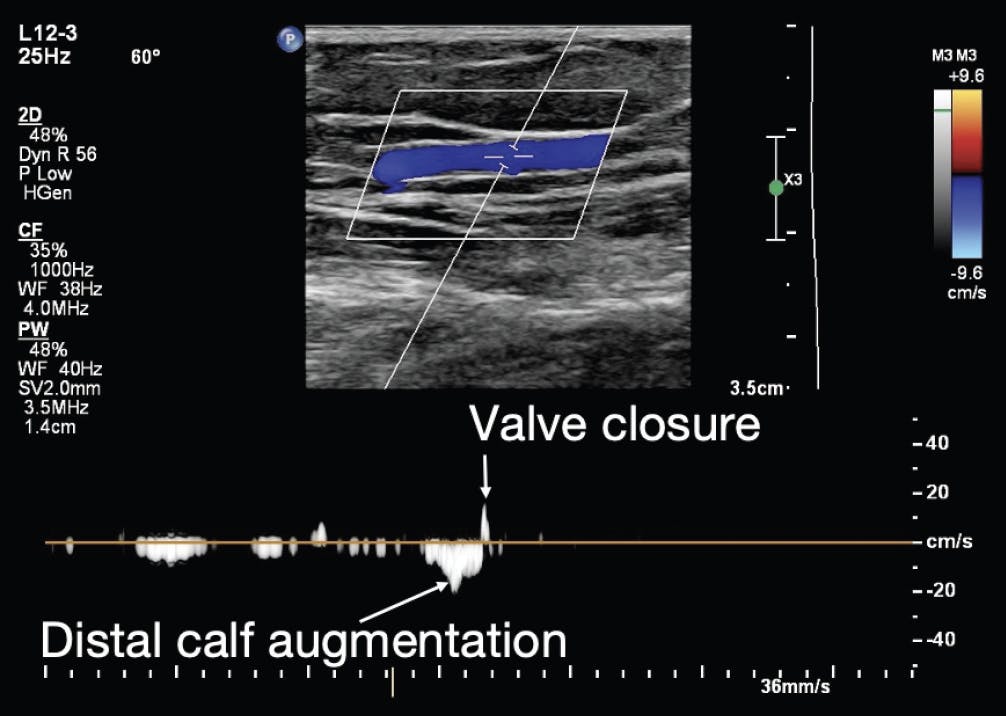
Figure 1. Pulsed-wave Doppler waveform demonstrates a competent GSV with normal valve closure.
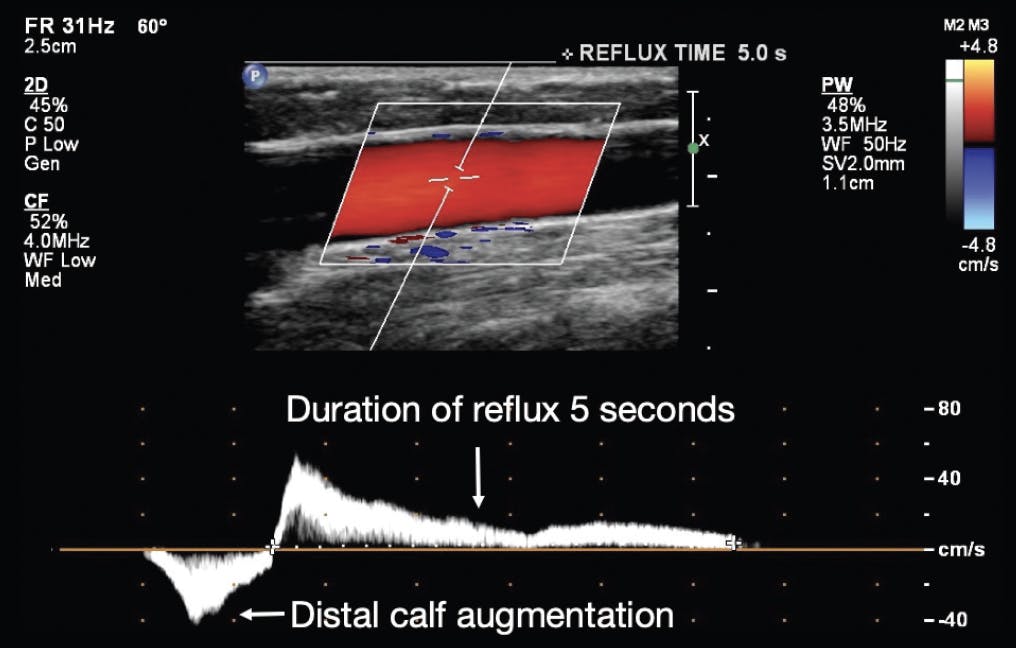
Figure 2. Pulsed-wave Doppler waveform demonstrates an incompetent GSV with a reflux time of 5 seconds. Waveform reflects clear delineation from the augmentation to the end of its duration. The reflux is color coded in red within the vessel lumen, coinciding with the direction of flow relative to the color bar, which is toward the transducer. The reflux waveform follows in the same direction (above the baseline).
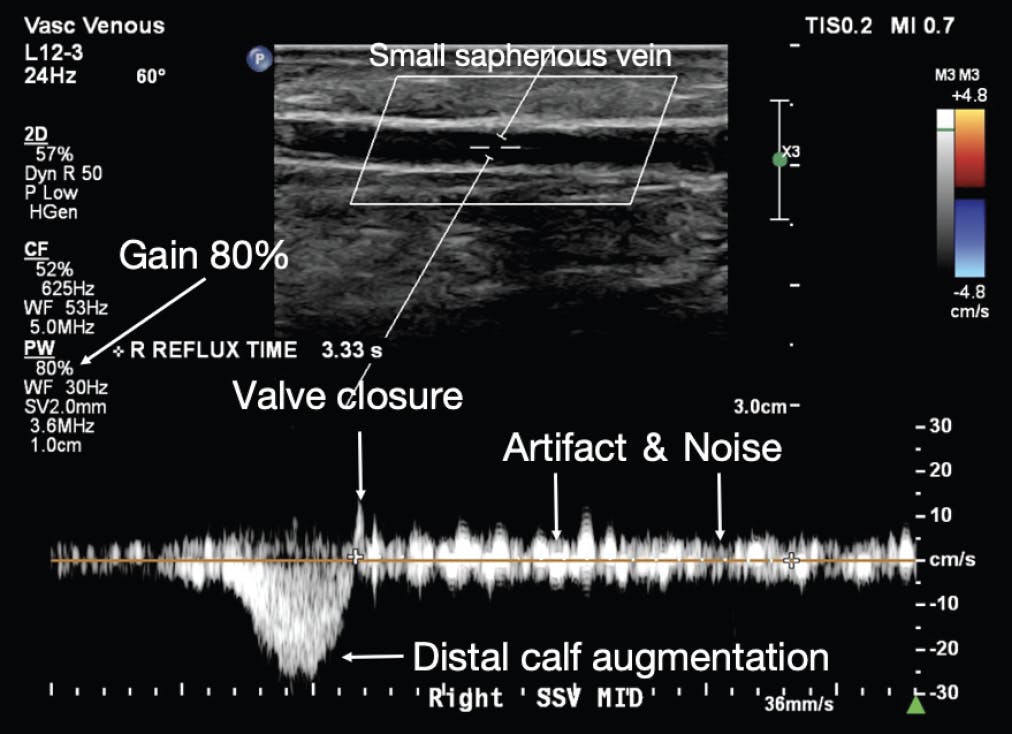
Figure 3. Pulsed-wave Doppler waveform demonstrates artifact and noise. These artifacts are reminiscent of excessive pulse-Doppler gain set at 80% and movement of the transducer. The operator measured the duration of reflux as 3.3 seconds, which is completely erroneous. This vein does not present evidence of reflux.
DUS for Saphenous Vein Ablation
For saphenous vein ablation, DUS is used for real-time percutaneous access of the saphenous vein, positioning of wires and catheters, and delivery of perivenous local anesthesia. It is useful during ultrasound-guided sclerotherapy of venous structures below the skin. DUS is generally not necessary prior to treating telangiectasias, reticular veins, or small varicose veins that are not associated with other limb symptoms (eg, swelling, aching, heaviness).
PANORAMIC IMAGING WITH CHROMATIC COLOR TINT
Panoramic imaging is an ultrasound feature that allows for real-time generation of longitudinal, extended field-of-view images with the use of a linear array transducer. Clinically, these images can serve the endovenous specialist with a “direct roadmap” of the superficial venous system pre- and postprocedure/treatment.
This modality works by first activating the panoramic image mode. Next, the operator advances the transducer over the vein of interest. The real-time portion of the image is then replaced by a static section, thus creating an extended field-of-view image.
Panoramic imaging uses a registration algorithm that identifies image signatures within each frame to provide a “sense” of the direction for each of the transducer movements. Compound imaging and smoothing functions automatically reduce noise and artifacts. After image acquisition, the operator can trim, zoom, rotate, and measure the length of the vein by adding a skin line ruler.
The images are further optimized by using chromatic orange color tint, which enhances the visual perception of the vein and surrounding soft tissues. This is based on how the human eye differentiates color variation, as our vision has significantly higher resolution in seeing color than conventional black and white. In summary, the benefit of the panoramic modality is that it provides a “venographic”-like image that demonstrates the superficial venous anatomy, as well as precise delineation of vein segments exhibiting aneurysm, fibrosis, occlusion, and tortuosity (Figure 4, Figure 5, Figure 6, Figure 7, Figure 8, and Figure 9).
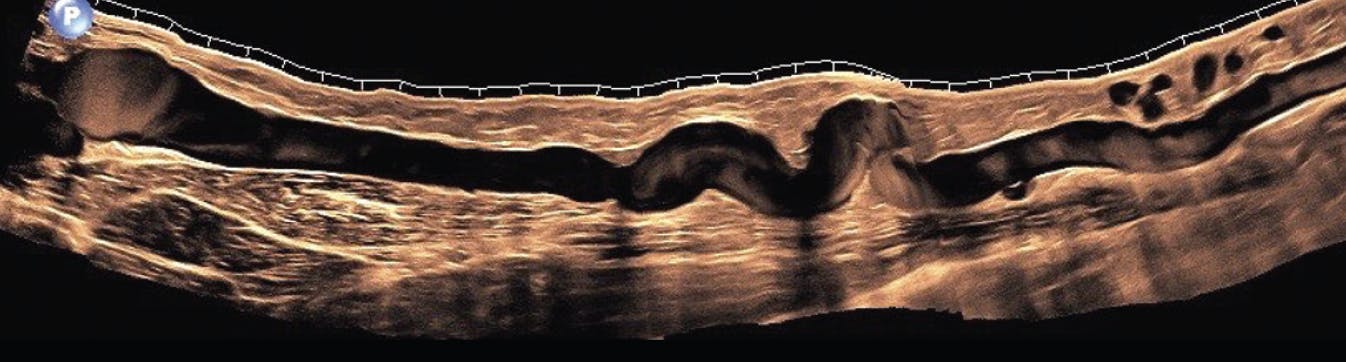
Figure 4. A 32-cm panoramic image with chromatic orange color tint demonstrates an incompetent aneurysmal saphenofemoral junction with a dilated tortuous GSV and varicose veins distally.
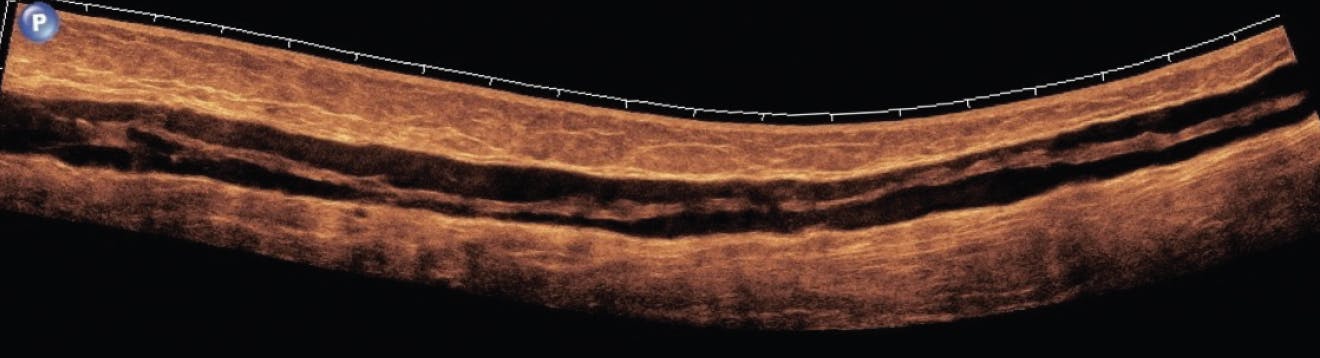
Figure 5. A 20-cm panoramic image with chromatic orange color tint of the GSV demonstrates venous fibrosis.
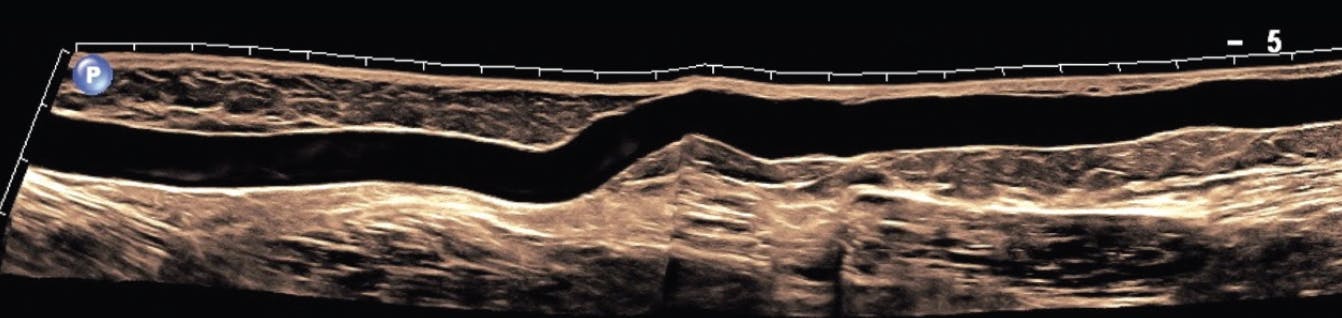
Figure 6. A 22-cm panoramic image with chromatic orange color tint of the GSV coming out of the saphenous compartment.
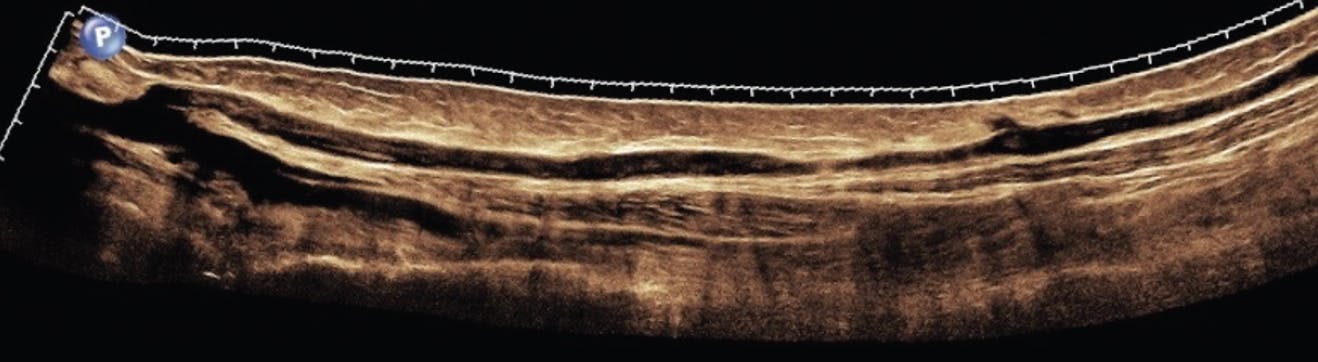
Figure 7. A 32-cm panoramic image with chromatic orange color tint of the GSV demonstrates occlusion after radiofrequency ablation treatment.

Figure 8. A 24-cm panoramic image with chromatic color tint of the GSV demonstrates occlusion after chemical ablation.
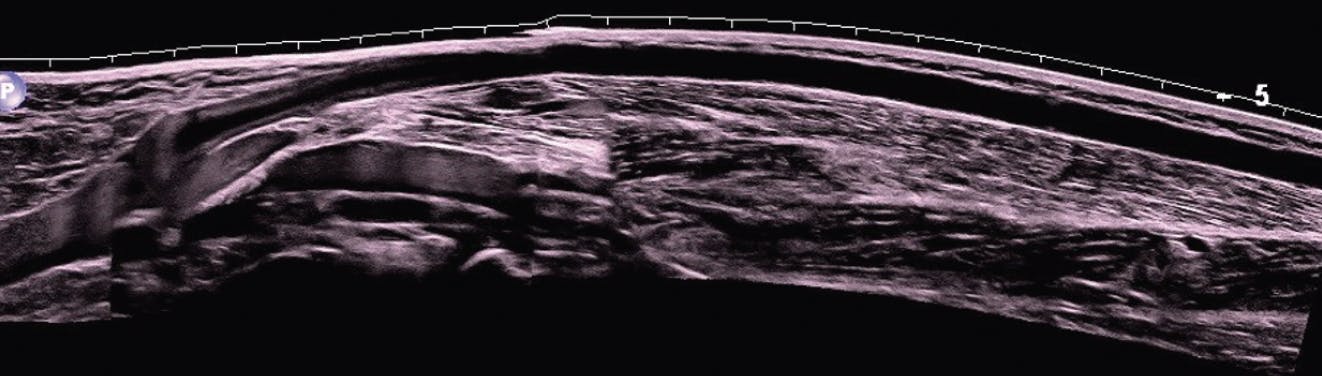
Figure 9. A 22-cm panoramic image with chromatic color tint of the saphenopopliteal junction and small saphenous vein.
MRV AND CTV
MRV and CTV are cross-sectional imaging modalities that can provide detailed images of the venous system, offering high venous contrast and high spatial resolution. MRV is particularly useful because it can help detect previously unsuspected nonvascular causes of venous insufficiency. MRV and CTV both have a sensitivity of 95% to 100% and a specificity of 90% to 100% for diagnosing SVI.4 MRV and CTV require the use of contrast agents and ionizing radiation, which makes them unattractive for routine SVI cases.5 Cross-sectional imaging is usually reserved for imaging of the deep venous system.
THERMAL IMAGING
Thermal imaging is a noncontact study that uses inexpensive equipment and does not require highly trained technicians, making it a practical and cost-effective screening tool.6 Its ability to provide important information related to blood supply and metabolic changes of skin areas makes it useful for diagnosing SVI.7 Thermal imaging has demonstrated excellent sensitivity and specificity in evaluating SVI (92% and 96%, respectively).8 However, thermal imaging does not assess vessel size or determine the severity of insufficiency, and it may not give clues about possible deep venous insufficiency.6 Further research and larger study groups may be needed to confirm and expand on these findings.7
NIR LIGHT
NIR light has been combined with DUS to detect recurrent lower limb varicose and dilated saphenous veins. This technology has shown promise in providing additional information for the diagnosis and management of SVI.5 Despite that, its use for diagnosis is not well-established in the current literature.
CONTINUOUS-WAVE DOPPLER
Continuous-wave Doppler is a nonimaging modality that can be used to assess venous incompetence. The device generates a sound, not an image. Therefore, it is difficult to know which vein is being insonated—an obvious major limitation of this technique.9 Continuous-wave Doppler has a sensitivity of 33% for diagnosing venous incompetence and a specificity of 48% for diagnosing deep vein reflux.10 Because of these shortcomings, continuous-wave Doppler has been largely replaced by DUS.
CONCLUSION
DUS is the preferred diagnostic modality for SVI. Panoramic imaging is an ultrasound feature that can serve the endovenous specialist with a “direct roadmap” of the superficial venous system pre- and postprocedure/treatment. Cross-sectional imaging may be useful in specific instances when further information is needed or when ultrasound is not available. NIR and thermal imaging may take on a greater role for SVI in the future. Continuous-wave Doppler is practically obsolete in the management of venous disease.
1. Khilnani NM, Min RJ. Imaging of venous insufficiency. Semin Intervent Radiol. 2005;22:178-184. doi: 10.1055/s-2005-921950
2. Casadaban LC, Moriarty JM, Hoffman CH. Physical examination and ultrasound evaluation of patients with superficial venous disease. Semin Intervent Radiol. 2021;38:167-175. doi: 10.1055/s-0041-1727103
3. Labropoulos N, Tiongson J, Pryor L, et al. Definition of venous reflux in lower-extremity veins. J Vasc Surg. 2003;38:793-798. doi: 10.1016/s0741-5214(03)00424-5
4. Nicolaides AN. Investigation of chronic venous insufficiency: a consensus statement (France, March 5-9, 1997). Circulation. 2000;102:E126-163. doi: 10.1161/01.cir.102.20.e126
5. Kahraman N, Yümün G, Demir D, et al. Detection of residual varicose veins with near infrared light in the early period after varicose surgery and near infrared light assisted sclerotherapy. Vascular. 2022;30:1174-1181. doi: 10.1177/17085381211051489
6. Walker C. Thermal imaging positioned to become the best tool in the evaluation of superficial venous insufficiency. Vasc Dis Manage. 2021;18:E35-36.
7. Cholewka A, Kajewska J, Marek K, et al. How to use thermal imaging in venous insufficiency? J Therm Anal Calorim. 2017;130:1317-1326. doi: 10.1007/s10973-017-6141-7
8. Soffer AD, Caine M, Hardigan PC, et al. Sensitivity and specificity of thermal imaging when used to detect superficial venous reflux as compared to duplex. Vasc Dis Manage. 2021;18:E45-E49.
9. Kauvar ANB, Khrom T. Laser treatment of leg veins. Semin Cutan Med Surg. 2005;24:184-192. doi: 10.1016/j.sder.2005.10.003
10. McMullin GM, Coleridge Smith PD. An evaluation of Doppler ultrasound and photoplethysmography in the investigation of venous insufficiency. Aust N Z J Surg. 1992;62:270-275.
Advertisement
Advertisement