Advertisement
Advertisement
May 2024
Distal Plantar Access: How We Do It
A review of plantar circulation anatomy with tips and tricks on puncture technique and access.
By Daniel A.F. van den Heuvel, MD, and Jos C. van den Berg, MD, PhD
During the last decade, the success rate of endovascular below-the-knee revascularization has increased significantly due to improved endovascular materials and operator skills. After failed antegrade crossing, a retrograde approach is frequently used and has been demonstrated to be feasible and safe.1 The most commonly used and less challenging access site is the distal segment of the posterior tibial (PT) and anterior tibial artery (including the dorsalis pedis [DP] artery). More challenging is obtaining access to the plantar arteries.
This article discusses the anatomy of the plantar circulation and provides tips and tricks to enhance the success rate of this approach and reduce complications.
ANATOMY
The plantar circulation is a continuation of the PT artery and proceeds as the common plantar artery below the ankle joint (after entering the tarsal tunnel). The common plantar artery divides into the medial and lateral plantar artery at the level of the transverse septum, between the abductor hallucis longus and the flexor digitorum brevis muscles.
The lateral plantar artery lies in the middle compartment of the foot and runs obliquely between the flexor digitorum brevis muscle and the quadratus plantae muscle toward the base of the fifth metatarsal. It then proceeds distally toward the proximal fifth metatarsal, where it lies underneath the flexor digiti minimi muscle and subsequently takes a medial turn, forming the deep plantar arch, which anastomoses directly with the DP artery in the proximal first interspace.
The medial plantar artery divides into the superficial and deep branches. The superficial branch follows an oblique course toward the naviculocuneiform joint and subsequently passes the superior border of the cuneiform and the first metatarsal bone. Distally, communications with the deep branch of the medial plantar artery and the first plantar metatarsal artery (which is a branch of the lateral plantar artery) exist. The deep branch of the medial plantar artery travels between the abductor hallucis muscle and the flexor digitorum brevis. At the level of the neck of the first metatarsal, it passes underneath the flexor tendons and anastomoses with the first plantar metatarsal artery and/or the distal lateral plantar artery.2
PUNCTURE TECHNIQUE AND ACCESS
The common plantar artery lies relatively fixed within the tarsal tunnel, making it a suitable target for distal access. However, tibial disease often extends into this segment, preventing access and requiring a more distal puncture in the lateral or medial plantar artery. The more distal the puncture needs to be, the more it becomes clear that percutaneous access of the lateral or medial plantar artery should be different. The lateral plantar can best be accessed by a plantar approach, since a medial approach would require a very long needle and would result in a needle entry path that is perpendicular to the artery (Figure 1). This makes it difficult to advance a wire and increases the risk of dissections. The medial plantar artery is commonly punctured via a medial approach, similar to a puncture of the distal segment of the PT or common plantar artery.
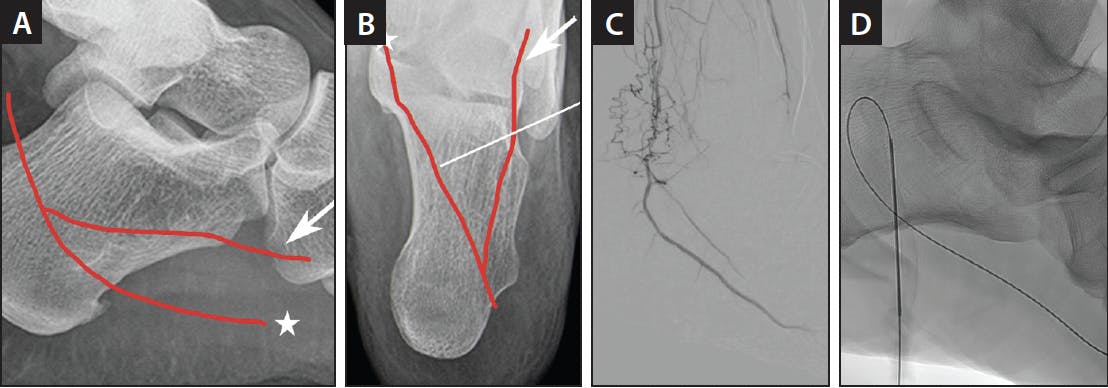
Figure 1. Lateral radiograph of the foot, with red lines indicating the course of the lateral (white star) and medial (arrow) plantar artery (A). Anteroposterior radiograph of the foot, with red lines indicating the course of the lateral (white star) and medial plantar artery (arrow) and white line indicating the projected needle path with a medial access. Note the entry perpendicular to the lateral plantar artery and the more favorable shallow entry angle into the medial plantar artery (B). Digital subtraction angiogram of left foot in lateral projection showing occlusion of the distal PT artery and proximal common plantar artery. The medial plantar artery is relatively small and outflow to the forefoot is mainly through the lateral plantar artery (C). Fluoroscopic image (same patient as Figure 1C) with needle in medial plantar artery and wire into the lateral plantar artery to facilitate positioning of pedal access set (wire purchase maneuver) (D).
The lateral plantar artery can best be punctured under ultrasound guidance with the foot in a neutral position. The position of the C-arm should be such that it allows for a lateral projection of the foot to be able to follow the guidewire in its course toward the PT artery (Figure 2).
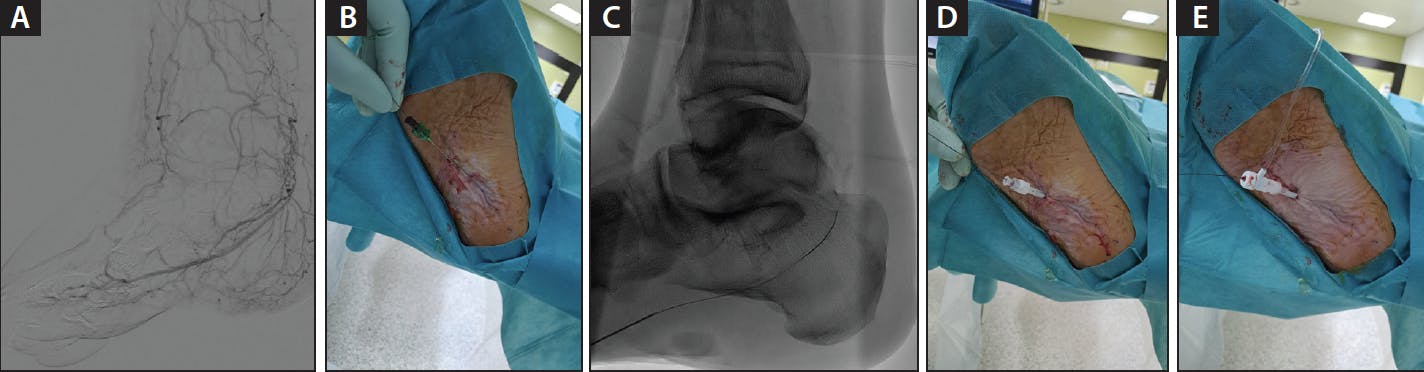
Figure 2. Digital subtraction angiogram of right foot in lateral projection showing occlusion of the distal PT artery and proximal common plantar artery (A). Image obtained after ultrasound-guided puncture of the lateral plantar artery from a plantar approach with needle and guidewire in place (B). Fluoroscopic image showing the needle and guidewire in the lateral plantar artery (C). Image after insertion of sheath and dilator of pedal access set (D). Image after placement of hemostatic valve of pedal access set (E).
The medial plantar artery can be accessed under either ultrasound or fluoroscopy guidance. When using the latter, antegrade access is also needed to inject contrast for roadmap guidance. When using fluoroscopy guidance, it is important to position the entire needle in line with the target artery,3,4 using either contrast injection from the antegrade approach or vessel wall calcification as a target. Ultrasound-guided puncture does not require radiation and therefore is safer for the operator, but it is sometimes limited by poor imaging of the target artery.
When choosing the optimal puncture site, it is not only important to consider the anatomy but also to evaluate whether there is enough length in the patent artery to place the supportive part of the guidewire and introducer sheath (or dilator or microcatheter) in.
In the absence of such a segment and when dealing with distal PT or common plantar artery occlusions, it can be difficult to advance the wire enough to have support beyond the access site. In this case, it is possible to “purchase” wire length by using collaterals or the other plantar artery (medial in case of later plantar access or vice versa) to park the wire in (Figure 1).
CONCLUSION
Knowledge of the plantar circulation anatomy is paramount when planning distal retrograde access. Familiarity with fluoroscopic- and ultrasound-guided access and “wire purchase” maneuver is a requisite when performing these complex procedures.
1. Schmidt A, Bausback Y, Piorkowski M, et al. Retrograde tibioperoneal access for complex infrainguinal occlusions: short- and long-term outcomes of 554 endovascular interventions. JACC Cardiovasc Interv. 2019;12:1714-1726. doi: 10.1016/j.jcin.2019.06.048
2. Clemens MW, Attinger CE. Angiosomes and wound care in the diabetic foot. Foot Ankle Clin. 2010;15:439-464. doi: 10.1016/j.fcl.2010.04.003
3. Nakama T, Ando H, Watanabe N, et al. Novel retrograde puncture technique for infrapopliteal artery revascularization: transplantar retrograde access. Cardiovasc Interv Ther. 2017;32:287-293. doi: 10.1007/s12928-016-0422-0
4. Ysa A, Lobato M, Patrone L, et al. Tips and tricks for simple and complex below-the-ankle punctures. J Endovasc Ther. Published online March 5, 2024. doi: 10.1177/15266028241234506
Advertisement
Advertisement